
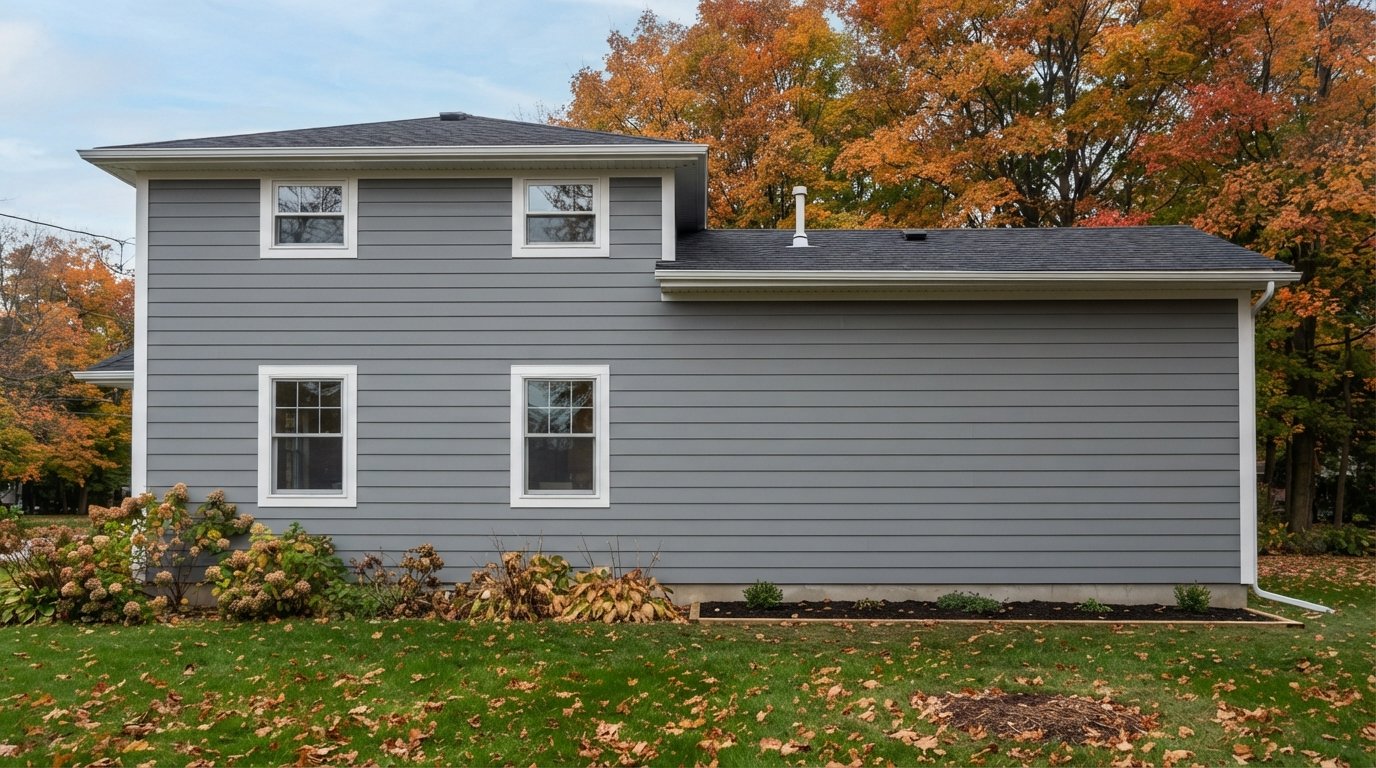
Fiber cement siding has become the cladding many Ontario homeowners ask about when they want something more substantial than vinyl without the upkeep of real wood. It is made from cement, sand and cellulose fibres pressed into planks, panels and trim, and the best-known brand in Canada is James Hardie. It is a heavy, stable board that installers either love or dread, and whether it lasts for decades comes down to a short list of details: the product line chosen for our climate, how cut edges are treated and how far the boards stay from soil, roofs and decks.
What Fiber Cement Siding Is And Why It Suits Ontario
Fibre cement boards are dense and heavy compared with vinyl. That weight is part of the appeal: the boards lie flat, hold a crisp edge and do not ripple in summer sun or rattle in wind. The cement content means the material does not rot, is not attractive to insects and, in James Hardie’s own product information, is described as noncombustible, with the note that this fire resistance does not extend to applied paints or coatings.
The trade-offs come from the same properties. The boards are heavier to handle and slower to install, cutting them produces fine silica dust that must be controlled, and a careless install can crack boards or leave edges unsealed. Fibre cement does not tolerate standing water at its bottom edge, which is why clearances and flashing get so much attention in the manufacturer’s instructions.
For a GTA house, the practical question is whether those benefits are worth the higher price over vinyl, and whether the existing walls, trim and soffits are in good enough shape to justify a cladding expected to last decades. If you are planning a full exterior refresh, our siding, soffit and fascia installation work looks at the whole envelope, because new boards on top of rotted sheathing or failed flashing will not perform.
James Hardie Siding And The HZ5 Formulation
James Hardie siding is sold under product families such as HardiePlank lap siding, HardiePanel vertical siding, HardieShingle, Hardie Artisan and HardieTrim boards and battens, plus soffit products. The company groups its products under what it calls the HardieZone System, matching the formulation to the climate. The HZ5 line is the one designed for cold climates; James Hardie describes it as suited to areas with freezing temperatures, extreme seasonal temperature swings, and snow and ice, with a surface engineered for paint adhesion and moisture resistance.
That matters in Ontario, where walls go through many freeze and thaw cycles each winter and spring. Water that gets into a board edge, then freezes, is what damages cladding over time. A product engineered for that climate helps, but the installation details below are what keep water out of the edges in the first place.
Before buying, ask your contractor which product line and which installation instructions they are working from. James Hardie’s instructions direct installers to confirm they are using the correct HardieZone product instructions, and the current versions are published on the manufacturer’s website. Warranty terms are also set out in the manufacturer’s current documents; James Hardie describes a limited, transferable substrate warranty for its siding and trim, and finish coverage for its factory-painted products is described separately. Read the current warranty for the specific product rather than relying on a sales summary.
How Fiber Cement Siding Compares With Vinyl And Engineered Wood
Most homeowners we meet are deciding between these three. Each one suits a different budget and priority.
| Factor | Fibre cement | Vinyl | Engineered wood |
|---|---|---|---|
| Appearance | Crisp edges, deep shadow lines, painted-wood look | Thinner profile, visible overlaps and some sheen | Wood-grain texture, deep shadow lines |
| Weight and handling | Heavy; two-person handling for long planks | Very light | Lighter than fibre cement |
| Thermal movement | Low | High; needs loose fastening and expansion gaps | Moderate moisture movement; gapping rules apply |
| Fire | Described by James Hardie as noncombustible | Melts and can burn | Combustible wood-based product |
| Moisture | Does not rot; edges and bottoms must be kept out of standing water | Does not absorb water; water can get behind panels | Treated, but cut edges must be sealed |
| Impact | Hard surface; edges can chip if hit | Can crack on hard impacts in cold weather | Good impact resistance |
| Finish | Factory-painted or primed for field painting | Colour through the material | Primed or prefinished |
| Installation skill | High; dust control, special blades or shears | Moderate | Moderate to high |
Vinyl is still the most affordable and easiest to maintain for many homes, and it is a sensible choice where budget is the main driver. Engineered wood offers a warm texture and lighter installation. Fiber cement siding tends to win where homeowners want the most durable, most architectural finish and are comfortable paying for it.
Prefinished Or Painted On Site
Fibre cement can be bought factory-finished or primed for painting after installation. James Hardie’s factory finish is called ColorPlus Technology, which the company describes as a baked-on colour cured between coats for consistency, adhesion and durability.
| Question | Factory-finished boards | Primed, field-painted boards |
|---|---|---|
| Colour choice | Limited to the manufacturer’s palette | Any exterior paint colour |
| Finish consistency | Very even, applied in a controlled setting | Depends on the painter and the weather |
| Timing | Finished on delivery; touch-ups only | James Hardie requires primed products to be painted within 180 days of installation |
| Paint type | Not applicable | Manufacturer recommends all-acrylic topcoats; no stain or oil-based paint |
| Cut edges and scuffs | Touch-up kits from the manufacturer | Primed or painted with the topcoat |
| Weather risk | Low | Painting needs dry conditions and suitable temperatures |
In autumn, the 180-day window for primed boards is worth planning around. Boards installed in October may not get a proper paint coat until late spring if the weather turns, so the schedule needs to account for that. Factory-finished boards avoid the problem, which is one reason many homeowners choose them for an autumn start.
Installation: Cutting, Dust Control And Fastening
Dust control
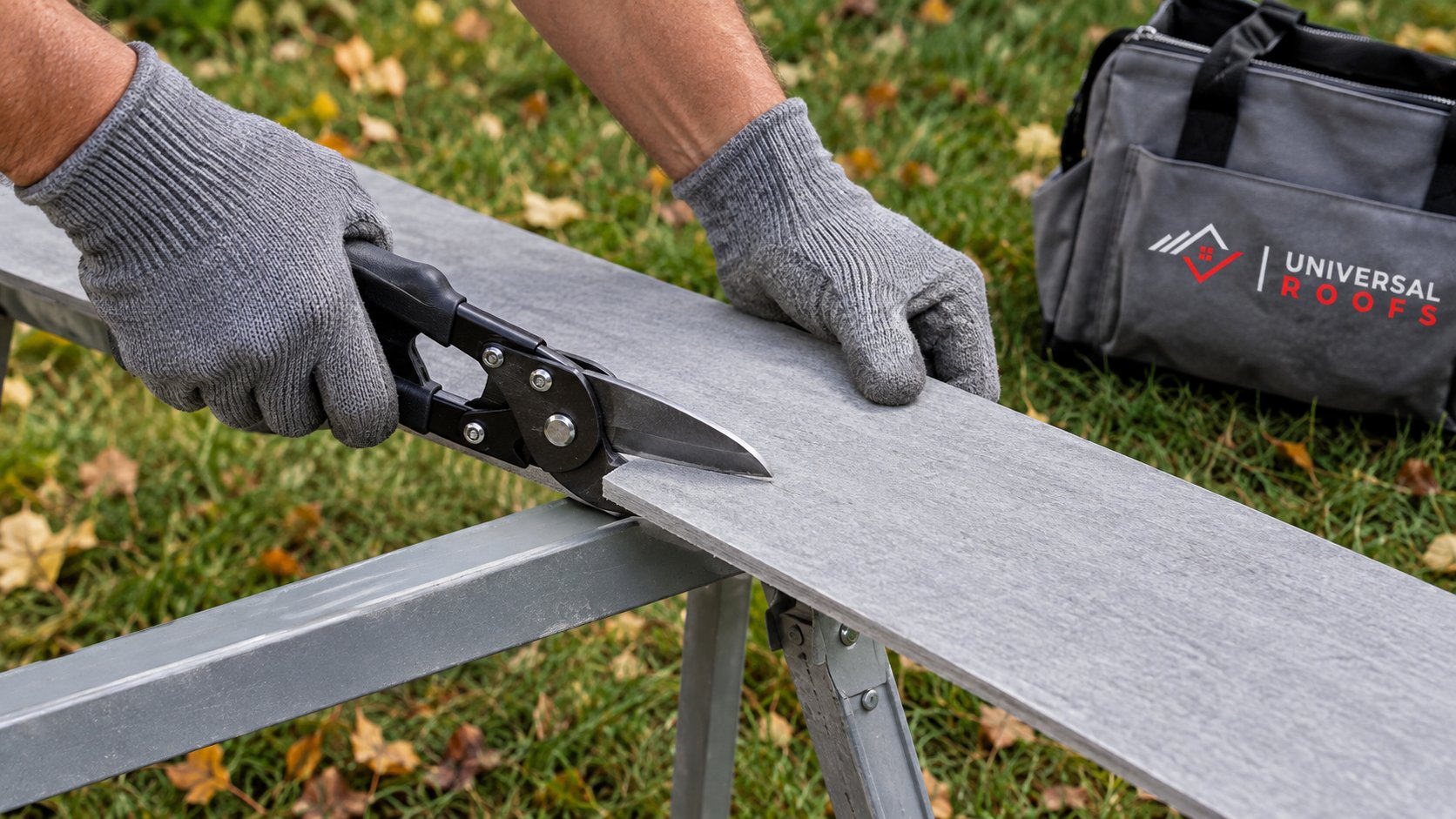
Cutting fibre cement releases respirable crystalline silica, which is a serious lung hazard. James Hardie’s instructions rank cutting practices, with a circular saw fitted with a fibre cement blade and an attached vacuum dust collection system listed as the best option, and they state plainly: never cut with a power saw indoors, and never dry sweep dust. Cutting is done at an outdoor station positioned so the wind carries dust away from the crew, and clean-up uses wet methods or a vacuum. Ask any contractor how they control dust on site; the answer tells you a lot about how they work.
Storage and handling
The boards should arrive and be stored flat, dry and covered. The manufacturer warns that installing siding wet or saturated may result in shrinkage at joints, which is a real consideration in a rainy autumn. Long planks are carried on edge, by two people where needed, because carrying them flat can crack them.
Wall preparation and fastening
Fibre cement shows the wall behind it. If the sheathing is wavy or the framing is out of plane, the long planks will mirror it. The instructions call for a water-resistive barrier installed with flashing at openings and junctions, and corrections to irregular framing before cladding goes on. Planks are fastened with corrosion-resistant nails at the nail line, driven snug but not overdriven, and butt joints are handled exactly as the product instructions specify, which typically includes a flashing behind the joint.
Cut edges
Every edge cut in the field is a potential entry point for moisture. The manufacturer’s instructions require field-cut edges to be caulked, painted or primed. On factory-finished boards, touch-up kits are used on cuts and scuffs. A crew that skips this step can create problems that show up years later as swelling or flaking at butt joints.
Clearances And Flashing That Protect The Boards
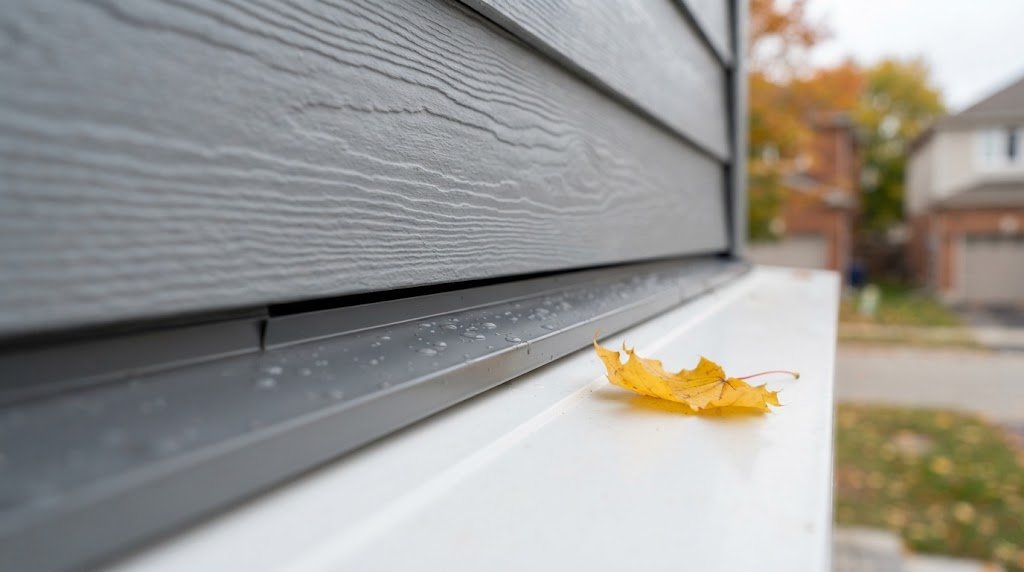
Fibre cement fails mostly where water sits against it. That is why James Hardie’s HZ5 instructions set out minimum clearances at the bottom of the wall and at every transition. Your contractor should follow the current instructions for the specific product, but these are the kinds of details to look for when fiber cement siding goes on:
| Location | What the HZ5 details show | Why it matters |
|---|---|---|
| Ground to siding | About 6 inches between the bottom of the siding and finished grade, with grade sloping away | Keeps boards out of soil moisture, splash-back and piled snow |
| Roof to wall | A minimum of about 2 inches above the roof surface, with step and counter flashing | Roof runoff and snowmelt would otherwise wick into the board ends |
| Decks, paths and steps | A minimum of about 2 inches above the hard surface | Hard surfaces splash water and hold snow against the wall |
| Above horizontal Z-flashing | A gap of about a quarter inch, left uncaulked | Lets water drain out rather than be trapped behind the boards |
| Bottom of a roof-to-wall joint | Kick-out flashing directing water into the eavestrough | Without it, water runs down the wall and behind the cladding |
| Eaves with eavestroughs | Shingles extended out from the fascia | Stops water running behind the trough and onto the siding |
These clearances often conflict with what is already on an older house. Soil may be built up against the foundation, or a deck may have been built tight to the wall. Part of a good quote is identifying those conflicts and solving them before the cladding goes on. On projects our Durham Region roofing, eavestroughs and attic work team handles, roof-to-wall flashing and eavestroughs are often redone at the same time as the cladding, because the two are so closely linked.
Freeze-Thaw, Moisture And Long-Term Care
In our climate, the biggest long-term risks to fiber cement siding are water at the bottom edge and water at joints. Snow piled against the bottom of the wall, a downspout discharging next to the foundation, and sprinklers hitting the siding all keep boards wet. Over repeated freeze and thaw cycles, that moisture can cause edges to swell, flake or crack.
Routine care is straightforward. James Hardie recommends washing the siding every 6 to 12 months with a garden hose or low-pressure spray, keeping vegetation trimmed back from the wall, keeping eavestroughs and downspouts clear, and maintaining joints, penetrations and flashing. High-pressure washing can damage the surface; the instructions advise keeping pressure washer tips well away from the wall and at low pressure. Paint on field-painted boards will need recoating over time, following the paint manufacturer’s guidance.
Check the caulking around windows, doors and trim every year or two. Caulk does not last as long as the siding, and a failed joint around a window is a common way for water to reach the wall behind.
What Fiber Cement Siding Typically Costs
With fibre cement, labour drives the price as much as the boards do: heavy planks, controlled cutting and more trim joints all take time. Wall height, access, sheathing condition and whether old cladding comes off move the number further. As broad estimates for the GTA:
- Fibre cement lap siding installed often falls in the range of roughly $12 to $22 per square foot of wall, with factory-finished products toward the higher end.
- Vinyl installed is commonly around $6 to $12 per square foot.
- Engineered wood installed is often around $10 to $18 per square foot.
- A full house in fibre cement can run from the mid tens of thousands of dollars upward, depending on size and complexity.
These fiber cement siding numbers are estimates only and vary by house, access and scope. When comparing quotes, check whether they include removal and disposal, sheathing repairs, house wrap, trim, flashing, soffit and fascia, and any painting.
Questions To Ask Before You Sign
Fiber cement siding is only as good as the crew installing it, and a few direct questions separate experienced installers from those learning on your house:
- Which product line and which instructions will you follow? The answer should name the specific product and the current manufacturer’s instructions for cold climates.
- How will you control cutting dust? Listen for an outdoor cutting station, vacuum-connected saws or shears, and wet or vacuum clean-up.
- What happens to the existing cladding and sheathing? A good quote explains how damaged sheathing, rotted trim or missing flashing will be handled when the old siding comes off.
- How are the clearances being met? Ask specifically about the bottom of the wall, any lower roofs, the deck ledger and the front steps.
- How are cut edges and butt joints treated? The answer should match the manufacturer’s requirements for sealing cut edges and flashing joints.
- What does the warranty cover, both from the manufacturer for the product and from the contractor for workmanship, and where are those terms written down?
It is also worth asking how soffit, fascia and eavestroughs fit into the plan. Replacing them at the same time as the cladding avoids disturbing new siding later, and it lets the crew detail the top of the wall properly.
Fibre Cement Questions
Is fibre cement better than vinyl in Ontario?
What is HZ5?
Do I need to paint fibre cement?
Is cutting fibre cement dangerous?
How long does fibre cement last?
Can fibre cement go over my old siding?
Planning Fiber Cement Siding For Your Home
If you are weighing fiber cement siding against vinyl or engineered wood, Universal Roofs will flag the clearance conflicts on your house, such as built-up soil, a tight deck or a lower roof, and price fibre cement beside the alternatives on the same written scope.
Call us today at (416) 732-2421 or request a free estimate.
Recladding homes in Durham Region and throughout the GTA.