
Soffit and fascia repair is not just a cosmetic job. Every time a contractor opens up that overhang, there is a fire-code opportunity sitting right there in the eaves: the gap between your attic and the outside world. In Toronto and across the GTA, the Ontario Building Code and the National Building Code both treat the soffit and fascia assembly as part of the fire separation between a home and its neighbour, especially on homes built close to the property line. Get the materials or the installation wrong during a repair and you can end up with a soffit that looks fine but no longer meets code, no longer resists flame spread, and no longer protects the roof structure above it.
This guide walks through the three fire protection solutions we use most often when repairing soffit and fascia on GTA homes: fire-rated vinyl and aluminum soffit systems, fire-retardant-treated wood fascia and blocking, and fire-stop caulking and mineral wool packing at the wall-to-roof junction. We will explain what each one does, when it is required, what it costs, and how to tell if your existing soffit already has a fire rating problem.
We have been repairing soffit, fascia, and the roofs above them across the Toronto area since 2005, and this is the same guidance our crews use on site. If you want a professional opinion on your specific eaves, our roof repair team can assess the whole assembly in one visit.
Why Fire Protection Matters in Soffit and Fascia Repair
The soffit is the underside of your roof overhang, and the fascia is the vertical board that caps the ends of your rafters or trusses and holds the eavestrough. Together they close off the attic space from the outside while still allowing ventilation through soffit vents. That opening is exactly why fire protection solutions for soffit and fascia repair matter so much: an open or unprotected soffit gives fire, embers, and smoke a direct path into the attic from outside, whether from a neighbouring structure fire, a grass or leaf fire near the foundation, or an ember storm carried on wind.
In closely spaced Toronto neighbourhoods, particularly in older areas of East York, the Beaches, and parts of Etobicoke and Scarborough where houses sit only a few metres apart, building officials pay close attention to the fire-resistance rating of exterior wall assemblies, including the soffit and fascia, when they are within a certain distance of the property line. If your home falls into that limiting-distance category, a soffit repair is not just about matching the old material. It is about restoring or improving the fire separation the original assembly provided.
Even outside of strict property-line cases, fire protection is simply good building practice. Vinyl soffit that has warped, cracked, or blown out in a windstorm leaves a gap straight into your attic insulation. Rotted wood fascia is fuel. A poorly sealed junction between the wall sheathing and the roof deck lets flame and hot gases travel upward faster than they should. Addressing these issues properly during a repair is cheaper and far less disruptive than dealing with fire damage or a failed insurance inspection later.
Solution 1: Fire-Rated Vinyl and Aluminum Soffit Panels
The most common fire protection solution for soffit and fascia repair on residential homes is switching to, or replacing like-for-like with, a fire-rated vinyl or aluminum soffit panel system. Not all vinyl soffit is created equal. Standard low-cost vinyl softens and can deform at relatively low temperatures, while fire-rated vinyl soffit is formulated with additives that slow ignition and self-extinguish once the heat source is removed, and it typically carries a Class A or Class 1 fire rating under ASTM E84 testing for flame spread and smoke development.
Aluminum soffit is inherently non-combustible and is often the preferred choice on homes that fall within a limiting distance from the property line, since it will not contribute fuel to a fire even though it will eventually deform under extreme heat. Many GTA contractors, including our crews, default to aluminum on homes under about 1.2 metres from a lot line, and fire-rated vinyl on homes set further back where code does not require non-combustible cladding.
When we repair a section of soffit, we always check what the original material was rated for and whether the home’s setback still requires the same standard today, since some older homes were built under previous code cycles. If your soffit was ever damaged by squirrels, ice damming, or wind and patched with mismatched material, this is the moment to correct it, not just patch over the same gap.
| Soffit Material | Fire Performance | Best Use Case | Approx. Cost per Linear Metre (Installed) |
|---|---|---|---|
| Standard vinyl soffit | Combustible, no fire rating | Detached homes with generous property setbacks | $18 – $28 |
| Fire-rated vinyl soffit | Class A / Class 1 flame spread rating | Semi-detached and homes closer to lot lines | $24 – $36 |
| Aluminum soffit (solid) | Non-combustible | Homes within limiting distance, urban infill | $28 – $42 |
| Aluminum soffit (vented) | Non-combustible, maintains attic airflow | Most standard replacements requiring ventilation | $30 – $45 |
| Fibre-cement soffit board | Non-combustible, rigid | Higher-end renovations, custom overhangs | $45 – $65 |
Pricing varies with overhang depth, accessibility, and how much rotted fascia board or blocking has to come out before the new panels go in. On a typical GTA detached home, a full soffit and fascia replacement using fire-rated materials runs somewhere in the range of a few thousand dollars, while a targeted repair to one section after storm damage is usually a fraction of that.
Solution 2: Fire-Retardant-Treated Wood Fascia and Blocking
The fascia board itself, and the blocking or nailers behind the soffit that the panels attach to, are often still wood even on homes with vinyl or aluminum soffit facing. If that wood is being replaced during a repair, upgrading to fire-retardant-treated (FRT) lumber is one of the most overlooked fire protection solutions for soffit and fascia repair. FRT wood is pressure-impregnated with chemical retardants that slow charring and combustion, and it is commonly specified on townhouse rows, semi-detached pairs, and any structure where the fascia sits close to an adjoining unit’s roofline.
Untreated spruce or pine fascia, especially once it has been repeatedly wetted by ice damming and eavestrough overflow, becomes both a rot problem and a fuel problem. When our crews pull old fascia off a house during a soffit repair, we are frequently finding water-softened wood that has been slowly decaying behind the eavestrough for years. Replacing it with FRT lumber solves two problems at once: it resists future moisture-related rot better than untreated stock, and it meaningfully slows flame spread if the assembly is ever exposed to fire.
FRT lumber costs more upfront than standard dimensional lumber, typically 30 to 60 percent more per board, but on a per-house basis the fascia and blocking represent a small enough quantity of wood that the total cost difference is usually a few hundred dollars, not a few thousand. For row housing, semi-detached homes, and any property where the local building department has flagged fire separation distance as a concern, we treat FRT fascia as the standard, not the upgrade.
Solution 3: Fire-Stop Sealant and Mineral Wool at the Wall-to-Roof Junction
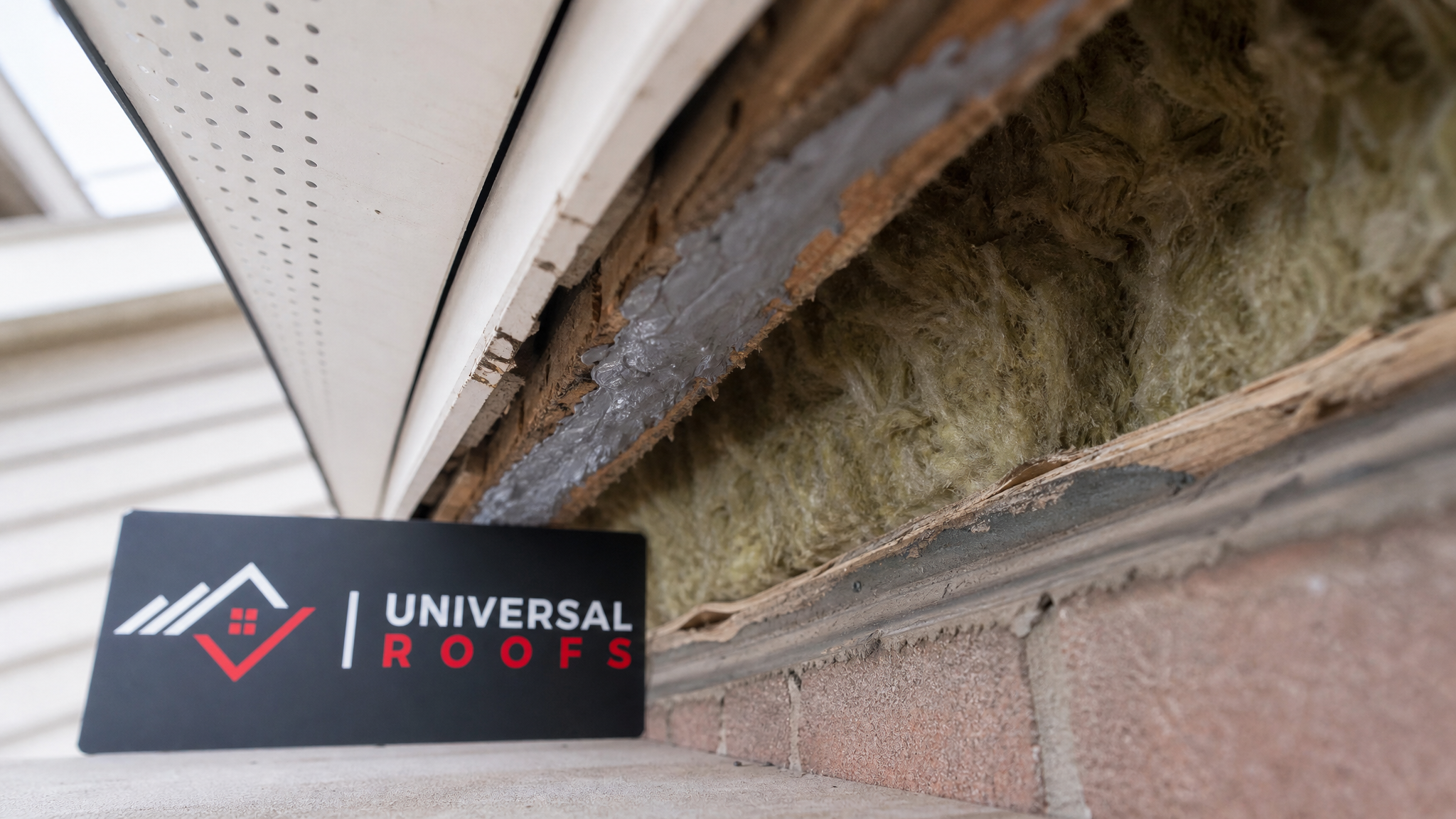
The third solution addresses the gaps rather than the panels themselves. Wherever the soffit meets the exterior wall, and wherever the fascia meets the roof deck or a party wall between semi-detached or row homes, there are seams and penetrations that need to be closed with fire-rated sealant and, in higher-risk assemblies, packed with mineral wool (rock wool) insulation instead of standard fibreglass batt.
Fire-stop caulking is an intumescent sealant, meaning it expands when exposed to heat, sealing the gap tighter rather than melting or shrinking away from it the way ordinary silicone or acrylic caulk does. We apply it around soffit vent penetrations, at the corners where soffit returns meet the fascia, and along any seam where the original assembly has separated due to age or storm damage. It is inexpensive relative to the rest of the job, usually a few hundred dollars in material and labour on a standard repair, but it is the detail that is most often skipped because it is invisible once the soffit panel goes back on.
Mineral wool is the second half of this solution. Unlike fibreglass, mineral wool is non-combustible and will not melt or off-gas under fire exposure, and it holds its shape in a gap rather than sagging over time. On party walls between semi-detached and townhouse units, and on any home where the soffit repair exposes the shared wall assembly, packing that cavity with mineral wool instead of leaving it open or refilling it with fibreglass is one of the higher-impact fire protection upgrades available during a repair, because it directly addresses the fire separation between two dwelling units.
| Fire-Stop Detail | Material Used | Where It’s Applied | Why It Matters |
|---|---|---|---|
| Soffit vent penetrations | Intumescent fire-stop caulk | Around each vent opening | Prevents ember and flame entry through vent gaps |
| Soffit-to-fascia corner seams | Fire-rated caulk, sealed J-channel | Where soffit panel meets fascia trim | Closes the most common wind and fire entry point |
| Party wall cavity (semis/townhomes) | Mineral wool (rock wool) batt | Behind soffit at shared wall line | Restores fire separation between units |
| Wall sheathing-to-roof deck gap | Fire-stop caulk plus blocking | Top of exterior wall behind fascia | Blocks vertical flame travel into attic |
| Old fastener holes and cracks | Fire-rated sealant | Anywhere original soffit has aged or split | Removes unintentional gaps left by wear |
How to Tell If Your Soffit and Fascia Already Have a Fire Protection Problem
Most homeowners never think about soffit fire rating until a repair is already underway, but there are visible warning signs you can check from the ground with binoculars or from a ladder if you are comfortable doing so. Warped or melted-looking vinyl soffit, even in sections nowhere near an obvious heat source, often means the original material was a lower-grade, non-fire-rated product that has degraded under normal summer sun exposure, since standard vinyl can soften well below the temperatures reached in a real fire event.
Gaps where soffit panels have pulled away from the fascia or the wall, missing or crushed vent covers, and fascia board that flexes or shows soft, water-stained wood are all signs the fire-stop detailing has failed even if the panels themselves look intact from a distance. On semi-detached and row housing specifically, ask whether the party wall soffit cavity has ever been opened and inspected. Many of these homes were built with only fibreglass batt or, in older stock, nothing at all in that critical cavity.
If your home is older than about 25 years and the soffit has never been replaced, it is worth having it inspected regardless of visible damage, since fire-rated soffit and fascia materials, and the code requirements around them, have both changed several times since the 1990s. Our attic and roof assessments routinely include a soffit and fascia check for exactly this reason, because attic ventilation, insulation, and fire protection are all tied to the same overhang assembly.
Repair Timeline and What to Expect
A soffit and fascia repair that incorporates all three fire protection solutions above is not a dramatically longer job than a standard cosmetic repair, but it does involve a few extra steps that homeowners should plan for. Below is the general sequence we follow on a typical GTA repair.
| Stage | What Happens | Typical Duration |
|---|---|---|
| Inspection and assessment | Full check of soffit, fascia, blocking, and vent condition; identify fire-stop gaps | 30 – 60 minutes |
| Material selection | Confirm fire-rated vinyl, aluminum, or fibre-cement based on setback and homeowner preference | Same day as quote |
| Removal of damaged sections | Strip failed soffit, rotted fascia, and old blocking; inspect sheathing behind it | 1 – 2 hours per side |
| Fire-stopping and blocking | Install FRT wood blocking, pack mineral wool at party walls, apply fire-stop caulk | 1 – 3 hours depending on scope |
| Panel and fascia installation | Install fire-rated vinyl or aluminum soffit and FRT fascia board | 2 – 4 hours per side |
| Final seal and cleanup | Seal all seams and vent penetrations, clean site, haul debris | 30 – 60 minutes |
Most single-section repairs are completed in a single day. A full-perimeter soffit and fascia replacement on a larger detached home can take one to two days, particularly if extensive rot is found once the old material comes off and additional blocking has to be rebuilt before the new fire-rated panels go on.
Summer Is the Right Window for This Repair
July and August are genuinely the best months in the GTA to have soffit and fascia work done properly. The lumber and sealants used in fire-stopping perform best when applied in dry, warm conditions, intumescent caulk cures more reliably above 10 degrees Celsius, and there is no ice, snow, or freeze-thaw cycling to complicate access to the eaves. It is also far easier to spot heat-related warping or sun damage to old vinyl soffit in the summer, since those are the exact conditions that cause it.
Waiting until fall or winter to address a soffit fire-protection gap means living with that gap through another freeze-thaw season, during which ice damming can push further into any existing openings and worsen both the moisture damage and the fire separation problem at the same time. If you already suspect an issue, a summer repair window avoids that compounding effect entirely.
Fire-Rated Materials Also Improve Ventilation and Durability
One reassuring point for homeowners weighing the cost of fire-rated materials: none of the three solutions above trade away performance to get fire resistance. Fire-rated vinyl and aluminum soffit panels are available in the same vented and solid profile options as standard products, so your attic ventilation rate does not change. FRT lumber, once properly kiln-dried after treatment, performs the same structurally as untreated wood and simply resists both rot and flame better. Mineral wool actually outperforms fibreglass batt on sound dampening between units in addition to its fire performance, which is a welcome side benefit for semi-detached and townhouse owners.
In practice, choosing fire-rated materials during a soffit and fascia repair is close to a free upgrade in terms of trade-offs. The main difference homeowners notice is a modest increase in material cost, which is a small fraction of the total labour and access cost of the repair itself.
Common Mistakes We See in DIY and Low-Bid Soffit Repairs
Because soffit and fascia repair looks straightforward from the ground, it attracts more DIY attempts and low-bid contractor shortcuts than almost any other part of the roof. The most common mistake is reusing old, non-fire-rated vinyl trim pieces and J-channel while installing new soffit panels, which undermines the fire performance of the new material at every seam. Another frequent issue is skipping the fire-stop caulk step entirely, since it adds time and is invisible once the panel is back in place, so it is easy for a rushed crew to leave it out without the homeowner ever knowing.
We also regularly find fascia repairs where new wood was face-nailed directly over old, rotted blocking rather than removing and replacing the blocking underneath. This leaves the fire-retardant benefit of new fascia board largely irrelevant, since the combustible, moisture-damaged wood behind it is still there and still connected to the attic space. A proper repair replaces the full assembly, not just the visible face.
Frequently Asked Questions
What are the best fire protection solutions for soffit and fascia repair?
Is fire-rated soffit required by code on all GTA homes?
How much does fire-rated soffit and fascia repair cost?
Can I install fire-rated soffit myself?
Does mineral wool really make a difference over fibreglass in soffit repairs?
How do I know if my existing soffit already has a fire protection gap?
Need Help With 3 Best Fire Protection?
Soffit and fascia repair is one of those jobs that is easy to underestimate until you see what is actually happening behind the panel. Getting the fire protection details right, the right material, the right fastening, the right sealant at every seam, is exactly the kind of work Universal Roofs has been doing across the GTA since 2005, alongside related work like roof replacement, flat roofing, and skylight installation and repair.
Call us today at (416) 732-2421 or request a free inspection to get started.
Universal Roofs proudly serves Toronto, Mississauga, Brampton, Vaughan, Markham, Oakville and the GTA since 2005.