
Commercial skylights do more than bring natural light into a warehouse, retail space, or office lobby — they are a structural penetration through your roof membrane, and every seal, flashing detail, and glazing unit is a potential point of failure. When a commercial skylight starts leaking, fogging, or rattling in the wind, property managers need skylight repair solutions for commercial buildings that address the root cause, not just the symptom, because a poorly diagnosed repair can mean the same drip reappearing on the warehouse floor six months later.
At Universal Roofs, we have spent nearly two decades repairing commercial skylights across the Greater Toronto Area, from big-box retail units in Mississauga to manufacturing facilities in Vaughan. Commercial skylights fail differently than residential ones — larger spans, flatter slopes, curb-mounted units, and heavier freeze-thaw cycling all change the repair calculus. This guide walks through the most common commercial skylight problems, the repair solutions that actually work, realistic cost and timeline expectations, and how to decide whether repair or full replacement makes more financial sense for your building.
Whether you manage a single-storey commercial plaza or a multi-unit industrial complex, understanding these repair options will help you make an informed decision the next time a tenant calls to report water stains on the ceiling tiles below a skylight.
Why Commercial Skylights Fail More Often Than Residential Units
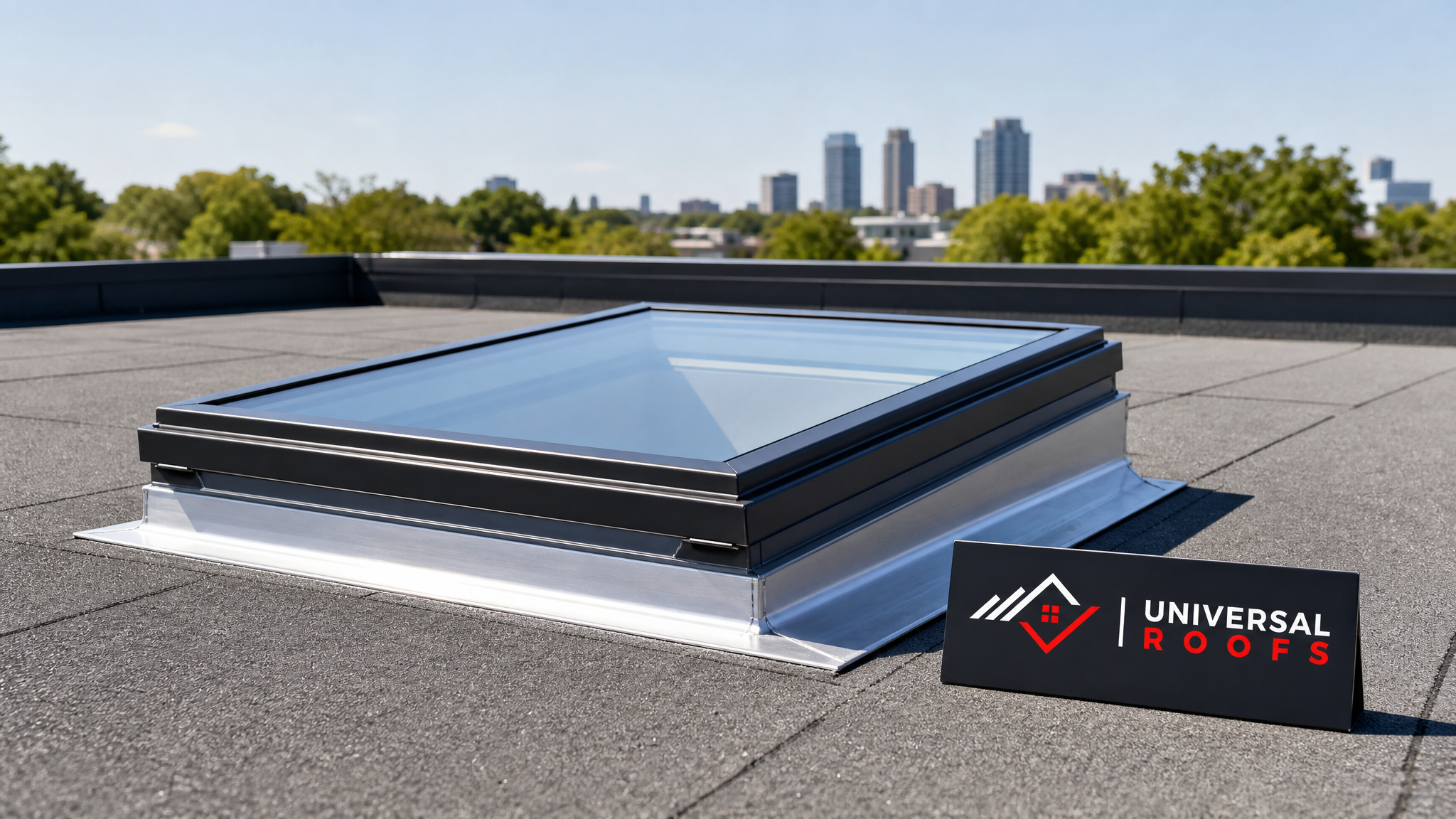
Commercial skylights are usually larger, flatter, and installed on low-slope or fully flat roofs — the exact roof profile where water pooling and membrane fatigue are most common. Unlike a steep residential roof where gravity does most of the work shedding water, a commercial flat roof often holds standing water around the base of a skylight curb for hours after a storm. Over years, that sustained moisture exposure breaks down sealants, corrodes metal flashing, and finds its way through even small gaps in the curb-to-membrane transition.
Commercial units are also exposed to more foot traffic from rooftop maintenance crews, HVAC technicians, and snow-clearing contractors, all of which can crack glazing, dent frames, or disturb flashing without anyone noticing until the next rainstorm. Add in Toronto’s freeze-thaw cycle — where meltwater refreezes in tiny cracks and expands them wider each winter — and you have a recipe for accelerated skylight failure on commercial buildings compared to residential ones.
The building’s flat roofing system and the skylight curb are also directly connected structurally, so a skylight leak is sometimes actually a roof membrane problem near the curb, not a skylight problem at all. That is why any competent commercial skylight repair starts with a proper diagnosis rather than assuming the glazing or seal is automatically at fault.
Diagnosing the Real Source of a Commercial Skylight Leak
Before any repair solution can be effective, the actual entry point of water needs to be identified. This sounds obvious, but water travels sideways along roof decking and structural members before it drips through a ceiling tile, so the visible stain is often several metres away from the actual leak. A thorough inspection typically includes:
- Examining the skylight curb-to-roof-membrane transition for cracked or lifted flashing
- Checking all four sides of the glazing frame for failed weatherstripping or dried-out sealant
- Inspecting for condensation versus active leak (condensation drips from the inside of the glass, not the frame)
- Looking for hail damage, thermal stress cracks, or UV-degraded polycarbonate panels
- Testing drainage weep holes to confirm they are not blocked with debris
- Reviewing the interior ceiling and insulation for the true path water has travelled
Our technicians also cross-reference skylight condition with the surrounding roof repair history, since a skylight installed on a membrane nearing the end of its service life is often better addressed as part of a broader roof repair scope rather than in isolation.
Repair Solution 1: Reflashing and Curb Sealant Renewal
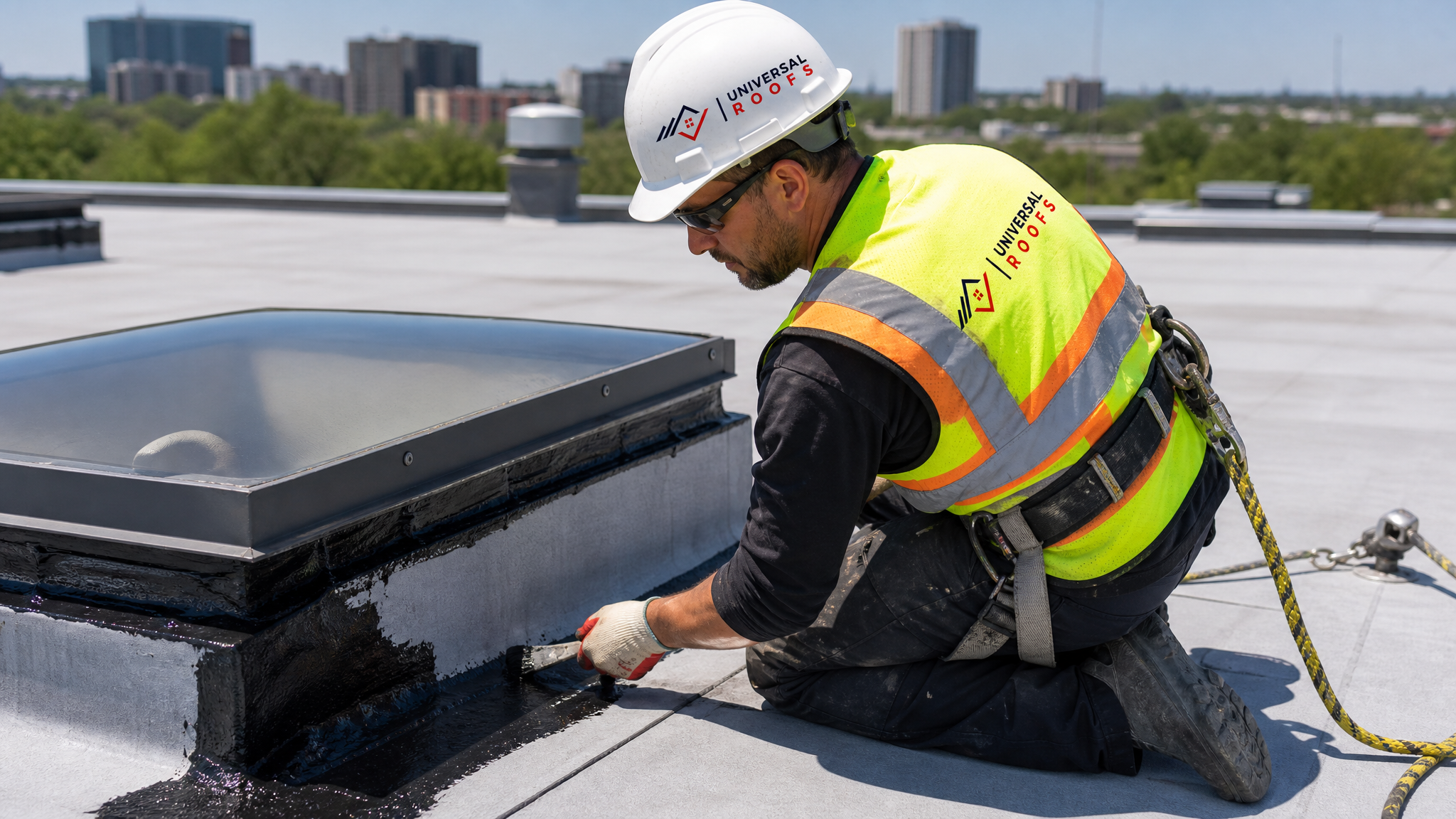
The single most common and most effective commercial skylight repair is reflashing the curb. Over 10-15 years, the sealant between the metal flashing and the skylight frame dries out, shrinks, and cracks, creating a direct path for water. Reflashing involves removing the old counterflashing, cleaning the substrate down to bare metal or membrane, and installing new flashing with a compatible, UV-stable sealant designed for the specific roofing material on your building.
This repair is highly effective when the skylight glazing itself and the curb structure are still sound — it is essentially a “refresh” of the weatherproofing envelope around an otherwise good unit. For commercial buildings with EPDM, TPO, or modified bitumen roofing, the flashing detail must be compatible with that specific membrane, which is why we always match repair materials to the existing roof system rather than using a generic sealant.
Repair Solution 2: Glazing and Gasket Replacement
When the leak or fogging originates from the glazing panel itself rather than the curb, the fix is different. Insulated glass units (IGUs) that have lost their seal will show visible condensation trapped between the panes — this is a clear sign the unit needs replacement glazing, not just a resealed frame. Similarly, polycarbonate dome skylights that have yellowed, crazed, or developed stress cracks from UV exposure need panel replacement rather than patching.
Gasket and weatherstripping replacement is a smaller-scale repair appropriate when the glazing is fine but the rubber seals around the frame have hardened and lost their compression fit. This is a faster, lower-cost repair that can resolve wind-driven rain infiltration without touching the glass at all.
Repair Solution 3: Structural Curb and Frame Repair
On older commercial buildings, we sometimes find the wood or metal curb itself has deteriorated from years of sustained moisture exposure, even if the visible flashing looks intact. Soft, spongy, or rotted curb material cannot properly anchor new flashing or hold a watertight seal no matter how well the surface repair is done. In these cases, the repair solution involves rebuilding or reinforcing the curb structure before any flashing or sealant work proceeds.
This is more invasive and time-consuming than a surface reflash, but skipping it means any cosmetic repair will fail again within a season or two. If the curb has deteriorated significantly, it is also worth evaluating whether the surrounding roof deck near the skylight opening needs attention as part of the same repair visit.
Comparing Commercial Skylight Repair Methods
| Repair Method | Best For | Typical Lifespan Added | Relative Cost |
|---|---|---|---|
| Curb reflashing & sealant renewal | Cracked flashing, dried-out sealant, isolated leaks | 8-12 years | $ |
| Gasket/weatherstrip replacement | Wind-driven rain, minor frame leaks | 5-8 years | $ |
| Glazing/IGU replacement | Fogged glass, cracked panels, failed seals | 15-20 years | $$ |
| Structural curb rebuild | Rotted curb, sagging frame, chronic leaks | 15-20 years | $$$ |
| Full unit replacement | Multiple failure points, end-of-life units | 20-25 years | $$$$ |
Repair Costs and Timelines for GTA Commercial Buildings
Costs vary significantly based on skylight size, roof access, and the extent of underlying damage, but property managers should expect the following general ranges for commercial units in the Toronto area. These figures assume a single skylight unit of typical commercial size (roughly 1.2 to 2.4 metres across); larger custom units or ridge-run skylight systems will scale accordingly.
| Repair Type | Typical Cost Range (CAD) | Typical Timeline |
|---|---|---|
| Sealant/caulking touch-up only | $300 – $700 | Same day |
| Full curb reflashing | $800 – $2,200 | 1 day |
| Gasket/weatherstrip replacement | $400 – $1,000 | Half day to 1 day |
| Glazing/IGU replacement | $1,200 – $3,500 | 1-2 days (subject to glass lead time) |
| Structural curb rebuild | $2,500 – $6,000 | 2-4 days |
Multi-unit buildings with several skylights on the same roof plane often see per-unit savings when repairs are batched into a single mobilization, since scaffolding, lift rental, and roof access setup are shared across the whole job.
Repair Versus Replacement: Making the Right Call
Not every leaking skylight needs to be replaced, but not every leak should be repaired indefinitely either. As a general rule, repair makes financial sense when the unit is under 15 years old, the glazing is intact, and the problem is isolated to flashing or sealant. Replacement becomes the smarter long-term investment when a unit is showing multiple simultaneous failure points, when the curb structure has deteriorated, or when the building has already had two or more repair visits to the same skylight within a few years.
| Situation | Recommended Approach | Why |
|---|---|---|
| Isolated flashing leak, unit <10 years old | Repair | Underlying components still sound |
| Fogged double-glazed unit only | Glazing replacement | Frame and curb typically still functional |
| Repeated leaks after 2+ repair visits | Replacement | Indicates deeper structural failure |
| Unit is 20+ years old with visible corrosion | Replacement | Repair cost approaches replacement cost |
| Planned roof recover/replacement project | Replacement | Cost-effective to bundle with roof work |
If your building is approaching a full roof recover or your skylights are original to a building built before 2005, it’s worth having our team assess whether skylight replacement alongside planned roof work would be more cost-effective than a series of piecemeal repairs. We can walk you through the comparison during a site visit, alongside a look at your broader roof replacement timeline if that is also on the horizon.
Preventive Maintenance That Extends Skylight Life
Many commercial skylight repairs are entirely avoidable with a basic maintenance routine. Building managers who schedule annual or semi-annual inspections consistently report fewer emergency leak calls and lower lifetime repair costs. A practical maintenance checklist includes:
- Clearing debris from drainage channels and weep holes at least twice a year
- Visually inspecting sealant and flashing for cracking each spring and fall
- Checking interior ceiling tiles and insulation around skylight openings for early staining
- Confirming rooftop HVAC or maintenance crews are not walking directly on skylight curbs
- Documenting skylight age and last service date for capital planning purposes
Summer is actually an ideal time in the GTA to schedule this kind of inspection — the roof surface is dry, sealants cure properly in warm weather, and any repair work identified now can be completed well before the fall rains and winter freeze-thaw cycle put additional stress on ageing seals. Waiting until a tenant reports a leak in November often means scheduling an emergency repair in far less favourable conditions.
Choosing a Contractor for Commercial Skylight Repair
Commercial skylight repair requires a different skill set than residential window or roofing work. Look for a contractor who can demonstrate experience specifically with commercial curb-mounted and dome skylight systems, who carries proper fall-protection certification for flat-roof access, and who is willing to explain the diagnosis before starting work rather than jumping straight to a quote.
It’s also worth asking whether the contractor services the Toronto, Peel Region, York Region, Halton Region, and Durham Region areas directly, since local familiarity with municipal building code requirements and typical regional roofing systems speeds up both the diagnosis and the permitting process where required. You can read what past commercial and residential clients have said about our work on our reviews page, and check our FAQ page for answers to common questions about scheduling and warranty coverage.
How Skylight Health Connects to Attic and Roof Ventilation
A commercial skylight that leaks or condensates excessively can also point to a broader ventilation issue in the roof assembly. Poor airflow in the space above a dropped ceiling or within an attic cavity traps warm, moist air against the underside of the glazing, accelerating condensation and, over time, contributing to mould growth on ceiling tiles and insulation near the skylight opening. If your building experiences recurring fogging or moisture issues even after a proper seal repair, it is worth having ventilation assessed as part of the same visit, since a skylight repair alone will not resolve a ventilation-driven moisture problem.
What are the most effective skylight repair solutions for commercial buildings with recurring leaks?
How much does commercial skylight repair typically cost in the GTA?
How do I know if my commercial skylight needs repair or full replacement?
Can a commercial skylight be repaired without replacing the glass?
How long does a typical commercial skylight repair take?
Why do commercial skylights leak more in Toronto’s climate specifically?
Need Help With Effective Skylight Repair Solutions?
If your commercial building has a leaking, fogging, or ageing skylight, the team at Universal Roofs can properly diagnose the issue and recommend the repair solution that actually solves it, not just masks it for another season.
Call us today at (416) 732-2421 or request a free inspection to get started.
Universal Roofs proudly serves Toronto, Mississauga, Brampton, Vaughan, Markham, Oakville and the GTA since 2005.