
When a commercial roof starts to leak, most property managers focus on the visible membrane, the flashing, or the drains. But underneath that surface layer sits the component that actually holds the entire system together: the roof decking. Understanding why proper roof decking repair is important for commercial buildings can be the difference between a routine maintenance line item and a six-figure structural emergency. In Toronto and across the GTA, where freeze-thaw cycles, heavy snow loads, and humid summers all take turns punishing a roof assembly, decking failures are one of the most expensive and most preventable problems a building owner will ever face.
Roof decking is the structural substrate — typically steel, plywood, oriented strand board (OSB), or concrete — that spans the building’s joists or trusses and supports every layer above it: insulation, cover boards, membrane, and any rooftop equipment. When decking deteriorates from moisture intrusion, rust, rot, or physical damage, it stops being a stable foundation and starts being a liability. A membrane can only perform as well as the surface beneath it, and no amount of premium roofing material will compensate for decking that flexes, sags, or crumbles under load.
This guide walks through what commercial roof decking actually does, how it fails, why repairing it properly (rather than papering over the symptoms) matters so much, and what the process looks like from inspection through completion. Whether you manage a single retail plaza or a portfolio of industrial buildings across the Toronto, Peel, York, Halton, or Durham regions, the fundamentals below apply directly to your roof.

What Roof Decking Does and Why It Matters for Commercial Buildings
Roof decking is the structural layer that transfers all rooftop loads — snow, wind, foot traffic, mechanical units, ponding water — down into the building’s primary structure. On most commercial buildings in the GTA, decking is one of three types: profiled steel deck (common on industrial and big-box buildings), plywood or OSB sheathing (common on smaller commercial and mixed-use buildings), and structural concrete (common in high-rises and parkades). Each has a different failure profile, but all three share one thing in common: once compromised, they can no longer safely support the assembly above them.
Proper roof decking repair matters for commercial buildings for several interlocking reasons. First, it is a matter of structural safety — a rotted or rusted-through deck section can collapse under snow load or worker weight, and that risk escalates quickly on flat and low-slope commercial roofs that pond water. Second, it protects the building envelope, since compromised decking almost always means moisture is already inside the insulation and possibly the ceiling assembly below. Third, it protects the investment in the roofing membrane itself — installing a brand-new membrane over failing decking is one of the most common and costly mistakes in commercial roofing, because the membrane will fail again within a year or two as the substrate continues to move and deteriorate.
Building owners sometimes ask our team at Universal Roofs why we insist on decking inspection before quoting membrane work. The answer is simple: a roof system is only as strong as its weakest layer, and decking is the layer everything else depends on.
Common Causes of Roof Decking Damage in the GTA Climate
Toronto’s climate is uniquely hard on commercial roof decking. The region moves through dramatic freeze-thaw cycles every winter, sees heavy spring rain, and experiences humid, storm-prone summers — all of which create repeated opportunities for water to find its way into a roof assembly and attack the decking underneath.
The most frequent causes we see during commercial roof repair calls include failed membrane seams that let water track laterally across the deck before it ever shows up as an interior leak, deteriorated flashing around parapets, curbs, and rooftop units, clogged or undersized drains that cause prolonged ponding, punctures from foot traffic or dropped tools during other rooftop trades’ work, and simple age — most commercial membranes are rated for 15 to 25 years, and decking beneath an aging membrane has often absorbed years of slow moisture cycling before any visible symptom appears indoors.
Steel decking typically fails through corrosion, showing rust bloom, flaking, and eventually perforation at seams and fastener points. Wood-based decking (plywood/OSB) fails through rot and delamination, often becoming spongy or visibly discoloured. Concrete decking is more resilient but can suffer from spalling, cracking, and rebar corrosion when water penetrates over long periods. Understanding which failure mode applies to your building is the first step in scoping a proper repair.
| Deck Material | Common Failure Mode | Typical Warning Sign | Repair Urgency |
|---|---|---|---|
| Steel deck | Corrosion / rust-through | Rust staining on ceiling, orange flaking at seams | High — structural section loss |
| Plywood/OSB | Rot, delamination, fungal growth | Spongy footing, dark staining, musty odour | High — loses load capacity quickly |
| Structural concrete | Spalling, rebar corrosion | Cracking, efflorescence, exposed rebar | Moderate to high depending on depth |
| Lightweight insulating concrete | Saturation, crumbling | Soft spots underfoot, damp core samples | Moderate — often widespread if found |
| Gypsum deck | Moisture absorption, disintegration | Sagging panels, visible sagging membrane | High — rapid loss of integrity |
The Risks of Ignoring or Improperly Repairing Roof Decking
Deferring decking repair, or having it done incorrectly, creates risk that compounds over time rather than staying static. The most immediate risk is structural: a weakened deck section can sag, deflect under snow load, or in severe cases collapse, endangering anyone on the roof and anyone below. Insurance carriers increasingly ask for documented roof condition reports, and a known decking deficiency that goes unaddressed can complicate a claim after a storm event or, in the worst case, void coverage entirely if the damage is deemed a maintenance failure rather than a sudden loss.
There is also a cascading cost risk. A membrane installed over unrepaired decking has nothing stable to adhere to or bear against — it moves independently, seams open, fasteners back out, and the new membrane can fail within one to three years instead of lasting its full 15-to-25-year service life. At that point, the building owner pays for the same membrane replacement twice, plus the interior damage that continued in the interim.
Business interruption is another underrated risk. Retail, warehouse, and office tenants do not tolerate active leaks well, and a leak that traces back to failed decking often reappears in a different spot every time it rains, making it look like an unsolvable mystery rather than what it usually is: water finding new paths through the same compromised substrate. Proper decking repair — cutting out the affected material, replacing it with matched, code-compliant decking, and re-securing the membrane correctly — is what actually stops the cycle.
How Professional Roof Decking Assessment and Repair Works
A proper commercial decking repair starts long before anyone cuts into the membrane. Our process at Universal Roofs begins with a full roof inspection, including a core sample or two in suspect areas to confirm deck condition without guessing. We look at moisture readings across the field of the roof using infrared scanning where appropriate, since trapped moisture under an intact membrane often extends well beyond where a leak is visible indoors.
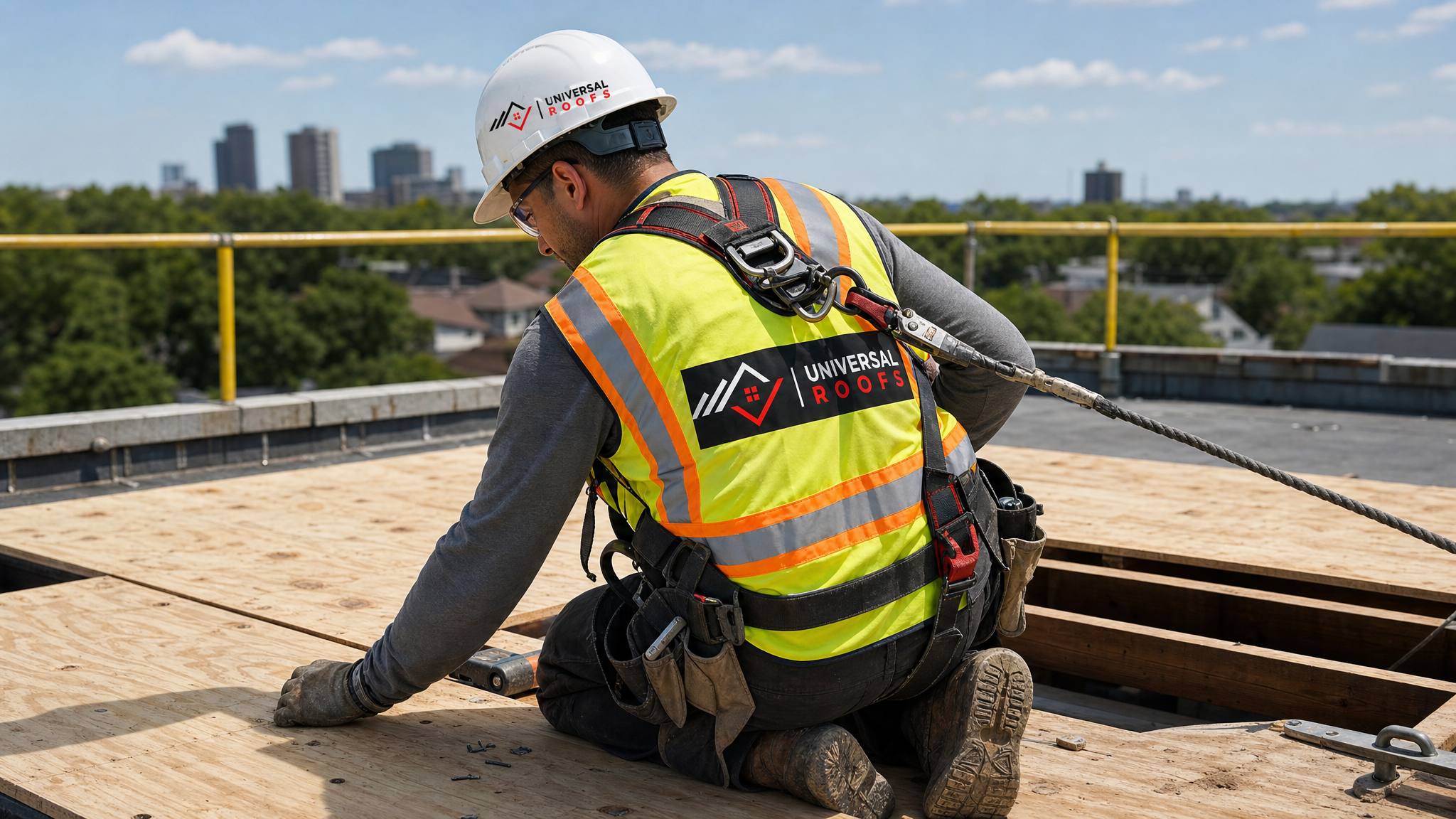
Once we understand the scope, we mark out the affected sections, remove the membrane and insulation in that area, and cut back the decking to solid, sound material — never just patching over a soft spot. Replacement decking is matched to the existing deck type and gauge or thickness, fastened to code, and tied properly into the surrounding structure so there is no differential movement at the repair boundary. Only then does the insulation and membrane go back down, with new flashing detailing at any transitions.
This is also the point in the process where our roof repair team coordinates with any planned roof replacement scope, since decking condition often determines whether a section-by-section repair makes sense or whether the building is better served by a full system replacement. On buildings with rooftop skylights, we also check the deck condition around curb penetrations, since these are common leak points — our skylights and skylight replacement teams frequently find decking issues concentrated right at these transitions.
Decking Repair vs. Full Roof Replacement: Making the Right Call
One of the most common questions building owners ask is whether decking damage means the whole roof needs to be replaced, or whether a targeted repair is enough. The honest answer depends on how widespread the damage is, how old the existing membrane is, and how the building is used.
If decking damage is isolated to one or two areas — typically near a failed drain, a specific flashing detail, or a single membrane puncture — a section repair is usually the right call, provided the rest of the roof and decking test sound. If moisture readings show damage spread across 20 to 30 percent or more of the roof’s field, or if the membrane is already near the end of its service life, it often makes more financial sense to treat the decking repair as part of a full roof replacement project rather than repairing piecemeal and re-covering an aging membrane.
For buildings with flat or low-slope roofs — the most common configuration across commercial properties in the GTA — decking condition is especially critical because these roofs pond water more readily than pitched residential roofs. Our flat roofing division deals with this scenario constantly: what looks like a simple membrane blister often turns out to be trapped moisture sitting directly on compromised decking.
| Scenario | Recommended Approach | Typical Timeline | Relative Cost |
|---|---|---|---|
| Isolated deck damage, sound membrane elsewhere | Section repair and re-flash | 1–3 days | Low |
| Damage at multiple discrete locations | Multi-point repair with core sampling | 3–7 days | Moderate |
| Widespread moisture (20%+ of field) | Full membrane tear-off with deck replacement | 1–3 weeks | High |
| Membrane near end of service life | Full roof replacement including deck | 2–4 weeks | Highest |
| Deck sound, membrane failing only | Membrane replacement, deck left in place | 1–2 weeks | Moderate to high |
Cost Factors and Long-Term Value of Proper Decking Repair
Commercial decking repair costs vary widely depending on deck material, extent of damage, roof access, and whether work can proceed during business hours or must be scheduled after hours to avoid disrupting tenants. Steel deck sections are generally faster to replace than large areas of rotted plywood or concrete spalling repair, which requires more surface preparation and cure time.
What matters most for building owners is understanding that decking repair is not an optional add-on to a membrane project — it is the part of the job that determines whether the membrane investment holds up. A membrane warranty from any manufacturer is typically void if it is installed over decking that was not properly repaired first, since manufacturers require a sound, code-compliant substrate as a condition of coverage. Paying for proper decking repair up front protects the far larger investment in the membrane, insulation, and roofing system above it.
There is also a facilities-budget argument. Reactive leak-chasing — patching the same spot repeatedly without addressing the decking underneath — costs more over a five-year period than one properly scoped decking repair, once you account for repeated service calls, interior repairs, and eventual premature membrane failure. Building owners who track total cost of roof ownership consistently find that proper decking repair, done once and done right, is the lower-cost path.
| Cost Factor | Impact on Project | Why It Matters | How to Manage It |
|---|---|---|---|
| Deck material and gauge | Affects material and labour cost | Steel vs. wood vs. concrete require different crews and materials | Confirm deck type during inspection, not after tear-off begins |
| Extent of hidden moisture | Can expand scope mid-project | Moisture often travels beyond the visible leak point | Use infrared scan and core samples before quoting |
| Access and staging | Affects labour hours and equipment needs | Rooftop equipment, parapet height, and crane access vary by building | Site walk with the roofing contractor before contract signing |
| Occupied-building scheduling | May require after-hours or phased work | Reduces tenant disruption but can extend timeline | Coordinate scope with property management calendar |
| Warranty requirements | Dictates repair standard, not just patching | Manufacturers require sound substrate for membrane warranty | Confirm warranty terms with contractor and manufacturer up front |
Preventive Maintenance to Protect Commercial Roof Decking
The best decking repair is the one you never need because the deck was protected before damage set in. For commercial building owners across Toronto and the surrounding regions, a modest annual inspection programme dramatically reduces the odds of a surprise structural repair.
Effective preventive practices include scheduling a professional roof inspection at least twice a year — typically spring and fall — to catch membrane wear, flashing gaps, and drain blockages before they translate into deck damage. Keeping drains, scuppers, and gutters clear year-round prevents the ponding that is the single biggest driver of decking deterioration on flat commercial roofs. Addressing small membrane punctures or seam separations immediately, rather than waiting for the next scheduled visit, keeps moisture from ever reaching the decking in the first place. It’s also worth having any rooftop mechanical work coordinated with your roofing contractor, since HVAC and electrical trades are a common source of accidental punctures during unrelated service calls.
Attic and below-deck ventilation also plays a role on buildings with accessible attic or roof-void spaces — trapped humidity from the interior side can attack decking from below just as effectively as an exterior leak attacks it from above. Our attic assessment services often turn up early-stage moisture issues that, caught early, avoid a full decking repair altogether. Building owners across Toronto, the Peel Region, York Region, Halton Region, and Durham Region all deal with the same freeze-thaw and ponding conditions, so the same preventive playbook applies regardless of which part of the GTA a property sits in.
Choosing a Contractor for Commercial Roof Decking Repair
Not every roofing company treats decking with the seriousness it deserves. Some crews will re-cover visible damage without ever confirming what condition the substrate is in beneath the membrane, which sets the building up for the same failure a year or two later. When evaluating a contractor for commercial decking repair, ask specifically how they assess deck condition before quoting, whether they perform core sampling or moisture scanning, and what decking material and fastening standard they use for replacement sections.
It’s also worth asking how a contractor documents their work, since a clear before-and-after record — including photos of the exposed deck, moisture readings, and replacement material specifications — is valuable both for your own facilities records and for any future insurance or warranty claim. A contractor confident in their process should have no hesitation providing this documentation.
Universal Roofs has been serving commercial and residential property owners across the GTA since 2005, and decking repair is one of the most common calls our commercial division handles — often as part of a broader roof repair or replacement scope. You can read about how we approach jobs on our about page, see feedback from other commercial and residential clients on our reviews page, or check our FAQ page for answers to other common roofing questions.
Why is proper roof decking repair important for commercial buildings specifically?
How do I know if my commercial roof decking needs repair?
Can I just install a new membrane without repairing the decking first?
What roof decking materials are most common on GTA commercial buildings?
How long does a commercial roof decking repair take?
Does deferring decking repair affect my building’s insurance coverage?
Need Help With Why Is Proper Roof?
Protecting a commercial roof starts below the surface, and getting the decking right is what makes every other layer of the system perform the way it should. Universal Roofs has the commercial roofing experience to assess, repair, and document decking work properly the first time.
Call us today at (416) 732-2421 or request a free inspection to get started.
Universal Roofs proudly serves Toronto, Mississauga, Brampton, Vaughan, Markham, Oakville and the GTA since 2005.