
Milton has grown faster than almost any other municipality in Ontario over the past two decades, and that growth shows up on its rooftops. A homeowner shopping for roofing Milton quotes today might own a postwar bungalow near the old town core, a builder-grade two-storey in a subdivision that went up in the mid-2000s, or a custom home on a larger lot closer to the escarpment. Those three roofs age differently, cost different amounts to replace, and call for different conversations with a contractor. This guide covers what roofing work actually costs in Milton in 2026, which materials hold up in Halton’s weather, what the Ontario Building Code requires, and how to tell a complete quote from a thin one. Everything below is written for roofing Milton conditions specifically, not generic advice borrowed from a different market.
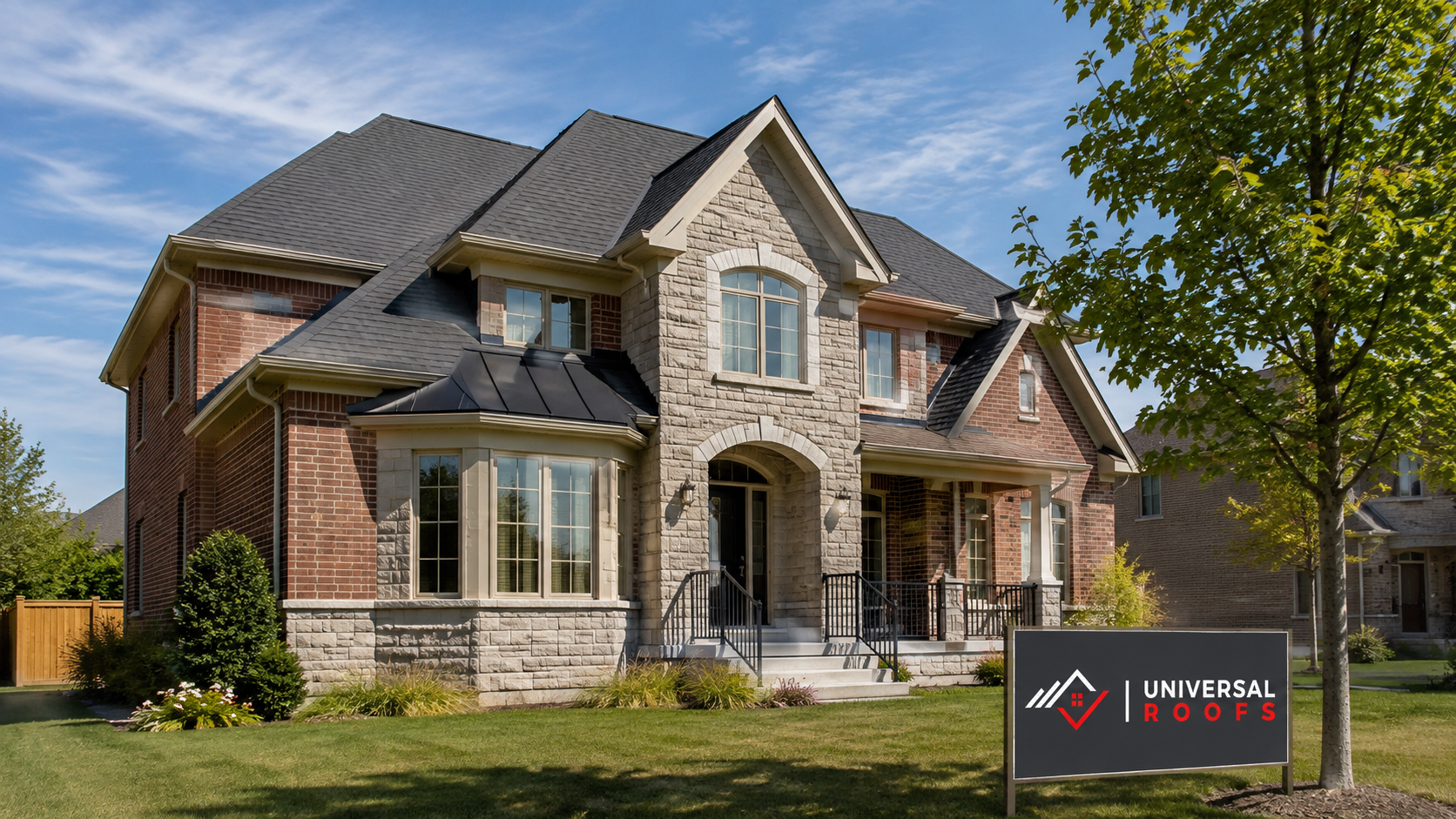
What Makes Roofing Milton Homes Different From the Rest of the GTA
Roofing Milton properties is not identical to roofing a home in downtown Toronto or an older Etobicoke neighbourhood. The differences are practical, and they show up in both the price and the workmanship.
The first factor is exposure. Milton sits at the base of the Niagara Escarpment on comparatively open ground, and the newer subdivisions on the east and north sides of town have limited mature tree cover. Roofs there take the full force of prevailing winds. Wind uplift at ridges, hips and rakes is the most common early failure point we see on those homes, which is why nailing patterns, starter strips and ridge cap fastening matter more here than they might on a sheltered urban lot.
The second factor is the age profile of the housing stock. Milton’s building history came in distinct waves, and roofs age in those same waves. Bungalows and side-splits from the 1950s through the 1970s are typically on their third or fourth roof covering. Homes built during the large subdivision expansion of the early to mid-2000s are now eighteen to twenty-two years old, which is exactly when builder-grade shingles reach the end of their service life. That is why entire streets seem to need work at the same time, and why roofing Milton crews book out weeks in advance once spring arrives.
The third factor is site access. Many newer Milton lots are narrow, with tight side yards and short driveways shared with a neighbour’s frontage. Where a crew places the disposal trailer, how tear-off debris is protected, and whether ladders and staging can be set safely all affect labour hours. A contractor who quotes without walking the property is guessing at these costs. Experienced roofing Milton contractors price access explicitly rather than burying it in a round number.
Finally, older brick homes near the town centre often carry complications a subdivision home does not: original board sheathing instead of plywood, undersized or absent attic ventilation, chimneys that need new flashing rather than reused counter flashing, and in some cases layered roof coverings that all have to come off. If you want an overview of the work we handle locally, our roofing services for Milton homeowners page outlines the scope in more detail.
Roofing Milton Costs in 2026: What Homeowners Actually Pay
Roofing Milton estimates in 2026 are driven by measurable variables, not guesswork. Understanding them lets you compare quotes on the same terms.
Roofers price by the square, which is 100 square feet of roof surface. A typical Milton detached home has between fourteen and twenty-four squares. On top of area, the main cost drivers are:
- Pitch. Anything above a 6:12 slope requires additional fall protection, staging and slower movement, adding roughly ten to twenty per cent to labour.
- Complexity. Valleys, dormers, hips, skylight curbs and multiple roof planes all add cut waste, flashing detail and time.
- Layers removed. A single layer tear-off is standard. A second layer adds disposal weight and labour.
- Deck condition. Rotted or delaminated sheathing is only visible after tear-off, so expect a per-sheet allowance in the contract.
- Material grade. The jump from basic laminate shingles to a premium designer profile or metal changes the number substantially.
The table below reflects realistic 2026 roofing Milton pricing ranges in the Halton and west GTA market, including tear-off, disposal, synthetic underlayment, ice and water protection, new flashings, ventilation and HST-exclusive labour and materials.
| Milton home type | Approximate roof area | 2026 installed cost range | Common add-ons |
|---|---|---|---|
| Postwar bungalow or side-split | 14 to 18 squares | $9,000 to $14,500 | Sheathing repair, new eave protection |
| Older 1.5-storey brick home | 15 to 20 squares | $11,500 to $17,500 | Chimney flashing, board deck replacement |
| Two-storey subdivision detached (2000s) | 18 to 24 squares | $13,500 to $20,500 | Ridge vent upgrade, skylight reflashing |
| Large detached with complex rooflines | 24 to 32 squares | $19,000 to $30,000 | Multiple valleys, steep-slope labour |
| Freehold townhome or semi | 8 to 13 squares | $6,500 to $11,000 | Party wall flashing, shared access staging |
| Larger rural or estate-lot home | 30 to 45 squares | $26,000 to $48,000 | Premium materials, dormers, long carry distances |
Two line items deserve attention when you read a roofing Milton quote. First, sheathing replacement should be listed with a unit price, commonly $85 to $130 per four by eight sheet installed in 2026, rather than left open-ended. Second, confirm whether the price includes new eavestrough, since many homeowners replace troughs at the same time and the combined cost is often quoted as one number.
If your project is a full tear-off rather than a repair, our roof replacement service page explains what a complete scope of work should include so you can hold every bid to the same standard.
Choosing Roofing Materials for Milton’s Climate
Halton Region delivers a demanding annual cycle: humid summers with UV exposure and occasional severe thunderstorms, followed by winters with repeated freeze and thaw swings around the zero mark. That freeze and thaw pattern, more than raw cold, is what damages roofs here. Water works into seams, freezes, expands, and enlarges the opening.
Architectural laminate asphalt shingles remain the default choice for roofing Milton homes, and for good reason. They balance cost, wind resistance and availability, and virtually every crew in the region installs them daily. Premium and designer asphalt profiles add thickness, longer warranty terms and better wind ratings at a moderate premium.
Standing seam metal is a genuine long-term option, particularly on larger rural properties and on homes with simple roof geometry where panel runs are uninterrupted. The upfront cost is roughly two to three times asphalt, but the service life can double, which is why it accounts for a small but growing share of roofing Milton projects. Metal also sheds snow efficiently, which helps on lower-slope sections.
Cedar remains available and looks appropriate on certain older homes, but it demands maintenance and carries a shorter practical life in our humidity than many homeowners expect. Low-slope and flat sections, common over rear additions, garages and sunrooms, need a membrane system rather than shingles. Modified bitumen or single-ply membranes are the correct answer there, and we cover those systems under flat roofing.
| Material | 2026 installed cost per sq ft | Expected service life | Best suited to |
|---|---|---|---|
| Three-tab asphalt shingle | $5.00 to $6.50 | 15 to 18 years | Budget projects, garages, outbuildings |
| Architectural laminate shingle | $6.50 to $9.00 | 25 to 30 years | Most Milton detached and semi homes |
| Premium designer shingle | $9.00 to $13.00 | 30 to 40 years | Exposed sites, higher-value homes |
| Standing seam metal | $15.00 to $24.00 | 45 to 60 years | Estate lots, simple roof geometry |
| Cedar shake | $14.00 to $22.00 | 25 to 35 years with upkeep | Heritage-style older homes |
| Modified bitumen membrane | $10.00 to $16.00 | 20 to 30 years | Flat additions, garages, sunroom roofs |
Colour choice is more than aesthetic. Darker shingles absorb more heat, which raises attic temperatures in July and August on west-facing slopes. On a poorly ventilated attic that accelerates shingle ageing from below. If you favour a dark colour, invest in the ventilation to support it.
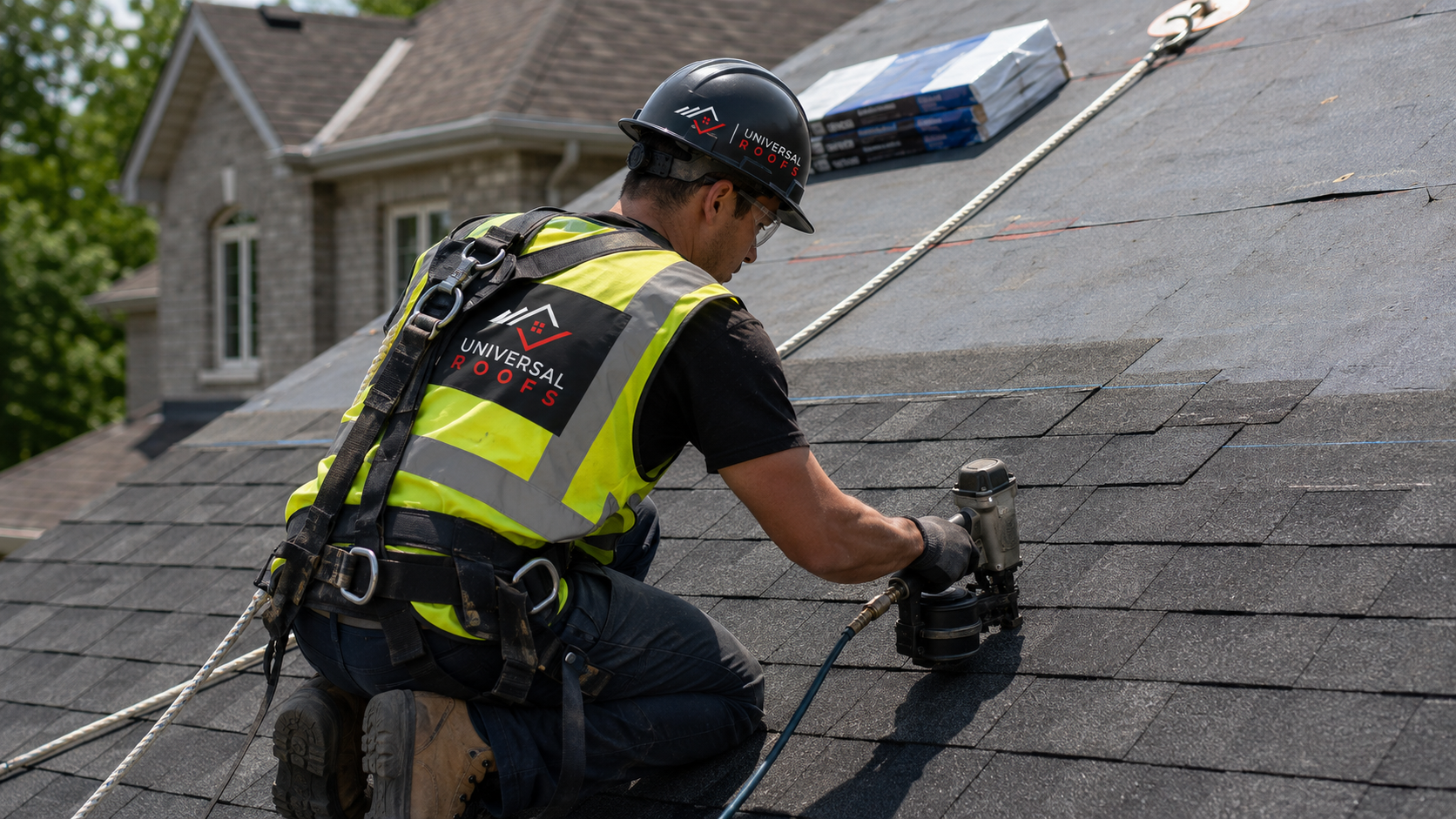
Permits, the Ontario Building Code and Milton Requirements
Before any roofing Milton project begins, it is worth knowing where permits apply. For most homeowners, replacing an existing roof covering with a similar covering does not require a building permit. Permits generally come into play when structural work is involved: repairing or altering trusses and rafters, changing the roof structure or slope, or adding a dormer. Because interpretation varies and requirements change, confirm your specific scope with the Town of Milton building department before work begins rather than relying on a contractor’s assumption.
The Ontario Building Code does set requirements that apply whether or not a permit is pulled, and these are the ones to check in a quote:
- Eave protection. A self-adhered membrane is required at eaves, extending from the roof edge to a point measured a minimum distance up the slope past the inner face of the exterior wall. On Milton homes with wide soffit overhangs this often means two courses, not one.
- Valley protection. Valleys need continuous membrane or metal valley flashing, not simply woven shingles over felt.
- Underlayment. Synthetic underlayment across the remaining deck is now standard practice and outperforms traditional felt.
- Attic ventilation. Unobstructed vent area of roughly one square foot for every 300 square feet of insulated ceiling area, balanced between intake at the soffit and exhaust near the ridge.
- Flashings. Step flashing at wall intersections and counter flashing at masonry should be new, not reused.
A quote that does not name these items is not necessarily cutting corners, but it does leave room for disagreement later. Ask for them in writing.
Why Attic Ventilation Decides How Long Your Roof Lasts
Ventilation is the single most under-discussed part of roofing Milton homes, and it is the reason two identical roofs installed on the same street can fail eight years apart.
An attic needs balanced airflow: cool air entering low at the soffits and warm, moist air leaving high at the ridge or through roof vents. When intake is blocked, which happens constantly when blown insulation drifts over the soffit without baffles, the exhaust vents simply pull conditioned air out of the house instead. In summer the attic overheats and cooks the shingles from underneath. In winter warm air escaping into the attic melts snow on the upper roof, which refreezes at the cold eave and forms an ice dam.
Ice damming is a recurring Milton problem, especially on 1970s and 1980s homes where insulation levels were raised over the years without anyone addressing intake ventilation. The visible symptom is water staining on interior ceilings near exterior walls in February and March. The cause is almost always inside the attic, not a defective shingle. Addressing insulation and airflow together at the time of a roof replacement is far cheaper than revisiting it later, which is why we look at attic insulation and ventilation as part of the same conversation.
Two practical checks: look up from the ground at your soffit and count how many vent panels are actually perforated, and in the attic look for daylight at the eaves behind the insulation. If neither passes, no ridge vent will save the roof.
What a Milton Roof Replacement Week Actually Looks Like
Most roofing Milton replacements on single-family homes are completed in one to two working days on site, but the full project runs longer once scheduling, material delivery and inspection are counted. Knowing the sequence helps you plan around it.
| Stage | Typical duration | What happens | Homeowner preparation |
|---|---|---|---|
| Inspection and measurement | 45 to 90 minutes | Roof and attic assessed, area measured, scope defined | Provide attic access, note past leaks |
| Written quote and material selection | 1 to 3 days | Line-item pricing issued, colour and profile confirmed | Compare bids on identical scope |
| Scheduling and delivery | 1 to 4 weeks in season | Crew booked, materials delivered to driveway | Clear driveway and side yard access |
| Tear-off and deck inspection | Half a day to 1 day | Old covering removed, sheathing checked and repaired | Move vehicles, protect attic-stored items |
| Installation | 1 to 2 days | Membrane, underlayment, flashings, shingles, vents | Expect noise and vibration indoors |
| Cleanup and final walkthrough | 2 to 4 hours | Magnet sweep, debris removal, workmanship review | Walk the property, confirm warranty paperwork |
Weather moves this schedule. Shingles seal properly through thermal bonding, so an installation on a cool, overcast day may take longer to fully seal. Reputable roofing Milton contractors will postpone rather than install into rain, and you want a company willing to make that call.
Repair or Replace: Reading the Warning Signs Correctly
Not every roofing Milton problem calls for a full tear-off. The right answer depends on the age of the covering and whether the failure is isolated or systemic.
Repair is usually appropriate when the roof is under fifteen years old, the shingles are otherwise flat and intact, and the issue is localised: a lifted ridge cap after a wind event, a failed pipe boot, deteriorated caulking at a chimney, or damaged step flashing at a wall. These are contained repairs and a good crew handles them in a few hours. Our roof repair work covers exactly this category.
Replacement becomes the better economic choice when you see several of the following together:
- Granule loss heavy enough to expose the black asphalt mat across multiple slopes
- Curling, cupping or clawing shingle edges rather than a few damaged tabs
- Repeated leaks in different locations over consecutive seasons
- Soft or spongy areas underfoot, indicating deck deterioration
- Shingle age of twenty years or more on original builder material
- Visible sagging along a ridge or between rafters
A useful rule: if the cost of the repairs you are contemplating exceeds roughly twenty-five per cent of a replacement, and the roof is past two thirds of its expected life, replacement is the better value. Patching an exhausted roof rarely buys more than a season or two.
How to Vet a Roofing Contractor in Milton
The roofing trade has a low barrier to entry, and Milton sees seasonal operators who follow storm activity through the GTA. Protect yourself with documentation rather than impressions. Established roofing Milton companies expect these questions and answer them without hesitation.
Ask for a current WSIB clearance certificate and a certificate of general liability insurance with a minimum of two million dollars in coverage. Verify the company name on both documents matches the name on your contract. Ask how long the company has worked in Halton and request local references you can actually contact. Reading a company’s customer reviews is a reasonable starting point, but references from comparable homes tell you more.
On the quote itself, look for a defined scope: number of squares, tear-off layers included, underlayment and membrane products named by manufacturer, ventilation type and count, flashing details, sheathing unit price, disposal, cleanup, HST shown separately, and both manufacturer and workmanship warranty terms with their durations. Be cautious with deposits above roughly fifteen per cent, with quotes that expire in forty-eight hours, and with any contractor asking for cash to avoid tax, since that also erases your warranty recourse.
Finally, ask who is actually on your roof. Some companies subcontract every job. That is not automatically bad, but you should know whether the crew answers to the company whose warranty you are holding.
Timing Your Roofing Milton Project Through the Year
Roofing Milton projects can proceed in almost any season, but the trade-offs differ. Late spring through early autumn is peak season: shingles seal quickly, crews work efficiently, and daylight is long. The cost is availability, since lead times stretch to several weeks at the height of summer.
Late autumn work is entirely feasible and often better priced, provided installation happens before sustained cold arrives. Shingles installed in cool weather need warm days afterward to seal, and hand-sealing may be specified. Winter replacement is reserved for genuine emergencies, where a temporary weather-tight repair is typically the better first step until conditions allow proper work.
If your roof is approaching twenty years, book the inspection in early spring rather than waiting for a leak. The homeowners who get the best pricing and the best scheduling are the ones who plan a replacement a season ahead instead of reacting to a storm. This is also the right moment to address related items in one mobilisation: skylight replacement, eavestrough, and attic work all cost less when combined with a roof project than when handled separately.
How much does a new roof cost in Milton in 2026?
Do I need a building permit to replace my roof in Milton?
How long does a roof replacement take?
What is the best roofing material for a Milton home?
Why do Milton homes get ice dams in winter?
Can I install new shingles over the existing layer?
Book Your Roofing Milton Inspection and Estimate Today
Whether your roof needs a targeted repair or a full replacement this season, the right starting point is an honest inspection and a written, line-item quote you can compare with confidence. Universal Roofs is a Toronto-area roofing company serving homeowners throughout Milton and Halton Region, and every roofing Milton estimate we issue spells out materials, ventilation, flashing details and warranty terms so there are no surprises after tear-off.
Call us today at (416) 732-2421 or request a free consultation. We will assess your roof and attic, explain what we find in plain terms, and give you a realistic timeline and price before you commit to anything.
Universal Roofs proudly serves Milton, Halton Region and communities across the Greater Toronto Area with residential and commercial roofing, repairs, flat roofing and attic solutions.