
When homeowners across the Greater Toronto Area ask us why their eavestroughs keep pulling loose, the answer almost always comes back to fasteners. Gutter screws are the single most important upgrade you can make to a residential gutter system, and yet they are the detail most builders skip. If your eavestroughs sag between the brackets, spill over during a summer downpour, or rattle in the wind, the fastening method holding them to your fascia is the first thing our crews at Universal Roofs inspect. In this guide we break down gutter screws versus the older spikes and hidden hangers, explain how each system behaves on Toronto homes, and show you how to fasten your eavestroughs so they stay tight for decades rather than seasons.
Toronto’s building stock is a mix of century-old brick semis, post-war bungalows, and newer suburban builds in Vaughan, Markham, and Mississauga. Each of those fascia types reacts differently to gutter fasteners, and choosing the wrong one is why so many homeowners find themselves re-nailing the same section every couple of years. Getting the fastening right the first time saves money, protects your soffit and fascia, and keeps water flowing to the downspouts where it belongs.
Why Gutter Screws Beat Spikes on Toronto Homes
For decades, eavestroughs were hung with long spikes driven through a ferrule sleeve into the fascia board. The spike-and-ferrule method is fast to install, which is exactly why volume builders loved it, but it fails predictably. A spike is a smooth-shank nail. It has no threads to grip the wood, so every time the gutter fills with water, heats in the summer sun, and cools overnight, the fascia expands and contracts and the spike backs out a fraction of a millimetre. Over a few seasons those fractions add up, the spike heads pop proud of the gutter face, and the whole run begins to droop.
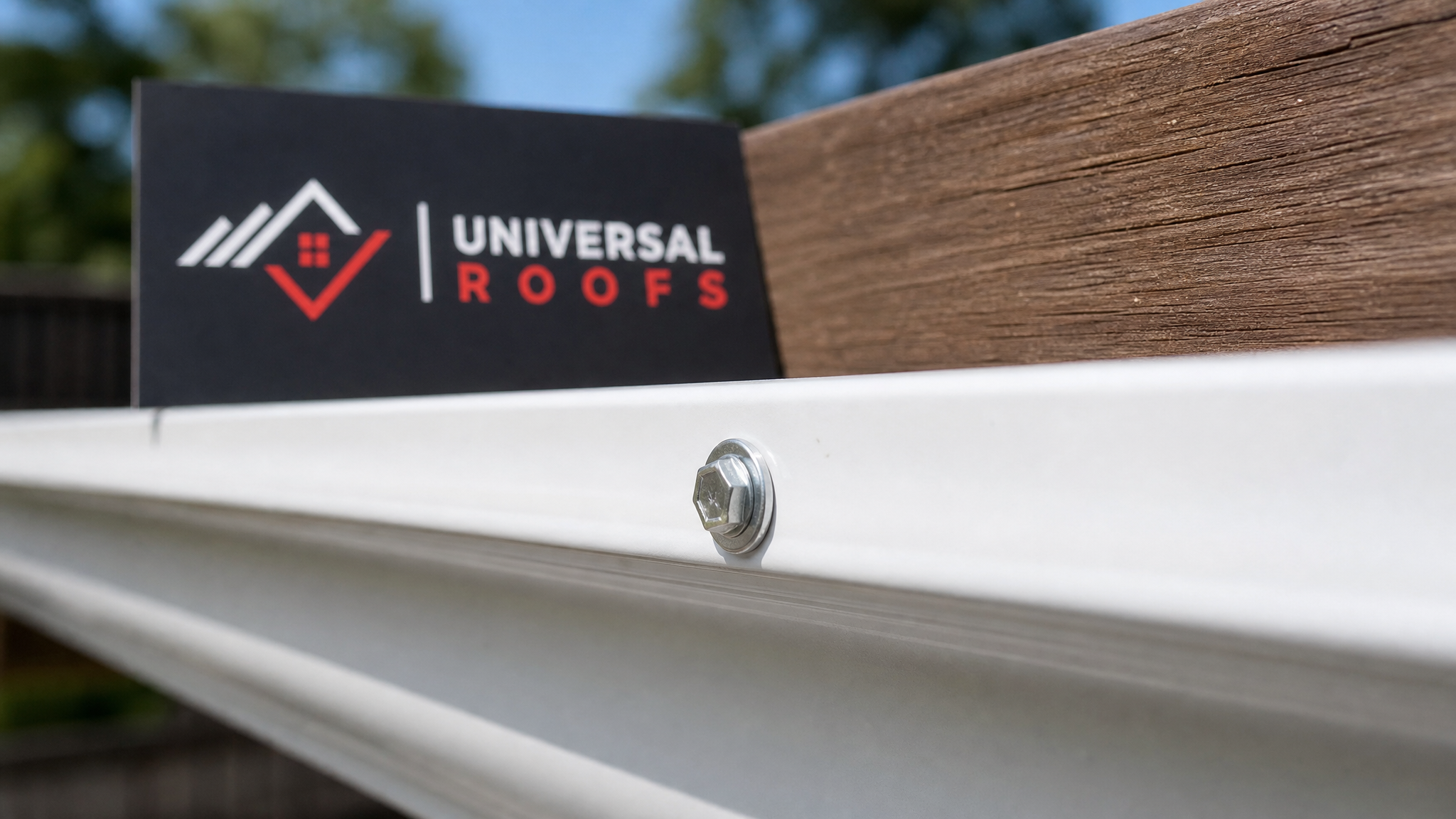
Gutter screws solve this at the physical level. A hex-head gutter screw has aggressive threads that bite into the fascia and stay locked. Because the threads mechanically engage the wood fibres, the fastener cannot vibrate or thermally cycle its way loose the way a spike does. Homeowners who switch to gutter screws report that the constant re-nailing simply stops. When our crews at Universal Roofs replace old spikes, we drive gutter screws through the existing ferrule holes wherever possible, giving the gutter a fresh, tight grip without leaving a row of empty holes across the fascia.
The difference is not just anecdotal. A gutter screw provides several times the withdrawal resistance of a smooth spike of the same diameter. That matters most during the heavy summer rain events the GTA sees in July and August, when a fully loaded eavestrough can hold dozens of kilograms of water. The fasteners are the only thing standing between that load and a gutter on the ground.
| Fastener Type | Grip Method | Typical Lifespan | Best For |
|---|---|---|---|
| Spike & ferrule | Smooth shank friction | 3-7 years | Budget or temporary installs |
| Gutter screws (hex-head) | Threaded mechanical grip | 20+ years | Permanent residential systems |
| Hidden hanger with screw | Bracket clip plus screw | 20+ years | Concealed, high-end look |
| Standard wood nail | Smooth shank friction | 2-4 years | Not recommended for gutters |
Gutter Screws vs Hidden Hangers: Two Modern Systems
Once you decide to move away from spikes, you have two solid modern paths, and both rely on screws. The first is the direct gutter screw and ferrule: a hex-head screw runs through a spacer ferrule that keeps the front and back walls of the eavestrough at the correct distance. The second is the hidden hanger, a bracket that clips over the front lip of the gutter and is anchored to the fascia with a screw driven through its back plate. Both are excellent, and both dramatically outperform spikes.
Hidden hangers give a cleaner exterior look because you see no fastener heads across the front face of the gutter. They also spread the load across a wider bracket, which is why they are often specified on longer runs and on homes where curb appeal matters. Direct gutter screws are faster to service and easier to inspect because you can see and tighten every fastener from a ladder. For most GTA homes either system will last the life of the gutter, and our team recommends the one that suits your fascia condition, roofline, and budget. If you are already planning a roof replacement, that is the ideal moment to upgrade the fastening system while the crew and equipment are already on site.
Spacing is where installers earn their keep. Hidden hangers and gutter screws should sit no more than 600 millimetres (24 inches) apart on a standard five-inch K-style eavestrough. On homes that see heavy tree debris, tighter spacing at around 450 millimetres adds insurance against overloading. Whatever the system, consistent spacing is what keeps a run dead straight instead of scalloped.
Choosing the Right Gutter Screws for Your Fascia
Not every gutter screw is created equal, and the right choice depends heavily on what your fascia is made of. Older Toronto homes often have solid wood fascia, sometimes original spruce or cedar that has softened with age. Newer builds may have engineered fascia board or an aluminium-clad wood substrate. The screw length, thread pattern, and coating all need to match the material so the fastener grips without splitting the board.
For solid wood fascia in good condition, a standard 63 to 76 millimetre (2.5 to 3 inch) hex-head gutter screw with a coarse thread is ideal. When the outer layer of fascia has softened, we step up to a longer screw that can reach past the punky surface wood into sound material or into the rafter tail behind it. Coating matters just as much as length: a gutter screw exposed to constant moisture must be corrosion resistant, so we specify stainless steel or a heavy zinc or ceramic coating rather than bare steel that will streak rust down your fascia within a year.
The diameter of the screw shank should match the ferrule so the fastener seats cleanly without deforming the gutter. Undersized gutter screws rattle in the ferrule and let the eavestrough shift; oversized ones can crack an aluminium ferrule. This is the kind of detail a homeowner rarely thinks about but a professional crew gets right on every fastener. If you would rather leave the sizing to specialists, our team is happy to request a free inspection and match the correct gutter screws to your specific fascia.
| Fascia Condition | Recommended Gutter Screw | Length | Coating |
|---|---|---|---|
| Solid wood, sound | Coarse-thread hex-head | 63-76 mm | Zinc or stainless |
| Softened surface wood | Long coarse-thread, reaching rafter | 89-100 mm | Stainless |
| Engineered/composite | Fine-thread self-drilling | 63-76 mm | Ceramic-coated |
| Aluminium-clad substrate | Self-tapping hex-head | 76 mm | Stainless |
Common Gutter Fastening Mistakes We See Across the GTA
Because we service eavestroughs across Toronto, Mississauga, Brampton, and the surrounding suburbs, our crews see the same fastening errors over and over. The most frequent is simple over-reliance on spikes long after they have stopped holding. Homeowners keep tapping the spikes back in, the fascia hole enlarges each time, and eventually there is nothing left for the spike to grip. By the time they call us, the fascia board itself often needs repair before any gutter screws can be installed.
The second common mistake is inconsistent spacing. When gutter screws are placed too far apart, the eavestrough sags between them and forms low spots where water and debris collect. Those pools of standing water are where mosquitoes breed in a Toronto summer and where corrosion starts. The third error is driving gutter screws at an angle, which pulls the gutter out of alignment and prevents proper drainage slope toward the downspout. A well-installed gutter run has a slight, deliberate fall of roughly 5 millimetres for every 3 metres of length, and the fasteners must respect that slope.
We also frequently find gutter screws that have simply been driven into rotten fascia. No fastener holds in wet, decayed wood. When we find this during an inspection, the underlying roof repair and fascia replacement has to come first, because a gutter is only as strong as the board it hangs from. Poor gutter fastening and hidden fascia rot often travel together, and one reveals the other. If you have never had your fascia checked, our Universal Roofs team can assess both the boards and the fasteners in a single visit.
How Gutter Screws Protect Your Roof and Attic
It is easy to think of eavestroughs as separate from the roof, but they are part of the same water-management system. When gutter screws fail and a section of eavestrough droops, water spills over the back edge and runs down behind the gutter, soaking the fascia and the roof edge. Over time that moisture wicks into the roof deck and can reach the attic, where it feeds mould and degrades insulation. Properly fastened gutters keep that water in the trough and channel it away from the structure.
This is why we treat gutter fastening as a roofing detail rather than an afterthought. A secure eavestrough protects the roof edge, the soffit, and the ventilation path into the attic. When water is allowed to back up because a sagging gutter cannot drain, it can even reach the lowest courses of shingles and work its way under them. Homeowners who invest in quality gutter screws are, without realising it, protecting their entire roof assembly.
On homes with skylights or flat roof sections, drainage is even more critical, because those roof types depend on clean, unobstructed water paths. If your home combines a sloped roof with a flat roofing section, we make sure the eavestroughs on the sloped portions are fastened tightly enough to handle the concentrated runoff. Good gutter screws are quiet, invisible insurance for the most expensive part of your house.
DIY Gutter Screws or Hire a Professional?
Installing gutter screws looks simple from the ground, and a handy homeowner can absolutely replace a few loose spikes on a single-storey bungalow. If you are comfortable on a ladder, the basic process is to remove the old spike, insert a ferrule if one is missing, and drive a hex-head gutter screw through the front face, through the ferrule, and into the fascia until the head just seats against the gutter without denting it. Work from a stable ladder, keep three points of contact, and never overreach.
That said, most GTA homes have two or three storeys, complex rooflines, and long runs that make ladder work genuinely hazardous. The height at the eaves of a typical Toronto two-storey puts you well above safe casual-ladder range, and that is where professional crews with proper fall protection earn their keep. Beyond safety, professionals bring the diagnostic eye to spot the fascia rot, slope errors, and spacing problems a homeowner might miss. There is little point in installing new gutter screws into a board that is about to fail.
Our approach is to assess the whole system, correct the slope, replace any compromised fascia, and fasten the eavestroughs with the correct gutter screws at the correct spacing so the repair lasts. Customers can read what their neighbours say about that work on our reviews page, and browse common questions on our FAQ. Whether you tackle a small section yourself or bring in a crew, the principle is the same: threaded gutter screws, correct length, correct coating, correct spacing.
| Task | DIY Suitable? | Professional Recommended? | Why |
|---|---|---|---|
| Replace 2-3 spikes, single storey | Yes | Optional | Low height, simple work |
| Full run re-fastening, two storey | No | Yes | Height and fall risk |
| Fascia rot found under gutter | No | Yes | Structural repair needed |
| Correcting drainage slope | No | Yes | Requires level and experience |
| Switching spikes to hidden hangers | Sometimes | Yes | Bracket alignment matters |
Maintaining Gutter Screws Season to Season
The beauty of gutter screws is how little they ask of you once installed. Unlike spikes, they will not creep out and need annual tapping. Still, a quick seasonal check keeps the whole system healthy. Twice a year, walk the perimeter of your home and look up at the eavestrough line. A run held by good gutter screws should be perfectly straight. Any dip or scallop signals a fastener that has lost grip or a section overloaded with debris, and catching it early prevents a bigger repair.
Keep the troughs clear of leaves and grit so the gutter screws are not fighting extra weight. In the GTA, mature maples and oaks shed steadily through the warmer months, and even a summer storm can pack a downspout with debris. Clean gutters put far less strain on the fasteners. While you are up there, glance at the screw heads: a properly seated gutter screw sits flush and shows no rust streaking. Any rust means the coating has failed and that fastener should be swapped for a stainless replacement before it stains the fascia.
If you are unsure what to look for, our team covers the whole GTA and can add a gutter and fastener check to any roofing visit. We service homes across our Toronto service area and the surrounding suburbs, and you can learn more about our crews and approach on our site. A few minutes of seasonal attention keeps your gutter screws doing their quiet job for twenty years or more.
Are gutter screws better than spikes for Toronto eavestroughs?
What length of gutter screws do I need?
How far apart should gutter screws be spaced?
Can I install gutter screws myself?
Will gutter screws stop my eavestrough from leaking?
What coating should gutter screws have in the GTA climate?
Fasten Your Eavestroughs Right With the Correct Gutter Screws
Choosing the right gutter screws is one of the highest-value, lowest-cost upgrades you can make to protect your home from water damage. Whether you are dealing with sagging spikes, planning a fascia repair, or simply want your eavestroughs fastened to last, the team at Universal Roofs matches the correct gutter screws, length, and spacing to your specific fascia and roofline across the GTA.
Call us today at (416) 732-2421 or request a free inspection to get started.
Universal Roofs proudly serves Toronto, Mississauga, Brampton, Vaughan, Markham, Oakville and the GTA since 2005.