
Copper gutters are the one eavestrough choice people buy partly for how they will look in ten years. Bright as a new penny on installation day, they darken to a warm bronze, then a deep brown, and on some homes eventually take on the soft green of old church roofs. They are also far more expensive than aluminum, need a different kind of installer, and can cause real damage if they are mixed carelessly with other metals.
This guide is for homeowners weighing copper for a heritage restoration, a high-end renovation or a new build with a traditional look. We cover half-round versus K-style profiles, how soldered seams differ from the sealed joints you know, what the patina actually does over time, the galvanic problems with aluminum and steel, and where the money makes sense.
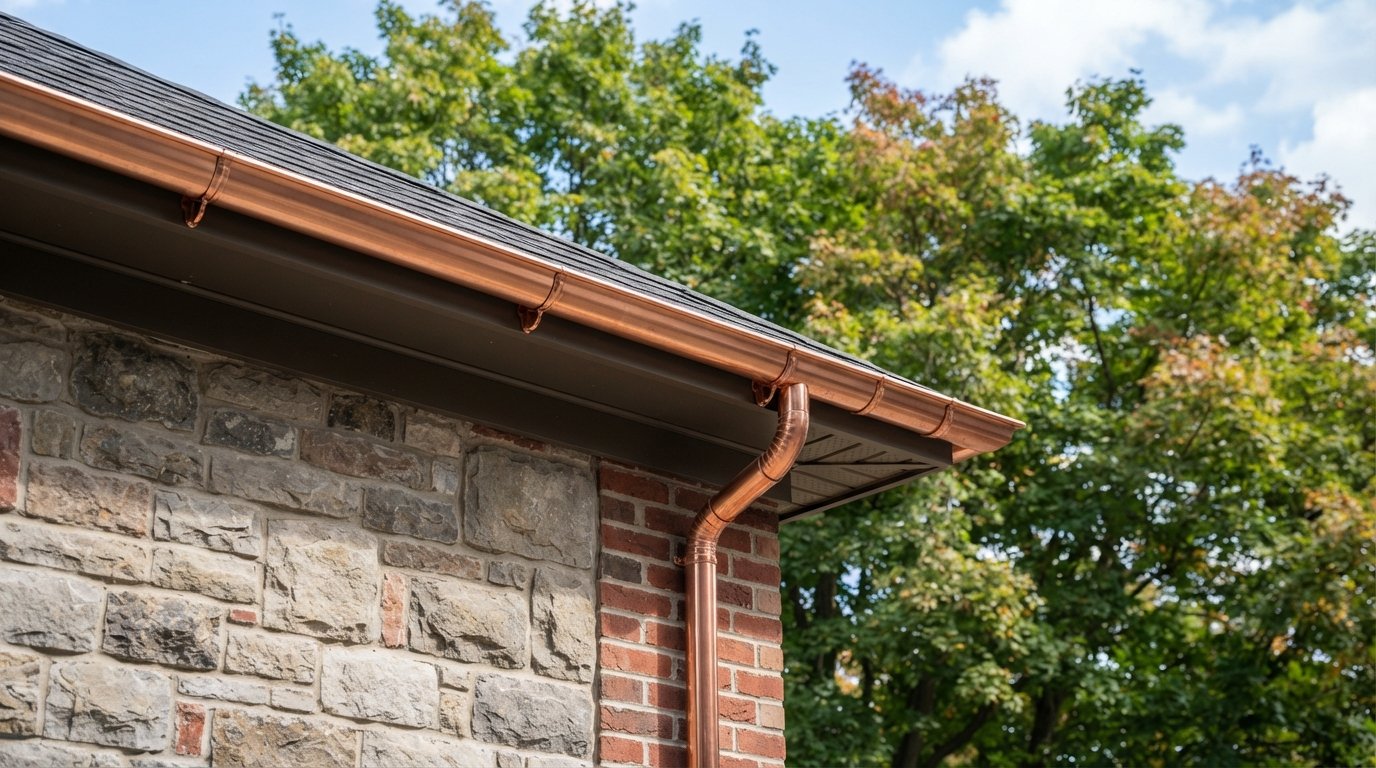
What Copper Gutters Are, And What They Are Not
Copper gutters are made from sheet copper, usually specified by weight per square foot rather than by thickness. Residential work typically uses 16-ounce or 20-ounce copper, with the heavier sheet chosen for larger profiles, long runs and places where snow and ice load the trough. The heavier the sheet, the stiffer and more dent-resistant the gutter.
Unlike seamless aluminum, copper troughs are generally supplied in fixed lengths and joined on site. The joints are not caulked laps; they are lapped, riveted and soldered, so the seam becomes one piece of metal. A properly soldered joint is one of the most durable connections in roofing, which is why copper systems on old institutional buildings can outlast several roofs.
What copper is not: it is not a fix for a poorly designed drainage layout. Undersized troughs, too few downspouts or rotted fascia will cause the same problems in copper as in aluminum, only at a higher price. It is also not a DIY material. Soldering copper at height, forming hangers and detailing expansion joints are skilled tasks.
Half-Round vs K-Style Copper Gutters
Copper comes in both main gutter profiles, and the choice is mostly about the architecture of the house.
| Feature | Half-round copper | K-style copper |
|---|---|---|
| Look | Traditional, rounded, suits heritage and period homes | Crisper, moulding-like face, suits more modern trim |
| Typical downspout | Round, smooth or corrugated | Rectangular or round |
| Hanging method | Exposed brackets or rods, often visible as a design feature | Hidden hangers similar to aluminum systems |
| Capacity at same width | Lower, since the rounded bottom holds less water | Higher per nominal width |
| Self-cleaning | Smooth curve flushes debris well | Flat bottom can hold grit and leaves |
| Fit to fascia | Can hang off fascia, rafter tails or roof deck | Mounts flat against fascia |
Because half-round carries less water than a K-style of the same nominal width, installers often step up a size when switching from K-style to half-round on the same roof. A house that had 5-inch K-style aluminum might get 6-inch half-round copper to keep the same capacity. That sizing conversation is worth having before you fall in love with a particular look.
Half-round brackets are part of the appeal. Traditional copper hangers can be fastened to the face of the fascia or to the roof deck under the shingles, where the shank is hidden and only the curved strap shows. The second method is best planned alongside roofing work, which is one reason many homeowners install copper as part of a full roof replacement rather than as a stand-alone job.
Soldered Seams And How Copper Is Installed
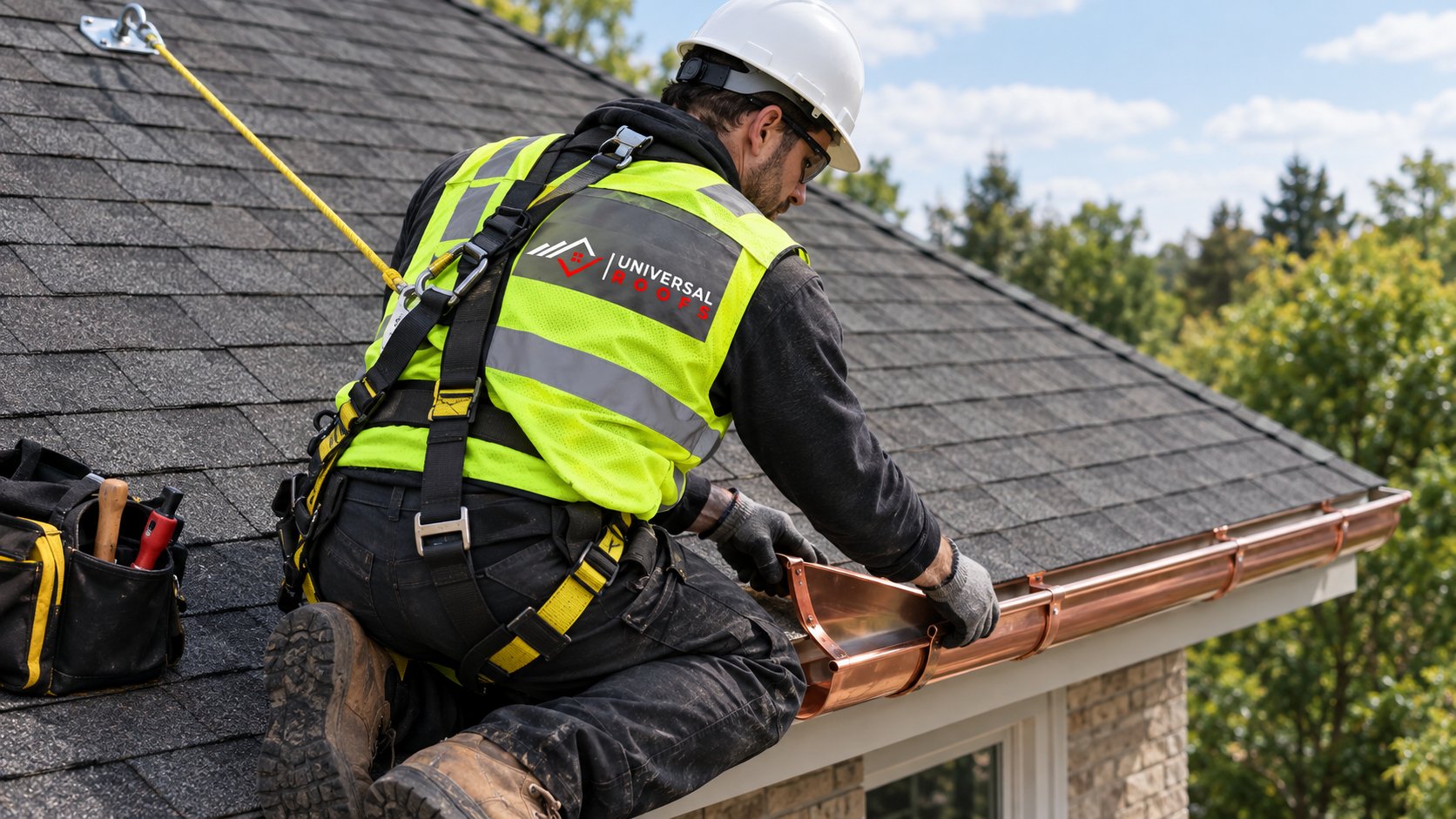
A copper installation is slower and more methodical than a seamless aluminum job. The sequence typically looks like this:
- Layout and slope. Each run is measured and snapped with a chalk line to give a steady fall toward the outlets. Long runs are split, with expansion joints planned in.
- Hangers first. Copper or compatible hangers are installed along the line at close spacing, since copper is heavier than aluminum and holds its shape only if well supported.
- Fitting lengths. Sections are lapped in the direction of flow, so the upstream piece sits inside the downstream piece.
- Riveting. Copper rivets pin each lap mechanically before any solder goes on.
- Cleaning and fluxing. The joint is cleaned to bright metal and fluxed so the solder can flow into the lap.
- Soldering. The installer heats the joint and runs solder into the seam until it fills the lap cleanly. Corners, end caps and outlets are soldered the same way.
- Downspouts and straps. Round or rectangular copper downspouts are fixed with copper straps and discharge onto a splash block or into an extension.
Two details separate a lasting copper job from one that gives trouble:
Expansion joints. Copper moves with temperature. On a long run, the metal needs a place to move without tearing soldered seams or pulling hangers. Installers typically break long runs with an expansion joint or at a high point, and they avoid soldering a very long continuous run tight between two corners.
Clean solder work. Excess flux left on the metal can discolour it, and lumpy, cold solder joints can crack. Neat, smooth seams are a good sign of an experienced copper installer.
The Patina Timeline: What Copper Looks Like Over Time
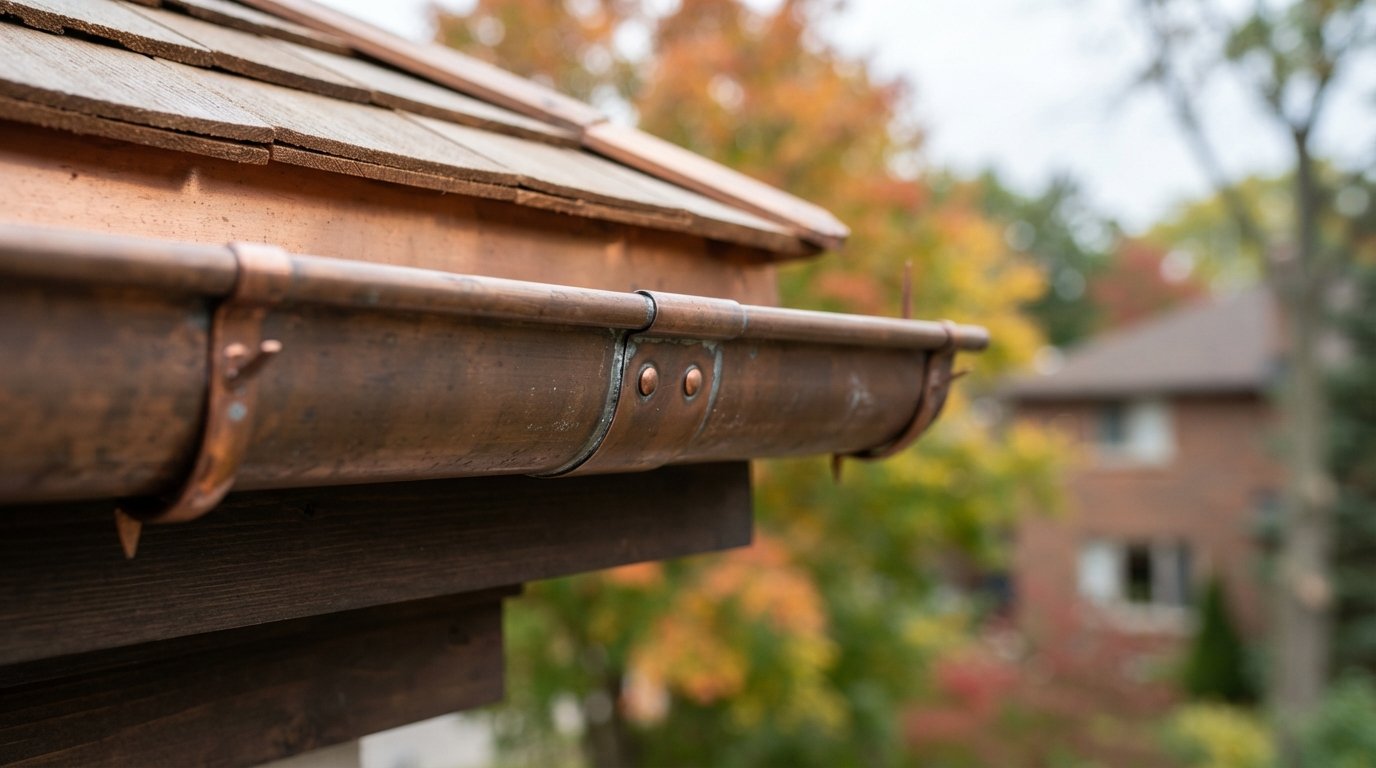
The colour change is gradual, and it varies with exposure, rain, sun, nearby trees and air quality. No installer can promise exactly when a given stage will arrive. As a general guide, homeowners usually see something like this:
| Stage | Rough timing (varies widely) | What you see |
|---|---|---|
| New | Installation day | Bright, shiny salmon-pink metal |
| Early oxidation | First weeks to months | Dulling to an uneven orange and tan, sometimes blotchy |
| Brown | Within the first year or two | Even, warm bronze to chocolate brown |
| Dark brown | Several years | Deep brown, sometimes almost black on sheltered faces |
| Green patina | Often many years, and on some homes rarely | Blue-green verdigris, first on exposed, rain-washed surfaces |
A few practical points follow from that timeline:
- The blotchy phase is normal. In the first months, fingerprints, rain patterns and flux residue show up as uneven tones. It evens out.
- Sheltered sections change more slowly. A gutter under a deep overhang or on a north wall may stay brown much longer than one in full weather.
- You can hold a colour, with effort. Clear coatings can slow the change for a period, but they need renewal. Chemical pre-patina treatments can speed the green, with mixed results. Most owners let copper age naturally.
- Runoff can stain. Water leaving copper carries dissolved copper that can leave green or dark streaks on light stone, stucco, concrete walkways and some siding. Plan downspout discharge so runoff lands on gravel, a splash block or a drain rather than across a pale surface.
Galvanic Reactions: The Mistake That Ruins Other Metals
This is the most important technical point in any copper conversation. When two different metals touch in the presence of water, the less noble metal corrodes faster. Copper sits high on that scale; aluminum and galvanized steel sit well below it. The result:
- Aluminum fastened to copper, or aluminum flashings sitting under copper runoff, can pit and corrode.
- Galvanized steel in contact with copper, or receiving its runoff, loses its zinc coating faster and rusts.
- Steel screws and nails in copper gutters corrode and can leave rust stains and loose hangers.
Runoff matters as much as contact. Water that flows over copper and then onto an aluminum drip edge, a galvanized valley or an aluminum lower gutter carries copper ions that accelerate corrosion on the lesser metal. That is why a proper copper installation looks at the whole water path:
- Use copper or compatible fasteners, rivets and hangers throughout.
- Check the drip edge and roof edge flashing above the gutter. Because the drip edge often touches or laps into the gutter, many installers use copper drip edge with copper gutters rather than leaving aluminum in direct contact.
- Do not let a copper upper gutter or downspout drain onto an aluminum lower gutter. Either do both in copper or reroute the upper downspout.
- Where dissimilar metals must meet, installers use separation materials to break contact, but avoiding the situation is better.
If you are adding copper to only part of a house, such as a front porch or a bay window roof, map where that water ends up before committing.
Where Copper Gutters Make Sense
We see copper chosen for good reasons in a fairly clear set of situations:
- Heritage and period homes, where half-round copper matches the original character and an aluminum K-style would look out of place. If a property is designated or sits in a heritage district, check with the municipality before changing exterior elements.
- High-end new builds and renovations with stone, brick and cedar, where copper is part of the design and budget.
- Copper roofing accents, such as bay window roofs, turrets or dormers already clad in copper, where copper gutters keep the metals compatible.
- Long-term owners who plan to stay for decades and value a system that can outlast aluminum when well maintained.
Copper makes less sense where the budget is tight, where heavy tree cover means constant cleaning of a delicate soldered system, or where the rest of the roof edge is aluminum and would be exposed to copper runoff. Our crews working across the GTA, including roofing, eavestroughs and attic work across Halton Region, will usually talk through these trade-offs before quoting copper.
Cost Relative To Aluminum
Copper is a premium material and its price follows the commodity market, so quotes can shift from season to season. The metal itself costs several times as much as aluminum coil, and installation is slower and more skilled. As broad estimates that vary by house, access, copper weight, profile and market price:
| Item | Seamless aluminum (estimate) | Copper (estimate) |
|---|---|---|
| Gutter, installed, per linear foot | Often roughly $10 to $20 | Commonly roughly $30 to $60 or more |
| Downspouts | A modest share of the total | A significant share, since each is formed and soldered |
| Corners and outlets | Pre-formed, quick to fit | Each soldered by hand, adding labour |
| Hangers | Hidden aluminum hangers | Copper hangers, often visible and closer spaced |
| Main price drivers | Storeys, access, number of corners | Copper weight, profile, market price, solder work |
Those figures are estimates only and should be treated as a starting point for budgeting, not a quote. A firm number needs a site visit, a measured layout and current copper pricing.
Caring For Copper Over The Years
Copper is low maintenance in the sense that it does not need painting, but it is not no maintenance. Autumn is the time to:
- Clear leaves and seed pods before they compost in the trough. Wet debris sitting against copper keeps it damp and can mark the patina unevenly.
- Look at the soldered seams from the ground with the light behind them. A dark line or drip at a seam in rain is worth attention before freeze-up.
- Check hangers for any that have loosened, especially under valleys where snow and ice will sit later in the season.
- Confirm downspout discharge is landing somewhere that will not stain a walkway or send water back to the foundation.
Avoid metal scoops and abrasive pads, which scratch the metal and patina, and leave ladder work to the crew. Installers use ladder stand-offs so the ladder bears on the wall or roof and the soft copper half-round is not dented.
Questions To Ask A Copper Installer
Copper work is specialized, and not every eavestrough crew does it regularly. Before you sign, it is worth asking:
- What weight of copper are you quoting, 16-ounce or 20-ounce, and why for my runs?
- Will seams be riveted and soldered, or only sealed? Sealant-only copper joints are a shortcut.
- Where will the expansion joints go on the longer runs?
- What hangers and fasteners will you use, and are they all copper or copper-compatible?
- How are the drip edge and existing flashings handled so that copper runoff does not land on aluminum or galvanized metal?
- Where will each downspout discharge, and how will you keep runoff off light stone or concrete?
- Can I see photos of your finished solder work on corners and outlets?
Clear, specific answers to those questions tell you more about the quality of the finished system than the price per foot does. An installer who hesitates on expansion or galvanic separation is probably not the right person to trust with an expensive metal.
Frequently Asked Questions
How long do copper gutters last?
When will my copper turn green?
Can copper gutters be connected to aluminum downspouts?
Will copper stain my brick or stone?
Is half-round or K-style better for a heritage home?
Should copper go in with a new roof?
Thinking About Copper Gutters?
Copper gutters reward careful planning: the right profile and size, soldered seams, room for expansion and a water path free of incompatible metals. Universal Roofs can assess your roof edge, fascia and drainage layout and give you an honest comparison between copper and aluminum for your home.
Call us today at (416) 732-2421 or request a free estimate.
Serving homeowners in Halton Region and across the wider GTA.