
A sagging ridge line, a bouncy attic floor, or a hairline crack creeping across a bedroom ceiling can look like a cosmetic nuisance. In reality, these are often the earliest visible signs of a stressed roof truss system, and why timely roof truss repair matters comes down to one simple fact: trusses are engineered as a single interdependent system, and a small problem in one member rarely stays small for long.
At Universal Roofs, we have inspected thousands of GTA attics since 2005, from century homes in the east end to new-build subdivisions in Vaughan and Milton. The pattern is consistent: homeowners who address truss damage within weeks spend a fraction of what homeowners who wait a season or two end up paying. This guide explains how roof trusses work, what causes them to fail, how to spot the warning signs, and why acting quickly protects both your wallet and your family’s safety.
Toronto’s climate is particularly unkind to a compromised truss system. Our freeze-thaw cycles, heavy spring rain, and the occasional summer microburst all place repeated, changing loads on a roof structure. A truss that is 90 percent sound can carry those loads indefinitely. A truss that has been quietly weakened by moisture, an improper renovation cut, or age can fail under exactly the kind of load it was designed to handle when new.
What a Roof Truss Actually Does
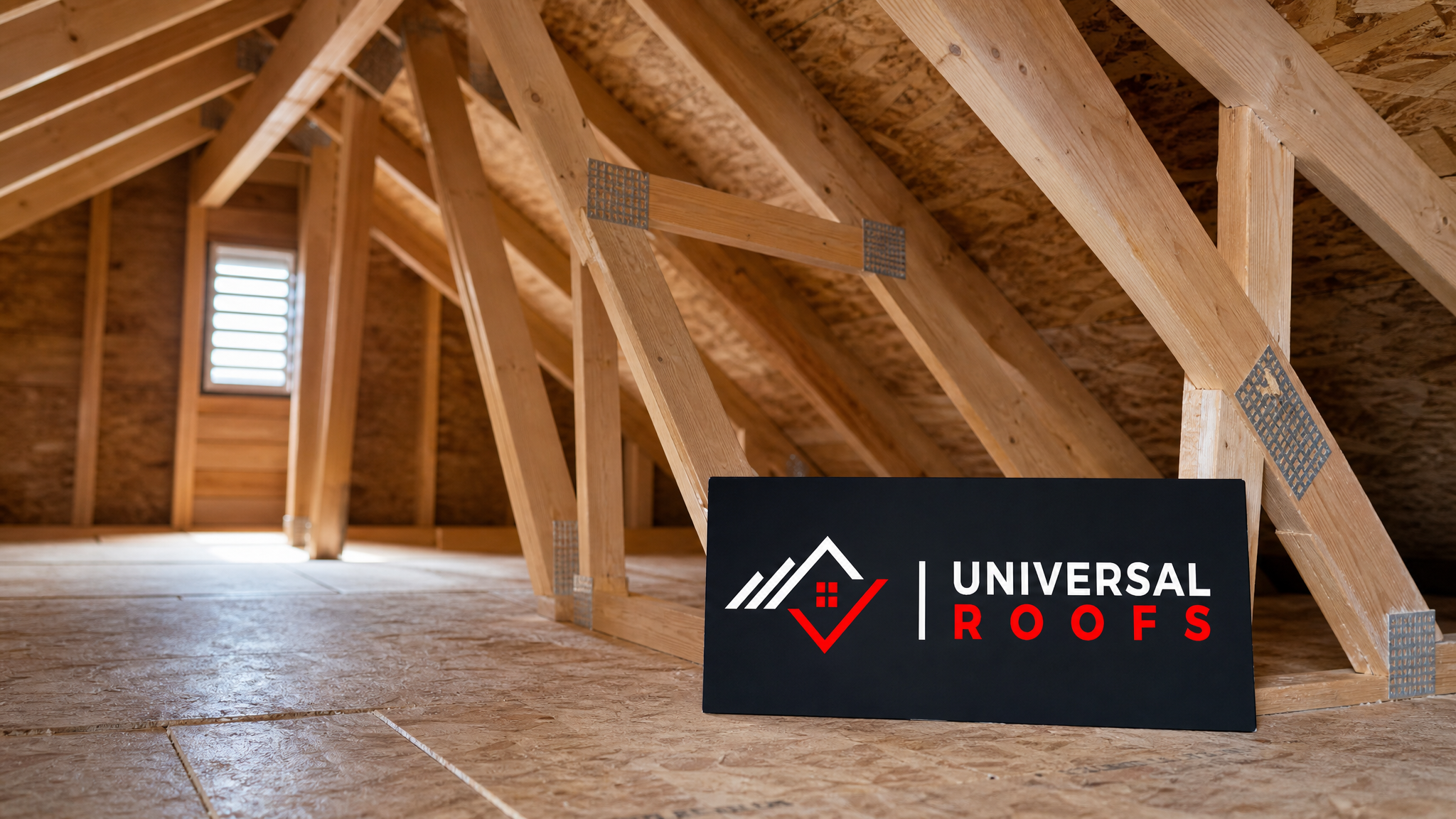
A roof truss is a pre-engineered triangular framework, typically built from dimensional lumber connected with metal gusset plates, designed to transfer the weight of the roof deck, shingles, snow load, and wind pressure down into the exterior walls. Unlike older stick-framed rafter roofs, modern trusses are calculated as a complete system: every chord, web member, and connection plate is sized to work together under a specific design load.
That interdependence is exactly why why timely roof truss repair matters so much more than people expect. Cut, notch, or drill through a single web member to run ductwork or add a skylight opening, and you have not just weakened one board — you have altered the load path for the entire truss, and often for the trusses tied to it through the roof sheathing and bracing.
Trusses generally fall into a few common categories used across the GTA:
- King post trusses — simple triangular trusses common on smaller spans, garages, and additions.
- Fink (W) trusses — the most common residential truss, recognizable by the W-shaped webbing.
- Scissor trusses — used to create vaulted ceilings, with a sloped bottom chord.
- Attic trusses — engineered with an open centre bay to allow for usable attic storage or living space.
Each type distributes load differently, which is why a proper roof repair assessment always starts with identifying the truss type before any structural work begins.
Common Causes of Truss Damage in GTA Homes
In our experience, truss problems in Toronto and the surrounding regions trace back to a handful of recurring causes.
Water Intrusion and Rot
A failed roof covering, ice damming along the eaves, or a leaking skylight curb allows water to travel along the truss chords. Wood-destroying fungi need only sustained moisture above roughly 20 percent to begin breaking down cellulose fibres. Once rot sets in, the truss loses cross-sectional strength exactly where it needs it most — at the connection points.
Ice Damming and Freeze-Thaw Cycling
Toronto’s winters create ice dams when heat escaping from a poorly insulated attic melts snow on the upper roof, which refreezes at the colder eaves. The resulting ice can back up under shingles, saturate the sheathing, and drip directly onto truss members below. Repeated freeze-thaw cycling then expands and contracts trapped moisture inside the wood grain, accelerating structural fatigue over several winters.
Unpermitted Renovation Cuts
This is the single most common cause we see. A previous owner (or an unlicensed contractor) cuts a web member to route a bathroom fan duct, widen an attic hatch, or “make room” for HVAC equipment. The truss may hold for years before the cumulative snow load of a heavy Toronto winter finally exposes the weakness.
Insect and Pest Damage
Carpenter ants and, less commonly in this region, wood-boring beetles will colonize damp or previously rotted truss members, hollowing out the interior of a board while the exterior surface looks deceptively intact.
Excessive Storage Loads
Standard residential trusses are engineered for the roof and ceiling loads only — not for stacked boxes, holiday decorations, and furniture in the attic. Overloading the bottom chord beyond its design capacity causes it to sag and, over time, deflect the connected webs.
| Cause of Damage | Typical Warning Sign | Urgency Level | Repair Complexity |
|---|---|---|---|
| Water intrusion / rot | Dark staining, soft or spongy wood | High | Moderate to extensive |
| Ice damming | Ceiling stains near exterior walls in winter | Moderate | Moderate |
| Unpermitted cuts | Visible saw marks, missing web sections | High | Extensive |
| Insect damage | Small holes, frass (sawdust-like debris) | Moderate to high | Moderate |
| Overloading / storage | Sagging bottom chord, bouncy attic floor | Moderate | Minor to moderate |
| Age-related fatigue | Cracked gusset plates, loosened nail plates | Moderate | Moderate |
Warning Signs You Should Never Ignore
Because trusses are hidden above the ceiling and below the roof deck, most homeowners only notice a problem once it has become visible from inside the living space. Watch for these indicators:
- A visible sag or wave along the roofline when viewed from the street.
- Cracks in interior drywall, particularly where walls meet ceilings.
- Doors or windows that suddenly stick or no longer close squarely.
- A “bouncy” or spongy feeling when walking across the attic floor.
- Gaps forming between gusset plates and the wood they were nailed to.
- Daylight visible through the roof deck where none should exist.
- Ridge board separation or a dip at the peak of the roof.
- Musty odours in the attic, suggesting hidden moisture and possible rot.
Any one of these signs justifies a professional inspection. Several together mean you should not delay — contact a licensed roofing contractor immediately. Our attic inspection service is specifically designed to catch these issues before they progress to structural failure.
Why Timely Roof Truss Repair Matters More Than You Think
The honest answer to why timely roof truss repair matters is that trusses fail through accumulation, not sudden events. Every week that a compromised truss carries load without correction, the surrounding wood fibres, connector plates, and adjacent trusses absorb a slightly larger share of the burden they were never designed to carry.
This creates three compounding risks:
1. Structural Risk Multiplies
A single damaged truss rarely fails in isolation. Roof sheathing, purlins, and bracing tie neighbouring trusses together, so a weakened truss gradually transfers stress to its neighbours. Left unaddressed, one damaged truss can become three or four compromised trusses within a couple of roofing seasons.
2. Repair Costs Escalate Sharply
A truss caught early, while the damage is confined to a single web member or connector plate, is often a same-day sistering repair. A truss left through another Toronto winter may require full replacement, interior drywall repair, insulation removal and reinstallation, and in some cases temporary shoring of the roof structure during the work.
3. Insurance and Resale Complications
Home insurers increasingly request a structural attestation before renewing coverage on homes with visible roofline sag. Buyers’ home inspectors flag truss damage immediately, and unresolved structural issues are one of the most common reasons a resale deal falls through or gets renegotiated at closing.
| Timeline of Inaction | Typical Condition | Estimated Repair Scope | Relative Cost |
|---|---|---|---|
| Caught within weeks | Single member, localized damage | Sistering or plate reinforcement | Lowest |
| 3-6 months delay | Adjacent members showing stress | Multi-truss reinforcement | Moderate |
| One winter season delay | Visible sag, interior cracking begins | Partial replacement + interior repair | High |
| Multiple seasons delay | Progressive deflection, possible deck damage | Full section replacement, shoring required | Highest |
How Professional Truss Repair Actually Works
A proper truss repair is an engineered process, not a quick patch job. Here is what homeowners can expect from a qualified crew.
Step 1: Inspection and Load Assessment
A technician examines the truss from both the attic side and, where relevant, the roof deck side, checking every chord, web member, and gusset plate connection along the affected span and its immediate neighbours.
Step 2: Identifying the Root Cause
Repairing the wood without addressing why it failed simply invites the same damage to return. If the cause is a leak, the roof covering, flashing, or skylight seal must be corrected first. If the cause is ventilation-related ice damming, attic airflow needs to be corrected as part of the same project.
Step 3: Sistering or Plate Reinforcement
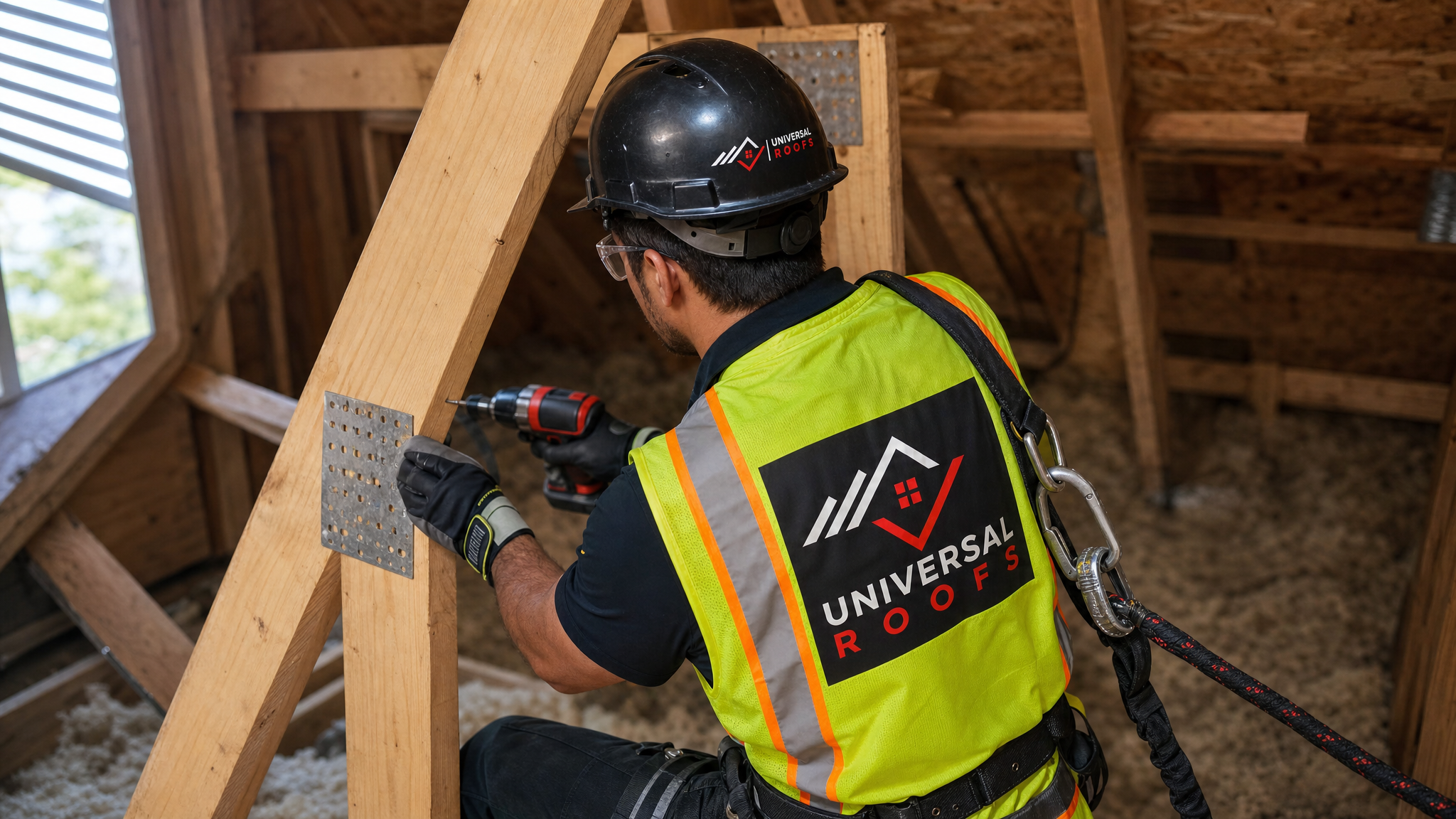
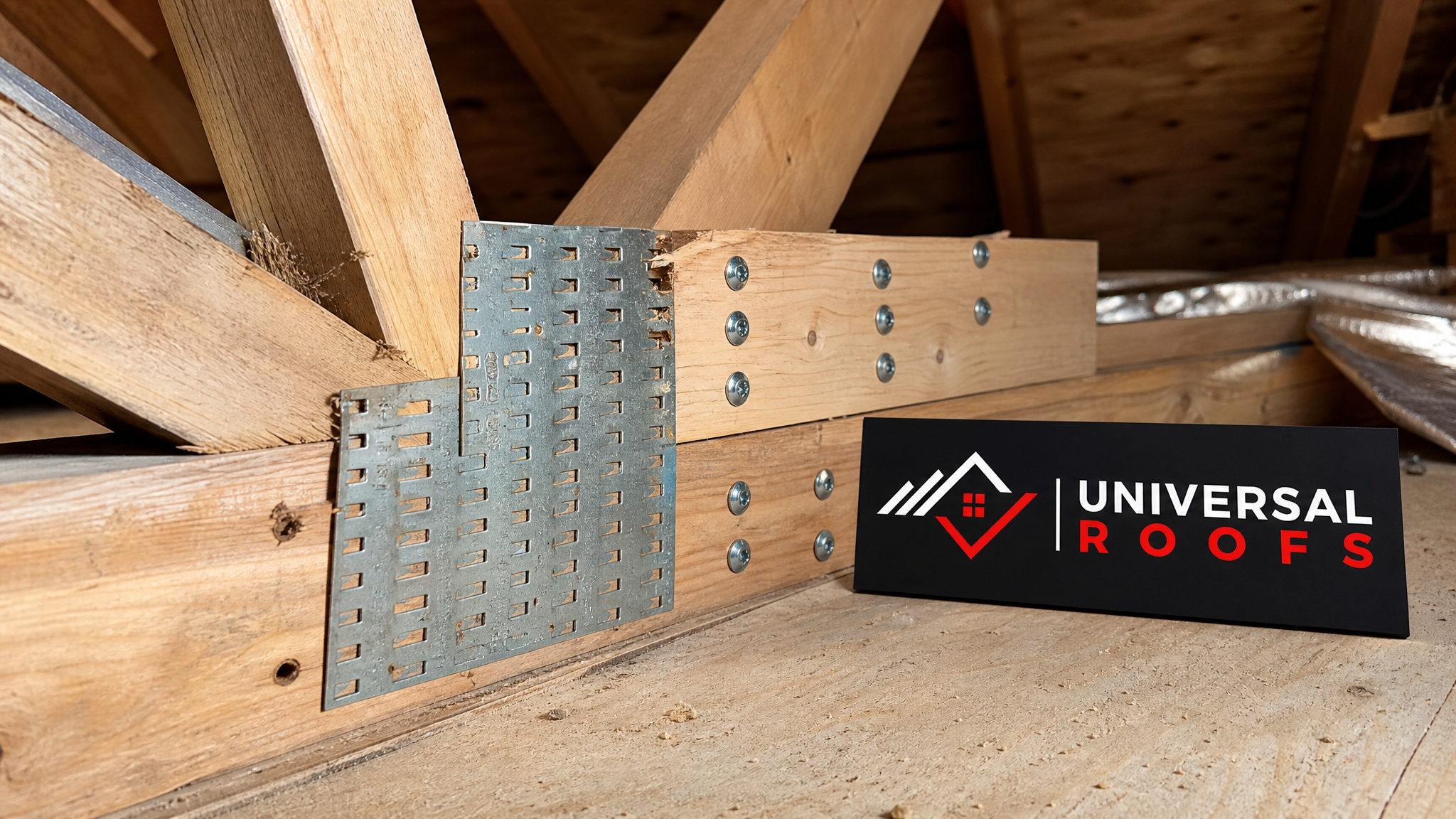
For localized damage, a new length of lumber (“sister”) is fastened alongside the damaged member using structural screws or bolts, restoring the original load capacity without removing the compromised piece entirely. Damaged gusset plate connections may be reinforced with new metal connector plates or engineered gusset repairs.
Step 4: Full Member or Truss Replacement
Where rot or a structural cut has removed too much material for sistering to be effective, the damaged section — or in severe cases the entire truss — is replaced according to an engineer’s specification, often with temporary shoring installed to support the roof load during the swap.
Step 5: Verification and Documentation
A reputable contractor documents the completed repair with photos and, for significant structural work, a letter from a professional engineer confirming the repair meets Ontario Building Code requirements. Keep this documentation for insurance and resale purposes.
| Repair Method | Best Suited For | Typical Duration | Structural Sign-Off Needed |
|---|---|---|---|
| Gusset plate reinforcement | Loosened or cracked connector plates | Half day per truss | Sometimes |
| Sistering | Single web or chord damage, rot, minor cuts | 1 day per truss | Often |
| Partial replacement | Extensive rot or multiple cuts on one member | 1-2 days per truss | Yes |
| Full truss replacement | Severe structural failure or code violation | 2-4 days, may require shoring | Yes |
Preventing Truss Damage Before It Starts
Prevention is far less expensive than any repair, and most of the preventive steps are straightforward for a homeowner to schedule.
- Schedule annual attic inspections, ideally in late summer or early autumn before the GTA’s freeze-thaw season begins.
- Maintain proper attic ventilation to prevent condensation and reduce ice damming risk — ask about our attic ventilation assessments.
- Never cut, drill, or notch a truss member without a stamped engineering review, regardless of what a contractor tells you is “standard practice.”
- Address roof leaks immediately rather than placing a bucket underneath and waiting for a dry stretch. Our roof repair team can typically respond within days.
- Avoid overloading attic storage beyond what the truss design allows — if in doubt, ask your contractor for the truss’s rated load capacity.
- Keep gutters and eaves clear so water drains properly and does not back up under the shingles during freeze-thaw cycles.
- Replace an aging roof covering proactively. A roof replacement before the underlying deck and truss system take on water damage is significantly cheaper than structural repair after the fact.
Truss Repair Costs Across the GTA
Costs vary by truss span, accessibility, and the extent of damage, but homeowners across Toronto, Mississauga, Vaughan, Markham, Oakville, and Durham Region can generally expect the following ranges for common scenarios. These are directional estimates — every quote should be based on an in-person inspection.
| Repair Scenario | Approximate Cost Range (CAD) | Typical Timeframe | Notes |
|---|---|---|---|
| Single gusset plate reinforcement | $300 – $700 | Same day | Fastest and least invasive fix |
| Sistering one truss member | $600 – $1,500 | 1 day | Most common repair type |
| Multi-truss sistering (3-5 trusses) | $2,000 – $5,000 | 2-3 days | Common after prolonged leaks |
| Partial truss replacement | $1,500 – $4,000 per truss | 1-2 days per truss | Often requires engineer sign-off |
| Full section replacement with shoring | $5,000 – $15,000+ | 1-2 weeks | Reserved for severe or widespread damage |
Notice how consistently the numbers reinforce the same lesson: waiting rarely saves money, and it almost always costs more once drywall repair, insulation replacement, and additional labour for accessibility are factored in.
Why Choose a Local, Experienced Contractor
Truss repair sits at the intersection of roofing and structural carpentry, and not every roofing crew is comfortable working on load-bearing framework. Since 2005, Universal Roofs has repaired and reinforced truss systems across the Greater Toronto Area, coordinating with structural engineers when a stamped report is required and pairing that work with any related roof covering, flat roofing, or skylight replacement needed to eliminate the original cause of the damage.
We serve homeowners throughout Toronto, Peel Region, York Region, Halton Region, and Durham Region, and our customer reviews reflect nearly two decades of straightforward, code-compliant structural work. If you have questions about a specific situation, our FAQ page covers many of the scenarios homeowners ask about most often, and you can read more about our team on our about page.
Why timely roof truss repair matters if the damage looks minor?
How do I know if my roof truss needs repair?
Can a damaged roof truss be repaired without full replacement?
What causes most roof truss damage in Toronto homes?
Is roof truss repair covered by home insurance?
How much does roof truss repair cost in the GTA?
Need Help With Why Timely Roof Truss?
If you have noticed a sagging roofline, cracked ceilings, or a bouncy attic floor, do not wait for the problem to grow. Universal Roofs has been diagnosing and repairing truss damage across the GTA since 2005, and our team can tell you within a single inspection whether you are looking at a same-day sistering repair or something more involved.
Call us today at (416) 732-2421 or request a free inspection to get started.
Universal Roofs proudly serves Toronto, Mississauga, Brampton, Vaughan, Markham, Oakville and the GTA since 2005.