
When a Toronto winter dumps 30 centimetres of wet snow on your roof overnight, the question homeowners ask isn’t whether to remove it — it’s who should do it, and how. Choosing the right roof snow removal services is one of the most consequential decisions a homeowner in the GTA will make during a heavy winter, because the wrong choice can mean anything from a scratched shingle to a collapsed ceiling joist. This guide breaks down exactly what separates a professional roof snow removal service from a risky do-it-yourself job, what the work should actually cost, which warning signs mean you need help immediately, and how to vet a contractor before they ever set foot on a ladder.
Toronto’s climate is uniquely hard on roofs. We get heavy, wet, lake-effect snow followed by freeze-thaw cycles that can happen several times in a single week. That combination is what causes ice damming, gutter failure, and — in the worst cases — structural stress on trusses that were never designed to hold the snow loads we sometimes see after a multi-day storm. A good roof repair contractor who also offers winter snow and ice management understands this local weather pattern and builds a removal plan around it, rather than applying a generic checklist that might work in a drier climate.
This article is written for homeowners across the GTA who are trying to decide whether they need professional snow removal this winter, what a legitimate service actually includes, and how to avoid the handful of common mistakes that turn a routine maintenance call into an expensive repair bill.
Why Roof Snow Removal Services Matter in the GTA
Ontario building codes size residential roof trusses for a specific ground snow load, but that figure assumes reasonably dry, fluffy snow. The snow that falls on Toronto roofs is frequently wetter and heavier than that baseline because of our proximity to Lake Ontario. A metre of fresh powder might weigh 10 to 15 kilograms per square metre, while the same depth of wet, compacted snow after a thaw-and-refreeze cycle can weigh 40 kilograms per square metre or more. On a typical 200 square metre roof, that difference is the gap between a manageable load and several tonnes of extra weight sitting on your rafters.
Most homes handle one storm’s worth of snow without issue. The danger comes from accumulation — several storms stacking on top of each other without a thaw in between, or an ice layer forming at the base of the snowpack that traps meltwater against the shingles. That trapped water is what causes ice damming, and it’s the single most common winter roof problem we see across Toronto, Peel Region, and York Region homes every year.
Professional roof snow removal services exist to interrupt that cycle before it causes damage. Done correctly, snow removal reduces structural load, eliminates the source water for ice dams, protects gutters and downspouts from being torn off by sliding ice, and extends the life of the shingles or membrane underneath. Done incorrectly — with metal shovels, pressure washers, or an untrained crew moving too fast — it can strip granules off asphalt shingles, puncture flat roof membranes, or send someone through a skylight.
What a Professional Roof Snow Removal Service Actually Includes
A legitimate snow removal visit is not just “shovel the roof off.” It’s a structured process that starts before the crew ever climbs up and ends with a report on what they found. Here’s what should happen on a proper visit:
- Ground-level assessment. The crew checks snow depth, ice buildup at the eaves, gutter condition, and identifies problem areas like valleys and low-slope sections before touching the roof.
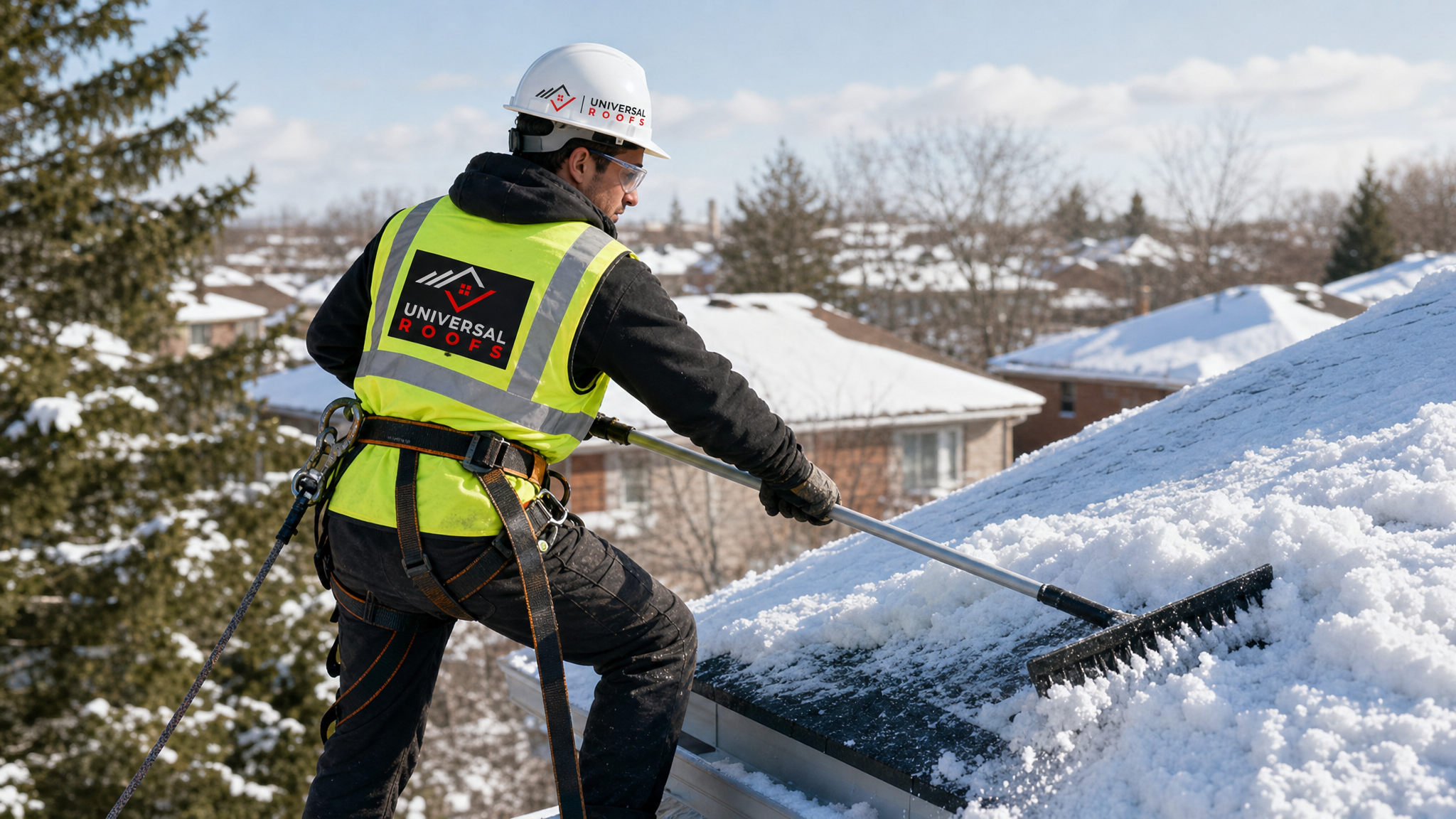
- Safe access setup. Ladders are secured, fall-protection harnesses and ropes are anchored, and the work zone at ground level is roped off to keep people and vehicles clear of falling snow and ice.
- Snow removal with roof-safe tools. Plastic or rubber-edged roof rakes and shovels are used — never metal blades directly on the shingle surface — to avoid scraping granules or membrane.
- Controlled removal sequence. Crews typically work from the ridge down in sections, leaving a thin buffer layer of snow directly on the shingles rather than scraping to bare roof, which protects the surface from tool contact.
- Ice dam mitigation. If ice has already formed at the eaves, a calcium chloride sock or steaming tool may be used to create channels for water to drain, rather than chipping at the ice, which can crack shingles.
- Gutter and downspout check. Once the roof is clear, gutters are checked for ice blockages and damage from the snow load.
- Post-service report. A reputable contractor documents any damage they observe — cracked shingles, lifted flashing, damaged vents — so you have a record for insurance or future repair planning.
If a company you’re considering skips the assessment and report and just shows up to shovel, that’s a sign they’re treating this as unskilled labour rather than a roofing service. The best snow removal providers are, at their core, roofing contractors first — which means they know what damage looks like and how to avoid causing it.
Comparing Snow Removal Methods and Tools
Not all snow removal techniques are appropriate for every roof type or storm severity. The table below compares the most common methods used across the GTA, along with when each one makes sense and what risk it carries if used incorrectly.
| Method | Best Used For | Typical Cost Range | Risk If Done Poorly |
|---|---|---|---|
| Plastic-edge roof rake (ground level) | Single-storey homes, first 1.2–1.8 metres of eave | $150–$350 per visit | Low risk; limited reach means upper roof stays loaded |
| Professional rope-and-harness manual removal | Multi-storey homes, steep or complex rooflines | $400–$900 per visit | Improper anchoring can lead to falls; requires trained crew |
| Steam-based ice dam removal | Established ice dams with active leaking | $500–$1,200 per visit | Low risk to shingles but slow; inexperienced use can miss saturated areas |
| Calcium chloride sock placement | Preventing new ice dams before they form | $100–$250 as add-on service | Minimal risk; ineffective if placed after ice has already built up |
| Metal shovel or pressure washer (not recommended) | Not recommended on any roof surface | Varies | High risk of granule loss, membrane punctures, and shingle cracking |
Notice that the least expensive option — a ground-level roof rake — is also the most limited in what it can accomplish. It clears the eave line, which is genuinely useful for preventing ice dams at the edge, but it does nothing for snow load sitting higher up on the roof plane or in valleys, which is where most structural concerns actually originate. For anything beyond a single-storey bungalow with a simple gable roof, a rake alone is not a complete solution.
Signs Your Roof Needs Snow Removal Now
Homeowners often wait too long to call for snow removal because the roof “looks fine” from the ground. By the time visible sagging or interior leaks show up, the situation has usually been developing for days or weeks. Watch for these warning signs:
- Visible sagging along the ridge line or between rafters, especially on flat or low-slope sections.
- Doors and windows sticking on upper floors, which can indicate the frame is flexing under roof load.
- Creaking or popping sounds from the attic or ceiling, particularly after a heavy snowfall.
- Icicles longer than 30 centimetres hanging from the eaves, a strong indicator of an active ice dam.
- Water stains on interior ceilings near exterior walls, which usually means an ice dam has already pushed meltwater under the shingles.
- Snow accumulation exceeding 60 centimetres that hasn’t compacted or melted after several days.
- Ice buildup around skylights or roof penetrations, which can lead to leaks around the flashing. If your home has a skylight, our skylights and skylight replacement pages cover how flashing and seals are supposed to perform in winter conditions.
Any one of these signs on its own is worth a phone call. Several of them together mean you should treat it as urgent — call for an assessment the same day rather than waiting for a scheduled visit.
Flat Roofs and Low-Slope Buildings Need a Different Approach
Flat and low-slope roofs — common on additions, garages, and many commercial buildings across the GTA — carry snow differently than a pitched asphalt shingle roof. Because there’s no slope to shed weight naturally, snow accumulates evenly across the whole surface and can pond as it starts to melt, adding weight from both snow and standing water simultaneously. This is one of the areas where generic snow removal crews get it wrong most often, because the membrane on a flat roofing system is far more vulnerable to punctures than shingles are.
On a flat roof, crews need to:
- Use only plastic or foam-edged shovels, never anything with a metal edge that could nick the membrane
- Leave a buffer layer of snow (typically 3–5 centimetres) directly on the membrane rather than scraping to bare surface
- Check and clear roof drains and scuppers first, since blocked drainage is what causes ponding after a thaw
- Distribute foot traffic evenly rather than repeatedly walking the same path, which can compress insulation underneath
If your property has a flat or low-slope section, ask specifically whether the contractor has experience with membrane roofing, not just shingles. The tools, techniques, and risk profile are different enough that general snow removal experience doesn’t automatically transfer.
How Much Roof Snow Removal Should Cost
Pricing for roof snow removal in the GTA varies by roof size, pitch, accessibility, and how much ice has already accumulated. The table below gives a realistic range based on typical residential jobs.
| Roof Type / Job Size | Typical Price Range | Time on Site | Notes |
|---|---|---|---|
| Bungalow, single storey, simple gable | $250–$450 | 1–2 hours | Fastest and least expensive due to easy access |
| Two-storey home, standard pitch | $400–$700 | 2–3 hours | Requires harness anchoring on upper sections |
| Complex roofline (multiple valleys, dormers) | $600–$1,000 | 3–5 hours | More labour due to sectioned removal around features |
| Flat or low-slope addition/garage | $300–$600 | 1.5–3 hours | Priced by square metre; drain clearing included |
| Emergency ice dam removal (active leak) | $500–$1,500 | 2–6 hours | Higher cost reflects urgency and steam equipment |
Be cautious of quotes that are dramatically below these ranges, especially during or immediately after a major storm. Extremely low prices usually mean a crew without proper insurance, no fall protection equipment, or plans to use metal shovels to finish the job faster. Any of those shortcuts can cost you far more than the service savings once shingle or membrane damage shows up in spring.
Preventing Ice Dams Before They Start
Snow removal treats the symptom; proper attic insulation and ventilation treat the cause. Ice dams form when heat escaping from the living space below warms the underside of the roof deck enough to melt the bottom layer of snow, which then refreezes at the colder eave overhang. The result is a ridge of ice that traps meltwater and forces it back up under the shingles.
The long-term fix is improving the thermal performance of your attic — adding insulation, sealing air leaks around pot lights and bathroom fans, and making sure soffit and ridge ventilation are actually moving air rather than being blocked by insulation batts stuffed too close to the eave. Homes with well-sealed, well-ventilated attics see far fewer ice dams even in the same storm conditions as a poorly insulated neighbour, because the roof deck stays close to the outdoor temperature rather than warming unevenly.
Snow removal and attic upgrades work best together: removal handles this winter’s storm, while attic improvements reduce how often you need removal in future winters. If you’re getting repeat ice dam calls every year, that’s usually a sign the attic — not the roof surface — is the root problem.
Questions to Ask Before Hiring a Snow Removal Contractor
Because roof snow removal sits at the intersection of unskilled labour and specialized roofing work, it attracts both excellent contractors and underqualified operators trying to make quick money during storm season. Before you hire anyone, ask:
| Question | What a Good Answer Sounds Like | Red Flag Answer |
|---|---|---|
| Are you insured for roof work specifically? | Yes, with liability coverage and WSIB clearance they can provide in writing | Vague answer, or “we’re covered under general liability” without specifics |
| What tools do you use on shingles? | Plastic or rubber-edged rakes and shovels only | “Whatever gets it off fastest,” or mentions metal shovels/blowers |
| Do you use fall protection? | Harnesses and anchored ropes on any pitched or multi-storey roof | “We’re careful, we don’t really need it” |
| Will you document any damage found? | Yes, photos and a written note included with the invoice | No mention of inspection or reporting at all |
| Can you also handle flat roofs and membranes? | Describes different tools/technique for membrane vs. shingle roofs | Treats all roof types the same |
A contractor who answers all five confidently and specifically is almost always safer to hire than one who gives generic reassurances. It’s also worth checking a company’s reviews for mentions of winter service specifically, since a contractor can have great reviews for summer roof replacements while having little real experience with snow and ice work.
DIY Snow Removal: When It’s Reasonable and When It Isn’t
Not every homeowner needs to call a professional for every snowfall. If you have a single-storey home with a simple roofline and can safely reach the first metre or two of eave from the ground with a roof rake, clearing that section yourself after each storm is a reasonable way to reduce ice dam risk without climbing anything.
That said, DIY snow removal has real limits. Never get on the roof yourself to clear snow — the combination of an icy, sloped surface and heavy wet snow is exactly the scenario that causes serious falls every winter across Ontario. If a rake from the ground can’t reach a section, that section needs a professional with proper harness anchoring, not a homeowner on a ladder with a shovel.
Other situations that call for a professional rather than a DIY approach:
- Any roof steeper than a standard 6:12 pitch, where footing is unreliable even with snow removed
- Flat or low-slope roofs, where membrane damage from an incorrect tool can cause a leak that isn’t visible until much later
- Any home with existing ice dams or active leaking, since chipping at ice yourself often makes the leak worse
- Two-storey homes or homes with dormers, where a ground-level rake simply can’t reach the upper sections
- Situations where you’re not confident in the ladder, footing, or weather conditions — wind and ice on a ladder base are a common cause of injury
The general rule: if you need to leave the ground to do it, it’s a job for a trained crew with the right equipment. The cost of a professional visit is small compared to an emergency room visit or a roof repair bill from a fall-related accident.
How Snow Removal Fits Into a Full Winter Roof Maintenance Plan
Snow removal works best as one part of a broader winter maintenance approach rather than a one-off emergency call. A well-maintained roof heading into winter should have already had its shingles, flashing, and gutters checked in the fall — problems that go unnoticed in October tend to become much bigger problems once snow and ice are added to the mix. If a roof is already near the end of its service life, snow load is often what exposes that weakness, which is why a pre-winter inspection through our roof repair service can catch issues while they’re still small and inexpensive to fix.
For homeowners whose roofs are approaching 20 years old or showing granule loss, curling, or missing shingles, it’s worth having an honest conversation about timing. Sometimes the more cost-effective path over several winters is a roof replacement rather than repeated snow removal and repair visits on a roof that’s already failing. A qualified contractor should be willing to have that conversation honestly rather than just booking removal visit after removal visit on a roof that needs bigger work.
Serving Homeowners Across the Greater Toronto Area
Snow load, ice damming, and roof stress don’t affect every GTA neighbourhood equally — lake-effect snowbands, tree cover, and roof orientation all play a role in how much accumulation a specific home sees in a given storm. We provide roof snow removal and winter roof maintenance across Toronto, Peel Region, York Region, Halton Region, and Durham Region, with crews trained on both shingle and flat roof techniques.
If you’re unsure whether your home needs a visit this season, our FAQ page and about page outline how our assessments work and what to expect from a first visit. The short version: a quick ground-level check is enough to tell an experienced technician whether removal is urgent, worth scheduling for later this week, or not yet necessary.
What are the best roof snow removal services for a typical GTA home?
How much snow is too much for a residential roof in Toronto?
Can I remove snow from my roof myself?
What is the difference between snow removal and ice dam removal?
Do flat roofs need different snow removal services than pitched roofs?
How do I prevent needing roof snow removal services every winter?
Need Help With What Are the Best?
Whether you need a same-day emergency visit after a major storm or you’re planning ahead for a winter maintenance schedule, Universal Roofs has been handling roof snow removal, ice dam mitigation, and full roofing services across the GTA since 2005.
Call us today at (416) 732-2421 or request a free inspection to get started.
Universal Roofs proudly serves Toronto, Mississauga, Brampton, Vaughan, Markham, Oakville and the GTA since 2005.