
Clay and concrete tile roofs are some of the most durable roofing systems installed on GTA homes, often lasting 50 years or more when properly maintained. But durability does not mean maintenance-free. Over time, tile roofs collect moss, algae, lichen, airborne debris, and mineral staining that dull their appearance and, in some cases, threaten the integrity of the roofing system underneath. Tile roof cleaning is one of the most overlooked parts of roof care in Toronto, largely because homeowners assume tile is indestructible and simply ignore it until problems surface.
The truth is that dirty tile is rarely just a cosmetic issue. Moss retains moisture against the tile surface, algae streaks can be a sign of trapped humidity in the attic space below, and built-up debris in valleys and around penetrations can redirect water under the tiles instead of over them. In a climate like Toronto’s, where freeze-thaw cycles run from late autumn through early spring, that trapped moisture becomes a serious risk. Water that seeps beneath a tile and then freezes can crack the tile, lift fasteners, and open a path for leaks long before the tile itself would otherwise fail.
This guide walks through the top three tile roof cleaning tips that actually protect your roof rather than just making it look better for a season, along with the methods, tools, and safety considerations every GTA homeowner should understand before attempting any tile roof cleaning project. We will also explain when a professional visit is the safer and more cost-effective choice, and how Universal Roofs approaches tile roof cleaning and maintenance across the Greater Toronto Area.
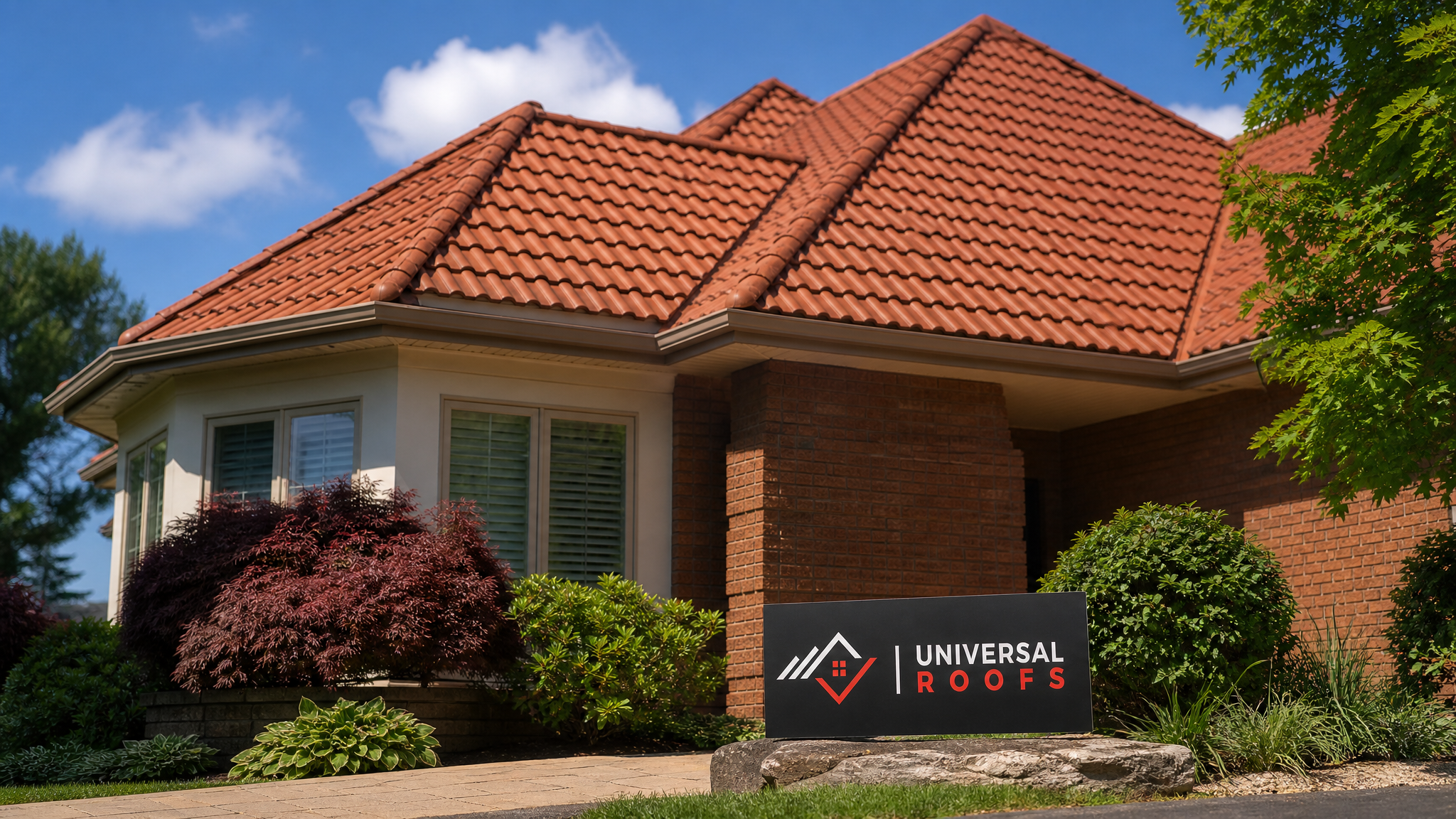
Why Tile Roof Cleaning Matters More Than Most Homeowners Realize
Tile roofing, whether clay or concrete, is porous by nature. That porosity is part of what gives tile its longevity and breathability, but it also means the surface readily absorbs moisture, airborne pollutants, and organic spores. Left unaddressed, this combination creates the perfect environment for moss colonies, black algae streaking (often visible as dark vertical stains), and lichen patches that anchor themselves directly into the tile surface.
In the GTA specifically, homes shaded by mature trees, situated on north-facing slopes, or located near ravines and green spaces tend to see the fastest moss and algae growth because those areas retain shade and humidity longer after rain or snowmelt. Roofs that never fully dry out between weather events are the ones that need cleaning most urgently.
Beyond appearance, neglected tile roofs suffer from several compounding problems:
- Moss mats hold water against the tile and underlayment, accelerating freeze-thaw cracking in winter
- Debris-clogged valleys and channels redirect water sideways instead of down, increasing the chance of leaks
- Algae and organic growth reduce a roof’s reflectivity, which can modestly increase attic heat gain in summer
- Heavy moss growth adds unnecessary dead weight to the roof structure over time
- Loose debris and grit can clog gutters and downspouts, causing water to back up under the eaves
Routine cleaning, done correctly, prevents all of these issues while also extending the interval between more expensive repairs. If you are already seeing cracked or slipped tiles during a cleaning inspection, it is worth having our team review options through the roof repair page before problems spread further across the field of the roof.
Tip 1: Use Low-Pressure Water, Never a Pressure Washer
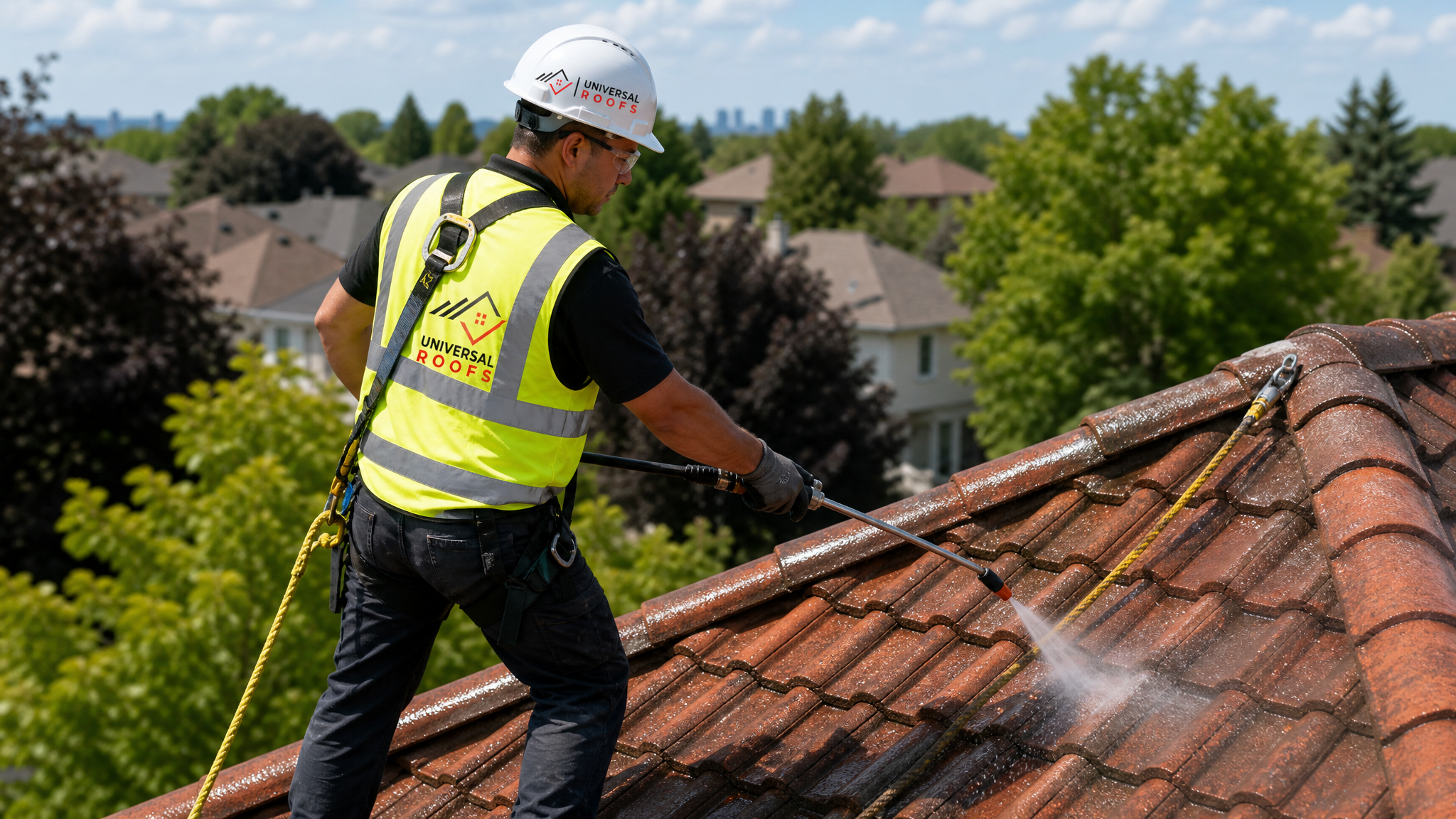
The single most damaging mistake homeowners make when cleaning a tile roof is reaching for a pressure washer. Standard consumer pressure washers generate anywhere from 1,500 to 3,000 PSI, which is far more force than a tile roof can safely tolerate. Concrete tile has a granular or coated surface layer that pressure washing strips away almost immediately, exposing the porous concrete beneath and accelerating future staining and moss growth. Clay tile is even less forgiving — the force can crack, chip, or dislodge tiles outright, especially older or weathered ones.
Instead, the correct approach is a soft wash: low-pressure rinsing, typically under 500 PSI, combined with a cleaning solution that is left to dwell on the surface before rinsing. This method uses chemistry rather than force to lift moss, algae, and lichen from the tile without abrading the surface or driving water beneath the tile laps.
A proper soft wash sequence looks like this:
- Clear loose debris (leaves, twigs, granules) from valleys and the roof surface by hand or with a soft brush
- Apply a roof-safe cleaning solution — typically a diluted sodium hypochlorite or specialized tile-safe biocide — starting at the ridge and working down
- Allow the solution to dwell for the manufacturer’s recommended time, usually 10 to 20 minutes, to break down organic growth
- Rinse thoroughly with low-pressure water, working from the ridge downward so water flows with the natural tile overlap, not against it
- Inspect the roof once dry for any tiles that shifted, cracked, or need attention
This is also the moment to check flashing around chimneys, vents, and skylights, since these transition points are where soft-wash rinsing tends to reveal hidden leaks or degraded sealant. If your home has a skylight integrated into the tile field, pay particular attention to the flashing perimeter, as debris buildup around skylight curbs is one of the most common causes of localized leaks on tile roofs.
| Cleaning Method | Pressure Used | Risk to Tile | Effectiveness on Moss/Algae |
|---|---|---|---|
| Consumer pressure washer | 1,500-3,000 PSI | High — cracks, chips, strips coating | Fast but temporary; strips protective layer |
| Soft wash (low-pressure + solution) | Under 500 PSI | Low — safe for clay and concrete | High and long-lasting when done correctly |
| Manual scrubbing with stiff brush | None | Moderate — can loosen granules or crack brittle tile | Moderate; labour-intensive, uneven results |
| Garden hose rinse only | Under 100 PSI | Very low | Low; removes surface dust but not established moss |
| Professional biocide treatment | Under 500 PSI | Low — applied by trained crew | Very high; includes preventive residual treatment |
Tip 2: Treat the Cause, Not Just the Symptom — Prevent Moss and Algae Regrowth
Cleaning a tile roof without addressing why moss and algae took hold in the first place is a short-term fix. Most homeowners are surprised to learn that a roof cleaned this summer can look just as dirty again within 12 to 18 months if the underlying conditions are not corrected. Regrowth prevention is the second pillar of effective tile roof cleaning, and it usually comes down to three factors: shade, moisture retention, and airflow.
Trees overhanging the roofline are the most common contributor. Overhanging branches drop organic debris directly onto the tile, shade the surface so it stays damp longer after rain, and provide a constant source of moss and algae spores. Trimming back branches to create a few feet of clearance from the roof edge dramatically slows regrowth, even without any additional chemical treatment.
The second factor is attic and roof ventilation. A roof deck that is poorly ventilated tends to run warmer and more humid than one with proper intake and exhaust airflow, and that differential can accelerate condensation on the underside of the roofing material, which in turn promotes moss and algae growth on the exterior surface directly above poorly ventilated sections. If cleaning reveals recurring moss patterns concentrated over specific areas of the attic, it is worth having that space assessed through our attic services to check baffle placement, insulation levels, and soffit or ridge vent performance.
The third and most direct prevention method is a preventive zinc or copper strip installed near the ridge. As rain washes over these strips, trace metal ions are carried down the roof slope, creating an environment that is inhospitable to moss and algae regrowth for several years at a time. This is a low-cost addition that pairs well with any professional cleaning service and is far cheaper than repeating a full cleaning every single year.
| Regrowth Cause | Warning Sign | Prevention Approach | Typical Cost Range (CAD) |
|---|---|---|---|
| Overhanging tree branches | Debris accumulation, concentrated shade patches | Trim branches 2-3 metres back from roofline | $150 – $500 |
| Poor attic ventilation | Moss concentrated over specific attic zones | Add or clear soffit/ridge vents, check baffles | $400 – $1,800 |
| No preventive metal strip | Regrowth within 12-18 months of cleaning | Install zinc or copper strip near ridge | $300 – $900 |
| Clogged valleys and gutters | Standing water, sediment build-up after rain | Clear valleys and gutters each season | $150 – $350 |
| North-facing or low-slope sections | Persistent dampness days after rain | Increase surface drainage, monitor closely | Varies by roof design |
Tip 3: Know When to Call a Professional Instead of Climbing Up Yourself
Tile roofs are genuinely dangerous to walk on without training. Unlike asphalt shingles, which flex slightly underfoot, tile can crack under uneven weight distribution, and a single cracked or dislodged tile can create a hidden leak point that isn’t discovered until the next heavy rain. Professional roofers walk tile roofs using techniques and foot placement that distribute weight along the tile’s structural support points, and they use harnesses and rope systems for any pitch beyond a gentle slope. For most homeowners, this is not a reasonable DIY skill to acquire for an occasional cleaning task.
Beyond the physical risk of working at height, there are several situations where calling a professional is simply the smarter decision:
- The roof pitch exceeds a gentle slope, making safe footing difficult without fall protection
- You notice cracked, slipped, or missing tiles during a visual inspection from the ground
- There are visible stains on interior ceilings suggesting an active or past leak
- The roof has not been cleaned or inspected in more than three years
- You are uncertain about the correct cleaning solution or dwell time for your specific tile type
- The home is more than two storeys, requiring specialized ladder or lift access
A professional visit also catches problems a homeowner would likely miss entirely: hairline cracks along tile edges, deteriorating flashing sealant, granule loss on adjacent flat sections, or early signs that a full roof replacement is approaching sooner than expected. Catching these issues during a routine cleaning appointment is significantly cheaper than discovering them after water has already entered the attic or ceiling assembly.
Many GTA homes also have secondary roofing systems — a flat roof section over a garage or addition, for example — that require entirely different maintenance approaches than the tile field. If your property includes one of these transitions, it is worth having both surfaces reviewed together; our flat roofing team frequently coordinates with tile cleaning crews so the whole roof system is assessed in a single visit rather than piecemeal.
| Service Tier | What’s Included | Recommended Frequency | Best For |
|---|---|---|---|
| Visual inspection only | Ground and binocular check for visible damage | Twice yearly (spring and fall) | All homeowners, low cost baseline |
| Gutter and valley clearing | Debris removal from valleys, gutters, downspouts | Twice yearly | Homes with mature trees nearby |
| Full soft-wash cleaning | Solution application, dwell, low-pressure rinse | Every 2-3 years, or as needed | Visible moss, algae, or staining |
| Cleaning + preventive treatment | Soft wash plus zinc/copper strip installation | Once, with periodic touch-up rinses | Shaded roofs, chronic regrowth |
| Full roof assessment | Cleaning plus tile, flashing, and vent inspection | Every 3-5 years or before resale | Older roofs, pre-listing homes |
Seasonal Timing: Why Summer Is the Right Window for Tile Roof Cleaning in Toronto
Timing matters as much as method when it comes to tile roof cleaning. In the Toronto area, late spring through summer is consistently the best window for this work. Winter and early spring bring freeze-thaw cycles that leave tiles more brittle and prone to cracking under foot traffic, and any moisture from a winter cleaning would have far less opportunity to dry before the next freeze. Cleaning during a stretch of warm, dry summer days allows any residual moisture from the wash and rinse cycle to evaporate fully within a day or two, minimizing the risk of trapped water re-entering a freeze-thaw cycle later in the year.
Summer scheduling also gives homeowners a full season to observe how the roof performs after cleaning — whether drainage in valleys has improved, whether previously shaded damp patches are drying faster, and whether any tile damage identified during the cleaning needs to be addressed before autumn rains and winter snow load arrive. Booking a cleaning in July or August, rather than waiting until October, gives our crews and yours the most flexibility to schedule follow-up repair work if anything is found.
Homeowners across Toronto, Peel Region, York Region, Halton Region, and Durham Region all deal with the same freeze-thaw climate pattern, so this seasonal guidance applies GTA-wide regardless of neighbourhood or roof orientation.
DIY Cleaning Solutions: What’s Safe for Clay and Concrete Tile
Homeowners who want to attempt light maintenance cleaning between professional visits should stick to solutions specifically formulated for roofing materials. Household bleach diluted improperly, or generic all-purpose cleaners, can degrade tile coatings, corrode metal flashing and fasteners, and damage surrounding landscaping when runoff reaches the ground. The safest DIY approach uses a properly diluted solution, applied with a pump sprayer rather than a pressure washer, and always tested on a small, inconspicuous section of the roof first.
| Solution Type | Effective Against | Tile Safety | Environmental Considerations |
|---|---|---|---|
| Diluted sodium hypochlorite (roof-safe ratio) | Moss, algae, black streaking | Safe when diluted per label; rinse thoroughly | Cover plants below; avoid runoff into gardens |
| Oxygen bleach (sodium percarbonate) | Algae, mild staining | Very safe for clay and concrete | Biodegradable; lower environmental impact |
| Commercial tile-safe biocide | Moss, lichen, algae with residual protection | Safe; formulated specifically for roofing | Follow manufacturer disposal guidance |
| Undiluted household bleach | Some organic growth | Risky — can damage coatings and metal fasteners | High risk of landscape and waterway harm |
| Vinegar solution | Very light surface grime only | Safe but weak | Environmentally gentle but limited effectiveness |
Regardless of which solution is used, always cover or thoroughly wet down surrounding plants, shrubs, and lawn areas before starting, and rinse landscaping again after the roof work is finished. Runoff containing cleaning solution can scorch grass and stress plants if left untreated.
Inspecting Your Tile Roof Before and After Cleaning
A cleaning appointment is also an ideal opportunity to catch small problems before they become expensive ones. Before cleaning begins, walk the perimeter of your home and look for tiles that appear cracked, chipped, or out of alignment with their neighbours. After the wash and rinse are complete and the roof has fully dried, repeat that inspection, since dislodged debris sometimes reveals damage that was previously hidden under moss or leaf litter.
Pay particular attention to:
- Flashing around chimneys, vents, and any skylight curbs, checking for lifted edges or cracked sealant
- Ridge and hip tiles, which are more exposed to wind and can loosen over time
- Valleys, where granules, needles, and leaf debris tend to accumulate fastest
- Any visible fastener heads that may have backed out or rusted
- Gutters and downspouts for sediment that washed down during the rinse cycle
If anything looks questionable, take photos and note the location relative to a chimney, vent, or roof edge so it can be pointed out precisely during a follow-up visit. Homeowners who are unsure what they are looking at can always request a professional opinion — our team walks through findings in plain language and never recommends work that isn’t actually needed. You can see how past clients describe this process on our reviews page, and browse common questions on our FAQ page before booking.
What Universal Roofs Includes in a Tile Roof Cleaning Service
Since 2005, our crews have serviced tile, asphalt, and flat roofing systems across the GTA, and tile roof cleaning follows a consistent, documented process on every job. We start with a ground-level and close-up visual inspection to identify existing damage before any water or solution touches the roof, so pre-existing cracks are never mistaken for something caused during cleaning. From there, our crew clears loose debris by hand, applies a tile-safe cleaning solution, allows the appropriate dwell time, and performs a low-pressure rinse from ridge to eave.
Every technician working at height wears full fall-protection equipment, including a harness and secured rope system, along with standard safety gear. We also document the condition of flashing, vents, and any skylight or skylight replacement candidates found during the visit, so homeowners have a clear, itemized picture of the roof’s condition rather than a vague verbal summary. You can learn more about our background and service area coverage on our about page.
How often should tile roof cleaning be done in Toronto?
Can pressure washing damage a tile roof?
What causes moss and algae to grow on tile roofs?
Is it safe to walk on a tile roof to clean it myself?
How much does professional tile roof cleaning cost in the GTA?
What is the best time of year for tile roof cleaning in Toronto?
Need Help With Top 3 Tile Roof?
A clean, well-maintained tile roof protects your home for decades, and a little seasonal attention goes a long way toward avoiding costly repairs down the road. Universal Roofs has been helping GTA homeowners keep their tile, flat, and skylight roofing systems in top condition since 2005, using safe, low-pressure methods that protect your investment rather than shorten its lifespan.
Call us today at (416) 732-2421 or request a free inspection to get started.
Universal Roofs proudly serves Toronto, Mississauga, Brampton, Vaughan, Markham, Oakville and the GTA since 2005.