
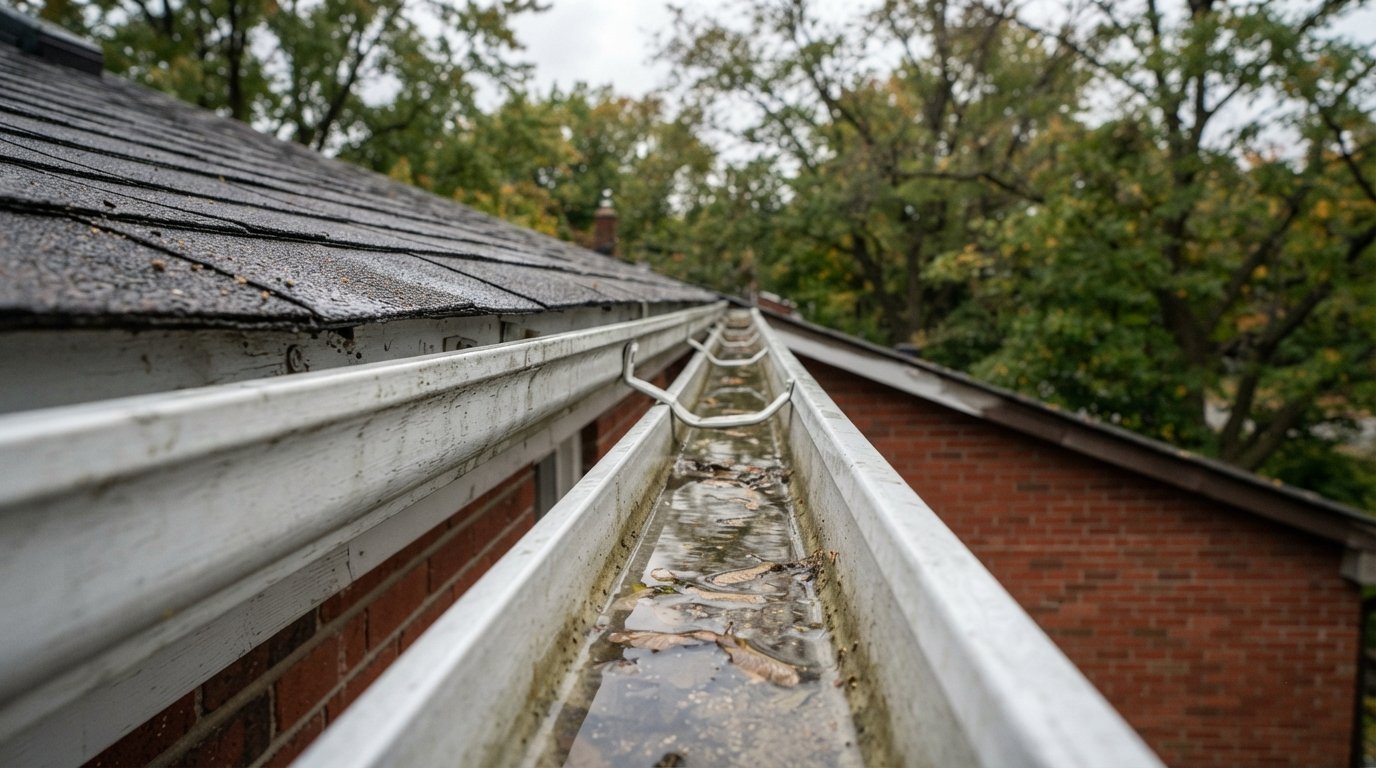
An hour after an autumn rain stops, a working eavestrough should be almost empty. If you can still see a strip of water sitting along one stretch, or a puddle full of floating maple keys at the far end of a run, the problem is usually gutter slope: the trough is flat, sagging or tilted the wrong way, so water has nowhere to go. It is one of the most common faults we find on GTA homes, and one of the easiest to misdiagnose as a clog.
This article explains what gutter slope a trough actually needs, why pitch gets lost over time, what you can safely see from the ground, what a crew checks with a level, and how a crew re-pitches troughs properly, including when the fascia behind them has to be fixed first.
What Gutter Slope Is And How Much You Need
Gutter slope, also called pitch or fall, is the small drop built into a trough from its high end to its outlet. Water in a trough does not move on its own; it needs gravity, and the slope provides it. Too little fall and water lingers. Too much and the trough looks visibly crooked against the fascia and can drop low enough at the outlet end that water from the roof misses it.
There is no single number in the building code that every installer follows, but a widely used rule of thumb in the trade is about a quarter inch of fall for every 10 feet of run, with some installers going a little steeper on long or leaf-prone runs. That sounds tiny, and it is. On a 30-foot run it adds up to roughly three quarters of an inch from one end to the other. The point of gutter slope is steady, even fall, not a dramatic tilt.
Two things matter as much as the number:
- Consistency along the run. A trough with correct average gutter slope but a sag in the middle will still hold water in the dip.
- Direction. Every section must fall toward an outlet. A run that was hung level, or that has been pushed up at the outlet end, will drain away from the downspout.
It is also worth knowing what is normal. A flat-bottomed K-style trough can hold a thin film of water or a few damp leaves after rain, especially if it is dirty. What should concern you is water deep enough to be obvious to the crew’s eye, lasting for hours, or collecting in the same place every time.
Why Standing Water Is A Problem
A little water in a trough seems harmless. Over a season it is not:
- Overflow in heavy rain. A trough that starts a storm half full has half the capacity. Autumn downpours then spill over the front, soaking the soil beside the foundation.
- Fascia and soffit rot. Standing water finds pinholes and seams. Constant dampness at the back of the trough softens the fascia board behind it.
- Weight. Water, wet leaves and, later in the year, slush and ice add up. The extra load bends hangers, which deepens the sag, which holds more water. It is a cycle.
- Freeze damage. Water frozen in a trough expands, stresses seams and end caps, and can tear hangers loose. Troughs full of ice also feed icicles and can worsen ice buildup at the roof edge.
- Insects and debris. Stagnant water and rotting leaves attract mosquitoes and grow sludge that blocks outlets.
Early autumn is the right time to correct gutter slope. Rain gives you an easy test, and there is time to re-pitch before the trough is carrying ice.
Why Troughs Lose Their Gutter Slope
Most troughs were pitched correctly when they went up. Gutter slope gets lost through a handful of predictable causes, and the fix depends on which one you have.
| Cause | What you see | Why it happens |
|---|---|---|
| Sagging hangers | Dips between hangers, water pooling in the low spots | Hangers too far apart, bent by snow and ice, or old spikes pulled loose |
| Rotted fascia | Trough pulling away from the house, hangers loose in soft wood | Years of seepage at seams or behind the trough |
| Installed flat | Water sits evenly along the whole run | Trough hung to the fascia line or a roofline that is not level |
| Reverse slope | Water collects at the end away from the downspout | Downspout end lifted during repair, or house settlement |
| Run too long for one outlet | Far end holds water, trough drops visibly at outlet | Not enough height available to pitch the full length |
| Ladder or impact damage | Kink or crushed section with pooling beside it | Ladder leaned on the trough, fallen branch, sliding snow |
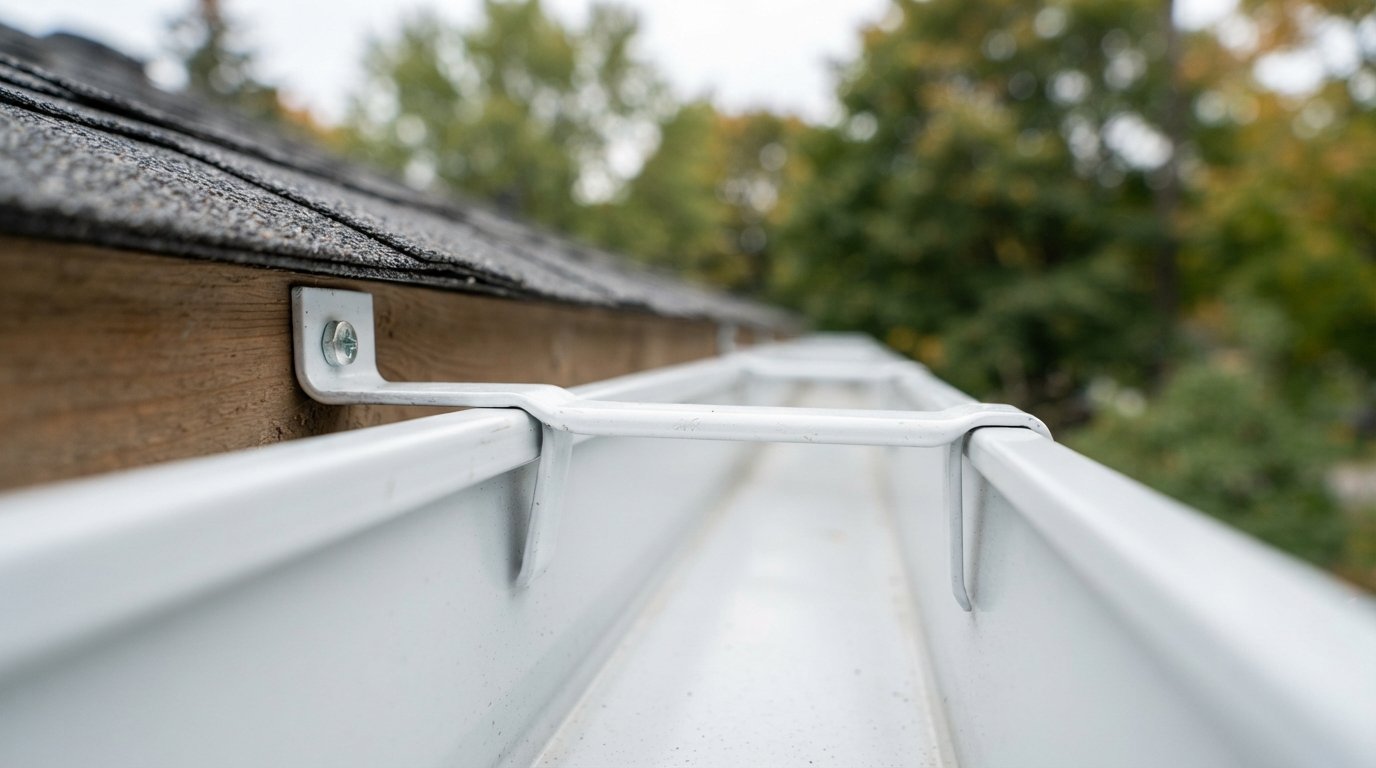
Hanger spacing is the cause we see most often on older systems. Many were hung with spike-and-ferrule fasteners every few feet. Each winter the spikes work a little looser. Modern hidden hangers screwed into sound fascia at close spacing hold gutter slope far better.
Rotted fascia is the one that cannot be skipped. If the board behind the trough is soft, no amount of adjusting will keep pitch for long, because the screws have nothing to bite into. Replacing damaged fascia and checking the roof edge above it is part of our roof repair and roof edge work, and it has to come before the trough goes back up.
How To Check Your Gutter Slope
You can learn a lot without special tools, and without leaving the ground. Checks at height, including anything that needs a ladder, are crew work. Please do not climb up to look.
What you can see from the ground during rain
- Watch during and after rain. Note where water spills over the front lip, and where drips continue long after the rain stops. Drips from the same mid-run spot usually mean a sag.
- Look for drips behind the trough. Water running down the fascia or wall behind the trough, rather than falling from the front, suggests the water is not staying in the channel.
- Note water at one end. If the trough looks fuller at the end away from the downspout, the run may be level or pitched the wrong way.
- Sight along the trough. Stand back at one end and look along the bottom edge against the fascia line and the brick or siding. Dips and humps are often visible.
- Look at the downspout. If the downspout runs dry during a steady rain while the trough overflows elsewhere, water is not getting to it.
What the crew does with a level
- Cleans the trough first. Debris dams water and hides the true slope.
- Uses a level to read the gutter slope on the trough bottom at a few points along the run. A short level shows whether each section falls toward the outlet.
- Checks the hangers by pressing gently on the front lip between them. Movement or a soft feel at the back means loose fasteners or soft fascia.
- Water-tests the run once the work is done, to confirm the water moves steadily toward the outlet and leaves little behind.
If you find standing water in just one dip, a single loose hanger may be the culprit. If the whole run holds water or the fascia is soft, it is a re-pitch job.

Long Runs: Splitting The Slope Both Ways
Long walls create a geometry problem. If you pitch a 50-foot run to a single downspout at a quarter inch per 10 feet, the low end sits well over an inch below the high end. On a house with a straight fascia, that drop is visible, and the low end can hang so far below the roof edge that water sheets behind or past it.
The standard answer is to split the run. There are two common layouts:
- High point in the middle, downspouts at both ends. Each half falls away from the centre. This is the usual choice when both corners of the house can take a downspout.
- High points at the ends, outlet in the middle. Both halves fall toward a central downspout. This works where the corners are unsuitable, for example above a walkway or a neighbour’s side yard.
Splitting halves the distance water travels, halves the total drop at each end, and doubles the outlet capacity. Many installers split any run over roughly 40 feet as a matter of course. If your existing long run has one downspout and holds water at the far end, adding a second outlet and re-pitching both halves is often the cleanest fix.
One caution: when a run is split, each half needs its own end cap or a proper high point. A trough that is simply re-pitched in the middle without rethinking outlets can end up with water pooling at the junction.
How A Crew Re-Pitches Eavestroughs
Re-pitching is more than bending a few hangers. Done properly, it follows a clear sequence.
| Step | What the crew does | Why it matters |
|---|---|---|
| 1. Clean and assess | Clear debris, water test, probe fascia | Separates slope problems from clogs and rot |
| 2. Detach the trough | Remove hangers and lower or take down the run | Gives access to fascia and a clean line to work from |
| 3. Repair the fascia | Replace soft sections, seal old fastener holes | New hangers need sound wood |
| 4. Snap a chalk line | Mark the correct fall from high point to outlet | Sets an even slope instead of following a crooked fascia |
| 5. Re-hang | Fasten hidden hangers to the line at close spacing | Holds the pitch through snow and ice loads |
| 6. Reseal and adjust outlets | Reseal end caps and corners, reposition outlets if needed | Outlet must sit at the true low point |
| 7. Water test | Run water from the high end and watch it drain | Confirms the run empties with nothing left standing |
A few details distinguish good work:
The line comes from the slope, not the house. Fascia boards on older homes are rarely perfectly level. A crew that hangs the trough tight to the bottom of a crooked fascia will reproduce the problem. The chalk line should follow the gutter slope you want, even if it means the trough sits slightly differently along the board.
The trough still has to catch water. As the low end drops, the installer checks that the roof edge still projects over the trough and that the drip edge or gutter apron directs water into it rather than behind it.
Hanger spacing is tightened. Many installers use around 24 inches between hangers, closer at corners and under valleys. Re-using the old spacing that let the trough sag in the first place defeats the purpose.
Sometimes replacement is cheaper. If the trough itself is dented, the seams are failing and the fascia is rotten, re-pitching old metal can cost nearly as much as new seamless troughs formed to the correct lengths.
Repair, Re-Pitch Or Replace?
Use this as a rough guide, and let the water test and fascia condition decide the details.
| What you find | Likely fix | Scale of job |
|---|---|---|
| One sagging spot, sound fascia | Add or replace one or two hangers | Small repair |
| Whole run flat or reversed, sound trough and fascia | Re-pitch the run on new hangers to a chalk line | Moderate |
| Long run holding water at the far end | Split the run and add a second downspout | Moderate |
| Soft fascia behind the trough | Replace fascia, then re-hang or replace the trough | Larger |
| Leaking sectional seams plus poor gutter slope | Seamless replacement formed to correct lengths | Larger, often better value |
Costs vary with storeys, access, run length and how much fascia is involved. As a broad estimate only, a simple re-hang of a single run is often a modest service call, while re-pitching several runs with fascia replacement can climb into the higher hundreds or low thousands of dollars. A site visit is the only way to price it properly. Our crews handle these repairs across the GTA, including roofing, eavestroughs and attic work across Durham Region.
Keeping The Pitch You Paid For
Once the gutter slope is right, a few habits keep it that way:
- Clean in autumn after most leaves fall, and again in spring. Heavy wet debris is a load the hangers do not need.
- Never lean a ladder on the trough. Use a stand-off that bears on the wall or roof.
- Watch the first heavy rain each autumn. A new drip in the middle of a run is an early sign a hanger has moved.
- Keep downspouts clear, since a blocked outlet makes even a perfectly pitched trough fill up.
- Fix seam leaks promptly so the fascia stays sound and the hangers keep their grip.
Frequently Asked Questions
How much slope should an eavestrough have?
Is a little water in the trough normal?
Can I fix a sagging trough myself?
Why does water pool at the end away from the downspout?
When should a long run be split?
Should I fix slope before winter?
Get Your Gutter Slope Checked This Autumn
If water is sitting in your eavestroughs after rain, the fix is usually straightforward once the cause is clear: better hangers, sound fascia, a correct chalk line and, on long runs, a second outlet. Universal Roofs tests, re-pitches and replaces troughs so they drain the way they should before the colder months arrive.
Call us today at (416) 732-2421 or request a free estimate.
Serving homeowners in Durham Region and across the wider GTA.