
Every Toronto homeowner learns the same lesson eventually: clogged eavestroughs do not fix themselves, and the difference between a frustrating afternoon and a smooth one comes down to having the right gutter cleaning tools on hand. Whether you live in a century home in Leslieville with mature maples overhead or a newer build in Vaughan surrounded by younger trees, the seeds, blossoms, and debris that accumulate through spring and summer will find their way into your troughs. Choosing the best gutter cleaning tools is not about buying the most expensive gear on the shelf at your local hardware store. It is about matching the tool to your home’s height, roofline, and the type of debris you are dealing with. This guide walks through every category of equipment worth owning in 2026, how to use each one safely, and when the smartest move is to put the ladder away and call a professional.

Why the Right Gutter Cleaning Tools Matter for Toronto Homes
Toronto’s tree canopy is one of the densest of any major North American city, and that greenery comes at a cost when it comes to your eavestroughs. Maple keys in late spring, poplar fluff in early summer, and a steady drizzle of pollen and grit throughout the season all collect in your troughs and downspouts. When water cannot drain, it spills over the edge, saturates the fascia board, and pools against your foundation. The right gutter cleaning tools let you clear that debris before it turns into rotted wood, a leaking basement, or a costly roof repair.
Beyond preventing water damage, good gutter cleaning tools make the job dramatically safer. A homeowner who owns a proper stabiliser bar and a ground-based flushing wand spends far less time perched at the top of an extension ladder than someone improvising with a garden trowel and a paint bucket. In a city where two-and-a-half-storey homes are common, reducing time on the ladder is not a luxury; it is the single most important safety decision you can make. Investing a little thought into your toolkit protects both your house and your wellbeing.
It also protects the rest of your building envelope. Overflowing troughs send water cascading down siding, into soffits, and back toward the attic, where trapped moisture can degrade insulation and encourage mould. Keeping your gutters clear with the right equipment is one of the cheapest forms of preventive home maintenance available to any GTA homeowner.
Essential Gutter Cleaning Tools Every Homeowner Should Own
Before you look at gadgets and attachments, build a foundation of core equipment. These are the workhorses that handle the majority of routine cleaning on an average Toronto home. You do not need all of them at once, but each solves a specific problem you will eventually encounter.
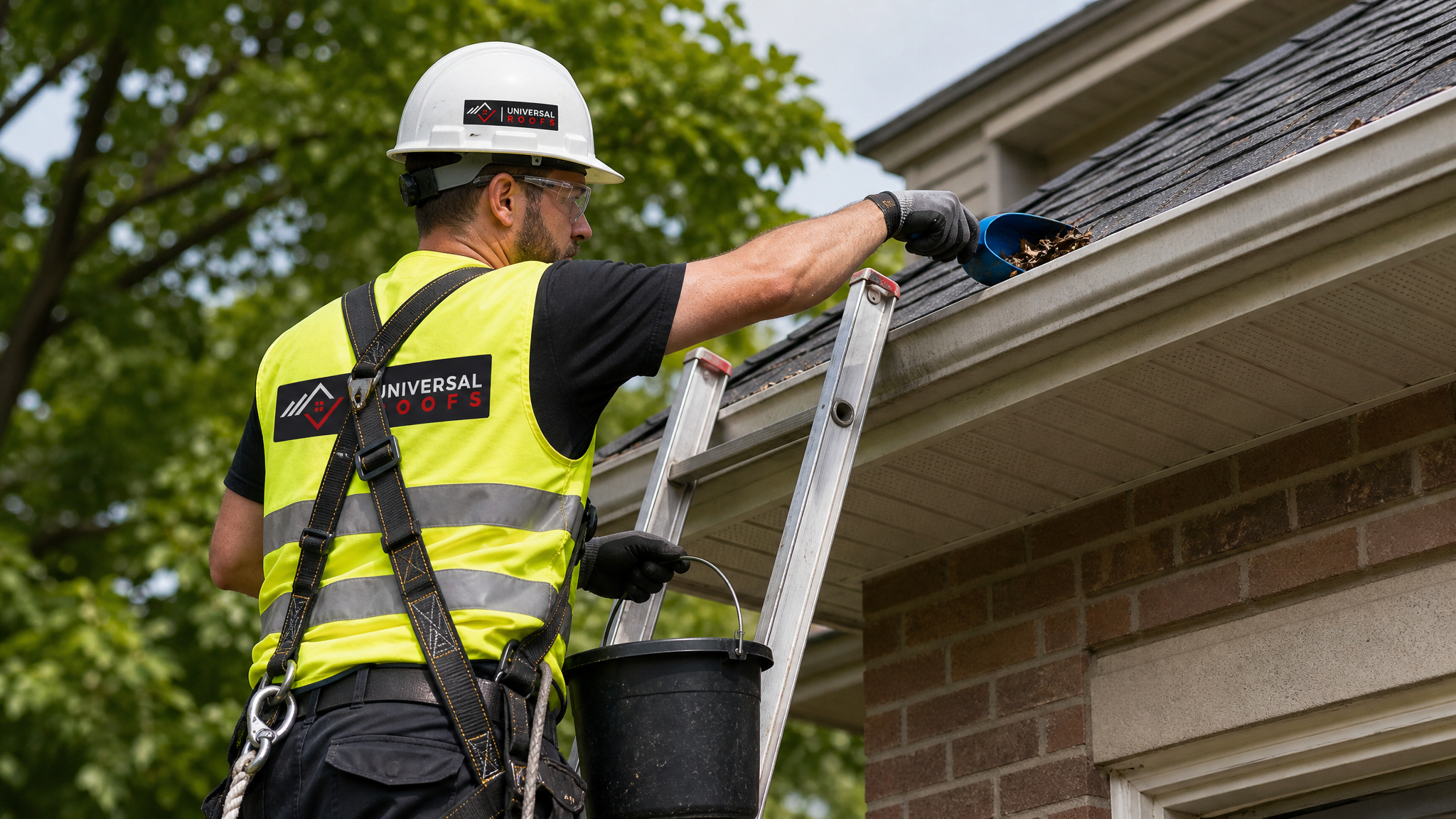
A sturdy gutter scoop is the starting point. Plastic scoops are lightweight, will not scratch aluminum troughs, and their narrow profile fits into standard five-inch gutters better than any hand you can cram in there. Pair it with a pair of durable work gloves rated for cuts, because wet leaf sludge often hides roofing grit, screws, and the occasional sharp branch. A collection bucket with a ladder hook keeps both hands free while you work, and a lightweight gutter brush or stiff hand broom clears the fine residue a scoop leaves behind.
For homeowners who would rather stay off the ladder entirely, a telescoping gutter wand that attaches to your garden hose is transformative. Modern versions extend to reach second-storey troughs from the ground and bend at the tip so you can flush debris toward the downspout. These ground-based gutter cleaning tools will not handle heavy, compacted muck, but for regular summer maintenance on a bungalow or a low two-storey they are often all you need. Rounding out the kit, a plumber’s auger or flexible drain snake clears blocked downspouts that no amount of flushing will shift.
| Essential Tool | Primary Use | Typical Price (CAD) | Best For |
|---|---|---|---|
| Plastic gutter scoop | Removing bulk leaves and sludge | $8 – $20 | Every homeowner |
| Cut-resistant work gloves | Hand protection from grit and edges | $15 – $35 | Every homeowner |
| Bucket with ladder hook | Hands-free debris collection | $20 – $40 | Ladder-based cleaning |
| Telescoping hose wand | Flushing troughs from the ground | $30 – $70 | Bungalows, low two-storeys |
| Flexible downspout auger | Clearing blocked downspouts | $25 – $55 | Persistent drainage clogs |
Ground-Based vs. Ladder-Based Gutter Cleaning Tools
The biggest decision you will make is whether to clean from the ground or from a ladder, and your choice of gutter cleaning tools follows directly from that. Both approaches have a place, and understanding the trade-offs helps you spend money wisely rather than buying gear you will never touch.
Ground-based tools keep both feet planted, which is a genuine safety advantage, especially for older homeowners or anyone uneasy on ladders. Telescoping wands, wet/dry vacuum gutter kits, and long-reach tongs let you work a two-storey trough without ever leaving the lawn. The limitation is control: you cannot see directly into the trough, so you are working partly by feel, and heavy compacted debris frequently resists a jet of water. On a home shaded by mature maples, ground-based gutter cleaning tools may leave a stubborn residue behind that only a hands-on scoop will fully clear.
Ladder-based tools give you full visual control and the leverage to lift out packed sludge, but they put you at height. If you go this route, a ladder stabiliser (also called a stand-off or stay) is non-negotiable. It holds the ladder off the wall, distributes weight across the roof edge instead of crushing the trough, and stops the sideways slip that causes most ladder falls. Never rest a ladder directly on an aluminum eavestrough; the metal is thin and will deform, and a bent trough is a drainage problem waiting to happen.
Power and Specialty Gutter Cleaning Tools
Once you have covered the basics, a handful of powered and specialty tools can turn a two-hour chore into a thirty-minute one. These are worth considering if you clean your own gutters two or three times a season, or if your lot is heavily treed and generates more debris than the average GTA property.
A wet/dry vacuum with a gutter attachment kit is the most popular upgrade. Curved plastic tubes extend the vacuum’s reach up to your troughs while you stand on the ground or a low step. They excel at dry leaves and lift damp debris well, though truly waterlogged sludge can clog the tubing. A pressure washer with a gutter-cleaning attachment blasts out compacted grime and is ideal for the fine, cement-like sediment that builds up over years, but it is messy and demands eye protection and care around older aluminum. For homeowners who want to avoid ladders altogether, gutter cleaning robots have matured considerably; these battery-powered units drive along the trough auger-first and chew through leaves, though they still struggle with corners and downspout openings.
Do not overlook camera-equipped inspection poles. A cheap telescoping pole with a phone clip, or a dedicated borescope on a rod, lets you see exactly what is happening in the trough and at the downspout mouth without climbing. This is invaluable for diagnosing whether a slow-draining section is clogged or whether the trough itself has lost its slope. Pairing the right specialty gutter cleaning tools with a good inspection routine means you fix the actual problem instead of guessing.
| Specialty Tool | How It Works | Strength | Limitation |
|---|---|---|---|
| Wet/dry vacuum kit | Suction through extension tubes | Fast on dry and damp leaves | Clogs on waterlogged sludge |
| Pressure washer attachment | High-pressure water jet | Clears compacted sediment | Messy; can dent thin aluminum |
| Gutter cleaning robot | Self-driving auger unit | Keeps you off the ladder | Weak at corners and outlets |
| Camera inspection pole | Live view from the ground | Accurate diagnosis | Does not remove debris |
| Long-reach gutter tongs | Grabbing clumps from below | No ladder required | Slow on heavy loads |
Matching Gutter Cleaning Tools to Your Roof Type
Your roof style shapes which gutter cleaning tools actually work on your home. A steep-pitched shingled roof, a low-slope addition, and a flat-roofed section each present different access and debris challenges, so a one-size-fits-all approach rarely delivers good results.
On a standard sloped asphalt-shingle roof, most of the debris is shed granules mixed with leaves, and a scoop plus a flushing wand handles it well. Homes with a flat roofing section behave differently: water moves slowly, debris settles rather than washing toward outlets, and internal or scupper drains can back up in ways a garden-hose wand will not touch. For flat and low-slope areas, a wet/dry vacuum and a downspout auger are usually more effective than pressure alone. If your home has skylights or roof penetrations, take extra care around the flashing, because aggressive scraping near those details is a common cause of leaks that later require a full roof replacement to trace and repair.
Roof height matters just as much as roof style. On a single-storey bungalow, ground-based gutter cleaning tools reach comfortably and there is little reason to climb. On a tall two-and-a-half-storey Toronto semi with a steep pitch, the geometry works against every ground tool, and this is precisely the situation where homeowners are best served by professional help rather than an over-extended ladder.
Safety Gear and Best Practices for Toronto Homeowners
No discussion of gutter cleaning tools is complete without the safety equipment that surrounds them. Falls from ladders send thousands of Canadians to hospital every year, and eavestrough cleaning is one of the most common triggers. The good news is that a modest investment in safety gear dramatically reduces the risk.
Start with the ladder itself: choose a fibreglass or aluminum extension ladder rated for your weight plus tools, set it at the correct one-to-four angle, and always maintain three points of contact. Add a stabiliser bar, wear non-slip footwear, and never stand above the second rung from the top. Eye protection is essential whenever you flush or pressure-wash, and gloves protect against both grit and the bacteria that thrive in decomposing leaf matter. If any part of the job requires you to lean, reach sideways, or work at genuine height, a fall-protection harness anchored properly is the professional standard for a reason.
Timing helps too. Clean on a dry, calm day when the troughs are not slick, avoid working alone so someone can steady the ladder and call for help if needed, and check the forecast so you are not caught out by a summer thunderstorm. Reading through a few honest customer reviews of local services can also give you a realistic sense of what a safe, thorough cleaning actually involves before you decide to tackle it yourself.
| Safety Item | Purpose | Priority | Notes |
|---|---|---|---|
| Ladder stabiliser bar | Prevents side slip; protects trough | Essential | Never rest ladder on the gutter |
| Fall-protection harness | Arrests a fall at height | High on steep or tall roofs | Requires a proper anchor point |
| Safety glasses | Shields eyes from debris and spray | Essential when flushing | Wrap-around style is best |
| Non-slip footwear | Grip on rungs and roof edge | Essential | Steel-toe adds impact protection |
| Cut-resistant gloves | Protects from grit and bacteria | Essential | Replace when worn |
When to Skip the Tools and Call a Professional
Owning quality gutter cleaning tools gives you real independence, but part of using them wisely is knowing when the job exceeds what any homeowner should attempt. There is no prize for cleaning your own troughs if it means balancing three storeys up on a windy afternoon.
Call a professional when your roof is tall or steeply pitched, when the eavestroughs are damaged or pulling away from the fascia, when you spot signs of rot or water staining behind the trough, or when downspouts remain blocked after augering. Professionals bring commercial-grade gutter cleaning tools, proper fall-protection systems, and the trained eye to catch small problems before they become expensive ones. A crew cleaning your gutters will often notice a lifted shingle, a failing seal around a vent, or an early fascia issue that a homeowner focused on scooping leaves would miss entirely.
The team at Universal Roofs serves homeowners across the GTA and combines eavestrough care with genuine roofing expertise, which means a single visit can address both drainage and any roof concerns it uncovers. You can learn more about our company and the neighbourhoods we serve throughout the Toronto area. For homeowners who value their weekends and their safety, handing off the ladder work is often the most sensible choice of all.
What are the most essential gutter cleaning tools for a first-time homeowner?
Can I clean my gutters without a ladder using ground-based tools?
How often should I use my gutter cleaning tools in Toronto?
Are pressure washers safe to use as gutter cleaning tools?
What safety gear should I pair with my gutter cleaning tools?
When should I stop using my own tools and hire a professional?
Get Expert Help With Your Gutter Cleaning Tools and Roof Care
The right gutter cleaning tools keep water moving away from your home, but even the best-equipped homeowner benefits from a trusted roofing partner who can handle the height, the hazards, and the roof issues that clogged troughs so often reveal. Universal Roofs combines thorough eavestrough care with full-service roofing knowledge, so a single visit protects your entire building envelope.
Call us today at (416) 732-2421 or request a free inspection to get started. If you have questions before booking, our FAQ page answers the ones we hear most often.
Universal Roofs proudly serves Toronto, Mississauga, Brampton, Vaughan, Markham, Oakville and the GTA since 2005.