
Almost every call for eavestrough repair Vaughan homeowners make in the autumn starts the same way: water is coming over the front of the trough during a heavy rain, and it did not do that last year. The instinct is to blame leaves. Sometimes that is the whole story. More often the leaves are only the trigger, and the real problem is that the system has quietly lost its pitch, its hangers have worked loose, or the fascia behind it has softened enough that nothing is holding properly any more.
September is the right month to deal with this. Ontario gets its heaviest sustained rainfall in the autumn, the leaf load is about to arrive, and an eavestrough that is already sagging will not survive the combination. This guide covers how to spot failing hangers and rotted fascia from the ground, what eavestrough repair Vaughan properties typically costs in 2026, and where the boundary sits between a fix and a full replacement of a run.
Why Eavestrough Repair Vaughan Homes Need Is An Autumn Priority
Vaughan is a municipality of two housing eras. Older village cores contain postwar and mid-century houses, many with original or first-replacement steel eavestroughs that are now well past the point where corrosion becomes the limiting factor. The much larger share of the city is covered by subdivisions built from the late 1980s through the 2000s and beyond, with big roof areas, complex rooflines, long trough runs and a great many inside and outside corners. Those long runs are exactly where pitch failures show up.
Autumn loading is the stress test. A trough that drains adequately in a summer shower behaves very differently when it is carrying wet leaves, standing water and the volume of a sustained October downpour. The weight of that load is what finally pulls a marginal hanger out of softened fascia, and once one hanger lets go, the ones either side of it carry more and follow. Booking eavestrough repair Vaughan homeowners have been putting off in September means the system is sound before that load arrives rather than after it has done its damage.
There is also an access argument. Once the weather turns, safe ladder work becomes harder and fascia repairs involving wood and paint need dry, mild conditions to be done properly. A fascia board replaced in November will not get a finish coat that cures. The window for doing eavestrough repair Vaughan properties need correctly, rather than patching it, closes at the end of the autumn.
Sagging Hangers And Lost Pitch
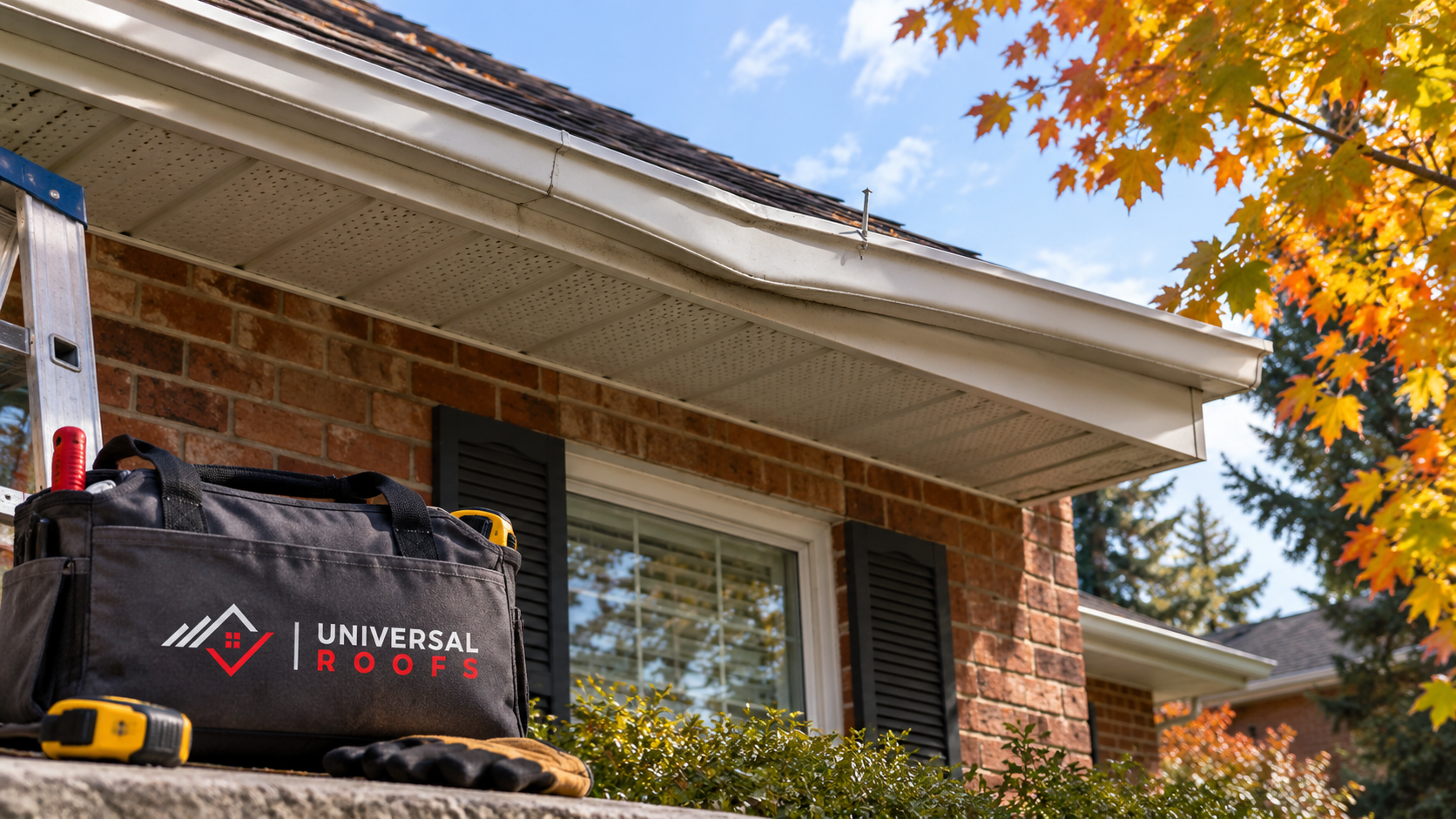
Most eavestrough repair Vaughan homeowners need starts with pitch. A trough is supposed to slope gently toward its outlet, roughly a quarter inch of fall over every ten feet. That is subtle enough that you cannot see it, but you can absolutely see when it is gone: water sits in the trough long after a rain, a dip appears in the middle of a run, or the front lip is visibly closer to the ground at one point than at the ends.
Two fastening systems turn up on eavestrough repair Vaughan jobs. Older homes use spikes and ferrules, a long nail driven through the front lip, through a tube spacer, and into the fascia and rafter tail. Spikes back out over time with thermal movement and the weight of seasonal loading, and once the head is proud of the trough by even a quarter inch the run has lost support. Newer homes use hidden hangers, a bracket that clips over the back and front of the trough and screws into the fascia. These are much better, but they still pull free when the wood behind them is compromised or when they were installed too far apart.
Spacing matters. Hangers every twenty-four inches is the practical standard for this climate. Builders frequently install them at thirty-six inches or more to save cost, which works until the first heavy seasonal loading and then does not. A large part of eavestrough repair Vaughan contractors perform on subdivision homes is simply adding hangers to close up spacing that was never adequate in the first place.
The fix depends on the underlying cause. If the fascia is sound, a sagging run is re-pitched by removing the old fasteners, snapping a level line, and installing new hidden hangers with structural screws at proper spacing. If the fascia has softened, no fastener will hold and the wood has to be addressed first, which is where a simple repair becomes a larger job.
Rotted Fascia: The Repair Behind The Repair
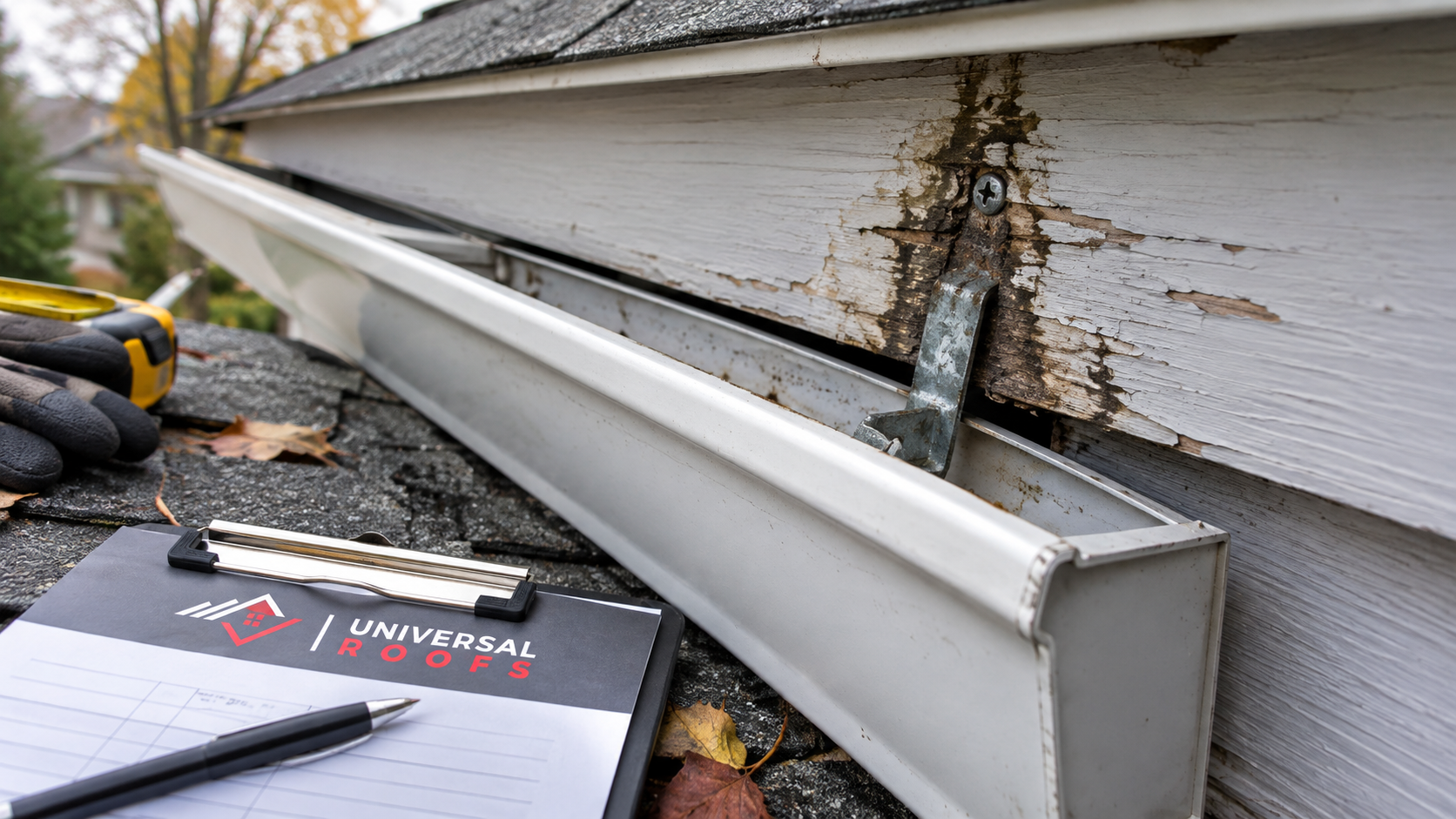
The hidden half of eavestrough repair Vaughan homes need is the fascia, the vertical board that closes the end of the rafter tails and carries the trough. On most homes in the area it is spruce or pine, sometimes capped with pre-finished aluminum. That aluminum capping is where a lot of trouble hides, because it looks perfect from the street while the wood behind it is saturated.
Rot behind an eavestrough repair Vaughan technician will find starts in one of three ways. Water overflowing the back of the trough runs down the face of the fascia. Water getting behind the trough, usually because drip edge is missing or is sitting behind the eavestrough instead of into it, wets the board continuously. Or the trough itself has a failed back seam and leaks directly onto the wood. In all three cases the symptom is the same: hangers that will not hold, a trough that keeps dropping no matter how many times it is re-secured, and eventually visible staining or peeling on the fascia.
| What you can see | Likely cause | Typical fix |
|---|---|---|
| Water sits in the trough hours after rain | Lost pitch from loose or over-spaced hangers | Re-pitch the run with new hidden hangers |
| Spike heads standing proud of the front lip | Spikes backing out, fascia no longer gripping | Convert to hidden hangers with structural screws |
| Water sheets down the fascia face during rain | Trough overflowing at the back, or back seam leak | Clear outlets, reseal back seam, check drip edge |
| Peeling paint or dark staining on the fascia | Chronic saturation of the board | Replace affected fascia sections, then re-hang |
| Trough pulls away from the wall at one end | Rotted fascia or missing rafter tail support | Replace fascia, sister the tail if needed, re-hang |
| Drips at a corner mitre or joint | Failed sealant or separated seam | Strip, clean and reseal, or replace the mitre |
A contractor who re-secures a trough into rotted fascia and leaves is selling you a repair that will fail again within a season. Ask directly whether the wood was probed. A screwdriver pushed into the fascia behind the trough tells you everything in three seconds, and any competent crew doing eavestrough repair Vaughan homes require will do that check before quoting.
Leaking Seams, Mitres And End Caps
Seam work is the other half of eavestrough repair Vaughan crews carry out. Continuous aluminum trough is rolled on site, so a straight run has no joints along its length. Every leak therefore occurs at a manufactured junction: an inside or outside corner mitre, an end cap, a downspout outlet, or a joint where two runs were coupled because the run exceeded the length of stock.
Every one of those junctions is sealed with a gutter-grade sealant that has a service life of roughly eight to fifteen years depending on exposure. South and west elevations fail first because of ultraviolet load. When a mitre starts dripping, the correct repair is to strip the old sealant completely, clean the aluminum with solvent, and apply new sealant to a properly prepared surface. Smearing fresh sealant over old failed sealant is the most common shortcut in eavestrough repair Vaughan homeowners pay for, and it typically buys a single season.
End caps are a related weak point. They are crimped and sealed, and they sit at the highest point of the run where debris accumulates, so they are wet longer than any other part of the system. Corroded steel eavestroughs almost always perforate at the end cap and outlet first.
2026 Costs For Eavestrough Repair In Vaughan
Pricing for eavestrough repair Vaughan contractors quote depends heavily on access. Work reachable from a step ladder at a single storey eave is inexpensive. The same repair at a third storey gable on a large detached home costs several times more because of setup, safety and time.
| Repair | Typical 2026 cost | What it covers |
|---|---|---|
| Re-secure and re-pitch a run | $180 to $420 per run | New hidden hangers, level line, fastening to sound fascia |
| Reseal a corner mitre or end cap | $90 to $180 per joint | Strip old sealant, clean, reseal properly |
| Replace a downspout with elbows | $150 to $320 each | New downspout, brackets, elbows and extension |
| Fascia board replacement | $22 to $45 per linear foot | Remove trough, replace wood, prime and re-hang |
| Replace a single run of 5 inch eavestrough | $11 to $18 per linear foot | New continuous trough, hangers, outlet and sealing |
| Full system replacement, typical detached home | $2,400 to $5,200 | All runs, downspouts, mitres and new hangers |
Minimum service call charges are normal and usually sit between $150 and $250, which means a single mitre reseal rarely justifies a dedicated visit. If you have several small items, batch them. Most companies handling eavestrough repair Vaughan wide will price a combined visit far better than three separate ones.
Downspouts, Sizing And Where The Water Goes
A trough that is correctly hung and still overflows in heavy rain has a capacity problem rather than an eavestrough repair Vaughan issue. Standard residential eavestrough is five inches with a two by three inch downspout. Six inch trough with a three by four inch downspout carries substantially more water, and on large roof areas with long runs and few outlets it is often the right answer.
Outlet count is usually the real issue. A single downspout serving a very long run will be overwhelmed regardless of trough size. As a rough guide, one outlet per thirty to forty feet of run is sensible on typical residential roof areas, and steep pitches concentrate flow faster so they benefit from more. Adding an outlet and a downspout is frequently cheaper and more effective than upsizing an entire system.
| Configuration | Downspout size | Roof area one outlet handles | Best suited to |
|---|---|---|---|
| 5 inch K-style trough | 2 x 3 inch | Roughly 550 to 700 sq ft | Bungalows and standard subdivision homes |
| 5 inch K-style trough | 3 x 4 inch | Roughly 900 to 1,100 sq ft | Long runs with limited outlet locations |
| 6 inch K-style trough | 3 x 4 inch | Roughly 1,200 to 1,500 sq ft | Large detached homes, steep pitches |
| 6 inch trough, oversized outlet | 3 x 4 inch, two outlets per run | Splits the run between outlets | Very long runs and large valley catchments |
| Added mid-run outlet on existing 5 inch | 2 x 3 inch | Halves the load on the original outlet | The cheapest fix for chronic overflow |
Discharge matters as much as collection. A downspout that dumps against the foundation defeats the purpose of the system. Extensions should carry water at least six feet from the wall onto a graded surface that slopes away. Where downspouts tie into buried drain lines, those lines silt up over the years and need flushing, and if one has failed the downspout should be disconnected and run to grade instead. Anyone quoting eavestrough repair Vaughan homeowners request should look at where the water ends up, not just at the trough.
What A Proper Autumn Inspection Covers
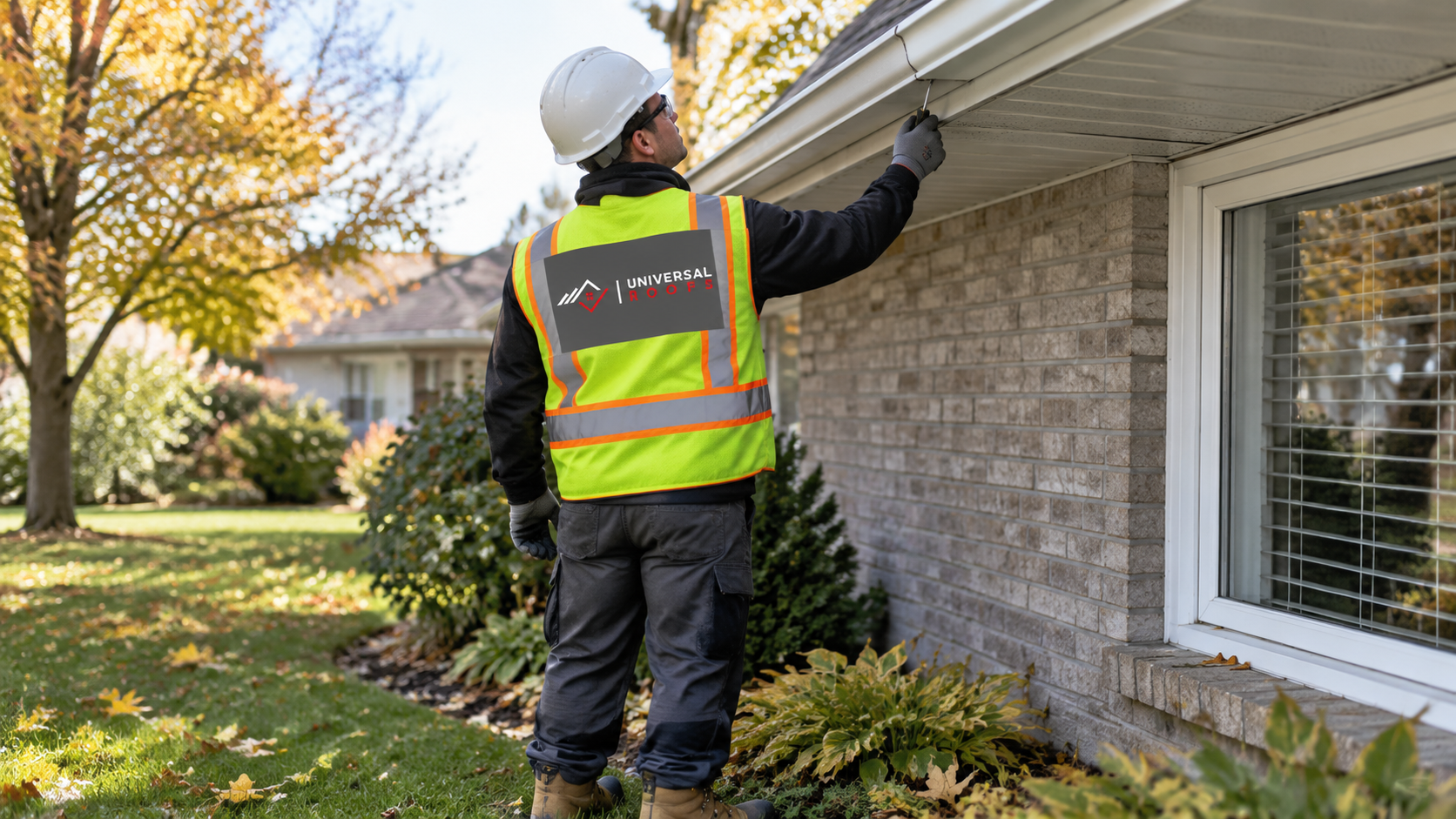
Before the heavy rains, a thorough eavestrough repair Vaughan assessment should cover the following. Several of these are visible from ground level during a heavy rain, and a contractor should confirm the rest safely at the eave.
- Pitch and standing water. Any trough holding water an hour after rain has lost fall.
- Hanger condition and spacing. Every hanger tested, spacing confirmed at roughly twenty-four inches.
- Fascia integrity. The wood probed behind the trough, particularly at the ends of runs.
- Seams, mitres and end caps. Sealant condition checked on every joint, not just the ones that drip.
- Drip edge relationship. The roof edge flashing must deliver water into the trough, not behind it.
- Outlets and downspouts. Each one flushed with water and watched at the discharge point.
- Discharge and grading. Extensions in place, water carried away from the foundation.
If that inspection turns up drip edge problems or a saturated roof edge, the issue has crossed from eavestrough work into roofing work. A targeted roof repair to correct the edge detail is what actually stops the water, and our Vaughan roofing services page explains how those assessments are handled locally. Eavestrough symptoms and roof edge problems overlap constantly, which is why it helps to have one contractor looking at both.
Frequently Asked Questions
How do I know if I need eavestrough repair Vaughan crews should handle, or just a cleaning?
Can a sagging eavestrough be re-hung, or does it need replacing?
How much does eavestrough repair cost in Vaughan?
Why does my eavestrough keep coming loose after being fixed?
Should I upgrade from five inch to six inch eavestrough?
How long should this work take?
Book Eavestrough Repair Vaughan Homeowners Can Count On
Getting this done before the heavy autumn rain is the difference between a few hundred dollars of hanger and sealant work and a fascia and roof edge repair next spring. Universal Roofs works from its Toronto base throughout Vaughan and York Region, and because we are roofers, we assess the drip edge and roof edge condition at the same time rather than treating the trough in isolation.
Call us today at (416) 732-2421 or request a free consultation. We will check pitch, hangers, fascia, seams and downspout flow, then tell you plainly what needs doing now and what can wait.
Universal Roofs proudly serves homeowners in Vaughan and across the Greater Toronto Area.