
An eavestrough heating cable is one of those products that homeowners either swear by or regret buying. Installed in the right place, for the right reason, it keeps a meltwater path open along the eaves and down the downspouts so water drains instead of backing up. Installed as a cure-all, it runs up the electricity bill and hides a roof problem that keeps getting worse. This guide covers the types of cable, the layouts that actually work, what the electrical side involves, and why autumn is the time to decide.
We install and service eavestroughs and roofs, and we also get called to the aftermath of ice damming every year. That gives us a fairly balanced view: heating cables help in specific spots, but they are rarely the whole answer.
What an Eavestrough Heating Cable Actually Does
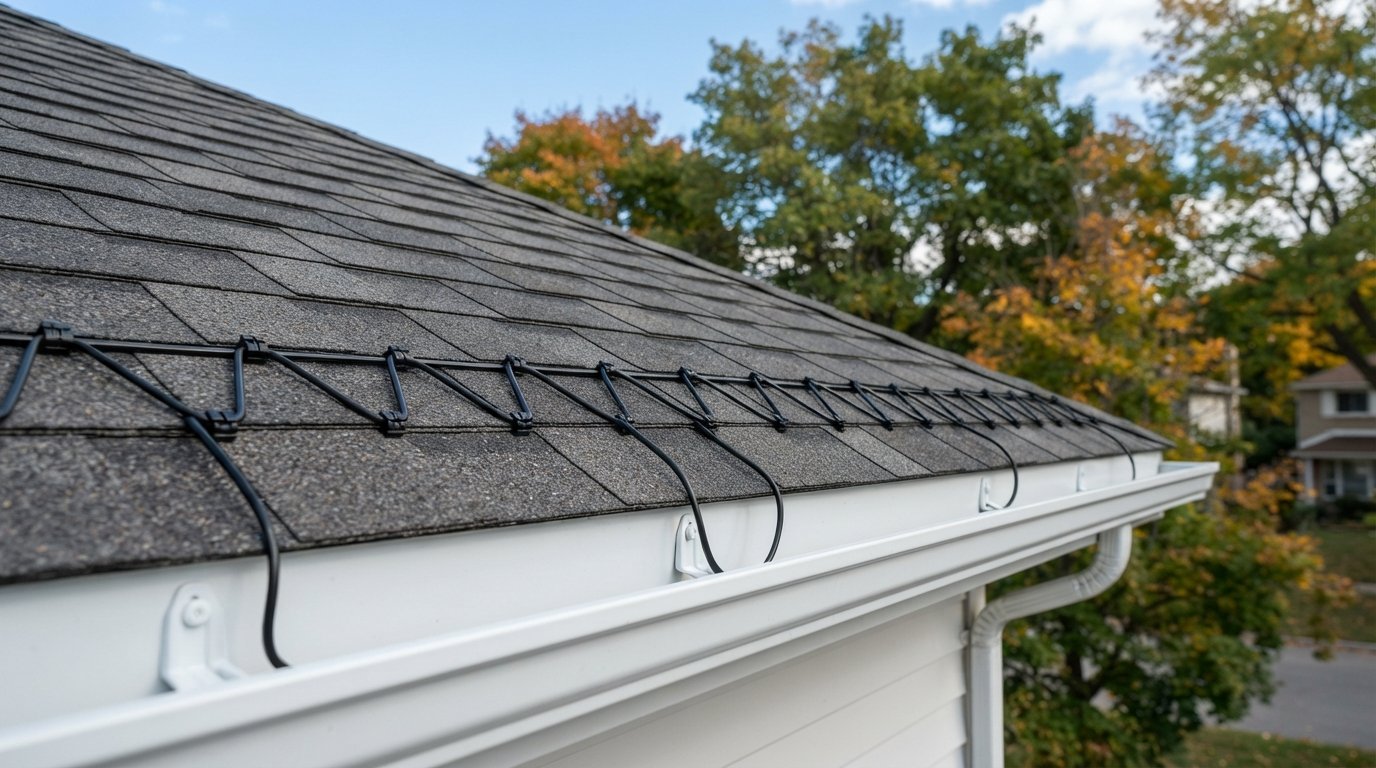
An eavestrough heating cable does not melt all the snow off your roof. It creates a warm path. Meltwater coming down the roof reaches that path, stays liquid, and drains through the eavestrough and down the downspout instead of refreezing at the cold edge of the roof.
That distinction matters. If you expect a bare roof, you will be disappointed. If you expect a channel that lets water escape from a trouble spot, a properly installed cable can do that well.
Where they help most:
- Chronic ice dam spots such as the eaves below a valley, over a bay window or above an entrance.
- North-facing eaves that stay shaded and cold.
- Downspouts that freeze solid, so the eavestrough fills and overflows.
- Low-slope transitions where a sloped roof meets a flatter section and water slows down.
- Heritage or complex roofs where fixing the underlying attic heat loss is difficult or expensive.
If you already have leaks from past ice damming, the roof itself may need attention before anything else. Our team handles roof repairs after ice dam and eave leaks, and a repair plus attic fixes is often a better first step than cable.
Self-Regulating Versus Constant Wattage Cable
There are two main kinds of heating cable, and the difference is important for safety, running cost and how the cable can be laid out.
Self-regulating cable
A self-regulating cable has a conductive polymer core between two bus wires. As the cable cools, the core allows more current to flow and it puts out more heat. As it warms, output drops. Each section of the cable responds to its own surroundings, so a length lying in cold meltwater produces more heat than a length in a warmer spot. Self-regulating cable is usually cut to length on site and terminated with a kit, and it is often hardwired to a dedicated circuit with a controller.
Constant wattage cable
Constant wattage cable puts out the same heat per metre whenever it is on, regardless of conditions. It is usually sold as preset lengths with a plug and clips, which is why it is common in retail kits. It is less expensive up front but less forgiving: the manufacturer instructions for these products typically prohibit the cable from crossing or touching itself, because overlapping sections can overheat.
| Feature | Self-regulating | Constant wattage |
|---|---|---|
| Heat output | Adjusts along its length to local temperature | Fixed whenever powered |
| Overlap tolerance | Generally more tolerant; check the manufacturer’s instructions | Usually must not cross or touch itself |
| Length | Cut to fit on site with termination kits | Fixed preset lengths |
| Typical connection | Hardwired to a dedicated circuit with a controller | Often plugs into an outdoor receptacle |
| Up-front cost | Higher | Lower |
| Running cost | Lower tendency to waste energy, especially with a controller | Uses full power whenever on; needs careful switching |
| Best for | Permanent installations, longer runs, downspouts | Small, simple areas and short-term fixes |
Whichever type you choose, use a product certified for use in Canada and rated for roof and eavestrough de-icing, and follow the installation instructions for that exact product.
Layouts: Zig-Zag, In-Trough and Downspout Runs
Getting the layout right is what separates an eavestrough heating cable that works from one that just warms a few inches of shingle.
Zig-zag along the roof edge
The classic pattern runs the cable up and down in triangles along the lower edge of the roof, held by clips designed for shingles. The triangles create warm lines that meltwater can follow down past the cold overhang. The height of each triangle usually extends a little past the exterior wall line, so the warm path reaches from the heated part of the roof down to the eave. Manufacturer instructions set the spacing and height.
Important details:
- Clips should hold the cable without nailing through the shingles or damaging them.
- The cable should not be pinched under shingle tabs or bent sharply.
- The bottom loops should drop into or just over the eavestrough so water has a clear route.
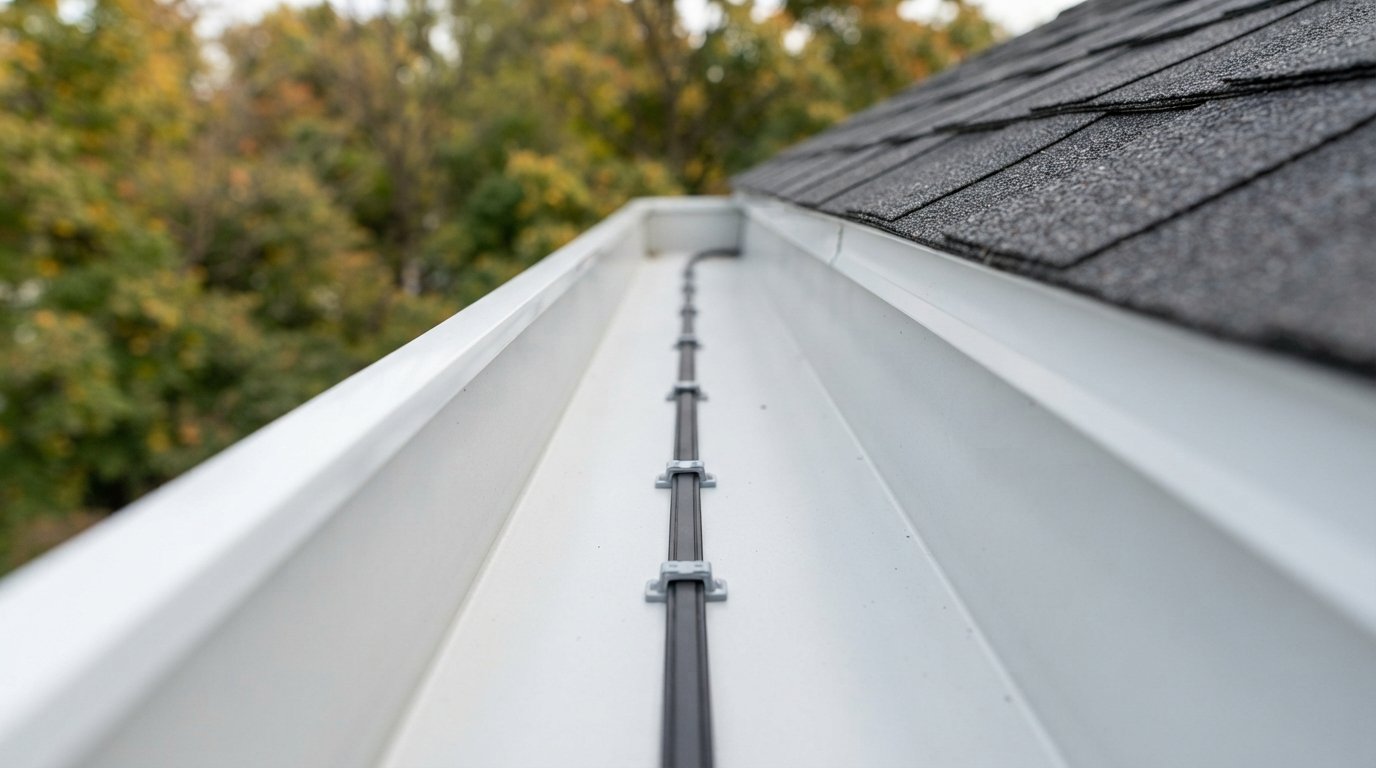
In-trough runs
A run along the bottom of the eavestrough keeps a channel open so water can flow to the outlet. On its own, an in-trough cable does not stop ice forming on the roof edge above, but paired with a zig-zag it completes the path.
Downspout cable
This is the step people skip, and it is often the most important. If meltwater reaches a frozen downspout, it stops. A cable dropped down inside the downspout keeps it clear. It needs to run to the bottom, and ideally past the outlet, so water can leave the downspout rather than freeze at the elbow. If the downspout goes into an underground pipe, water can freeze beyond the reach of the cable, so discharge above ground is often better where heating cable is used.
The Electrical Side, Stated Plainly
Heating cable is an electrical appliance installed outdoors, next to water, on or near a roof. That combination means the electrical details matter as much as the layout.
- Ground-fault protection. Heating cable circuits generally require ground-fault protection. A licensed electrician will know what applies to your installation.
- Proper circuit and receptacle. A plug-in kit should connect to a suitable outdoor receptacle with a weatherproof cover, not an extension cord draped across the siding. Larger or hardwired systems usually need their own circuit.
- Permits and licensed work. In Ontario, electrical work is regulated by the Electrical Safety Authority (ESA). New circuits and hardwired connections are generally work for a licensed electrical contractor, with the required ESA notification. Confirm the current requirements with ESA or a licensed electrician before starting.
- Controls. A controller or thermostat switches the cable on only when conditions call for it. Without controls, cables often end up either left on for weeks or forgotten until ice has already formed.
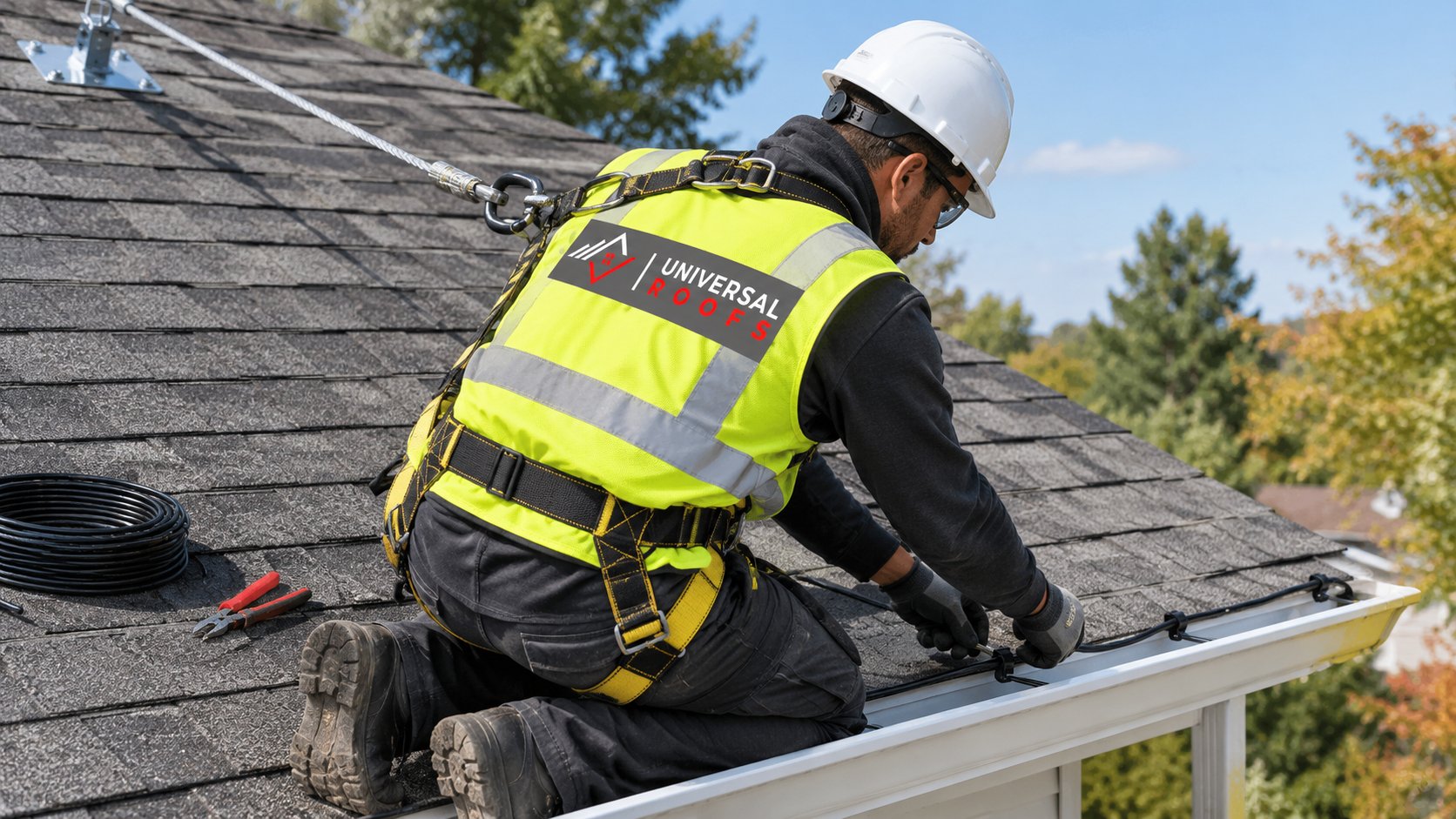
In practice, many installations split the work: the roofing or eavestrough contractor handles the cable layout and clips on the roof, and a licensed electrician handles the power supply and connections.
Why Autumn Is the Time to Install an Eavestrough Heating Cable
Every eavestrough heating cable job goes better before the freeze-up. Early autumn has several practical advantages:
- Eavestroughs can be cleaned first. Leaves and granules under a cable trap moisture and block the channel the cable is meant to keep open.
- Shingles are still pliable. Clips go on without cracking cold shingle edges.
- The roof is dry. Safe footing and good adhesion for any clips that use adhesive.
- Electricians have time. Once the cold arrives, everyone wants cable installed at the same time.
- You can test it. Running the system on a cool day confirms the circuit, controller and ground-fault protection work before you need them.
Crews doing roofing, eavestroughs and attic work across Durham Region and the wider GTA usually pair cable installation with an eavestrough clean and a check of the downspouts, because a cable cannot help if the outlet it drains to is blocked.
Cables Treat Symptoms: The Attic Is Usually the Cause
This is the part we tell every client. Ice dams form because heat from the house warms the roof deck, snow melts on the warm section, and the water refreezes at the cold eave. That heat almost always comes from the attic: air leaks from the house, thin insulation, or poor ventilation.
An eavestrough heating cable does nothing to stop that heat loss. It only helps the resulting meltwater escape. If the attic problem is significant, you will keep paying for electricity to manage a symptom, and moisture from the leaking warm air may still be causing trouble on the underside of the roof.
So the usual order of priorities is:
- Air seal the attic floor: hatches, pot lights, plumbing and wiring penetrations, bathroom fans.
- Top up insulation to a sensible depth.
- Restore ventilation: clear soffit intake and make sure exhaust is adequate.
- Protect the roof edge with proper eave membrane at the next re-roof.
- Use heating cable for the spots that still need it, such as valleys, shaded eaves and frozen downspouts.
Many houses end up needing cable in one or two places rather than along every eave once the attic is addressed.
Costs and Common Mistakes
The costs below are broad estimates only. Prices vary with roof height, access, the length of cable, the type of cable and the electrical work required.
| Option | What it usually involves | Typical range (estimate, CAD) | Common mistakes |
|---|---|---|---|
| Plug-in gutter heat cable kit for one area | Constant wattage cable, clips, installation on one eave section | Often falls around $200 to $600 installed, depending on access | Overlapping the cable, using an indoor extension cord, no switching |
| Downspout cable only | Cable dropped through one or two frozen downspouts | Often falls around $150 to $500 per downspout, depending on setup | Cable not reaching the bottom, water freezing in underground pipe |
| Self-regulating system on several eaves | Cut-to-length cable, zig-zag and in-trough runs, downspouts | Often falls around $1,000 to $3,500 before electrical work | Poor clip spacing, cable pinched under tabs |
| Electrical supply and controller | Dedicated circuit, ground-fault protection, controller, ESA notification | Priced by a licensed electrician; varies with distance to the panel | Skipping controls, unlicensed wiring |
| Attic air sealing and insulation | Fixing the heat loss that causes ice dams | Priced by the attic; often the better long-term investment | Assuming cable makes attic work unnecessary |
A gutter heat cable left on constantly through the colder months can use a noticeable amount of electricity, which is another reason a controller and a targeted layout matter.
Looking After an Eavestrough Heating Cable Year to Year
An eavestrough heating cable is not a set-and-forget item. A short routine each autumn keeps it safe and useful:
- Inspect from the ground first. Look for loops that have slipped out of their clips, sections hanging off the roof edge, or cable pulled tight across a corner.
- Clean the eavestroughs around it. Debris packed around the cable holds water against it and blocks the channel it is meant to keep open. Clean carefully so tools do not nick the jacket.
- Check the jacket and connections. Cracks, crushed spots or damage from ladders and squirrels are reasons to have a section replaced, not taped.
- Test the controller and ground-fault protection on a cool autumn day, before you need the system.
- Replace missing clips with the type the manufacturer specifies, not nails or screws through the shingles.
If an eavestrough heating cable is ever being replaced during a re-roof, it is a good moment to reconsider whether that area still needs it after any attic improvements.
What to Ask Before Installing
| Question | Why it matters |
|---|---|
| Where exactly will the cable go, and why there? | Cable should target problem areas, not every eave by default |
| Self-regulating or constant wattage, and which certified product? | Affects safety, overlap rules, running cost and how it is wired |
| Will the downspouts be included? | A clear path to the ground is essential |
| Who will handle the electrical work and ESA notification? | Hardwired circuits are regulated electrical work |
| What controller or switch will run it? | Prevents wasted energy and forgotten cables |
| Has the attic been checked for air leaks and insulation? | Cable treats the symptom; the attic is usually the cause |
A good contractor will be comfortable telling you when an eavestrough heating cable is not the best answer for your house.
Frequently Asked Questions
Do heating cables prevent ice dams?
Is self-regulating cable worth the extra cost?
Do I need an electrician?
Should the cable go down the downspout?
When is the best time to install heating cable?
Can I just leave the cable on all season?
Plan Your Eavestrough Heating Cable Before Freeze-Up
If you have a spot that ices up every year, now is the time to decide how to handle it. Universal Roofs can inspect your roof, eavestroughs and attic, tell you whether cable makes sense and where, and fix the underlying heat loss where we can. Call us today at (416) 732-2421 or request a free estimate.
Serving homeowners across Durham Region and the wider GTA with roofing, eavestroughs and attic work.