
Dark streaks, green patches, and grimy black staining across a roofline are more than a cosmetic nuisance for GTA homeowners. That discolouration is usually Gloeocapsa magma, an airborne algae that feeds on the limestone filler in asphalt shingles, along with moss and lichen that take hold in shaded, north-facing sections of the roof. Left untreated, these organisms trap moisture against the shingle surface, accelerate granule loss, and can shave years off a roof’s lifespan. The instinct many homeowners have is to reach for a pressure washer and a jug of bleach, but that combination is one of the fastest ways to void a shingle warranty, kill the landscaping below, and send chlorinated runoff into storm drains.
Eco friendly roof cleaning solves the same problem without the collateral damage. The right low-impact method removes algae, moss, and lichen while protecting shingle granules, garden beds, pets, and the municipal water system that eventually receives your runoff. In the Toronto area, where freeze-thaw cycles already stress roofing materials and where many municipalities now regulate stormwater discharge from residential properties, choosing a gentle, biodegradable cleaning approach is not just an environmental preference. It is a practical way to protect your investment.
This guide walks through the four best eco friendly roof cleaning solutions available to homeowners today, how each one works, what it costs, when to use it, and when the smarter move is to bring in a professional. If your roof has more than surface staining, our roof repair team can assess whether the algae has caused underlying damage that cleaning alone will not fix.
Why Roof Algae, Moss, and Lichen Are So Common in the GTA
Southern Ontario’s climate is close to ideal for algae growth. Humid summers, frequent rain, and roofs that stay shaded by mature trees for large parts of the day create the damp, low-light conditions Gloeocapsa magma needs to spread. The algae travels on wind currents and bird activity from roof to roof, which is why entire streets in neighbourhoods across Toronto, Mississauga, and Vaughan often show staining on the same north-facing slopes at roughly the same time.
Moss is a slightly different problem. It typically establishes itself in areas where debris, pine needles, or leaf litter has been allowed to accumulate, holding moisture against the shingle mat. Once moss gets a foothold, its root-like rhizoids work under shingle tabs and lift them slightly, which is exactly the kind of gap that lets wind-driven rain find its way into the roof deck. Lichen, a combination of fungus and algae, is more stubborn still and tends to show up on older roofs or in areas with poor airflow, such as valleys and around chimneys.
None of these organisms are purely cosmetic. Algae staining absorbs more solar heat than clean shingles, which can modestly raise attic temperatures in summer. Moss and lichen physically degrade the shingle mat over time. If your attic already runs hot or you have noticed uneven shingle wear, it is worth having our team look at your attic ventilation at the same time as any roof cleaning, since poor airflow is one of the underlying reasons algae and moss return year after year.
What Makes a Roof Cleaning Solution Genuinely Eco Friendly
Not every product marketed as “green” or “safe” actually is. A genuinely eco friendly roof cleaning solution should meet several criteria: it breaks down into harmless compounds after use, it will not bleach or kill grass, shrubs, and garden beds when it runs off the roof edge, it is safe for pets and children who may be in the yard during or shortly after application, and it does not require high-pressure equipment that can strip protective granules from asphalt shingles.
Chlorine bleach fails most of these tests. While it does kill algae quickly, it is corrosive to gutters and metal flashing, toxic to plants, and produces chlorinated byproducts in runoff that many municipalities specifically discourage homeowners from allowing into storm sewers. The four methods below were selected because they balance real cleaning effectiveness with a genuinely lower environmental footprint.
| Cleaning Method | Main Active Ingredient | Environmental Impact | Best For |
|---|---|---|---|
| Sodium percarbonate soft wash | Oxygen bleach (sodium percarbonate) | Low — breaks down to soda ash, water, oxygen | Widespread algae staining |
| Diluted white vinegar treatment | Acetic acid | Very low — fully biodegradable | Light staining, spot treatment |
| Plant-based enzyme cleaners | Enzymatic surfactants | Low — non-caustic, no bleaching | Moss and lichen removal |
| Zinc or copper control strips | Metallic ion runoff | Low — passive, no chemical application | Long-term prevention |
1. Sodium Percarbonate Soft Washing
Sodium percarbonate, often sold as “oxygen bleach,” is the closest thing the roofing industry has to a gold standard for eco friendly roof cleaning. Unlike chlorine bleach, it breaks down into soda ash, water, and oxygen once it has done its work, leaving behind no persistent residue that can harm plants or waterways. It is the active ingredient professional soft washing crews use because it kills algae, moss spores, and mildew on contact without requiring the abrasive scrubbing or high water pressure that damages shingle granules.
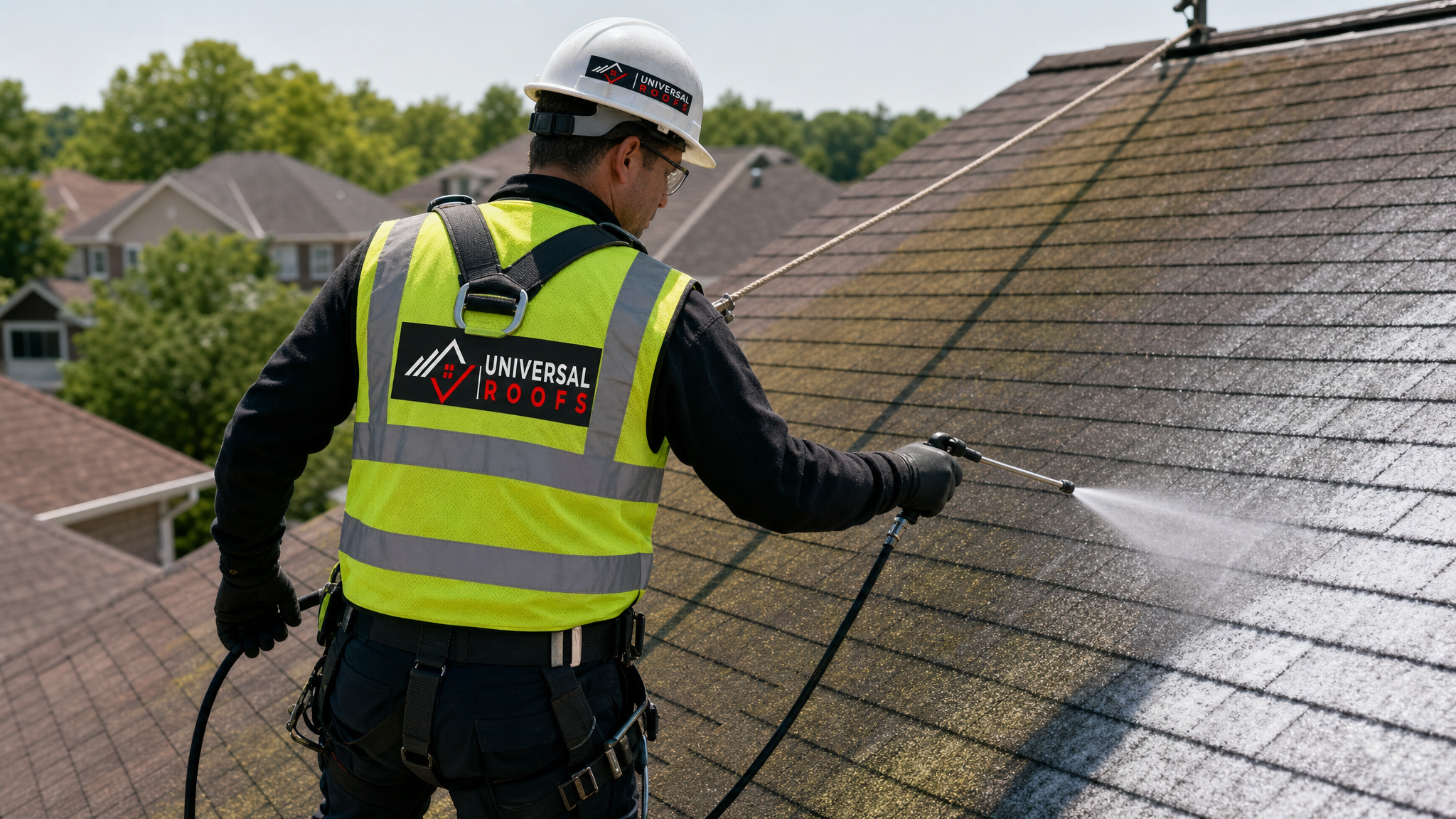
The technique matters as much as the chemical. Soft washing applies the sodium percarbonate solution at low pressure, typically under 100 psi, using a wide fan-tip nozzle. The solution is left to dwell on the roof surface for ten to twenty minutes so it can fully penetrate the algae colonies, then it is rinsed with a gentle low-pressure rinse rather than blasted off. Homeowners attempting this themselves often make the mistake of pairing a good product with a pressure washer, which strips granules and can drive water up under shingle tabs.
Before applying any soft wash solution, the surrounding landscaping should be pre-wetted and covered where possible, and downspouts should be temporarily diverted away from garden beds. Professional crews also tarp sensitive plants and rinse foliage immediately after the roof rinse to prevent any residual film from sitting on leaves in direct sun, which can cause minor leaf burn even with a biodegradable product.
2. Diluted White Vinegar Treatment
For homeowners who want the simplest, most widely available option, a diluted white vinegar solution is a legitimate eco friendly roof cleaning method for light to moderate algae staining. Vinegar’s acetic acid disrupts the cell structure of algae and mildew, and because it is a food-grade product, it poses essentially no risk to pets, children, or garden beds even in fairly high concentrations.
A typical DIY mixture combines one part white vinegar with one part water in a pump garden sprayer, applied to affected areas and left to dwell for fifteen to thirty minutes before a gentle rinse with a garden hose. Some homeowners increase the vinegar ratio for stubborn staining, though full-strength vinegar is rarely necessary and can accelerate wear on rubber gaskets and metal fasteners if used repeatedly.
The main limitation of vinegar is depth of penetration. It works well on surface algae but struggles against established moss colonies with root structures already lodged under shingle tabs, and it offers essentially no residual protection against regrowth. Vinegar treatments are best thought of as a maintenance step between more thorough soft washes, ideal for homeowners who want to knock back light staining on their own without hiring a crew for every touch-up.
| Staining Severity | Recommended Method | Typical Dwell Time | Repeat Frequency |
|---|---|---|---|
| Light surface streaking | Diluted vinegar spray | 15–30 minutes | Every 6–12 months |
| Moderate algae coverage | Sodium percarbonate soft wash | 10–20 minutes | Every 2–3 years |
| Moss with root penetration | Enzyme cleaner + manual removal | 20–40 minutes | Every 1–2 years |
| Heavy lichen colonies | Professional soft wash with enzyme boost | 30+ minutes | As assessed |
3. Plant-Based Enzyme Cleaners
Enzyme-based roof cleaners take a different chemical approach entirely. Rather than oxidizing or bleaching organic growth, these formulas use surfactants and biological enzymes that break down the cell walls and root structures of moss, lichen, and algae so they can be rinsed away, or in some cases simply lift off during the next heavy rain. Because the active ingredients are biological rather than caustic, enzyme cleaners are considered among the gentlest options for roofs with delicate or aging shingles, and they carry a lower risk of any bleaching or colour change to the shingle surface.
Enzyme cleaners tend to perform best on moss and lichen specifically, since the enzymes target the organic tissue directly rather than relying on surface contact alone. Application typically involves a low-pressure sprayer, a longer dwell time than oxygen bleach treatments, and in cases of thick moss growth, a soft-bristle brush pass to loosen material that the enzymes have already broken down. Never use a wire brush or stiff-bristle deck brush on asphalt shingles, since these will tear granules loose regardless of how gentle the chemical treatment was.
The tradeoff with enzyme cleaners is speed. They generally work more slowly than oxygen bleach, and heavy infestations may need a second application two to three weeks after the first. For homeowners managing a moss problem that has been building for several seasons, pairing an enzyme treatment with a professional inspection is worthwhile, since moss that has lifted shingle tabs may have already allowed moisture underneath. If your roof is approaching the end of its service life, our team can advise whether cleaning is still worth the investment or whether replacement makes more financial sense.
4. Zinc and Copper Control Strips for Long-Term Prevention
The fourth eco friendly solution is not a cleaning product at all, it is a prevention system. Zinc or copper control strips are thin metal strips installed just below the ridge line on either side of the roof. Each time it rains, trace amounts of zinc or copper ions wash down the roof slope with the water, and those metallic ions are toxic to algae, moss spores, and lichen at the microscopic level while remaining completely safe for humans, pets, and most garden plants in the low concentrations involved.
This method is entirely passive once installed. There is no chemical application, no scheduled maintenance treatment, and no runoff beyond the trace mineral content already naturally present in many municipal water supplies. Control strips are most effective as a preventive measure on a freshly cleaned roof, since they are designed to stop new algae colonies from establishing rather than removing heavy existing growth. Homeowners who have just had a soft wash performed often install control strips at the same time to extend the interval before the next full cleaning is needed, sometimes stretching it from two to three years out to five or more.
Copper strips tend to offer slightly broader-spectrum protection and last longer than zinc, though they cost more upfront. Both metals are widely used across the GTA specifically because our climate’s frequent rainfall keeps the strips actively working through most of the year, unlike drier regions where control strips see less consistent rain to carry the protective ions down the roof slope.
DIY Roof Cleaning vs. Hiring a Professional
Every one of the four methods above can technically be attempted by a homeowner, but roof cleaning carries real risk that goes beyond the chemistry. Working at height on a sloped, often wet shingle surface is inherently dangerous, and ladder-related falls are among the most common home maintenance injuries reported every year. There is also a real risk of causing damage that costs more to fix than the algae staining ever did.
Pressure washers are the single biggest source of DIY roof damage. Even homeowners who buy the correct eco friendly chemical often reach for a gas pressure washer out of habit, and psi levels above 1,500 will strip granules from asphalt shingles almost immediately, exposing the asphalt mat underneath to UV degradation. Improper harness use, missed flashing points, and walking directly on brittle older shingles are other common causes of accidental damage during amateur cleaning attempts.
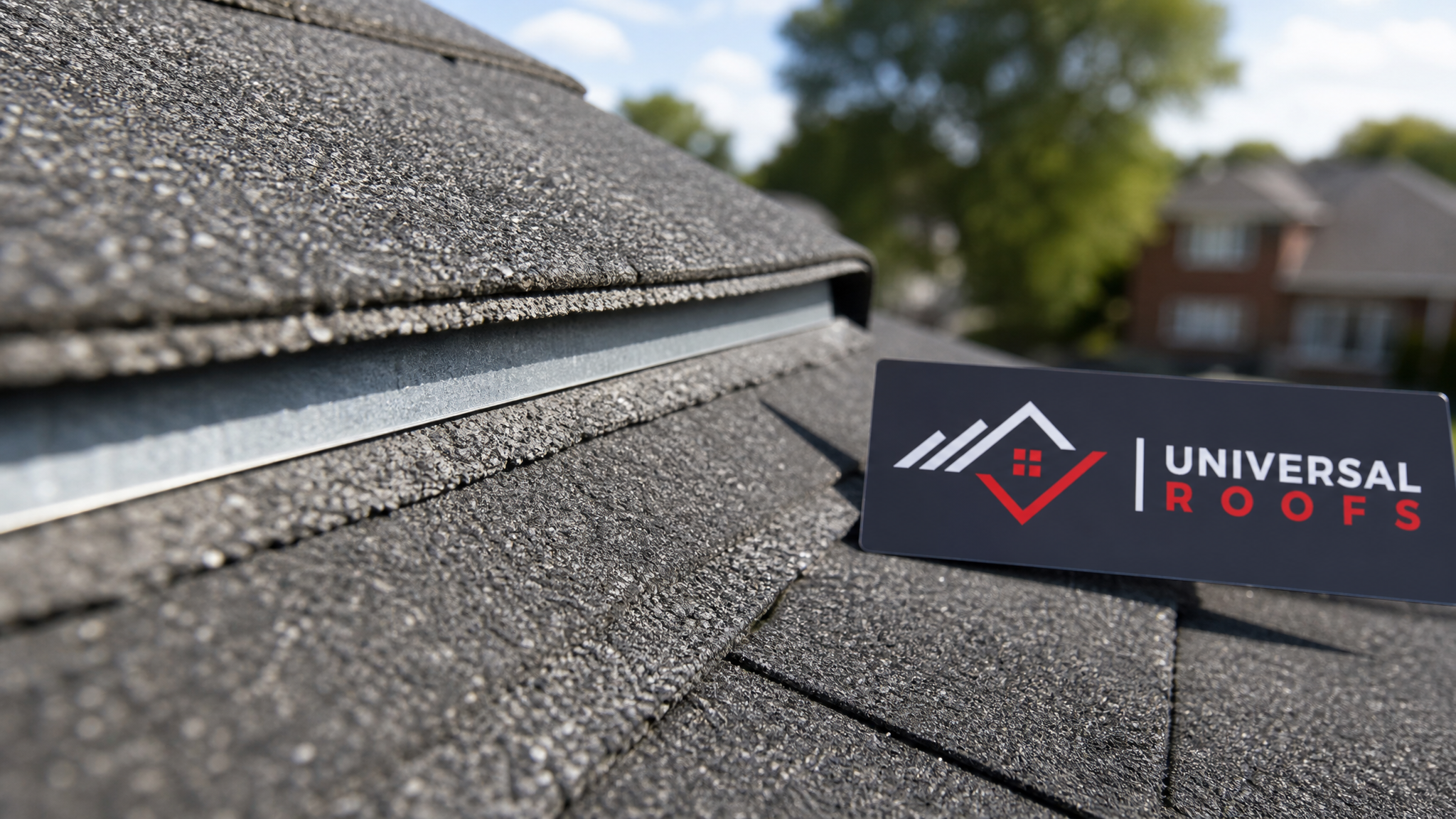
A professional soft washing crew brings calibrated low-pressure equipment, commercial-grade biodegradable chemical concentrates, proper fall protection, and the experience to identify problem areas, like lifted flashing or already-compromised shingles, before they become leaks. If you are unsure whether your roof’s condition still justifies cleaning versus repair, our roof repair specialists can give you a straightforward answer during the same visit.
| Factor | DIY Cleaning | Professional Soft Washing |
|---|---|---|
| Equipment cost | $50–150 for sprayer and chemicals | Included in service price |
| Typical total cost (average GTA home) | $50–150 | $350–650 |
| Fall protection | Rarely used | Harness, rope, and anchor points standard |
| Risk of shingle damage | Moderate to high | Low, calibrated low-pressure equipment |
| Warranty consideration | May void shingle manufacturer warranty | Typically compliant with manufacturer guidelines |
Preventing Algae and Moss Regrowth Between Cleanings
Cleaning a roof without addressing the conditions that let algae and moss thrive in the first place is a temporary fix. A handful of ongoing maintenance habits make a measurable difference in how long a clean roof stays clean. Trimming back overhanging tree branches allows more direct sunlight to reach shaded roof sections, which algae and moss both struggle to colonize in drier, brighter conditions. Keeping gutters and valleys clear of leaf litter and debris prevents the standing moisture pockets where moss most commonly establishes itself.
Attic ventilation plays a bigger role than most homeowners expect. A poorly ventilated attic traps heat and moisture that migrates upward through the roof deck, keeping the underside of shingles warmer and damper than they should be, conditions that favour algae growth from below as well as above. If your roof seems to develop staining faster than your neighbours’, an attic ventilation assessment is often the missing piece.
Finally, timing matters. Late spring and early summer, before algae has had a full season of humid weather to spread, is the ideal window for a preventive soft wash in the GTA. Homeowners who wait until staining is severe in late summer or fall are working against a full growing season of established colonies, which typically means a longer, more intensive cleaning process.
How Roof Cleaning Interacts With Other Roof Systems
Roof cleaning rarely happens in isolation from the rest of a home’s roofing system. Flat roof sections, common on additions, garages, and some GTA home styles, require an entirely different cleaning approach than sloped asphalt shingle roofs, since membrane materials like TPO and modified bitumen respond differently to both chemicals and pressure. If your property includes a flat roof section, it is worth having it assessed separately through our flat roofing team rather than treating it with the same soft wash approach used on the shingled portions.
Skylights are another area that needs careful attention during any roof cleaning project. The flashing and seals around a skylight are more vulnerable to water intrusion than the surrounding shingle field, and aggressive cleaning techniques or excessive chemical pooling around the frame can accelerate seal degradation over time. A professional crew will typically mask or carefully hand-treat these areas rather than applying the same broad low-pressure spray used elsewhere. If you already know your skylights are due for maintenance, or if a unit is older and you are weighing skylight replacement, mentioning that during a roof cleaning quote lets the crew coordinate both jobs in a single visit.
Signs Your Roof Needs More Than Cleaning
Algae staining is almost always a cosmetic and preventive maintenance issue, but occasionally a cleaning inspection reveals something more serious. Granule loss so severe that the black asphalt mat is visible in patches signals a shingle nearing the end of its functional life, not just its cosmetic one. Soft or spongy spots underfoot during inspection, curling or cupping shingle tabs, and moss that has visibly lifted shingles away from the deck are all signs that water may already be finding its way past the shingle layer.
Homeowners in Toronto, Mississauga, Brampton, Vaughan, Markham, and Oakville dealing with a roof that is fifteen years or older and showing heavy, recurring algae or moss growth should treat a cleaning appointment as an opportunity for a broader inspection rather than a standalone service. A crew already on the roof for cleaning can flag flashing issues, worn valleys, or ventilation gaps while they are up there, saving a second site visit later.
Frequently Asked Questions About Eco Friendly Roof Cleaning
What is the safest eco friendly roof cleaning method for asphalt shingles?
Is bleach ever an acceptable eco friendly roof cleaning solution?
Can I pressure wash my own roof to remove algae?
How often should a GTA roof be cleaned to prevent algae buildup?
Will eco friendly roof cleaning harm my garden or lawn?
Does eco friendly roof cleaning remove moss as well as algae?
Need Help With 4 Best Eco Friendly?
Whether your roof has light streaking or years of established algae and moss growth, Universal Roofs has the equipment, biodegradable products, and safety-trained crews to clean it properly the first time without risking your shingles or your landscaping.
Call us today at (416) 732-2421 or request a free inspection to get started.
Universal Roofs proudly serves Toronto, Mississauga, Brampton, Vaughan, Markham, Oakville and the GTA since 2005.