
A single hidden leak can quietly destroy a roof deck, soak insulation, and grow mould inside a wall cavity long before a single drop ever appears on a ceiling. This is exactly why advanced leak detection technology has become essential for roof repairs across the GTA. Traditional guesswork, poking around with a flashlight and hoping the stain points to the source, simply cannot compete with thermal imaging, moisture meters, and electronic leak detection equipment that reveal exactly where water is travelling beneath the surface.
At Universal Roofs, we have relied on these tools for years because roofs, especially flat and low-slope roofs common on Toronto homes and commercial buildings, rarely leak where the water shows up indoors. Water travels along rafters, pools under membranes, and re-enters the building envelope metres away from the visible stain. Without precise diagnostic technology, a repair crew is essentially guessing, and guesswork means repeat leaks, wasted money, and growing structural damage.
The Problem With Traditional Leak Hunting
For decades, roof leak diagnosis relied almost entirely on visual inspection. A technician would climb onto the roof, look for obvious cracks, blistering, or separated flashing, and make an educated guess about where water might be entering. This approach still has a place, but on its own it is deeply unreliable for anything beyond the most obvious surface damage.
The core issue is that water does not travel in straight lines. On a flat roof, water can enter through a pinhole in the membrane, travel across the top of the insulation layer, and drip through the ceiling several metres from the actual entry point. On a sloped roof, water can wick along a nail shank, follow a truss, and appear on a bedroom ceiling on the opposite side of the house from the failed shingle. Homeowners who pay for repairs based on a visual guess often find themselves calling back the same contractor a few months later because the real source was never found.
How Thermal Imaging Cameras Find Hidden Moisture
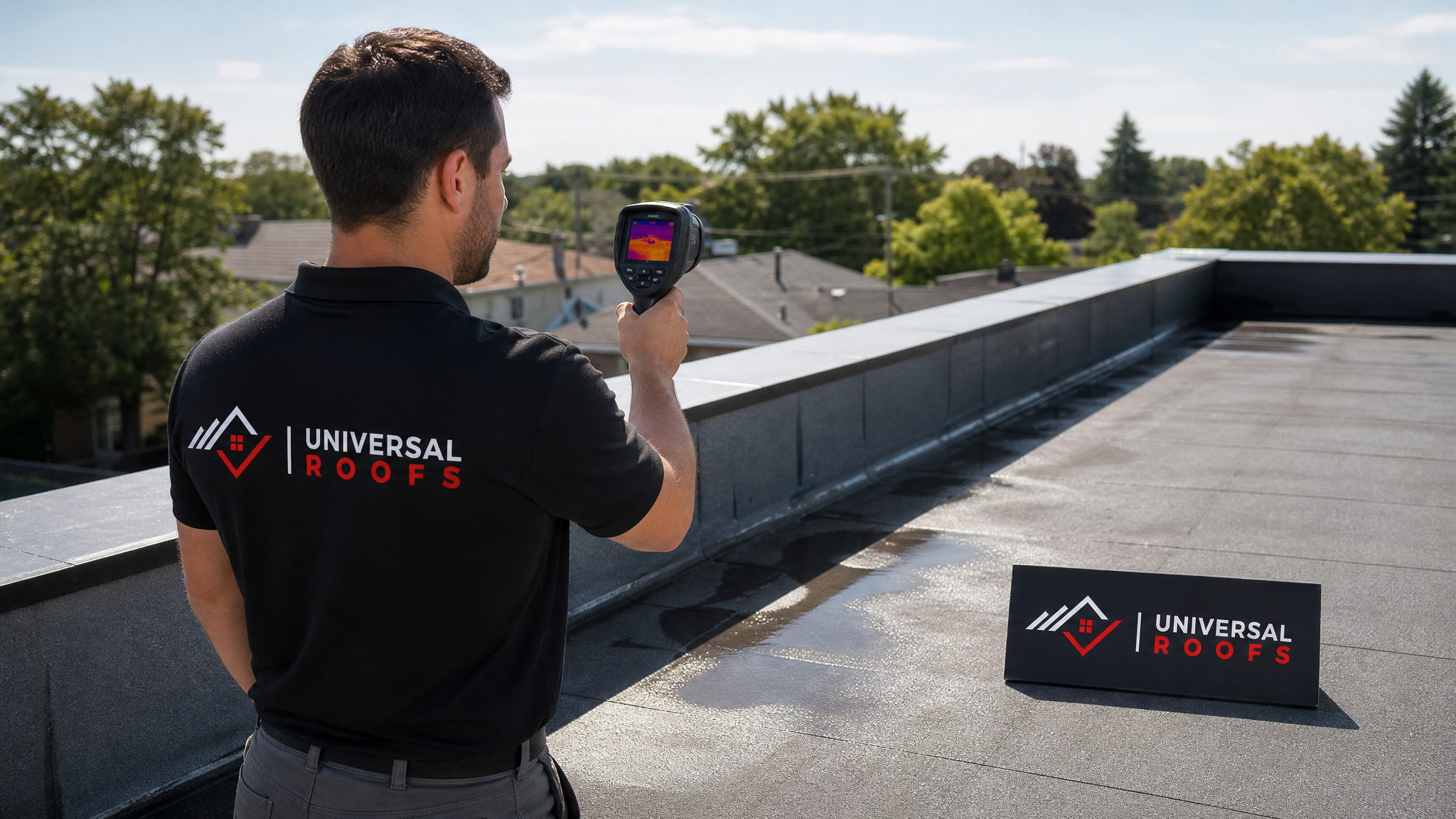
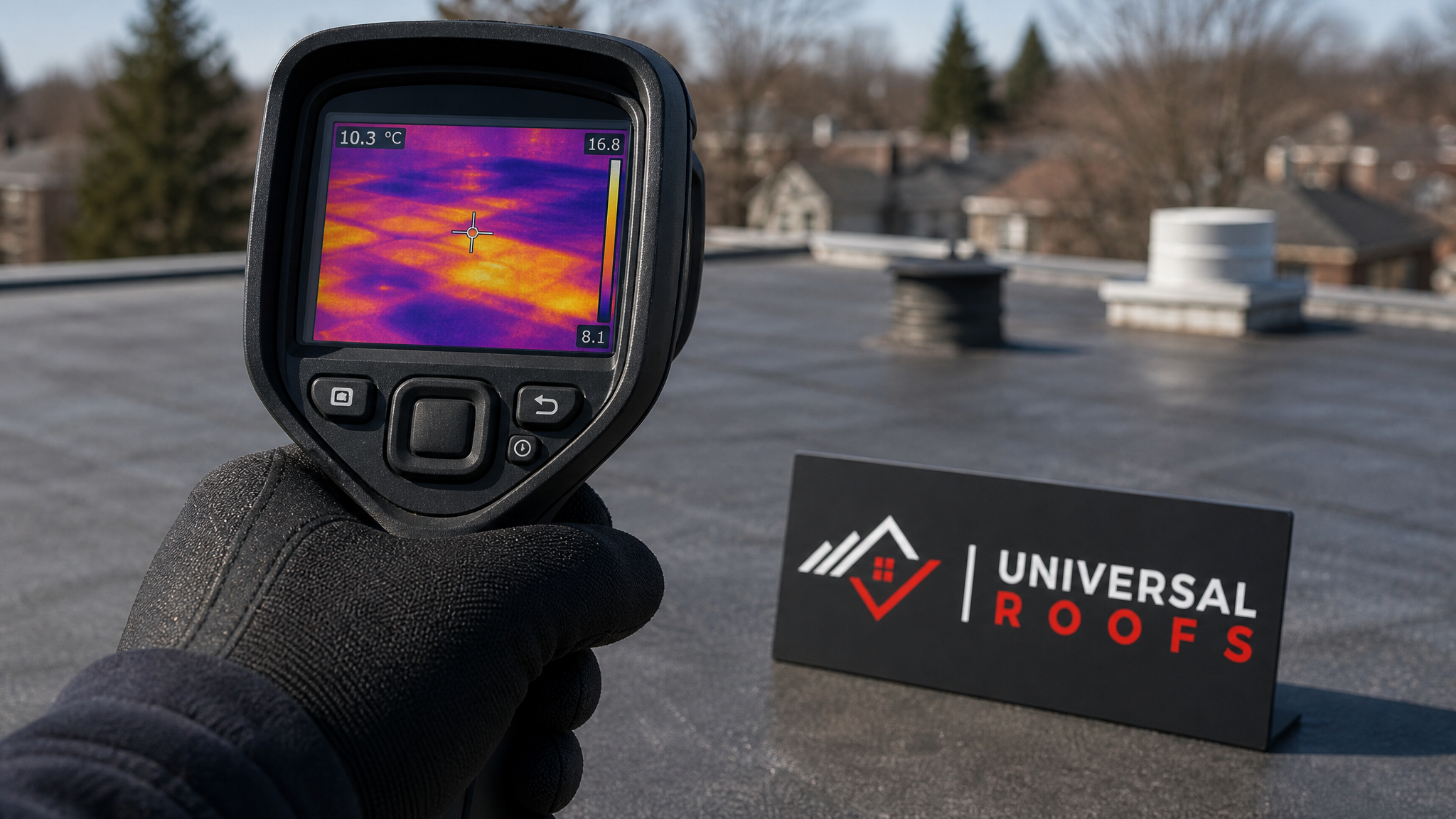
Thermal imaging is one of the most valuable tools in modern roof diagnostics. A thermal camera reads the surface temperature of the roof membrane and converts it into a colour-coded image. Wet insulation and saturated roofing materials retain heat differently than dry materials, so once the sun has warmed the roof during the day, trapped moisture shows up as a distinct thermal signature after sunset, when the dry areas cool faster than the wet ones.
This matters enormously for flat roofing systems, where insulation sits directly beneath the membrane and can hold water for months without any visible sign at the surface. A scan that takes twenty minutes with a thermal camera can map out the entire extent of a wet insulation zone, something that would otherwise require cutting open multiple test sections of membrane and guessing at the boundaries. Our flat roofing crews use thermal scans routinely before any major repair to confirm the true scope of water intrusion, not just the point where a stain appeared on the ceiling below.
Thermal imaging also protects homeowners financially. Instead of tearing up an entire roof section on a hunch, technicians can pinpoint precisely which areas of insulation are saturated and need replacement, and which areas are still dry and can be left alone. That precision translates directly into lower repair costs and less disruption to the building.
Electronic Leak Detection for Flat and Low-Slope Roofs
While thermal imaging shows where moisture already exists, electronic leak detection (ELD) is used to find the exact breach point in a membrane before or during a repair. This method works by running a low-voltage electrical current across the roof surface, which is kept wet during the test. Because the roof deck and structure are grounded, any point where the membrane has a puncture, seam failure, or flashing gap will complete the circuit, and the detection unit pinpoints that location within centimetres.
This is especially valuable for single-ply membranes such as TPO and EPDM, which are common on commercial flat roofs and modern residential additions across Toronto. These membranes can develop pinhole punctures from foot traffic, dropped tools, or wildlife, and a single puncture the size of a pencil tip can let in enough water to saturate an entire insulation board over a rainy season. Electronic leak detection finds that pencil-tip hole directly, rather than requiring a crew to remove and replace large sections of membrane just to search for it.
Moisture Meters and Their Role in Confirming Damage
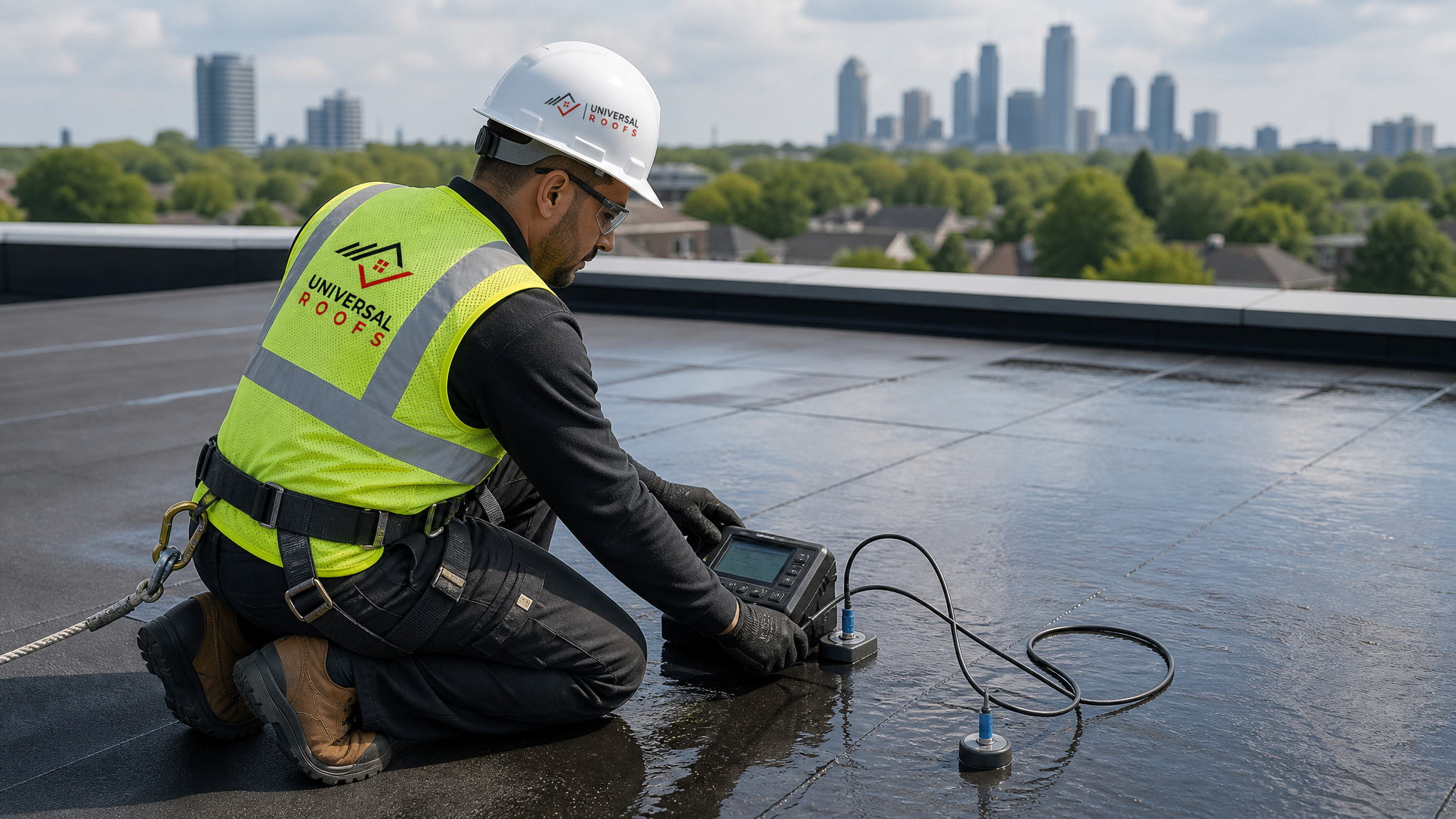
Moisture meters complement thermal imaging by giving technicians a precise numerical reading of moisture content within roofing materials, decking, and even interior drywall or framing near a suspected leak. While a thermal camera shows a pattern, a moisture meter confirms the reading with hard data, which is especially useful for documenting damage for insurance claims or before-and-after repair verification.
There are two common types used on roofing jobs. Pin-type meters use small probes inserted into the material to measure electrical resistance, giving an exact percentage reading of moisture content. Pinless meters use electromagnetic sensors pressed against the surface, allowing technicians to scan large areas quickly without damaging the roofing material. Combining both types allows our crews to confirm the extent of saturation identified by a thermal scan and decide exactly how much insulation or decking needs replacement.
This data-driven approach also protects homeowners from unnecessary repairs. If a moisture meter confirms that decking readings are within a normal range, there is no reason to replace it, even if it is adjacent to a section that failed. That kind of precision keeps repair costs proportional to the actual damage rather than inflated by guesswork.
Why Guesswork Costs Homeowners More in the Long Run
It is tempting to assume that a lower quote from a contractor who skips diagnostic technology is a better deal. In practice, the opposite is usually true. When a leak’s source is never actually located, a repair crew ends up patching the areas that look the most damaged rather than the areas that are actually letting water in. The leak often returns within a single rainy season, and the homeowner pays for a second, third, or even fourth repair attempt.
Worse, every month that a hidden leak goes undetected, moisture continues to spread through insulation, decking, and framing. What might have been a localized membrane patch becomes a full deck replacement once rot sets in. What could have been a simple flashing repair around a skylight becomes a much larger project once water has travelled into the surrounding roof structure. Advanced diagnostic tools are not an upsell, they are what keeps small problems from becoming expensive ones.
| Diagnostic Method | What It Detects | Best Used For | Typical Time on Site |
|---|---|---|---|
| Thermal imaging camera | Trapped moisture patterns beneath the membrane | Flat and low-slope roofs, insulation assessment | 20-40 minutes |
| Electronic leak detection | Exact membrane puncture or seam failure location | Single-ply membranes (TPO, EPDM, PVC) | 30-60 minutes |
| Pin-type moisture meter | Precise moisture percentage in decking or framing | Confirming saturation depth, insurance documentation | 10-20 minutes |
| Pinless moisture meter | Surface-level moisture scanning without damage | Quick large-area screening | 10-15 minutes |
| Visual inspection only | Surface cracks, obvious blistering or separation | Preliminary assessment, not conclusive on its own | 15-30 minutes |
What a Professional Leak Detection Visit Looks Like
When our technicians arrive for a diagnostic visit, the process typically starts with a conversation about where the leak has appeared indoors and how long it has been happening. From there, a visual inspection identifies any obvious surface damage, flashing separation, or clogged drainage that could be contributing to the problem. If the source is not immediately obvious, and on most flat roof calls it is not, we move to instrumented testing.
A thermal scan is usually performed first, ideally after the roof has had a full day of sun exposure so temperature differentials between wet and dry areas are pronounced. If the scan identifies a suspect zone, electronic leak detection or targeted moisture meter readings confirm the exact breach point. Only once the source is confirmed does the actual repair work begin, whether that means a localized membrane patch, replacing a section of wet insulation, or addressing failed flashing around a chimney, vent, or skylight curb.
| Repair Scenario | Without Leak Detection | With Advanced Leak Detection | Cost Impact |
|---|---|---|---|
| Small membrane puncture | Full section replacement based on guesswork | Localized patch at confirmed puncture site | Significantly lower |
| Wet insulation zone | Entire roof deck opened to search | Only saturated boards identified and replaced | Moderate savings |
| Recurring ceiling stain | Repeated patch attempts over multiple visits | Root cause found and resolved in one visit | Avoids repeat service calls |
| Flashing failure near skylight | Entire flashing assembly replaced preventively | Exact failure point repaired | Lower material cost |
| Insurance claim documentation | Limited photo evidence, disputed claims | Thermal and moisture data supports the claim | Faster claim approval |
Comparing Diagnostic Investment to Repeat Repair Costs
Homeowners often ask how the upfront cost of a diagnostic visit stacks up against simply hiring a crew to patch the visible symptom and hoping for the best. The table below breaks down how these two approaches typically play out over the life of a single leak issue.
| Approach | Typical Number of Visits | Root Cause Found? | Long-Term Outcome |
|---|---|---|---|
| Visual-only patch repair | 2 to 4 visits over a season | Rarely, unless damage is obvious | Leak often recurs, cumulative damage spreads |
| Thermal imaging scan | 1 visit | Yes, for hidden moisture zones | Confirms true extent before repair begins |
| Electronic leak detection | 1 visit | Yes, for membrane punctures and seams | Exact breach located, minimal demolition needed |
| Combined diagnostic approach | 1 visit | Yes, cross-confirmed with multiple tools | Single, targeted repair with lasting results |
As this comparison shows, the combined diagnostic approach consistently produces a single, correctly targeted repair, while repeated visual-only patch attempts tend to compound both cost and damage over time.
When to Call in Professional Diagnostics
Not every roofing concern needs a full thermal and electronic diagnostic visit, but certain warning signs make it worthwhile. A ceiling stain that appears after every heavy rain, a musty smell in an attic or top-floor room, visible sagging in a flat roof section, or a leak that keeps returning after a previous repair are all strong indicators that the actual source has not yet been identified. Homeowners considering a roof replacement also benefit from a diagnostic scan beforehand, since it reveals how much of the existing deck and insulation is salvageable versus how much needs to be replaced.
Commercial property owners in particular benefit from routine thermal scans as part of preventative maintenance, since flat commercial roofs are large enough that a small undetected leak can spread across a significant area of insulation before it ever produces a visible interior sign. Catching that early with a scheduled scan is far less expensive than waiting for a tenant complaint.
If you are unsure whether your situation calls for advanced diagnostics or a standard roof repair visit, our team can advise after a quick phone conversation about your symptoms. Homeowners across our Toronto service area can also read about past diagnostic and repair experiences on our reviews page, or check our FAQ page for more on how we approach leak investigations.
Attic and Interior Signs That Point to a Hidden Leak
Roof leaks rarely announce themselves clearly from inside the home. Instead, they show up as secondary symptoms that homeowners often dismiss until the damage has progressed. Checking the attic for discoloured insulation, dark streaking on rafters, or a persistent damp smell is one of the simplest early warning checks a homeowner can do. Any of these signs justify bringing in a thermal camera and moisture meter rather than waiting for a ceiling stain to appear, because by the time water reaches drywall, it has usually been travelling through the structure for weeks or months.
We have found that homeowners who schedule a diagnostic visit at the first sign of trouble, rather than after a leak becomes visible and severe, consistently spend less on repairs overall. The technology exists precisely to catch problems while they are still small, localized, and inexpensive to fix.
Frequently Asked Questions
Why is advanced leak detection technology essential for roof repairs?
How does thermal imaging detect roof leaks?
What is electronic leak detection used for on flat roofs?
Can a moisture meter confirm how much roof damage has occurred?
Is advanced leak detection more expensive than a standard roof inspection?
When should I call a professional for roof leak diagnostics?
Need Help Finding a Roof Leak?
Guesswork has no place in professional roofing, which is why Universal Roofs relies on thermal imaging, electronic leak detection, and moisture meters on every diagnostic call. If a leak keeps coming back or you have noticed early warning signs in your attic or ceilings, it is worth having the actual source confirmed before another repair attempt.
Call us today at (416) 732-2421 or request a free inspection to get started.
Universal Roofs proudly serves Toronto, Mississauga, Brampton, Vaughan, Markham, Oakville and the GTA since 2005.