
The cheapest month to fix an attic is September. Nothing about attic insulation north york homeowners install is urgent in warm weather, which is exactly why it gets postponed until the first cold snap, when every insulation contractor in the region is booked three weeks out and the heating bills have already started. If you own a house built between 1950 and 1975 in this part of the city, there is a good chance your attic is insulated to roughly a third of the level current construction targets.
This guide covers what R value your attic should actually reach, why insulation without ventilation makes things worse rather than better, what attic insulation north york properties cost to upgrade in 2026, and how the whole thing connects to the condition of your roof. It is written around the local housing reality: postwar bungalows and side splits with shallow roof pitches and low heel heights, 1960s two storeys, and large rebuilds where the attic was insulated once, decades ago, and never revisited.
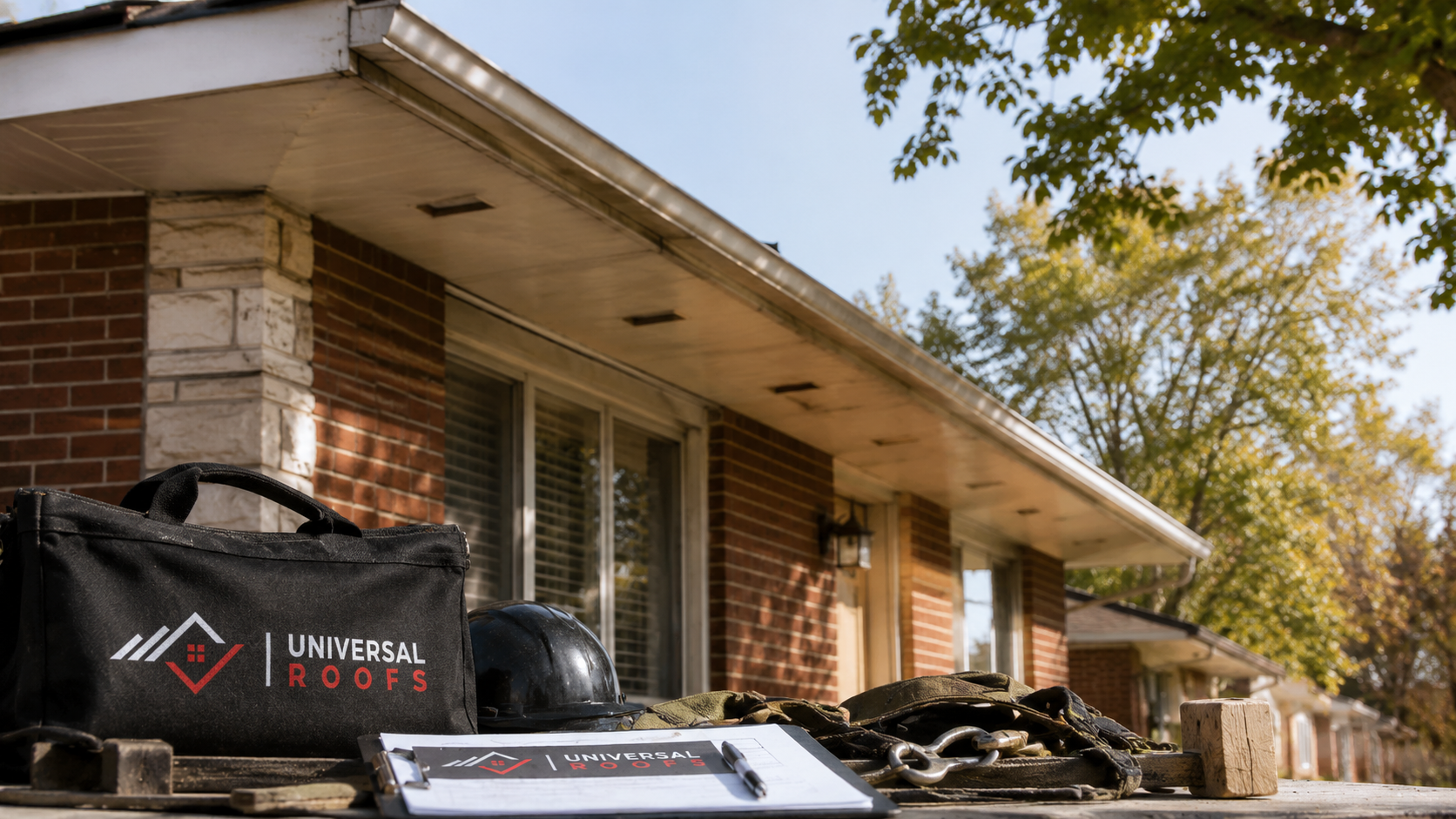
What R Value Attic Insulation North York Homes Should Reach
Ontario construction practice for new houses now targets roughly R60 in the attic, which is a nominal thermal resistance of about RSI 10.5 in metric terms. That figure is worth knowing because it is the reference point everything else is measured against, not because an older house is legally required to meet it. There is no obligation to upgrade an existing attic. There is simply a very large difference in comfort and heating cost between R20 and R60.
Here is what we typically find in this district, and what it means in practice.
| Era and typical original insulation | Approximate R value | Depth of loose fill | Recommended action |
|---|---|---|---|
| Pre 1950, often little or none | R0 to R8 | 0 to 60 millimetres | Full upgrade, air seal first |
| 1950s to 1960s, original batts or fill | R12 to R20 | 90 to 150 millimetres | Air seal and top up to R60 |
| 1970s, upgraded once since | R20 to R30 | 150 to 230 millimetres | Top up, verify soffit intake |
| 1980s to 1990s construction | R28 to R40 | 230 to 300 millimetres | Top up if easy access allows |
| Post 2012 construction | R50 to R60 | 380 to 450 millimetres | Verify, usually no action needed |
| Any age, compressed or settled fill | Effectively reduced by 20 to 40 percent | Uneven coverage | Rake level and top up |
Two practical notes. Loose fill settles over decades, so a 1970s attic that was blown to R32 may perform closer to R24 today. And coverage matters as much as depth: an attic with R60 in the centre and R10 at the eaves loses heat through the perimeter, which is precisely where ice dams form. Even coverage right out to the top plate of the exterior wall is the goal, and achieving it in a shallow pitched roof is the hard part of attic insulation north york work.
Why Ventilation Comes Before Attic Insulation North York Upgrades
The single most common mistake in attic insulation north york projects is material added on top of blocked soffit vents. It is easy to do. Someone blows in 300 millimetres of cellulose, the material drifts out to the eaves, and it buries the soffit intake completely. The house is now better insulated and considerably worse ventilated, and within a winter or two there is frost on the underside of the roof sheathing.
The mechanism is simple. Attic ventilation works as a continuous flow: cool outside air enters at the soffits, rises up the underside of the roof deck, and exits at the ridge or through roof vents. That airflow carries away the water vapour that inevitably migrates up from the living space, and it keeps the deck cold so snow does not melt and refreeze at the eave. Block the intake and the exhaust vents have nothing to draw from, so the air stops moving. Warm moist air then reaches the cold sheathing and condenses, and in winter it freezes there. When it thaws, it drips onto the insulation, which mats down and loses most of its value.
The fix is inexpensive if it is planned in from the start. Rigid baffles, sometimes called insulation stops, are installed in every rafter bay from the top plate up past the insulation line, holding a clear air channel between the insulation and the deck. On the shallow pitched roofs common here there may be only 100 to 150 millimetres of headroom at the eave, so baffles are essential rather than optional. Ventilation ratio guidance is generally one square metre of net free vent area for every 300 square metres of attic floor, split roughly evenly between intake at the soffits and exhaust at or near the ridge.
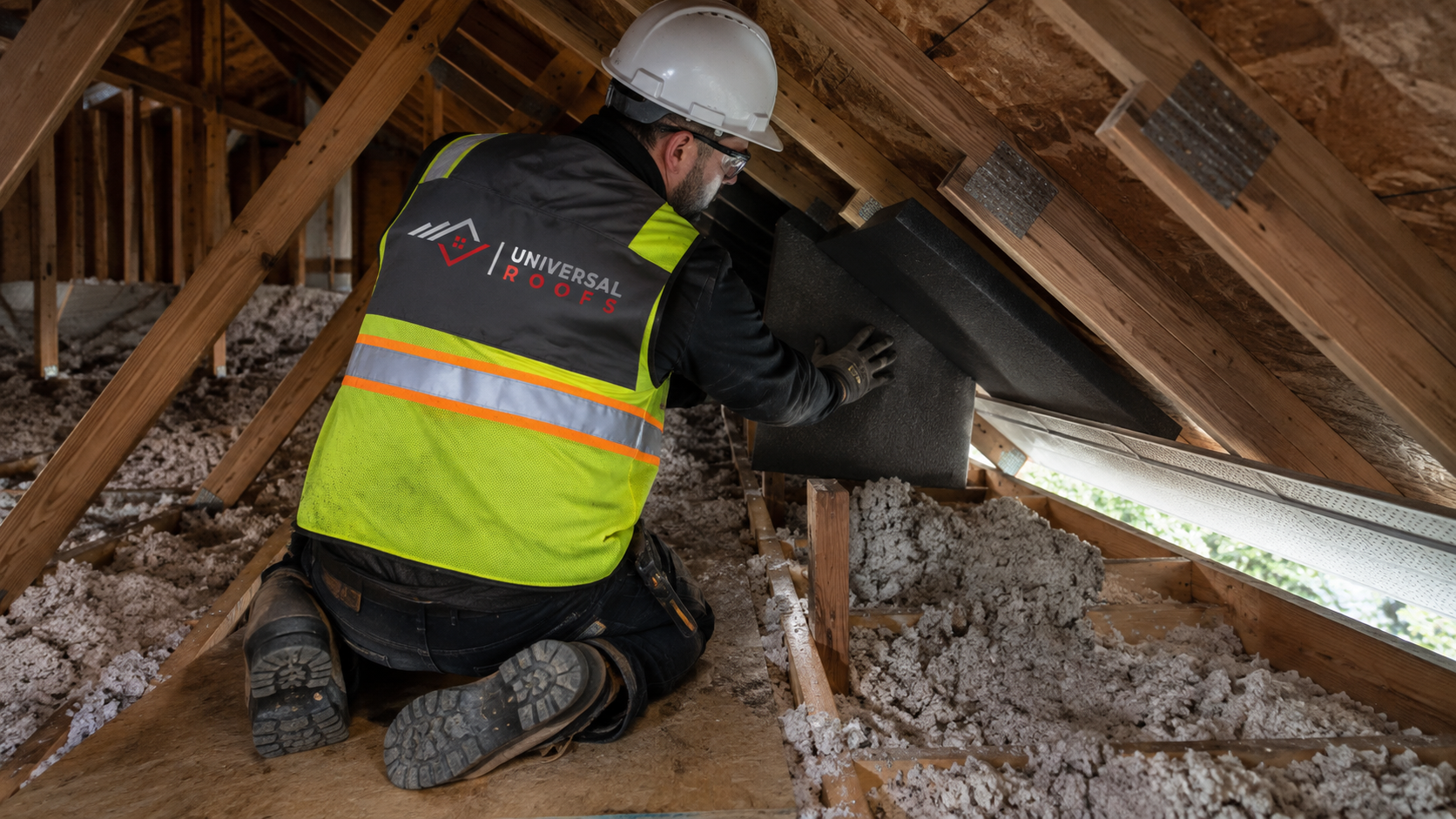
Air Sealing: The Attic Insulation North York Step That Gets Skipped
Attic insulation north york contractors install slows heat transfer. It does not stop air movement, and a great deal of the heat leaving a house does so as warm air physically travelling through gaps into the attic. Blowing new material over an unsealed ceiling plane is like putting a thick sweater over a shirt full of holes.
Before any material goes in, the ceiling plane should be sealed at every penetration. On the housing here the usual culprits are consistent.
- The attic hatch, which is very often a thin plywood panel with no weatherstripping and no insulation on top of it.
- Plumbing stacks and vent pipes passing through the ceiling, usually with a rough cut hole around them.
- Recessed light fixtures, particularly older non IC rated cans, which need proper airtight covers before being buried.
- Bathroom and kitchen exhaust fan housings, and just as importantly the ducts from them, which must vent outside rather than into the attic.
- Chimney and flue chases, sealed with fire rated materials at the correct clearances.
- Top plates of interior partition walls, which are open paths from the wall cavities straight into the attic.
- Wiring and dropped ceiling penetrations, common where kitchens and bathrooms have been renovated over the years.
Bathroom fans deserve a specific mention because they cause so much winter damage. A fan ducted into the attic instead of through the roof or wall dumps warm humid air directly onto cold sheathing every time someone showers. That produces frost, then drips, then stained ceilings, and it is frequently misdiagnosed as a roof leak. If you have unexplained ceiling staining near a bathroom, check the duct before calling about the shingles.
What Attic Insulation North York Upgrades Cost In 2026
Pricing for attic insulation north york upgrades depends on attic area, existing conditions, how much air sealing is required and how accessible the space is. A low pitched bungalow attic where a technician can barely crawl at the eaves costs more per square metre than a tall open attic in a two storey house.
| Scope | What it involves | 2026 cost range | Timeline |
|---|---|---|---|
| Air sealing only | Seal penetrations, hatch, fan housings | 600 to 1,800 dollars | Half to one day |
| Baffles and soffit vent clearing | Baffle every rafter bay, clear intake | 500 to 1,500 dollars | Half to one day |
| Top up existing to R60, blown fibreglass | Rake level, blow to depth, mark rulers | 2.50 to 4.00 dollars per square foot | One day |
| Top up existing to R60, cellulose | As above, denser material | 3.00 to 4.75 dollars per square foot | One day |
| Remove old material and reinsulate | Vacuum out, seal, baffle, reinsulate | 5.50 to 9.00 dollars per square foot | One to two days |
| Add roof vents or upgrade exhaust | Cut in vents, flash, seal | 200 to 450 dollars per vent | Half day |
| Typical bungalow, complete package | Seal, baffle, top up to R60 | 3,500 to 6,500 dollars | One to two days |
Removal and full replacement is only warranted in specific cases: rodent contamination, water damaged and matted material, prior fire or smoke, or vermiculite that needs professional assessment before anyone disturbs it. Otherwise topping up over sound existing material is both cheaper and perfectly effective. It is also worth checking current provincial and utility efficiency programs before booking, since insulation and air sealing rebates come and go and the eligibility rules usually require a pre and post assessment carried out in a specific order.
How Attic Insulation North York Work Connects To Your Roof
Attic insulation north york work and roof work are not separate subjects, and treating them separately is how homeowners end up paying twice. Nearly every winter roof problem in this climate traces back to attic conditions.
Ice dams are the clearest example. They form because heat escaping into the attic warms the roof deck and melts snow on the upper slope, and that meltwater refreezes when it reaches the unheated overhang. The result is a ridge of ice at the eave that backs water up under the shingle courses. On the shallow pitched roofs common in this area, water backs up under shingles far more easily than on a steep roof, so the consequences are worse. The permanent fix is not heat cable and not a bigger eavestrough. It is a colder attic, achieved through properly installed attic insulation combined with unblocked intake ventilation.
Deck condensation is the second example. Chronic moisture in an underventilated attic degrades the plywood or board sheathing, promotes mould growth on the underside of the deck, and shortens shingle life from the inside out. Homeowners are often surprised to learn that a roof can fail early because of what is happening below it rather than above it.
The practical implication is timing. If your roof is due for replacement within a couple of years, do the attic assessment first. Roof vents, ridge venting and any new soffit intake are all far easier and cheaper to install while the roof covering is off. Our attic insulation and ventilation services are routinely coordinated with roofing work for exactly that reason, and homeowners can see the full range of roofing services available in North York when planning both together.
Choosing A Material For Attic Insulation North York Projects
For attic floors in this climate, the realistic choices are blown fibreglass, blown cellulose, or batts. Each has a sensible use case.
| Material | R per inch | Strengths | Limitations |
|---|---|---|---|
| Blown fibreglass | Roughly R2.5 | Light, fills irregular cavities, does not settle much | Loses some performance in extreme cold if underdepth |
| Blown cellulose | Roughly R3.5 | Denser, better air flow resistance, recycled content | Settles over time, heavier on the ceiling structure |
| Fibreglass batts | Roughly R3.2 | Inexpensive, workable in open accessible attics | Gaps and compression are common, poor at the eaves |
| Mineral wool batts | Roughly R4.0 | Fire resistance, dimensional stability | Higher cost, still gap prone at the perimeter |
| Closed cell spray foam | Roughly R6.0 | Air barrier and insulation in one | Costly, changes the ventilation strategy entirely |
For the overwhelming majority of houses here, air sealing followed by blown loose fill to R60 with baffles at every rafter bay is the correct answer. Spray foam applied to the underside of the roof deck creates an unvented conditioned attic, which is a legitimate approach but a fundamentally different building assembly requiring careful design, and it is rarely the right call as a simple upgrade to a postwar bungalow.
What A Proper Attic Insulation North York Assessment Includes
Before quoting attic insulation north york work, a contractor should be in the attic, not estimating from the driveway. A thorough assessment covers depth measurement at several points including the perimeter, identification of the existing material, condition of the sheathing looking for staining, frost marks or mould, whether soffit vents are clear, what exhaust venting exists at the ridge or roof, where every penetration through the ceiling plane is, whether bathroom fans terminate outside, evidence of rodent activity, and the condition of the attic hatch. That inspection takes half an hour and it is what separates a real quote from a guess.
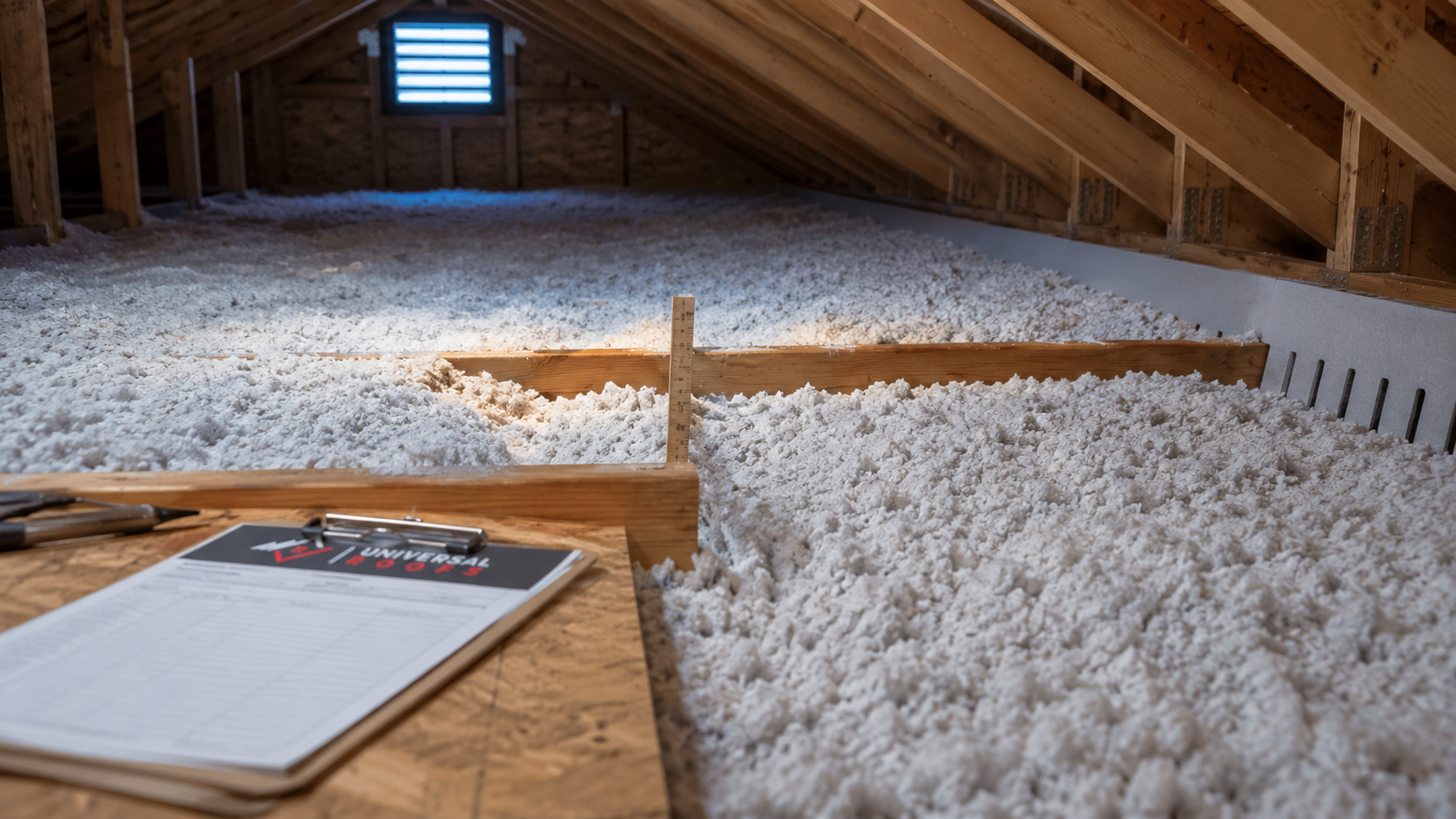
Ask for the target R value in writing, the material and installed depth, confirmation that baffles are included at every bay, and confirmation that air sealing is part of the scope rather than an extra. Depth rulers stapled to the joists throughout the attic are the standard way to verify the finished result, and any reputable installer will include them without being asked.
What R value should attic insulation north york homes have?
How much does attic insulation north york work cost in 2026?
Do I need to remove the old insulation first?
Will more insulation stop my ice dams?
Should insulation be done before or after a new roof?
How long does the work take?
Book Your Attic Insulation North York Assessment This Autumn
Universal Roofs is a Toronto based roofing company serving every part of the city, and our attic insulation north york crews treat the attic and the roof as one system rather than two separate trades. That means air sealing, baffles, even coverage to the eaves and working ventilation, so the upgrade actually reduces your heating load and your ice dam risk instead of just adding depth.
Call us today at (416) 732-2421 or request a free consultation to have your attic assessed before the heating season begins.
Universal Roofs serves homeowners throughout North York and across the wider Greater Toronto Area with roofing, attic insulation and ventilation services.