
If your Toronto home feels like an oven in July and an icebox in January, the roof insulation materials you have (or don’t have) overhead are likely the reason why. Insulation is the single most cost-effective upgrade a GTA homeowner can make to control energy bills, because a poorly insulated attic or roof assembly lets conditioned air escape through the single largest surface of the building envelope.
At Universal Roofs, we’ve spent nearly two decades inspecting attics and roof decks across the GTA, and the pattern is consistent: homes built before the mid-2000s were insulated to codes that no longer reflect today’s energy pricing or our increasingly volatile summers and winters. Choosing the right roof insulation material — and installing it correctly — is what separates a comfortable, efficient home from one that fights its own HVAC system twelve months a year.
This guide breaks down the four best roof insulation materials for energy efficiency, how they compare on R-value, cost, and longevity, and what actually matters when you’re deciding between them for a Toronto-area home.
Why Roof Insulation Matters More in the GTA Climate
Toronto and the surrounding regions sit in a climate zone that swings from humid, 30-plus degree summers to winters that regularly dip below minus 15. That temperature range puts enormous stress on a roof assembly. In winter, warm indoor air rises and escapes through an under-insulated attic, melting snow on the roof deck that then refreezes at the cold eaves — the classic recipe for an ice dam that forces water backward under the shingles. In summer, a poorly insulated attic can reach temperatures of 60 degrees Celsius or more, radiating heat down into living spaces and forcing air conditioners to run constantly.
The right roof insulation materials for energy efficiency address both problems at once. They slow heat transfer in both directions, which means less strain on your furnace and air conditioner, fewer freeze-thaw cycles damaging your shingles, and a meaningfully lower utility bill. Natural Resources Canada estimates that a well-insulated, well-sealed attic can cut heating and cooling costs by 10 to 20 percent in a typical Ontario home — often the fastest payback of any home energy upgrade.
It’s also worth noting that insulation performance is inseparable from ventilation and air sealing. We cover this in more detail on our attic services page, but the short version is: insulation without proper intake and exhaust ventilation can trap moisture, and moisture is the enemy of every insulation material on this list, to varying degrees.
The 4 Best Roof Insulation Materials for Energy Efficiency
There is no single “best” insulation for every home — the right choice depends on your roof type, attic configuration, budget, and whether you’re insulating a vented attic, a cathedral ceiling, or a flat roof assembly. Here are the four materials we recommend most often to GTA homeowners, based on performance, availability, and cost-effectiveness.
1. Spray Foam Insulation (Closed-Cell and Open-Cell)
Spray polyurethane foam is the highest-performing insulation material available for roofs, and it’s our top recommendation whenever budget allows. Closed-cell spray foam delivers an R-value of roughly 6 to 7 per inch, nearly double that of fibreglass batt, while also acting as an air barrier and a vapour retarder in a single application. This matters enormously in roof assemblies, where air leakage — not just poor insulation — is usually the bigger driver of energy loss.
Open-cell spray foam has a lower R-value (around 3.5 to 3.6 per inch) but expands more, fills irregular cavities completely, and costs less than closed-cell. It’s an excellent choice for cathedral ceilings and finished attic spaces where a vapour-permeable assembly is preferred to let the roof deck dry to the interior.
The main drawback is upfront cost — spray foam typically runs two to three times the price of fibreglass batt per square metre. It also requires a trained applicator, since improper application (wrong thickness, poor mixing ratio, or spraying over damp sheathing) can cause long-term problems. For homeowners planning a roof replacement, adding spray foam to the attic or roof deck at the same time is one of the most efficient ways to combine projects and reduce overall labour costs.
2. Rigid Foam Board (Polyiso, XPS, and EPS)
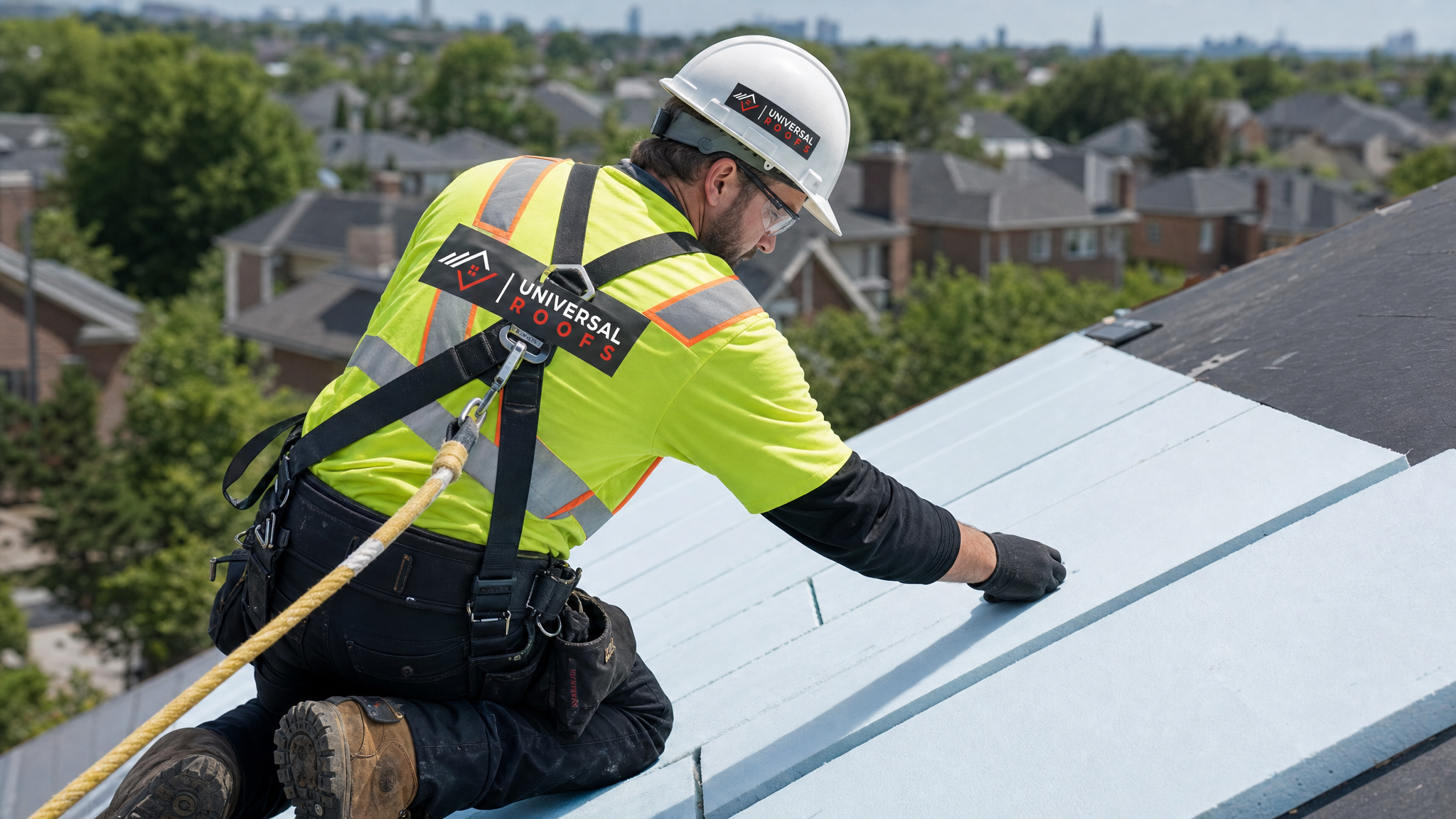
Rigid foam boards — polyisocyanurate (polyiso), extruded polystyrene (XPS), and expanded polystyrene (EPS) — are the go-to insulation material for flat and low-slope roofs, and they’re also used above roof decks in “hot roof” cathedral ceiling assemblies. Polyiso offers the highest R-value per inch of the three (roughly R-6), followed by XPS (about R-5) and EPS (about R-3.6 to R-4).
Rigid foam is dimensionally stable, resists moisture far better than fibreglass, and can be layered to achieve very high total R-values without adding excessive weight — a major advantage for flat roofing systems where structural load and drainage slope both need careful planning. Continuous rigid foam above the roof deck also eliminates thermal bridging through rafters or joists, which batt insulation alone cannot do.
The tradeoff is installation complexity and cost. Rigid foam needs to be properly taped or sealed at every seam to perform as an air barrier, and on sloped roofs it’s usually installed as part of a full roof-over or tear-off project rather than a standalone retrofit.
3. Blown-In Loose-Fill Insulation (Cellulose and Fibreglass)
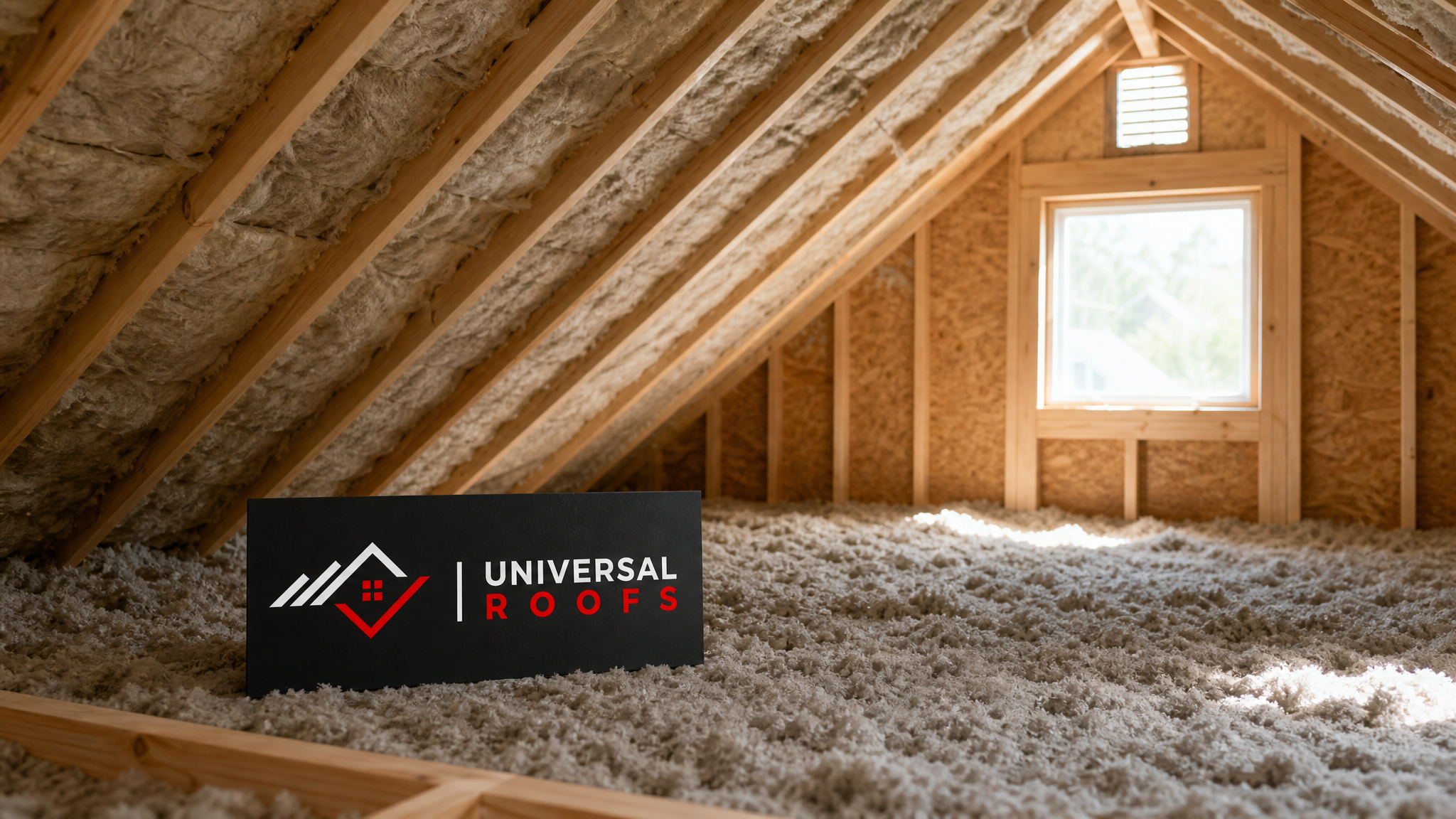
For vented attics — by far the most common attic configuration in GTA homes — blown-in loose-fill insulation is the most practical and cost-effective option for reaching modern R-value targets. Cellulose, made from recycled newsprint treated with fire retardant, offers roughly R-3.2 to R-3.8 per inch and does an excellent job filling irregular spaces around wiring, trusses, and pot lights. Blown fibreglass performs similarly, at around R-2.2 to R-2.7 per inch, and is slightly more resistant to moisture absorption than cellulose.
Ontario’s Building Code currently recommends attic insulation levels of R-60 for new construction in most of the GTA, which typically means adding 45 to 60 centimetres of loose-fill material. Because it’s blown in rather than laid by hand, this method achieves far more consistent coverage than batts, with fewer gaps and compression points — both of which are common causes of heat loss in older homes.
Loose-fill is also the most budget-friendly way to bring an under-insulated attic up to current standards, and it pairs well with air sealing work done beforehand (sealing top plates, light fixture penetrations, and the attic hatch) to maximize the return on investment.
4. Fibreglass Batt Insulation
Fibreglass batts remain the most widely recognized roof and attic insulation material, and for good reason — they’re affordable, easy to source, and simple to install in standard joist and rafter spacing. Standard batts offer roughly R-3.1 to R-3.4 per inch, with high-density versions reaching closer to R-4.3 per inch in the same thickness.
Batts work best in attic floors with regular, unobstructed joist spacing and in new construction where cavities can be sized to fit standard widths precisely. Their main limitation is that they perform poorly when compressed, cut around obstructions, or fitted loosely — any gap or compression point creates a thermal bridge that lets heat pass through far more easily than the surrounding material. In our experience inspecting older GTA attics, batts installed decades ago are very often compressed, gapped, or partially covering pot lights and wiring in ways that seriously undercut their rated performance.
Batts are a reasonable choice for budget-conscious upgrades or DIY-friendly projects, but for maximum energy efficiency, we generally recommend combining a layer of batts with a top layer of unfaced blown-in insulation, or choosing loose-fill exclusively for irregular attic spaces.
Comparing R-Value, Cost, and Best Use by Material
The table below summarizes how these four roof insulation materials for energy efficiency compare on the metrics that matter most to GTA homeowners.
| Insulation Material | R-Value per Inch | Typical Cost (per sq. ft. installed) | Best Application |
|---|---|---|---|
| Closed-cell spray foam | R-6 to R-7 | $4.50 – $7.50 | Cathedral ceilings, roof decks, air sealing |
| Open-cell spray foam | R-3.5 to R-3.6 | $2.50 – $4.50 | Finished attics, vapour-permeable assemblies |
| Rigid foam board (polyiso) | R-5.6 to R-6.5 | $2.00 – $4.00 | Flat and low-slope roofs |
| Blown-in cellulose | R-3.2 to R-3.8 | $1.00 – $2.00 | Vented attics, irregular spaces |
| Blown-in fibreglass | R-2.2 to R-2.7 | $1.00 – $1.80 | Vented attics, moisture-prone climates |
| Fibreglass batt | R-3.1 to R-4.3 | $0.65 – $1.20 | Standard joist spacing, budget upgrades |
Prices vary based on attic accessibility, existing insulation removal, and whether air sealing is included. These figures reflect typical GTA market ranges and should be treated as planning estimates rather than fixed quotes — an on-site assessment is the only way to get an accurate number for your home.
How Much Insulation Do You Actually Need?
Ontario’s current building code targets for attic insulation are higher than what most homes built before 2012 actually have. If your attic insulation is still at the level common in the 1990s and early 2000s, you’re likely leaving significant energy savings on the table. The table below shows recommended minimum R-values by roof and attic type for the GTA climate zone.
| Roof / Attic Type | Recommended Minimum R-Value | Approx. Insulation Depth (loose-fill) |
|---|---|---|
| Vented attic (standard) | R-60 | 45 – 60 cm |
| Cathedral / sloped ceiling | R-31 to R-38 | Depends on rafter depth or foam thickness |
| Flat roof assembly | R-25 to R-35 | Rigid foam layers, sloped for drainage |
| Roof deck (hot roof, spray foam) | R-38 to R-49 | 5 – 8 inches closed-cell foam |
| Older homes (pre-1990 baseline) | Often R-12 to R-20 (undersized) | Typically needs top-up to reach code |
If you’re unsure what you currently have, an attic inspection is a quick way to find out. We regularly measure existing insulation depth and condition as part of broader roof assessments — something worth bundling in if you’re also due for a roof repair or considering upgrades to your skylights, since skylight shafts are a common weak point for heat loss regardless of how well the surrounding attic is insulated.
Common Insulation Problems We See in GTA Homes
Beyond simply choosing the right material, how insulation is installed and maintained determines whether it actually performs. Here are the issues our technicians encounter most often during attic and roof inspections across Toronto, Peel, York, Halton, and Durham Region.
| Problem | Likely Cause | Recommended Fix |
|---|---|---|
| Compressed or gapped batt insulation | Improper original installation, disturbed by storage or wiring work | Remove and replace, or top up with blown-in loose-fill |
| Wet or matted cellulose | Roof leak, poor ventilation, or ice damming | Repair leak source first, then replace affected insulation |
| Ice damming despite “enough” insulation | Air leaks bypassing insulation (pot lights, plumbing stacks, attic hatch) | Air seal penetrations before adding more insulation |
| Uneven attic temperatures | Insufficient depth in corners or over exterior walls | Add loose-fill to achieve consistent, level coverage |
| Insulation blocking soffit vents | Loose-fill or batts pushed too far into eaves | Install baffles/chutes to preserve airflow, then re-insulate |
That last point deserves emphasis: insulation and ventilation have to work together. Blocking soffit intake vents with insulation is one of the most common mistakes we find, and it can undo much of the energy benefit the insulation was meant to provide by trapping moisture and encouraging ice dam formation at the eaves.
Insulation Considerations for Flat Roofs and Skylights
Flat and low-slope roofs, common on additions, garages, and some commercial and residential properties across the GTA, need a different insulation approach than a standard vented attic. Because there’s no attic space to blow loose-fill into, rigid foam board installed above or within the roof assembly is almost always the right call. Layering polyiso boards allows installers to build in the slight slope needed for proper drainage while hitting strong R-values without excessive added weight — something our flat roofing crews plan carefully on every project.
Skylights deserve special mention too. Even the best-insulated attic can lose significant heat through an aging skylight shaft or poorly sealed skylight curb. If you’re weighing a broader energy-efficiency upgrade, it’s worth having your skylights assessed at the same time — sometimes a skylight replacement with a modern, better-insulated frame delivers a bigger comfort improvement than people expect, especially in homes with older single-glazed units installed before double- or triple-glazed skylights became standard.
DIY vs. Professional Installation: What’s Worth the Investment
Some roof insulation upgrades are genuinely DIY-friendly. Adding a layer of unfaced fibreglass batts or purchasing a rental blower for loose-fill cellulose in an easily accessible attic is within reach for many homeowners, and it’s a reasonable weekend project if you’re comfortable working in a hot, cramped attic space.
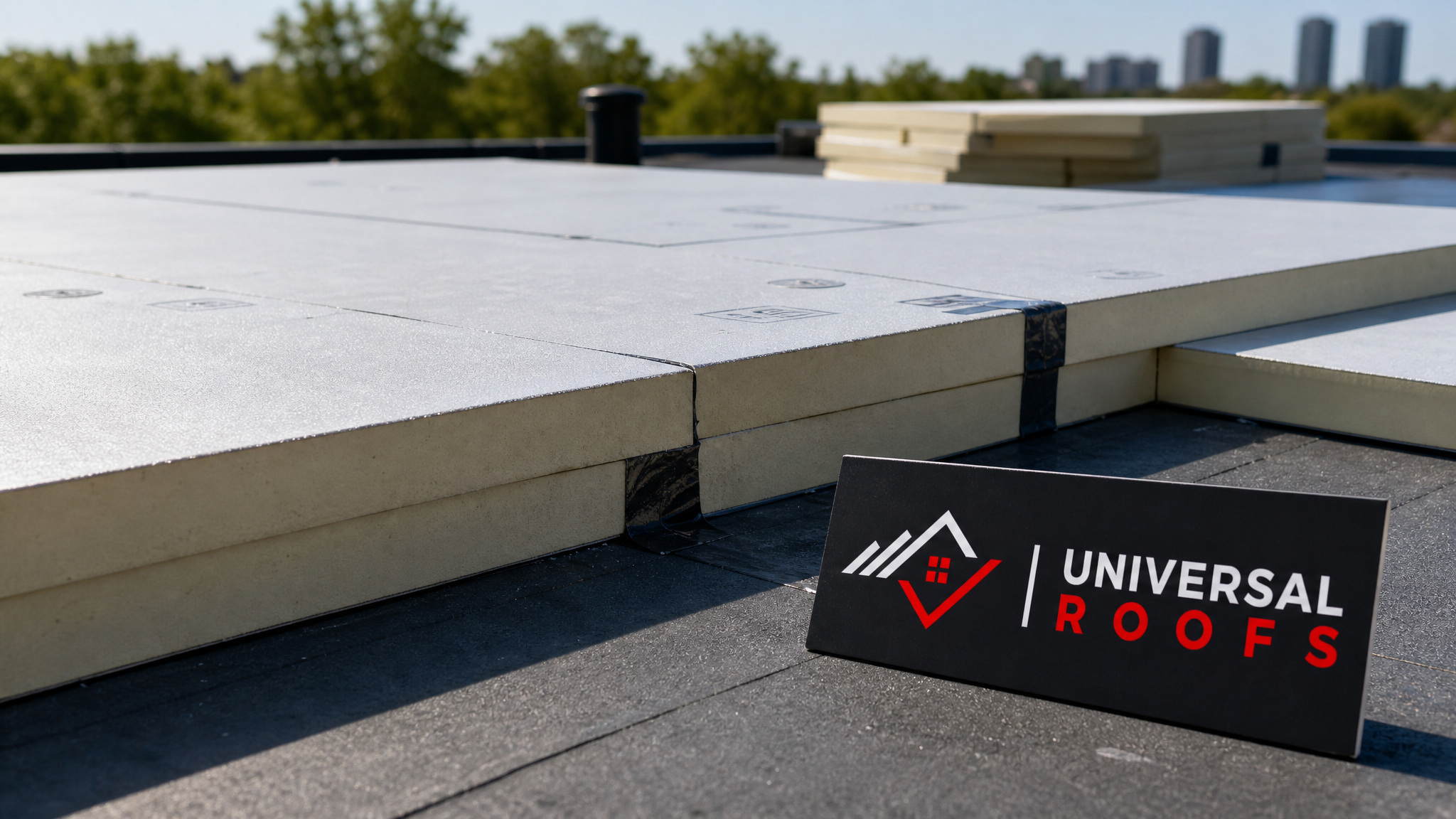
Spray foam, however, is not a DIY material for roof applications. It requires specialized equipment, precise mixing ratios, and experience to avoid under- or over-application, both of which cause long-term performance and moisture problems. Rigid foam board on flat roofs also benefits from professional installation, since proper seam taping, fastening patterns, and drainage slope calculations are easy to get wrong and expensive to fix later.
Our general advice: if the job involves working on the roof deck itself, spray foam application, or coordinating insulation with a broader roofing project, bring in a professional. If it’s a straightforward top-up of loose-fill in an accessible, well-ventilated attic, a motivated homeowner can often handle it with rented equipment from a hardware store.
Signs Your Roof Insulation Needs an Upgrade
A few warning signs tend to show up consistently in homes with inadequate roof insulation:
- Noticeably higher heating or cooling bills compared to similar-sized neighbouring homes
- Ice dams or icicles forming along the eaves each winter
- Uneven temperatures between the main floor and upper floor, especially in summer
- Visible frost or condensation on the underside of the roof deck in winter
- Snow melting unevenly on the roof, with bare patches over heated living space
- An attic that feels excessively hot in summer even with adequate ventilation
If any of these sound familiar, it’s worth having a professional take a look. We service homes throughout Toronto, the Peel Region, York Region, Halton Region, and Durham Region, and insulation assessments are a routine part of our roof inspections in every one of those areas.
Choosing the Right Material for Your Home
To summarize the decision-making process: if you have a vented attic and want the best value, blown-in cellulose or fibreglass loose-fill will get you to code-level R-values affordably. If you have a cathedral ceiling, finished attic, or roof deck without attic space, spray foam is worth the extra cost for its combined insulation and air-sealing performance. If you have a flat or low-slope roof, rigid foam board is essentially the only practical option, and it should be installed as part of a properly engineered roofing assembly.
Whichever direction you lean, pairing insulation upgrades with air sealing and proper attic ventilation is what actually delivers the energy savings homeowners are looking for. Insulation alone, without addressing air leakage, typically underperforms its rated R-value in real-world conditions — something we see often enough in attic inspections across the GTA that it’s worth repeating here.
You can read about real customer experiences with our insulation and roofing projects on our reviews page, and we’ve also answered many of the most common homeowner questions on our FAQ page. To learn more about our team and our history serving the GTA since 2005, visit our about page.
What is the best roof insulation material for energy efficiency?
How much attic insulation do I need in Toronto?
Can I mix different roof insulation materials?
Does spray foam insulation stop ice dams?
Is rigid foam board better than spray foam for flat roofs?
How do I know if my current roof insulation is underperforming?
Need Help With 4 Best Roof Insulation?
Whether you’re topping up an under-insulated attic, planning insulation for a flat roof, or combining it with a full roof replacement, Universal Roofs has the experience to get the material and installation right the first time.
Call us today at (416) 732-2421 or request a free inspection to get started.
Universal Roofs proudly serves Toronto, Mississauga, Brampton, Vaughan, Markham, Oakville and the GTA since 2005.