
When a flat roof starts leaking, most Toronto homeowners assume the worst: a full tear-off and thousands of dollars in unavoidable expense. The good news is that there are several genuine options for affordable flat roof repair, and full replacement is rarely the first step. In the vast majority of cases, a properly diagnosed problem area can be patched, sealed, or reinforced for a fraction of the cost of a new roof system, and the repair can last for years when it is done correctly.
The challenge is that flat roofs behave very differently from sloped shingle roofs. Water does not simply run off — it sits, pools, and finds the smallest gap in a seam, flashing, or membrane. That means the “affordable” option is not always the cheapest quick fix; it is the option that actually addresses the root cause without wasting money on a repair that fails again during the next freeze-thaw cycle or heavy summer downpour. This guide walks through every realistic repair path available to GTA homeowners, what each one costs, how long it lasts, and how to tell which one is right for your roof.
We will cover the difference between spot repairs and full sectional repairs, compare materials like modified bitumen, EPDM rubber, TPO, and liquid-applied membranes, explain when a repair is genuinely enough versus when you are just delaying a bigger bill, and give you a practical decision framework so you are not guessing. If your flat roof is showing signs of trouble, our roof repair team can also assess it directly, but this article will help you understand your options either way.
Why Flat Roofs Fail Differently Than Sloped Roofs
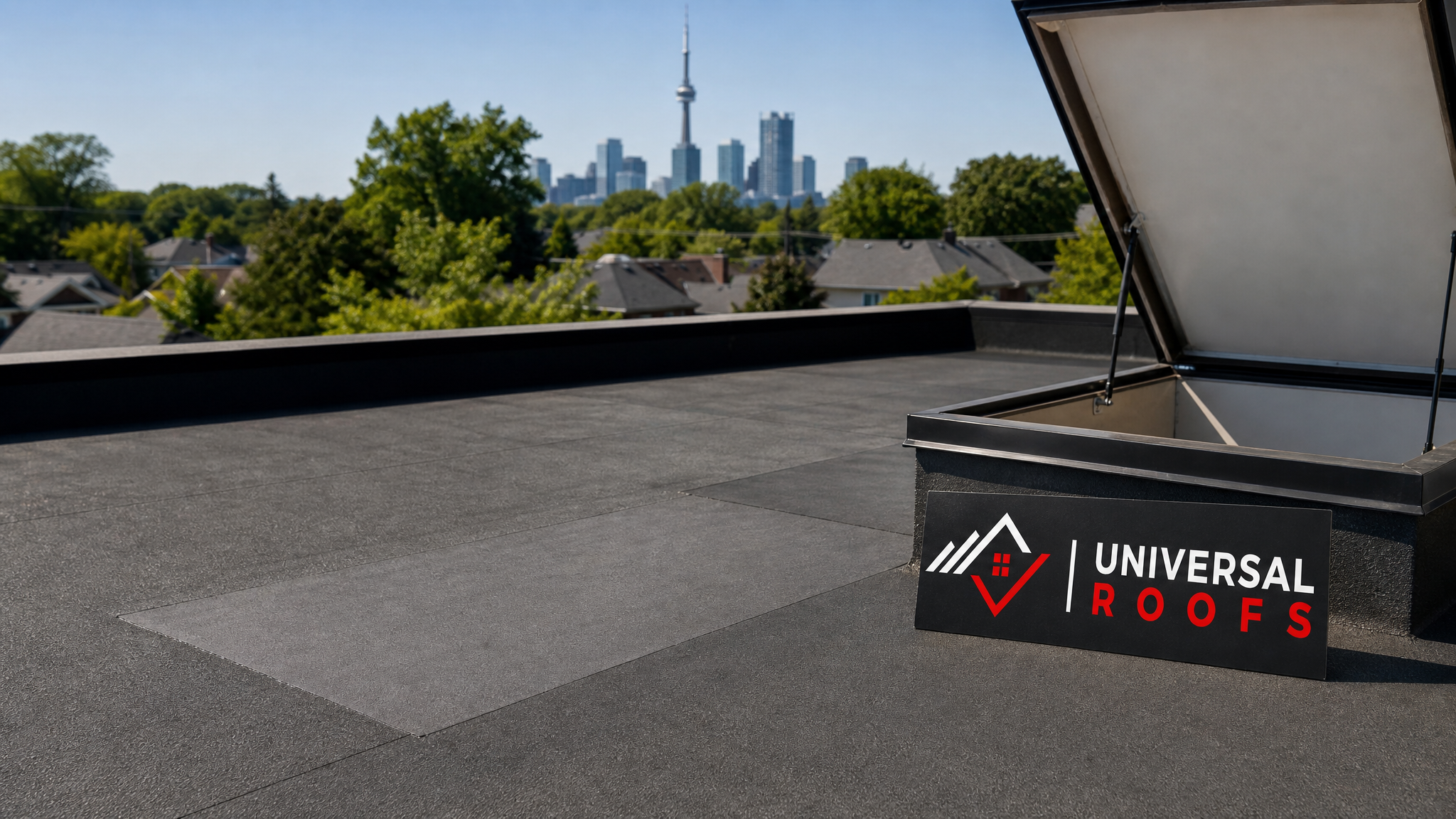
Before comparing repair options, it helps to understand why flat roofs develop problems in the first place. A sloped shingle roof sheds water quickly by design. A flat or low-slope roof — common on garages, additions, porch roofs, and many commercial buildings across the GTA — relies on a membrane system and a very slight drainage slope, sometimes as little as 1/4 inch per foot, to move water toward drains or scuppers. Any imperfection in that slope, or any breach in the membrane, creates a spot where water can collect and eventually penetrate.
Toronto’s climate makes this worse. Our winters bring repeated freeze-thaw cycles that expand tiny cracks into larger splits. Ice damming at parapet walls and drain openings is common. Summer brings intense UV exposure and thermal cycling that dries out and shrinks membrane materials over time, particularly on older tar-and-gravel or modified bitumen systems. By the time a leak actually shows up inside the building, the membrane has often been compromised for months.
The practical implication is that affordable flat roof repair is most successful when it is proactive rather than reactive. A roof inspected every spring and after major storms catches small issues — a lifted seam, a cracked pipe boot, ponding water — before they become expensive interior damage. Waiting until there is a visible stain on the ceiling usually means water has already been tracking through insulation and decking, which increases both the scope and the cost of the eventual repair.
Option 1: Localized Spot Repairs
A spot repair addresses a single, clearly identified failure point — a split seam, a puncture from foot traffic or debris, a failed pitch pocket around a vent pipe, or cracked flashing at a wall termination. This is the most affordable flat roof repair option in almost every case, because it requires minimal material and labour and does not disturb the rest of the roof system.
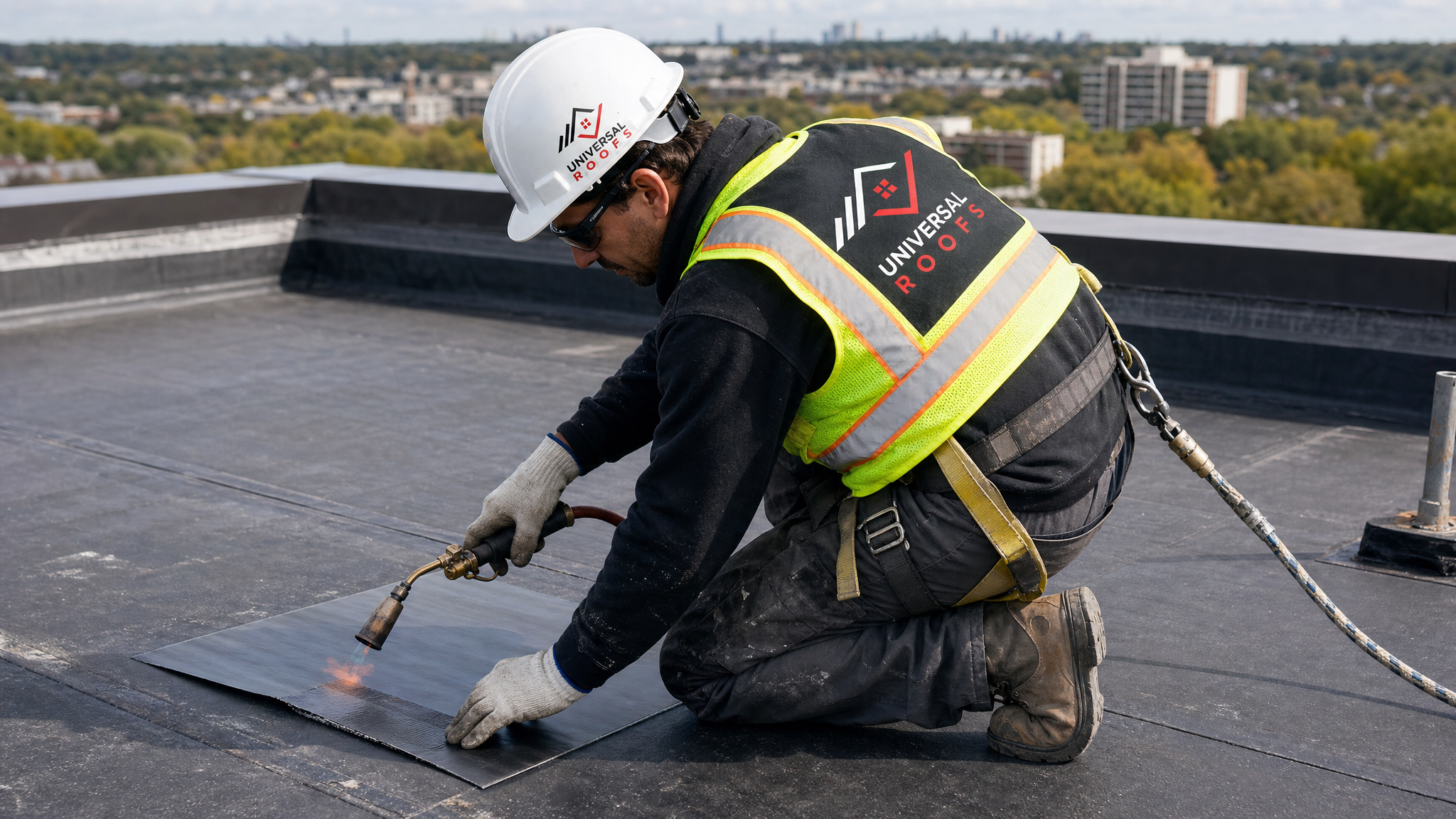
For modified bitumen and built-up roofs, spot repairs typically involve cutting out the damaged section, priming the substrate, and torching or cold-applying a new patch of matching membrane that overlaps the surrounding area by at least 100 millimetres on all sides. For EPDM rubber roofs, a liquid seam primer and a cured patch (or a self-adhered EPDM patch) restores the waterproof layer. For TPO, technicians use hot-air welding to fuse a patch directly to the existing membrane, creating a bond that is often stronger than the original seam.
Spot repairs are ideal when the rest of the membrane is still in reasonably good condition — flexible, adhered, and free of widespread blistering or UV degradation. If an inspection shows the damage is isolated, there is rarely a reason to spend more than what a spot repair costs.
Option 2: Sectional (Partial) Membrane Replacement
When damage is spread across a larger area — for example, an entire corner of the roof where ponding water has degraded the membrane over several seasons — a sectional repair replaces that portion of the roofing system down to the deck or insulation layer while leaving the rest of the roof untouched. This sits between a spot repair and a full roof replacement in both cost and scope.
Sectional repairs make sense when 15-40% of the roof surface is compromised but the remainder still has useful service life left. This is common on roofs where one side gets more sun exposure, one drain has been chronically clogged, or an addition was tied into an older roof with a weak transition detail. Tackling just the failing section can add 5-10 years of service life to that portion without the expense of redoing sound material.
The trade-off is that a sectional repair creates a new seam where old membrane meets new membrane, and that transition needs to be detailed carefully to avoid becoming the next failure point. This is one area where DIY attempts tend to go wrong — an improperly lapped or under-sealed transition seam is one of the most common causes of recurring leaks we see when inspecting a previously “repaired” roof.
Option 3: Liquid-Applied Roof Coatings
Liquid-applied membranes — acrylic, silicone, or polyurethane coatings — are one of the most cost-effective ways to extend the life of an aging flat roof, particularly modified bitumen or built-up systems that are structurally sound but showing surface wear, chalking, or minor cracking. Rather than cutting and patching, a coating is rolled or sprayed over the entire roof surface (or a defined section) to create a new, seamless waterproof layer.
These coatings reflect UV radiation, which reduces thermal cycling and slows further degradation, and many carry a 10-year manufacturer warranty when applied at the correct thickness. They are significantly less expensive than membrane replacement and can often be applied in a single day for a typical residential garage or addition roof.
The important caveat: a coating is a restoration option, not a repair for active structural damage. It will not fix a soft, waterlogged deck, close a wide split, or correct ponding caused by insufficient slope. Coatings work best as a maintenance and life-extension tool applied to a roof that does not currently have an active leak. If your roof already has a confirmed leak, that area needs a proper patch or sectional repair before a coating goes on top.
Comparing the Main Affordable Repair Options
The table below summarizes how the primary repair paths compare on cost, typical lifespan, and best-use scenario. Costs are presented as relative ranges since actual pricing depends on roof size, access, and the extent of damage found once the membrane is opened up.
| Repair Option | Relative Cost | Typical Added Lifespan | Best For |
|---|---|---|---|
| Spot / patch repair | $ (Lowest) | 3-8 years | Isolated punctures, small seam splits, single flashing failures |
| Pitch pocket / penetration reseal | $ (Lowest) | 3-6 years | Leaks around vents, pipes, and rooftop equipment |
| Liquid-applied coating | $$ (Moderate) | 8-12 years | Aging but structurally sound membranes with surface wear |
| Sectional membrane replacement | $$$ (Moderate-High) | 10-15 years (on repaired section) | Localized failure across 15-40% of roof area |
| Full membrane replacement | $$$$ (Highest) | 20-25 years | Widespread failure, structural damage, or roof past end of life |
Membrane Materials and How Each One Is Repaired
Not every flat roof material is repaired the same way, and knowing what is on your roof matters before you get quotes. Older Toronto homes and additions frequently have built-up (tar and gravel) or modified bitumen roofs, while newer installations more often use EPDM rubber or TPO single-ply membranes. Each has a different repair method, cost profile, and material lifespan.
| Membrane Type | Typical Lifespan | Common Repair Method | Repair Difficulty |
|---|---|---|---|
| Built-up roof (BUR / tar and gravel) | 15-25 years | Hot tar patch, cap sheet overlay | Moderate — gravel must be cleared first |
| Modified bitumen (torch-down) | 15-20 years | Torched or cold-adhered patch | Moderate — requires careful heat control |
| EPDM rubber | 20-25 years | Liquid primer + cured or self-adhered patch | Easier — good for smaller repairs |
| TPO single-ply | 20-25 years | Hot-air welded patch | Requires specialized welding equipment |
If you are unsure what material is currently on your roof, that is a normal starting point for a proper assessment rather than something you need to diagnose yourself. Our flat roofing team identifies the membrane type as the first step of any inspection, since it determines both the repair method and what a reasonable price should look like.
When a Repair Is No Longer the Affordable Option
Repairs are only affordable when they actually solve the problem. There are situations where continuing to patch a flat roof costs more over time than simply replacing it, and recognizing these signs early can save significant money.
- Recurring leaks in the same general area despite two or more previous patch attempts usually indicates a systemic issue — inadequate slope, saturated insulation, or a membrane that has lost its overall integrity, not just one bad spot.
- Widespread ponding water that lasts more than 48 hours after rainfall across large sections of the roof points to a structural slope problem that patching cannot fix.
- Soft or spongy decking underfoot means water has already penetrated into the substrate. Patching the surface membrane over compromised decking is a temporary cosmetic fix, not a real repair.
- A membrane older than 20-25 years with brittle, cracking material across most of its surface is past the point where spot repairs make economic sense — the material itself has reached the end of its useful life.
- Interior damage spreading to multiple rooms or recurring on the attic side indicates the leak point has been active for a long time and the affected roof deck and insulation likely need replacement, not just resealing.
If any of these apply to your roof, an honest assessment may point toward roof replacement rather than repeated repair spending. A reputable contractor should tell you this directly rather than selling you another patch that is unlikely to hold.
Cost Factors That Affect Your Repair Price
Several variables determine where your specific repair will land within the cost ranges above. Understanding these helps you evaluate whether a quote is reasonable for your situation.
| Factor | Effect on Cost | Why It Matters |
|---|---|---|
| Roof access and height | Increases cost with difficulty | Steep pitches, tight lot lines, or third-storey access require more equipment and time |
| Size of the damaged area | Directly proportional | Larger patches or sectional work need more material and labour hours |
| Number of penetrations nearby | Increases cost | Vents, skylights, and HVAC curbs each need their own flashing detail |
| Underlying insulation condition | Can significantly increase cost | Wet insulation must be removed and replaced before a new membrane goes down |
| Time of year | Minor seasonal variance | Summer offers the widest material and scheduling flexibility for curing times |
Summer, like right now, is genuinely one of the best times to have flat roof repairs done in Toronto. Warm, dry conditions allow adhesives and coatings to cure properly and give torch-applied membranes consistent results, whereas repairs attempted in cold or wet weather are more prone to poor adhesion and premature failure.
DIY Repair: What’s Realistic and What Isn’t
Homeowners often ask whether they can save money by handling a flat roof repair themselves. For very minor issues — a small crack sealed with a compatible roofing caulk, or a temporary tarp over an active leak until a professional can attend — a careful DIY approach can buy time without making things worse.
Beyond that, DIY flat roof repair carries real risk. Roofing membranes need specific primers and adhesives matched to the exact material type; using the wrong product can actually accelerate failure by preventing proper adhesion or causing a chemical reaction with the existing membrane. Torch-applied modified bitumen work involves an open flame on a roof deck, which is a genuine fire hazard without proper training and fire-watch protocols. And any repair performed without addressing the underlying cause — poor drainage, a failed flashing detail, deteriorated insulation — is likely to fail again within a season or two, meaning the “savings” evaporate once you pay for a second repair.
The most cost-effective approach for anything beyond a temporary patch is a proper inspection and diagnosis from a qualified roofing contractor who can identify the actual failure point rather than just treating the visible symptom.
How to Get a Genuinely Affordable Quote
Affordable does not mean the lowest number on paper — it means the best long-term value for the actual problem you have. Here is how to evaluate quotes so you are comparing apples to apples:
- Ask for a specific diagnosis, not just a price. A contractor who tells you exactly what failed and why is more likely to fix the right thing.
- Confirm what is included: material type, warranty length, whether insulation will be checked, and cleanup.
- Get more than one opinion if a quote jumps straight to full replacement without explaining why a repair or sectional fix would not work.
- Check for manufacturer-backed warranties on coatings and membrane patches, which typically run from 5 to 15 years depending on the product.
- Read reviews from other homeowners in your area to see how a company has handled repair work in the past, particularly whether repairs held up over time.
It’s also worth having your roof’s drainage and attic ventilation checked at the same time as a repair. A poorly ventilated attic can trap moisture that accelerates membrane deterioration from underneath, which is easy to miss if only the surface is inspected.
Maintenance Steps That Keep Repairs Affordable Long-Term
Once a repair is complete, a few simple habits extend its life and reduce the odds of needing another one soon:
| Maintenance Task | Recommended Frequency | What It Prevents |
|---|---|---|
| Clear debris from drains and scuppers | Every season, plus after storms | Ponding water and overflow onto membrane edges |
| Visual inspection of seams and flashing | Spring and fall | Small splits developing into full leaks over winter |
| Trim overhanging tree branches | Annually | Punctures and accelerated debris buildup |
| Check pitch pockets around vents/pipes | Annually | Sealant shrinkage that opens a path for water |
| Professional inspection | Every 1-2 years | Missed early-stage damage that becomes expensive later |
Homeowners in different parts of the GTA face slightly different conditions — properties in Toronto proper often deal with mature tree canopy and older housing stock, while homes across the Peel Region, York Region, Halton Region, and Durham Region tend to have newer flat roof additions and garage roofs that still benefit from the same seasonal maintenance routine.
Don’t Overlook Skylights and Roof Penetrations
A significant share of flat roof leaks are not failures in the field membrane at all — they originate at the flashing around skylights, vents, and other penetrations. If your flat roof has a skylight, it’s worth having that unit inspected alongside the membrane, since a degraded skylight seal can mimic the symptoms of a membrane leak and lead to unnecessary roof-wide repairs when the real fix is isolated to the skylight replacement or reseal itself. Our skylights team routinely finds that a targeted flashing repair solves a “roof leak” that a homeowner assumed required a full membrane job.
What are the most affordable flat roof repair options available?
How much does a typical flat roof patch repair cost in Toronto?
Can I repair a flat roof myself to save money?
How do I know if my flat roof needs a repair or a full replacement?
What is the best time of year for affordable flat roof repair?
Do liquid roof coatings count as a real repair or just a temporary fix?
Need Help With What Are the Options?
Every flat roof is different, and the most affordable repair for your situation depends on the membrane type, the age of the roof, and exactly where the damage is located. The team at Universal Roofs has been diagnosing and repairing flat roofs across the GTA since 2005, and we start every job with an honest assessment of whether a spot repair, coating, sectional fix, or replacement makes the most sense for your budget.
Call us today at (416) 732-2421 or request a free inspection to get started.
Universal Roofs proudly serves Toronto, Mississauga, Brampton, Vaughan, Markham, Oakville and the GTA since 2005.