
If you see water dribbling down the fascia behind your eavestrough during rain, or a line of rot and peeling paint just under the roof edge, the missing piece is often a strip of bent metal most homeowners never notice: the gutter apron or the drip edge. Both are roof edge flashings. They look similar on the shelf, but they are shaped for different jobs, and fitting the wrong one, or fitting the right one in the wrong order with the underlayment, leaves a gap that lets water run behind the trough instead of into it.
Below we explain the common profiles, which edge of the roof each belongs on, how they lap with underlayment and ice and water membrane at the eaves and rakes, and how a crew fixes water running behind troughs on an existing roof.
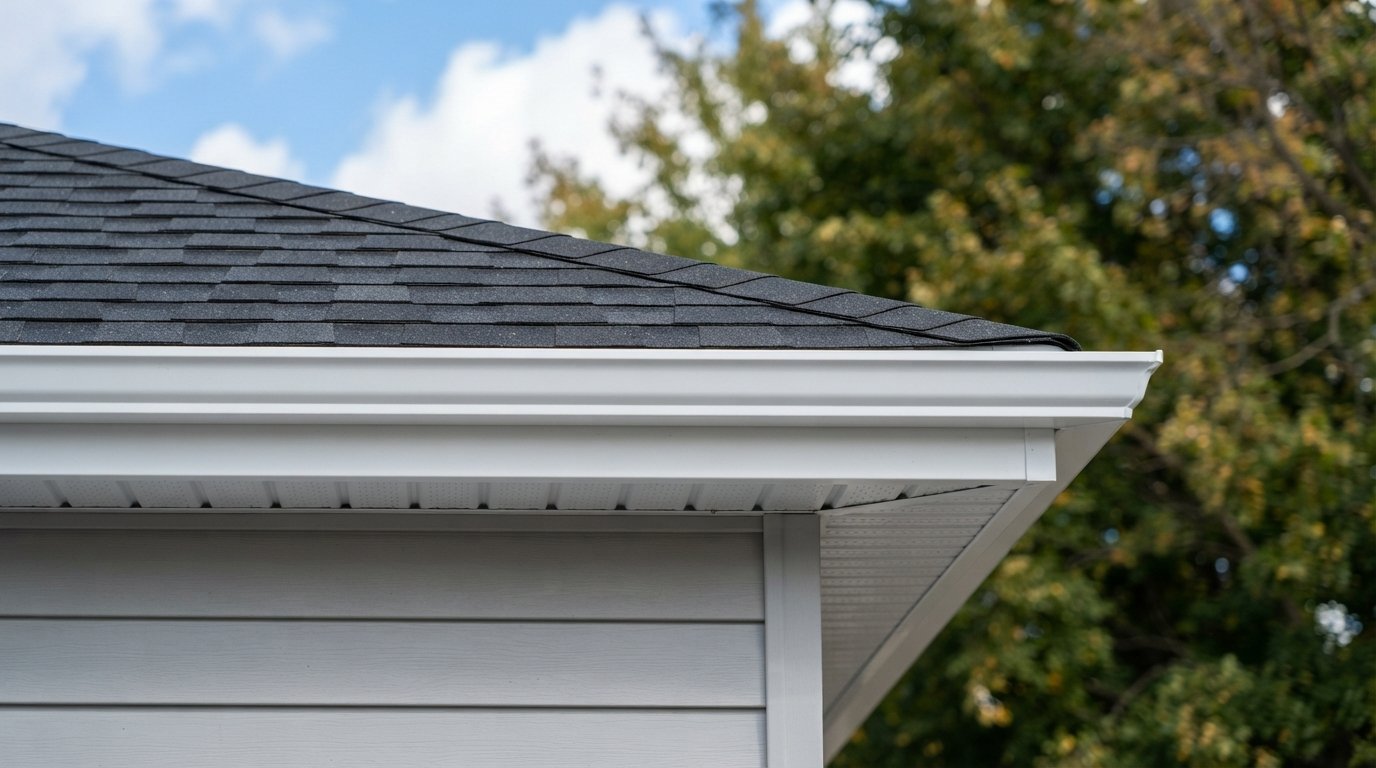
Gutter Apron And Drip Edge: What Each One Does
Every roof edge has the same weak point. Water running off the last course of shingles does not always drop cleanly. Surface tension lets it cling to the underside of the shingle, curl back toward the house and run along the fascia. Wind pushes it upward. At the rakes (the sloped gable ends), wind-driven rain can blow sideways under the shingle edge. Roof edge flashing interrupts all of that.
Drip edge is a metal flashing installed along roof edges to support the shingle overhang, protect the edge of the deck and fascia, and throw water off with a small outward kick. It is used at eaves and at rakes.
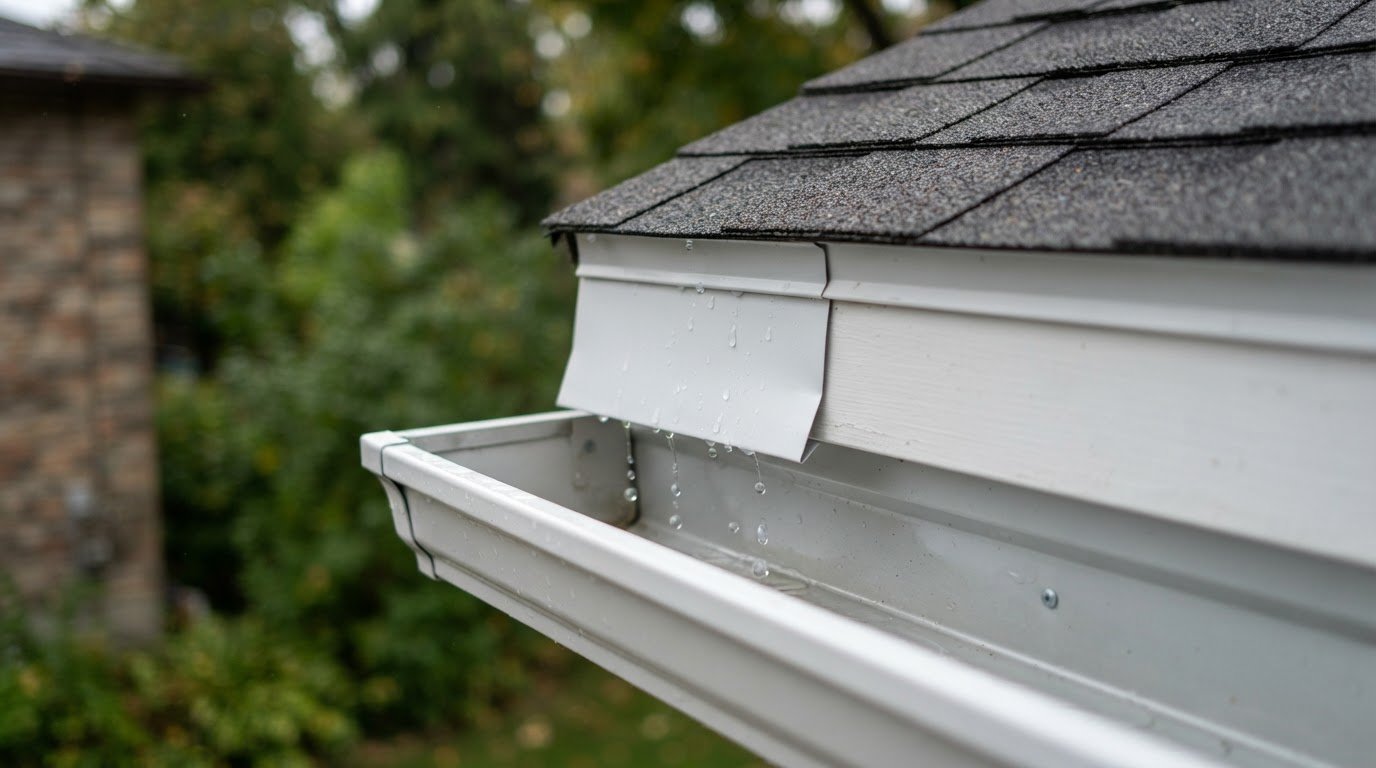
A gutter apron is a type of eave flashing designed specifically to work with eavestroughs. It has a flange that lies on the roof deck under the shingles and a longer lower leg, often with an angled bend, that extends down into the trough behind its front edge. Its purpose is to bridge the gap between the roof edge and the back of the trough so water has nowhere to go but in.
In short: drip edge is the general roof edge flashing; a gutter apron is the eave flashing to use when you need to deliver water into a trough that sits a little low or a little away from the roof edge.
The Common Profiles
Roofing suppliers sell edge metal in several shapes. Names vary by supplier and region, but the profiles you will hear about most are these.
| Profile | Shape | Typical use | Limitation |
|---|---|---|---|
| L-style drip edge | Simple right angle: one leg on the deck, one down the fascia | Basic edge protection at rakes and eaves | Little outward kick; water can still cling and run back |
| T-style or D-style drip edge | Deck flange, vertical face and a projecting lower hem | Most common modern drip edge at eaves and rakes | Lower hem may not reach into a low-hung trough |
| Gutter apron | Deck flange with a longer, angled lower leg | Eaves with troughs, especially where the trough sits low | Not intended for rakes; must be fitted before or under shingles |
| Extended drip edge | Drip edge with a deeper face | Thick fascia build-ups or gaps behind troughs | Needs to match fascia depth to look tidy |
The small outward hem on a T-style or D-style drip edge is what breaks the path of clinging water. On an apron, the length and angle of the lower leg do the work by putting the edge of the metal inside the trough.
Where Each Goes: Eaves vs Rakes
Two roof edges, two different jobs.
At the eaves
The eave is the horizontal lower edge where the trough hangs. Here, you want water that runs down the underlayment to flow out onto the top of the metal, not underneath it. The commonly used sequence is:
- Eave metal (drip edge or apron) fastened directly to the roof deck along the eave.
- Ice and water protection membrane applied over the metal’s deck flange, running up the roof.
- Starter strip, then the first course of shingles, overhanging the metal slightly.
Because the membrane laps over the flange, anything that gets under the shingles drains onto the metal and into the trough. Some membrane and shingle manufacturers describe alternative sequences for particular products, so installers should follow the specific instructions for the materials used.
At the rakes
The rake is the sloped gable edge. There is no trough, and the concern is wind-driven rain being pushed sideways under the edge. So the order reverses:
- Underlayment runs out to the rake edge first.
- Drip edge is installed over the underlayment.
- Shingles and starter follow along the rake.
Placing the rake metal over the underlayment stops rain that blows against the gable from getting beneath the flashing. An apron is not used at rakes; its long leg would serve no purpose there.
Where the eave metal and rake metal meet at the corner, the rake piece should lap over the eave piece so water running down the rake lands on the eave flashing and flows toward the trough.
Side by side, the two sequences look like this:
| Question | At the eaves | At the rakes |
|---|---|---|
| Main threat | Water running down the roof and clinging back toward the fascia | Wind-driven rain pushed sideways under the edge |
| Metal used | Drip edge or apron flashing | Drip edge only |
| Metal relative to membrane or underlayment | Under it, fastened to the bare deck | Over it |
| Where the water should end up | Inside the eavestrough | Off the gable edge, clear of the fascia |
| Corner detail | Receives the rake metal lapped over it | Laps over the eave metal |
Choosing The Right Gutter Apron Or Drip Edge For Your Eaves
The decision at the eave depends on the relationship between the roof edge and the trough.
- Trough sits snugly under the roof edge, drip edge hem reaches inside it: a T-style or D-style drip edge is usually fine.
- Trough sits lower than ideal, or there is a gap between fascia and trough: a gutter apron extends the metal into the trough and closes the gap.
- Fascia has been built out or covered with thick cladding: an extended drip edge or an apron with a longer leg may be needed to clear it.
- Shingles overhang too little: water drops onto the fascia line. Edge metal helps, but the overhang may need correcting at the next reroof.
Many roofers use a gutter apron at every eave with a trough simply because it tolerates small differences in trough height. The important point is that the edge of the metal ends inside the trough, behind its front lip.
Material matters too. Pre-painted aluminum or steel edge metal is standard; colour-matching it to the trough and fascia keeps the edge tidy. With copper troughs, use copper edge metal to avoid mixing metals where water runs from one to the other.
Overhang, Fascia And Trough Height Work Together
Edge metal cannot fix a bad layout on its own. Three measurements decide whether water from the roof ends up in the trough, and a good installer checks all of them together.
Shingle overhang. The first course of shingles should project a short distance past the edge metal so water drips off the shingle onto the metal and into the trough. Too little overhang and water runs back under the shingle edge; too much and the shingle droops, cracks in cold weather or throws water beyond the trough in heavy rain. Shingle manufacturers give an overhang range in their instructions.
Fascia position. On many older homes the fascia sits slightly below or back from the edge of the roof deck, leaving a gap. A standard drip edge can end up hanging in mid-air behind the trough. This is exactly where an apron with a longer leg earns its place.
Trough height. The back of the trough should sit close under the roof edge, with the metal ending inside it. A trough hung too low to gain slope, or one that has sagged, opens a gap that no flashing profile can close. In that case the trough needs rehanging, sometimes with the run split so it can stay high along its length.
Why Water Runs Behind Your Troughs
If water is getting behind the trough on your house, one or more of these is usually the cause. Early autumn rain is a good time to watch and diagnose it. Correcting the roof edge is part of our roof edge and eaves repair work, and it is usually a modest job when caught before the fascia rots.
| Symptom | Likely cause | Typical fix |
|---|---|---|
| Water dripping between trough and fascia along the whole run | No drip edge or gutter apron at the eave | Retrofit a gutter apron under the first shingle course |
| Streaks or rot only at certain spots | Short or damaged sections of edge metal | Replace or extend the affected pieces |
| Water running behind trough at a corner | Rake and eave metal lapped wrongly or missing at the corner | Rework the corner so rake metal laps over eave metal |
| Overflow behind trough in heavy rain only | Trough hung too low or tilted outward | Rehang the trough higher and add a gutter apron |
| Soft, stained fascia behind the trough | Long-term water behind the trough | Replace fascia, add correct edge metal, rehang trough |
| Icicles forming behind the trough in winter | Meltwater tracking behind the trough plus heat loss | Edge metal fix plus attic insulation and ventilation review |
Look carefully before blaming the roof edge. Leaking trough seams, a clogged outlet causing overflow, or a trough sloped away from its downspout can all leave similar stains. Clean the trough, then watch it in steady rain.
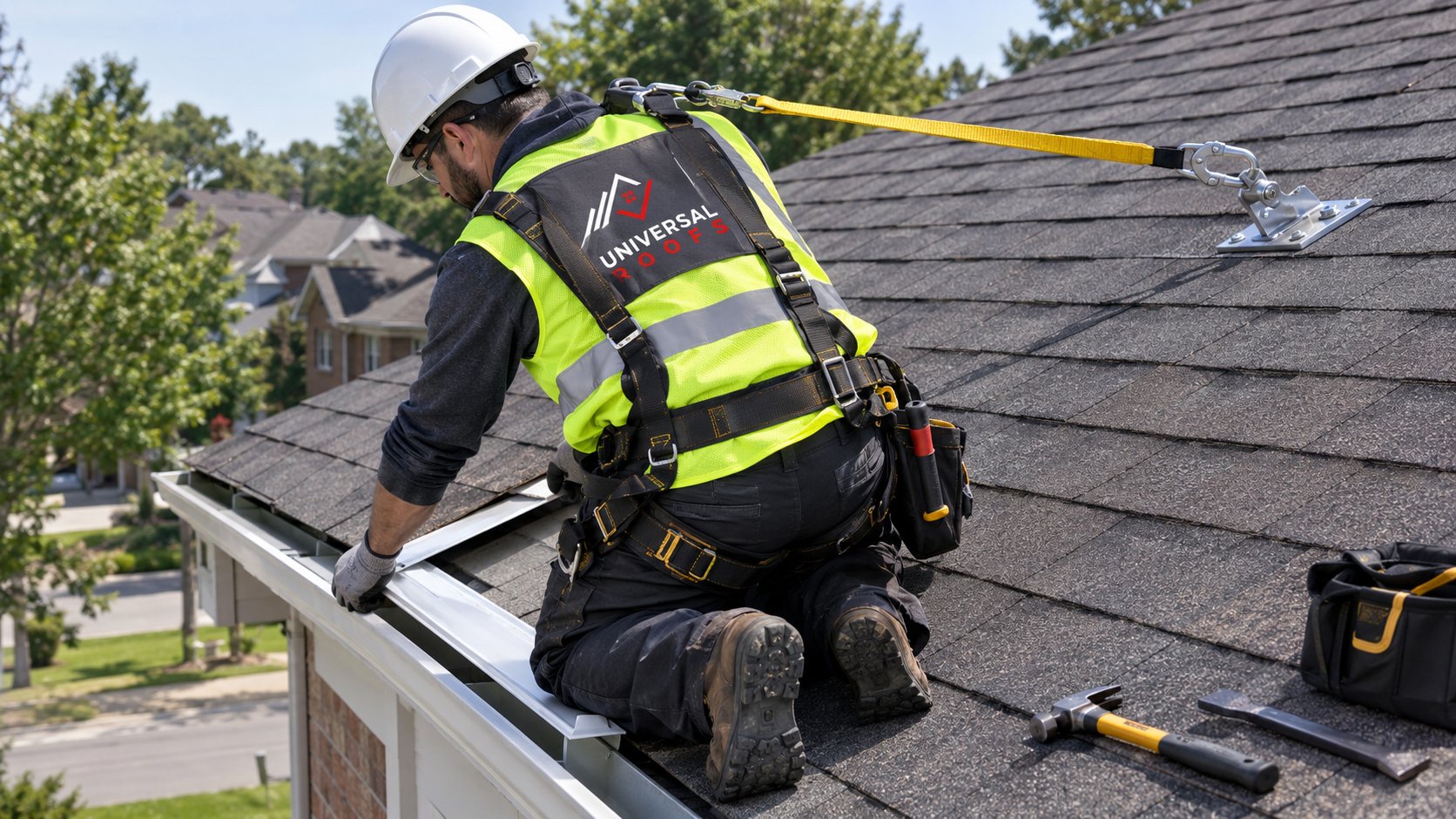
Retrofitting A Gutter Apron On An Existing Roof
You do not need a new roof to add one. On many homes an apron can be retrofitted at the eave. The typical approach:
- Check the conditions. The crew confirms the shingles are pliable enough to lift without cracking. This is one reason early autumn is a better time than late autumn; cold shingles are brittle.
- Break the seal. The first course and starter are carefully released from their sealant along a section of eave.
- Slide the apron in. The apron’s deck flange slides up under the starter and first course, and where practical under the edge of the underlayment or membrane, with the lower leg dropping into the trough.
- Fasten. The apron is fastened high on its flange where the nails will be covered by shingles, avoiding existing nails.
- Lap the joints. Each length overlaps the next, lapped in the direction of water flow.
- Reseal the shingles. The lifted courses are pressed down and resealed with compatible roofing cement where needed.
- Adjust the trough. If the trough is too low, it is rehung so the apron’s leg sits inside it.
If the fascia is rotted, it has to be replaced first, and the trough comes down anyway. At that point it may also be worth checking the deck edge for damage, which is easier while the trough is off.
Getting It Right During A Reroof
A roof replacement is the best time to fix edge details for good, because everything is open. Ask your roofer:
- Will you replace all edge metal, or reuse the old?
- Which profile will you use at the eaves, and is it a gutter apron or a drip edge?
- Does the eave metal go under the ice and water membrane, and the rake metal over the underlayment?
- How will the corners where rake meets eave be lapped?
- Will the metal colour match the trough and fascia?
- If the trough is being replaced too, who coordinates the height so the metal sits inside it?
Check the requirements that apply to your project with your municipality and the shingle manufacturer’s installation instructions, since manufacturers specify edge details as part of their installation requirements. Our crews work across the GTA, including roofing, eavestroughs and attic work across Peel Region, and we treat edge metal as a standard line item rather than an optional extra.
On cost, edge metal itself is inexpensive. As a broad estimate that varies by house and access, retrofitting apron flashing along an eave is often a few hundred dollars for a typical run, with more for multiple storeys, fascia repair or trough rehanging. A site visit gives the real number.
Frequently Asked Questions
Is a gutter apron the same as drip edge?
Do I need both on my roof?
Does edge metal go over or under the underlayment?
Can a gutter apron be added without replacing shingles?
Why is my fascia rotting behind the trough?
Is edge metal needed on a flat roof?
Book A Gutter Apron And Roof Edge Check
Water behind your troughs is a roof edge problem as much as an eavestrough problem, and it is much cheaper to fix before the fascia rots. Universal Roofs inspects the eaves and rakes, fits the right gutter apron or drip edge, and rehangs troughs so water goes where it should.
Call us today at (416) 732-2421 or request a free estimate.
Serving homeowners in Peel Region and across the wider GTA.