
A storm rolls through the GTA at 2 a.m., a branch punches through your shingles, and water starts tracking down the attic joists. In that moment, homeowners face a choice that shapes everything that follows: patch it yourself, call the first name that shows up in a late-night search, or contact a licensed, insured roofing contractor who actually answers the phone. That decision determines whether the damage stops tonight or multiplies for weeks.
This is exactly why choose professional emergency roof repair matters more than most homeowners realize until they are standing in a hallway with a bucket catching drips. A qualified emergency roofer does more than throw a tarp over a hole. They diagnose the real source of the leak, stabilize the structure safely, document the damage for your insurer, and set you up for a permanent repair instead of a temporary Band-Aid that fails during the next rain.
Toronto’s climate makes this an especially local issue. Freeze-thaw cycles crack shingles and flashing all winter, summer thunderstorms and microbursts tear off sections of aging roofs, and the humidity swings common to the GTA accelerate rot once water gets behind a membrane. Whether you are in Toronto, Mississauga, Vaughan, Oakville, or Ajax, understanding what separates a professional emergency response from a risky DIY fix — or worse, an unlicensed “storm chaser” — can save you thousands of dollars and protect your family’s safety.
What Makes a Roof Repair a True Emergency
Not every roofing problem needs a same-day response, but knowing the difference can prevent a manageable repair from becoming a full roof replacement. A true emergency involves active water intrusion, structural compromise, or a safety hazard that will worsen measurably within hours, not weeks.
Common triggers for an emergency call in the GTA include wind-lifted or missing shingles after a summer storm, a tree limb or falling branch puncturing the roof deck, ice damming in winter that forces water back under shingles, a skylight seal failure during heavy rain, and flashing that has separated around a chimney or vent stack. Each of these situations shares one trait: the longer water sits against wood framing, insulation, or drywall, the more expensive the eventual repair becomes.
Professional crews are trained to triage these calls quickly. A homeowner describing “a dark stain spreading across the ceiling” versus “a small drip after rain” gets a different response priority, because experienced roofers know how those symptoms map to underlying severity. That triage step alone is one of the most overlooked reasons professional response outperforms a DIY attempt — you are working from pattern recognition built over thousands of past jobs, not guesswork under pressure.
The Real Risks of DIY or Unlicensed Emergency Repairs
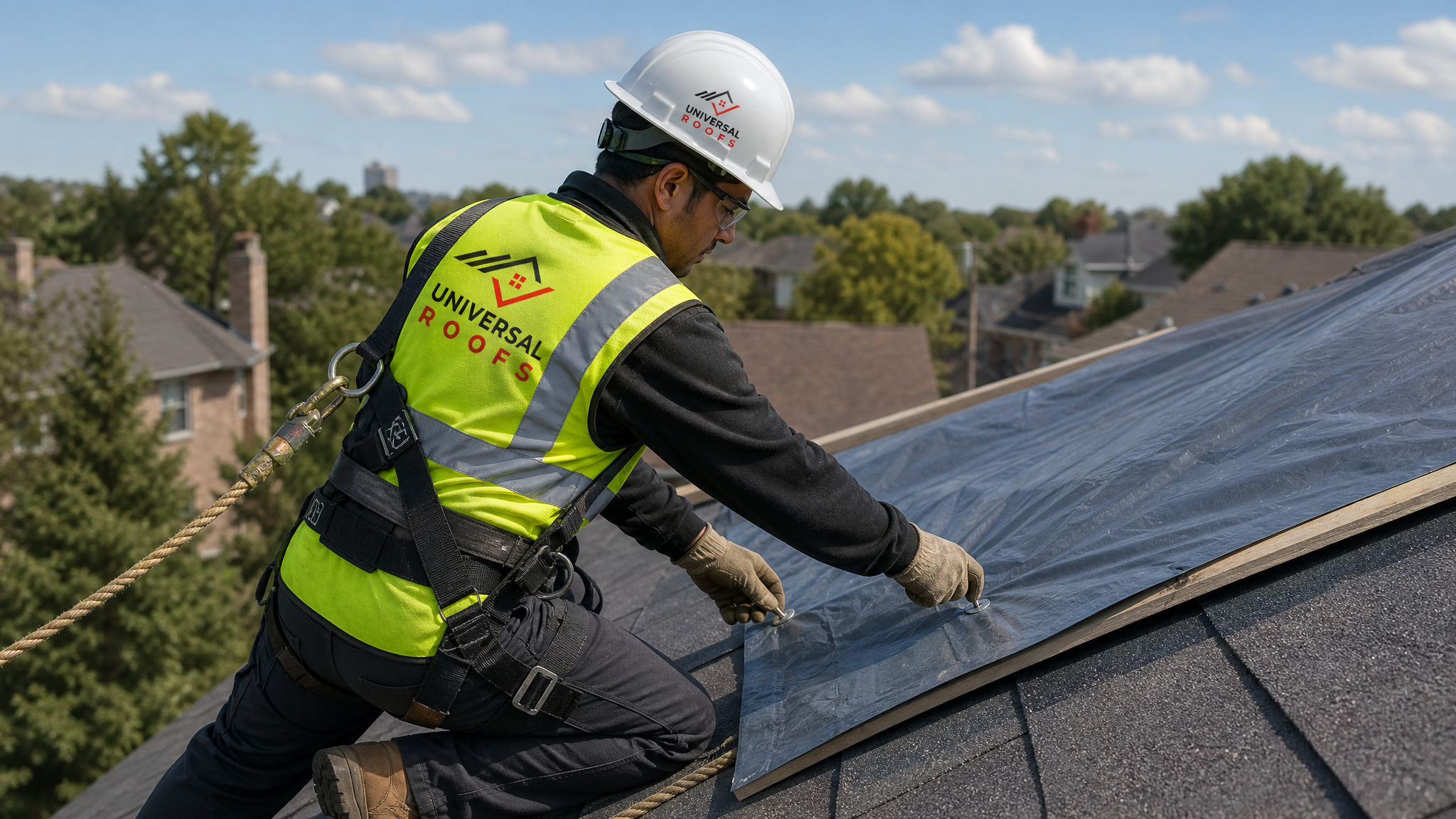
It is tempting to grab a ladder and a tarp the moment you spot a leak, especially at 3 a.m. during a downpour. But climbing a wet, sloped roof in the dark is one of the leading causes of serious fall injuries reported to Ontario emergency rooms every storm season. Professional emergency roof repair crews carry fall-protection harnesses, anchor points, and rope systems specifically because working at height in poor weather is inherently dangerous — even for people who do it daily.
Beyond the physical risk, DIY tarping often fails to actually stop water intrusion. A tarp stapled directly into shingles can create new puncture points, and improper securing in high wind can tear the tarp away entirely within hours, leaving the exposed area worse off than before. Unlicensed “storm chasers” who canvas neighbourhoods after major weather events present a different problem: they frequently perform surface-level patches, take a deposit, and disappear before the underlying issue is properly diagnosed.
| Response Type | Typical Cost | Water Intrusion Stopped? | Insurance Documentation | Long-Term Reliability |
|---|---|---|---|---|
| DIY tarp job | $0-$150 (materials) | Often partial or temporary | None provided | Low — commonly fails within days |
| Unlicensed “storm chaser” | $300-$800 deposit | Inconsistent | Rarely documented properly | Low — no warranty, no accountability |
| General handyman | $200-$500 | Sometimes | Basic photos only | Medium — lacks roofing-specific expertise |
| Licensed emergency roofer | $250-$900 for stabilization | Yes, engineered fix | Full report with photos and notes | High — backed by warranty and follow-up |
That final column — long-term reliability — is where the real cost difference shows up. A homeowner who pays for a professional tarp-and-stabilize visit rarely needs a second emergency call for the same leak. A homeowner who tries three DIY fixes before calling a professional has usually paid more in cumulative materials and interior damage than the professional visit would have cost from the start.
What a Professional Emergency Response Actually Includes
When you contact a professional roofing company for emergency roof repair, the visit typically follows a structured process rather than an improvised patch job. Understanding these steps helps homeowners know what to expect and what questions to ask when a crew arrives.
First is a phone triage, where the technician asks about the location and size of the leak, when it started, and whether there is any visible sagging or ceiling staining — this helps them bring the right materials on the first trip. Second is a rapid, safe assessment of the roof using proper fall protection, checking not just the visible damage but surrounding shingles, flashing, and fasteners that may be compromised. Third is temporary stabilization: synthetic underlayment, peel-and-stick membrane, or properly secured tarping fastened into structural points rather than shingles alone, designed to survive additional wind and rain until a permanent fix can be scheduled.
Fourth is documentation — photos of the damage, a written assessment, and often a report formatted for insurance claims. Fifth is a clear explanation of next steps, whether that means scheduling a full roof replacement for an aging system or a targeted repair to the affected section only. This structured approach is precisely why choose professional emergency roof repair over an ad-hoc fix: every step reduces the odds of repeat damage.
How Toronto’s Climate Shapes Emergency Repair Needs
The GTA’s weather pattern is uniquely hard on roofing systems, and understanding this context explains why local expertise matters as much as general roofing skill. Winters bring repeated freeze-thaw cycles that expand and contract shingle granules, nails, and flashing seals, gradually loosening components that then fail suddenly during a thaw or a wind event. Ice damming along eaves — common on homes with inadequate attic ventilation — forces meltwater back under shingles rather than off the roof edge, which is one of the most frequent causes of winter emergency calls.
Summer introduces a different hazard profile: sudden thunderstorms and localized microbursts that can rip shingles off in seconds, combined with UV exposure that makes older asphalt shingles brittle and prone to cracking. Homes with flat or low-slope sections, common across many GTA neighbourhoods, face their own risk pattern where ponding water finds any seam weakness in a flat roofing membrane. A contractor who works across Toronto, Mississauga, Brampton, Vaughan, Markham, and Oakville year-round develops pattern recognition for exactly which failure points show up after which type of weather — insight a generalist handyman or out-of-town crew simply does not have.
| Season | Common Roof Emergency | Typical Root Cause | Response Priority |
|---|---|---|---|
| Winter | Ice dam leaks along eaves | Poor attic ventilation/insulation | High — active interior water risk |
| Spring | Flashing separation | Freeze-thaw expansion over winter | Medium-high |
| Summer | Wind-torn or missing shingles | Thunderstorms, microbursts | High — immediate exposure |
| Fall | Clogged gutters causing backup | Leaf debris, poor drainage | Medium |
Because today is early July, the most relevant seasonal risk is exactly this summer pattern — sudden storm cells moving through the GTA that can strip shingles or crack flashing in minutes. Homeowners who have their roof assessed proactively before storm season, rather than waiting for the first leak, generally spend far less over the following year.
Why Licensing, Insurance, and Warranty Coverage Matter
One of the clearest practical answers to why choose professional emergency roof repair comes down to accountability. A licensed roofing contractor carries liability insurance that protects your property if something goes wrong during the repair — a dropped tool damaging siding, for example, or a fall that causes injury on your property. An unlicensed operator carries none of that protection, which means any damage caused during the “fix” becomes the homeowner’s financial problem.
Warranty coverage is equally important. A professional emergency stabilization is typically followed by a warrantied permanent repair, meaning if the same leak recurs within the coverage period, the company returns at no additional charge. DIY fixes and unlicensed patch jobs offer no such recourse — if the tarp fails again next week, the homeowner is back to square one, older and no wiser about what actually caused the leak.
Insurance claims add another layer where professional documentation pays for itself. Adjusters expect clear, dated photos and a written scope of damage. Homeowners who show up with a phone photo and no professional report often face slower claims processing or partial denials. A company with a track record — read through the customer reviews from past emergency calls — has typically handled dozens of insurance-adjacent repairs and knows exactly what documentation adjusters want to see.
What Homeowners Should Do the Moment a Leak Starts
Before a professional crew arrives, there are a few safe, sensible steps homeowners can take without climbing onto the roof. Move furniture and valuables away from the affected area, place a bucket or container to catch dripping water, and if the ceiling is visibly bulging with trapped water, carefully puncture a small relief hole with a screwdriver into the bucket below — this prevents a much larger, uncontrolled ceiling collapse. Photograph the interior damage as soon as it is safe to do so, since this timestamp helps establish when the damage began for insurance purposes.
What homeowners should avoid: climbing onto a wet or sloped roof, especially in the dark or during active rain; attempting to seal a leak from the exterior without proper fall protection; and using generic caulk or sealant on flashing, which often traps moisture rather than releasing it and can accelerate rot. These situations are exactly why choose professional emergency roof repair services exist — the risk-to-benefit ratio of a DIY roof climb during an active emergency rarely favours the homeowner.
| Homeowner Action | Safe to Do Yourself? | Why |
|---|---|---|
| Move belongings, place a bucket | Yes | No height risk, prevents interior damage |
| Puncture a bulging ceiling to relieve water | Yes, carefully | Prevents uncontrolled collapse |
| Photograph interior damage | Yes | Supports insurance claim timeline |
| Climb onto the roof to inspect | No | High fall risk, especially in wet conditions |
| Apply caulk or sealant to flashing | No | Can trap moisture and worsen rot |
| Remove damaged shingles yourself | No | Risk of enlarging the opening or falling |
Skylights, Attics, and Other Emergency Failure Points
Not every emergency call originates from the shingle field. Skylight seal failures are a common source of sudden leaks, particularly on older units where the flashing kit has degraded or the glazing seal has separated after years of thermal cycling. A professional assessment of a leaking skylight distinguishes between a simple reseal and a case requiring full skylight replacement, which matters because a temporary reseal on a unit near end-of-life often fails again within a season.
Attic ventilation is another frequently overlooked contributor to emergency leaks. Poor airflow through the attic space allows heat and moisture to build up, accelerating ice dam formation in winter and shingle degradation in summer. A thorough emergency response often includes a quick check of attic ventilation and insulation, because fixing the roof surface without addressing an underlying ventilation problem tends to produce the same emergency again within a year or two.
Choosing the Right Emergency Roofing Contractor
When evaluating who to call, homeowners across the GTA should look for a few concrete signals of legitimacy. Confirm the company holds proper licensing and liability insurance, ask whether they provide written documentation suitable for insurance claims, and check whether they warranty both the temporary stabilization and the eventual permanent repair. A company that has served the region for close to two decades typically has crews familiar with the specific building codes and weather patterns across Toronto, Peel Region, York Region, Halton Region, and Durham Region.
It also helps to ask direct questions before a crew arrives: How quickly can you respond? Do you carry the materials needed for temporary stabilization on the truck, or will there be a delay? Will I receive photos and a written report? Is the stabilization visit itself warrantied? A contractor who answers these clearly and promptly is signalling the same organizational discipline that will show up in the actual repair. For answers to common questions before you call, the FAQ page and the about page outline typical response times and service history.
The True Cost of Waiting
Perhaps the most persuasive answer to why choose professional emergency roof repair is a simple cost comparison over time. A small, actively leaking area addressed within 24 hours typically involves shingle and flashing repair alone. The same leak left unaddressed for a week can saturate insulation and drywall, requiring interior remediation in addition to the roof repair. Left for a month, it can compromise roof decking and framing, pushing the project from a repair into a much larger structural rebuild.
| Time Leak Left Unaddressed | Likely Damage Scope | Estimated Repair Complexity |
|---|---|---|
| 0-24 hours | Localized shingle/flashing damage | Low — targeted repair |
| 1-7 days | Insulation and drywall staining | Medium — repair plus interior patching |
| 1-4 weeks | Mould risk, sagging drywall | Medium-high — remediation required |
| 1+ months | Rotted decking, framing damage | High — structural repair or replacement |
This progression is why professional emergency response is not a luxury service reserved for catastrophic damage — it is the most cost-effective decision available the moment a leak is discovered, in every season and at every scale of damage.
Why choose professional emergency roof repair instead of a DIY tarp fix?
How fast can a professional roofer respond to an emergency in the GTA?
Is emergency roof repair covered by home insurance?
What is the difference between temporary stabilization and permanent roof repair?
Can ignoring a small roof leak really lead to major structural damage?
How do I know if a roofing contractor is qualified for emergency work?
Need Help With Why Choose Professional Emergency?
Storm damage does not wait for business hours, and neither should your response. Universal Roofs has built its reputation on fast, documented, properly stabilized emergency repairs across the GTA — the kind of response that protects your home the first time, without a second emergency call the following week.
Call us today at (416) 732-2421 or request a free inspection to get started.
Universal Roofs proudly serves Toronto, Mississauga, Brampton, Vaughan, Markham, Oakville and the GTA since 2005.