
Rain chains have moved from Japanese temple architecture onto GTA porches and garden sheds, and they come up often when we look at eavestroughs in the fall. The honest answer to whether rain chains work in Ontario weather is: yes, in the right spot, sized for the right amount of roof, with a plan for where the water lands and a plan for winter. They are not a drop-in replacement for every downspout on a two-storey house, and treating them that way is how basements get wet.
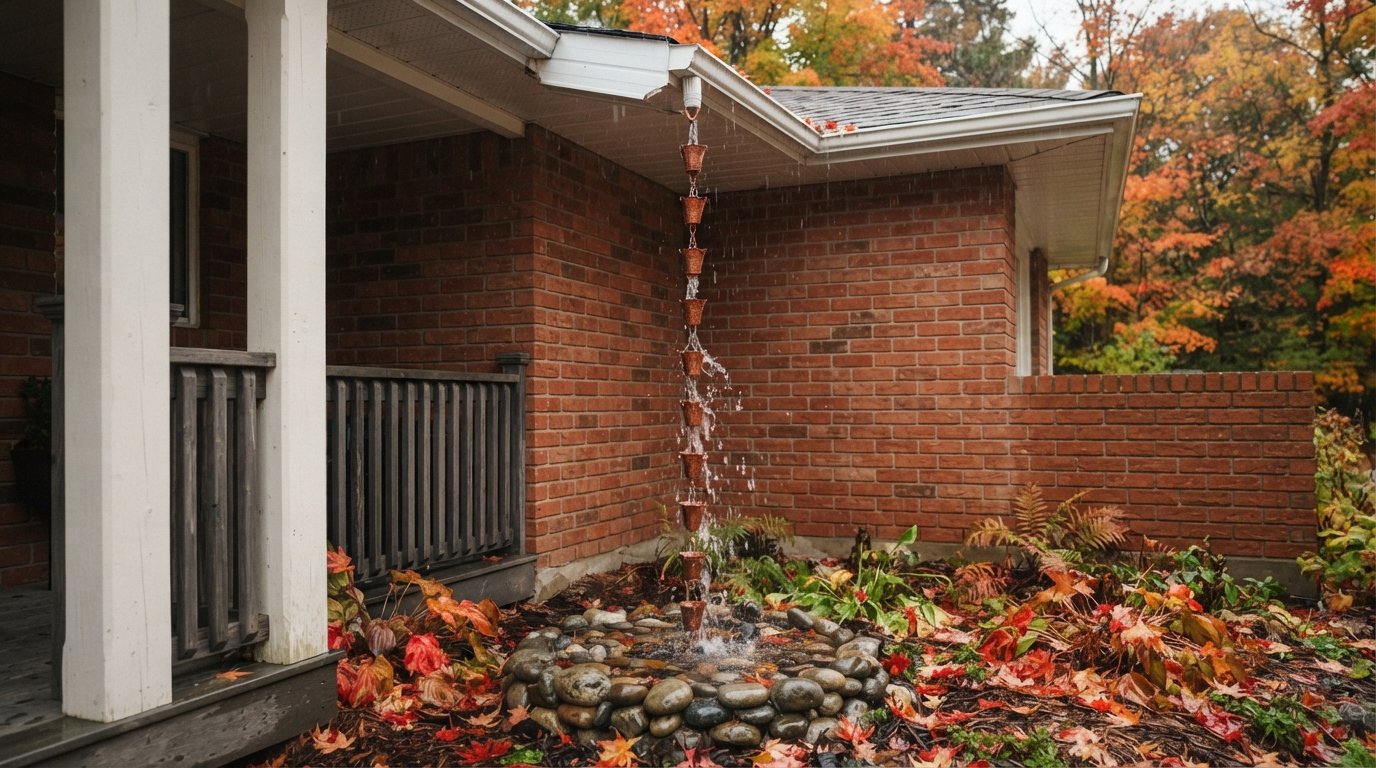
What Rain Chains Actually Do, And What They Do Not
A downspout is a closed pipe. Water that enters the outlet at the bottom of the eavestrough is contained until it exits at the elbow, which means it can move a large volume quickly and deliver it to one controlled point. Rain chains replace that closed pipe with an open path. Water clings to the chain by surface tension and falls from cup to cup or link to link; whatever the chain cannot hold simply drops free.
That difference explains everything about how rain chains behave. In a steady light rain they look calm. In a short, intense storm, the kind autumn fronts push through southern Ontario, the water arriving at the outlet can exceed what the chain can guide, and the excess sheets off and splashes. Wind matters too: a free-hanging chain swings and throws water sideways onto siding, windows and the foundation wall.
So the useful way to think about a chain is as a decorative, low-volume drain. It is excellent for a porch roof, a bay window bump-out, a garden shed, a pergola with a small roof or a gazebo. It is a poor choice as the only drain for a long eave on a two-storey house where a large section of roof feeds a single outlet. Before adding one, it is worth confirming that the eavestrough itself is sound: if the trough is pulling away, the hangers are loose or the fascia board behind it has gone soft, sort out that roof edge and eavestrough repair work first, because a chain adds weight and movement to whatever it hangs from.
Cup Chains Versus Link Chains
The two broad families of rain chains look similar from the street but handle water very differently. Cup chains are a series of cups or bells, each with a hole in the base, joined by links or a centre cable; water fills each cup and pours into the next. Link chains are simply loops, sometimes twisted or shaped, that water runs down by clinging to the metal.
Cups contain the water more effectively, so they splash less and cope with more flow before they overflow. Link chains are lighter, cheaper and more open, and they look striking in a gentle rain, but they shed water readily once flow picks up, and they splash more at every stage.
| Feature | Cup chains | Link chains | Funnel or hybrid designs |
|---|---|---|---|
| Flow handling | Best of the three, still well below a downspout | Lowest; overflows early in a heavy shower | In between, depends on cup size and spacing |
| Splash | Moderate; mostly at the overflow point and the base | High, especially in wind | Moderate |
| Weight when dry | Heavier, especially solid copper | Lightest | Medium |
| Ice behaviour | Cups can fill and freeze solid, adding a lot of weight | Ice coats the links, usually less mass per metre | Similar to cups |
| Sound | A gentle trickle and pour | Quieter, mostly a soft patter at the base | Varies with design |
| Best fit | Porches, entrances, small roof sections that see real flow | Sheds, pergolas, very small roofs, decorative use | Mid-sized small roofs where appearance matters |
Material matters too. Copper develops a brown and eventually green patina and can leave blue-green staining on light masonry or concrete below it over time. Aluminum, powder-coated steel and stainless steel stay closer to their original colour. If the chain will hang beside light-coloured stone, stucco or a pale walkway, think about staining before choosing copper.
How Much Water Rain Chains Can Handle Compared With A Downspout
Few manufacturers publish meaningful flow ratings for rain chains, so be cautious of any product that claims to match a downspout. A sealed pipe moves whatever the outlet feeds it; a chain is limited by how much water can cling to it.
What determines whether a chain copes on your house is the roof area feeding the outlet and the steepness of that roof. A steep roof sheds water faster, so the eavestrough receives a sharper surge. A large roof plane that funnels into one corner outlet can send a lot of water to that corner in a short storm. A small, low-slope porch roof sends a gentle, manageable stream.
Here is how we look at the decision on site:
- Count the outlets on that run of eavestrough. If the chain would be the only drain for a long eave, it is likely to be overwhelmed. If there is another downspout on the same run that can carry most of the load, a chain at the other end becomes more reasonable.
- Look at what drains onto that roof. Upper roofs and other downspouts often discharge onto lower roofs. A small porch roof that collects water from a large upper roof is not a small drainage area at all.
- Look at what sits below. A chain over a window well, a basement walkout, a set of concrete steps or a walkway that freezes is a bigger risk than one over a planted bed sloping away from the house.
- Consider leaves. Autumn debris that would wash down a downspout can catch in cups and in the outlet adapter, so a chain under mature trees needs either a gutter guard or more frequent cleaning.
| Situation | Rain chain suitability | What we usually suggest |
|---|---|---|
| Single-storey porch or entry roof with its own short eavestrough | Good | Cup chain into a gravel basin or rain barrel, anchored at the base |
| Garden shed, gazebo or pergola roof | Very good | Link or cup chain, simple splash basin, take down for winter if light-duty |
| Main eave of a two-storey house with one outlet | Poor | Keep the downspout; consider a chain only on a secondary outlet |
| Lower roof that collects water from an upper roof | Poor to fair | Redirect the upper downspout or keep a closed downspout on the lower roof |
| Outlet above a walkway, steps or window well | Poor | Relocate the outlet or keep a closed downspout with an extension |
| Long run with two outlets, chain at the far end | Fair to good | Chain on the end with the smaller share of water, closed downspout on the other |
How A Rain Chain Is Installed At The Eavestrough
Most problems we see with rain chains come from the connection at the top and the anchor at the bottom, not the product.
At the outlet
The usual approach is to remove the existing downspout and the drop outlet, the short collar that the downspout slips onto. The chain then hangs from an installation bar or gutter adapter that spans the opening on the inside of the trough. Some chains come with a funnel or a decorative gutter adapter that seats into the hole and guides water onto the first cup. The outlet hole should be sized for the adapter: too small and water backs up in the trough, too large and the adapter does not seat and water bypasses the first cup.
The eavestrough around that outlet carries the full weight of the chain, so hanger spacing and the condition of the fascia matter. We check that a hanger sits close to the outlet, that the trough has a slight, even slope toward it and that the fascia is sound enough to hold screws. A run that already sags will sag more with a wet copper chain on it, and far more with a frozen one.
At the base
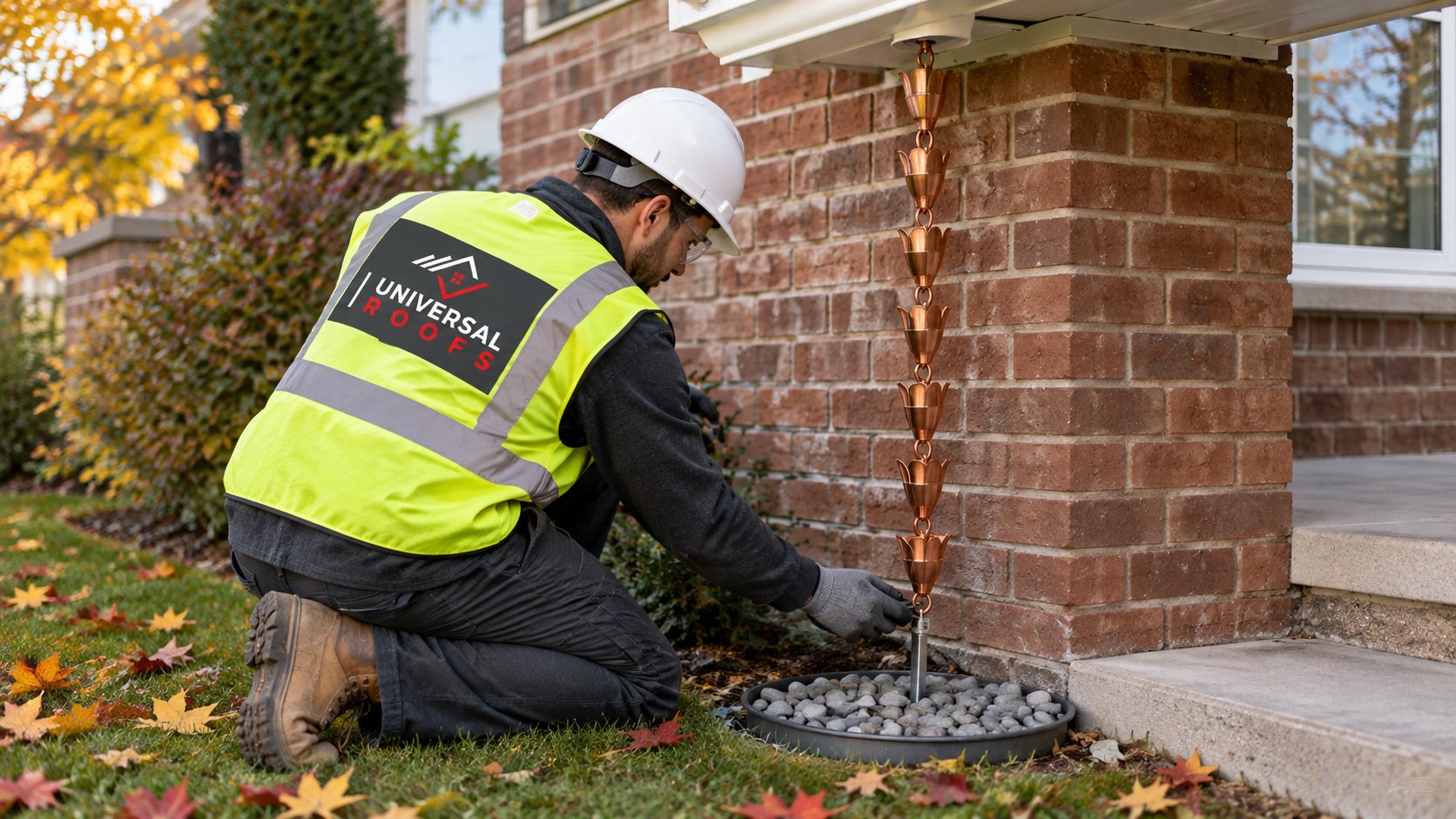
A free-hanging chain will swing. The bottom should be fixed so that it hangs plumb and stays put in wind. Common methods are a ground stake driven into the soil, a weighted anchor sitting in a basin, or a hook fixed into a rain barrel lid or a stone basin. The chain should be taut enough to stay straight but not so tight that it pulls down on the eavestrough. That balance becomes important in winter, which we cover below.
Managing Splash And Ground Drainage At The Base
Rain chains deliver water far less tidily than a downspout extension, so the receiving area has to be built for it.
A gravel-filled basin or shallow dry well is a common choice. Clear, washed stone absorbs the impact, reduces splash and lets water spread and soak in. A decorative stone or metal basin looks tidy and can have an overflow that feeds a splash pad or a channel. A rain barrel works well on a small roof, with the chain fixed to the lid and an overflow hose leading away from the house.
Whatever you choose, the ground around it should slope away from the foundation. A chain over flat or back-sloped soil will put water against the wall every time it rains. Where the soil is heavy clay, which is common across much of the GTA, water soaks in slowly, so a basin may need to be larger or connected to a longer channel or swale. On many properties we discuss the chain together with grading, because neither works without the other.
Check for splash onto the house too: water bouncing off a hard surface can wet the bottom course of siding and basement window frames, so look for staining or peeling paint after the first heavy autumn rain. If damage is already showing, our siding, soffit and fascia work often starts by moving the drainage point away from the wall.
Ice Build-Up: Take Rain Chains Down Or Anchor Them Before Winter
Winter is where Ontario weather tests rain chains hardest. On mild days in late autumn and winter, meltwater from the roof runs down the chain. As temperatures fall again, it freezes in layers. Over a few freeze and thaw cycles, a chain can turn into a solid column of ice, and cup chains can fill and freeze solid, cup by cup. The visual effect is attractive, but the weight is real, and it hangs entirely from the eavestrough at one point.
Three things can go wrong: the eavestrough bends or pulls off the fascia at the outlet; a tightly fixed base anchor adds strain as ice builds and frost heaves the ground; and the column eventually breaks loose, a real hazard over a doorway or walkway.
Before the first sustained cold snap, decide which approach suits your chain and your house:
- Take it down. For a light link chain on a shed or pergola, or any chain over a doorway, removal is the simplest answer. Store it, and fit a short downspout or a cap on the outlet so water still drains away from the house through the winter.
- Leave it up but slacken the anchor. If you keep the chain in place, set the anchor so the chain hangs plumb without tension, which allows for ice weight and for ground movement.
- Strengthen the support. Add a hanger close to the outlet and confirm the fascia is solid. On a light-duty or older trough, this may not be enough, and removal is the safer choice.
- Clear the trough first. Clean leaves out of the eavestrough and the chain adapter in autumn. Debris holds water against the outlet and makes ice build-up worse.
If your eaves already form ice dams or icicles every winter, a chain at that outlet will collect even more ice. That is usually a sign of heat loss into the attic, and addressing attic insulation and ventilation helps the whole roof edge, not just the chain.
| Problem you notice | Likely cause | Practical fix |
|---|---|---|
| Water spills over the eavestrough near the chain in heavy rain | Chain cannot carry the flow, or the adapter is clogged with leaves | Clean the adapter, add a second outlet or return to a downspout |
| Splashing on siding or windows | Chain hangs too close to the wall or is not anchored | Fix the base to a stake or basin and move the drainage point outward |
| Puddle or wet soil against the foundation | Basin too small or ground slopes toward the house | Enlarge the gravel basin and regrade the soil away from the wall |
| Eavestrough sagging at the outlet | Chain weight, loose hangers or soft fascia | Add a hanger near the outlet, repair the fascia, consider a lighter chain |
| Heavy ice column in winter | Meltwater refreezing on the chain | Slacken the anchor, take the chain down, or deal with heat loss at the eaves |
| Green or blue staining below a copper chain | Normal copper runoff | Use a stone or gravel basin, or choose aluminum or stainless near light surfaces |
Downspout Disconnection Rules And Where The Water Can Go
Many municipalities in Ontario have rules about roof drainage, and they apply to rain chains just as they apply to downspouts. In general terms, a number of GTA municipalities either require or encourage homeowners to disconnect downspouts from the sanitary or storm sewer and to let the water discharge onto their own property, provided it drains away from the foundation and does not create a problem for neighbours, sidewalks or the street. Some also allow exemptions where disconnection is not practical.
A rain chain is by nature a disconnected downspout, so it fits the spirit of these rules, but the discharge point still has to be sensible: never onto a neighbour’s property, across a public sidewalk or into a shared side yard where it pools against the next house. Rules vary and change, so confirm current requirements with your municipality before removing a connection to a pipe in the ground.
If the downspout you are replacing goes into an underground pipe, cap that pipe properly. An open pipe collects debris, and depending on where it connects, it can allow sewer gas or water backing up from the system to reach the surface. Our crews doing roofing, eavestroughs and attic work across York Region see plenty of older homes with buried downspout connections, and the cap is always part of the job when we take the downspout off.
What To Ask Whoever Installs Your Chain
- Have you counted the roof area feeding this outlet, including upper roofs that drain onto it?
- Will you add a hanger beside the outlet and check the fascia before the chain goes up?
- What is the base made of, and how far does it put water from the foundation?
- Who takes the chain down or slackens it before winter, and what covers the outlet if it comes down?

Rain Chain Questions Homeowners Ask
Can a rain chain replace a downspout on a two-storey house?
Are cup chains better than link chains?
Should I take my rain chain down for winter?
Where should the water from a rain chain go?
Do I need permission to disconnect my downspout?
Will a copper rain chain stain my walkway?
Planning Rain Chains For Your Home
Thinking about a chain for a porch, an entrance or a garden building? Universal Roofs will measure the roof feeding that outlet, check the trough and fascia, look at the ground below and tell you plainly whether a chain will cope or the downspout should stay. We can set up the base, cap old connections and plan for winter too.
Call us today at (416) 732-2421 or request a free estimate.
Eavestrough and roof edge work for York Region homeowners and the wider GTA.