
If your eavestroughs drip from the same few spots every time it rains, look closely at those spots. Most often they are joints: a slip connector between two lengths, a corner, or an end cap where the sealant has dried and cracked. That single observation is the whole case for a seamless eavestrough, which is formed on site in one continuous piece for each wall, so the only joints left are the ones the house shape makes unavoidable.
Seamless is not automatically the right answer for every situation, though. Below we explain how seamless troughs are made, where the real differences from sectional systems lie, what gauge, finish and hangers to ask for, and the handful of cases where sectional troughs still make sense.
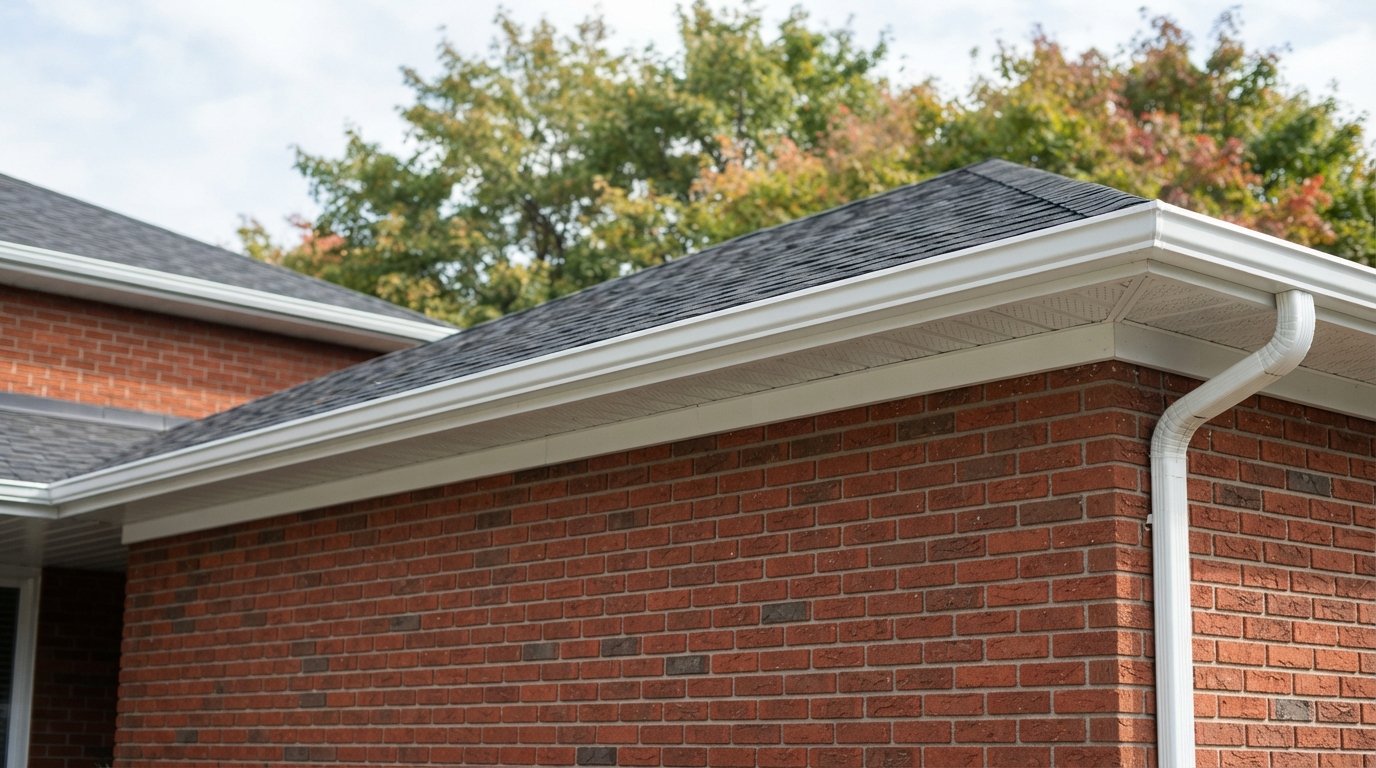
How A Seamless Eavestrough Is Made
A seamless eavestrough starts as a roll of flat, pre-painted aluminum coil. The installer brings a portable roll-forming machine to the house, feeds the coil through a series of rollers that bend it into the K-style profile, and cuts each piece to the exact length of the wall it will hang on. A 38-foot rear wall gets one 38-foot trough. There is no stock of 10-foot pieces to splice together.
That process has a few practical consequences:
- Every run is custom length. The crew measures each wall, forms the trough, then carries it up in one piece. Long runs take two or three people to handle without kinking.
- Joints only where the house forces them. Inside and outside corners, end caps and downspout outlets are the only places the metal is joined.
- Colour is set by the coil. Seamless coil comes pre-finished, so the trough and matching downspouts are usually ordered in a colour chosen to suit the fascia, soffit and trim.
Sectional eavestroughs, by contrast, are bought in fixed lengths, often 10 feet, and joined with slip connectors or overlapping laps sealed with caulking. They come in aluminum, vinyl and galvanized steel, and they are what you find in the big-box store aisle.
Why Joints Are Where Troughs Leak
Water that sits in a trough is not the problem; a trough is designed to hold water briefly. The problem is water finding a gap. Every joint is a gap that depends on a sealant bead to stay closed, and that bead faces a hard life in Ontario:
- Thermal movement. Aluminum expands and contracts noticeably between a hot afternoon and a cold night. Over a long run, each joint is pushed and pulled daily, and sealant eventually loses its grip.
- Freeze and thaw. Water that seeps into a hairline gap freezes, expands and widens the gap a little more each cycle.
- Debris and standing water. Leaves and grit collect at joints because the lap creates a small ridge. Wet debris keeps the sealant damp for days.
- Ladder and snow loads. A ladder leaned against a sectional trough, or a heavy slab of snow sliding off the roof, can flex a joint enough to crack the seal.
On a sectional system, a typical 40-foot wall has three or four joints in the middle of the run plus the corners. On a seamless eavestrough, that same wall has none in the middle. Fewer joints means fewer places for water to reach the fascia, drip onto walkways or freeze into icicles at the seam.
Joint drips also do quiet damage. Water that escapes at a seam runs down the back of the trough onto the fascia board, and over a few years that board softens. When we remove old sectional troughs, the rotted stretches of fascia often line up exactly with the old seams. Replacing that wood is part of our roof edge and fascia repair work, and it is much cheaper to catch early.
Seamless Eavestrough vs Sectional: Side By Side
| Factor | Seamless aluminum | Sectional (aluminum, vinyl or steel) |
|---|---|---|
| Joints along a straight wall | None; one piece per wall | Every 10 feet or so, each sealed |
| Typical leak points | Corners, end caps, outlets | Every seam, plus corners and outlets |
| Appearance | Clean continuous line, colour matched | Visible seams and connectors |
| Installation | Needs roll-forming machine and trained crew | Pre-cut lengths and connectors, assembled by a crew |
| Maintenance | Occasional corner and outlet reseal | Regular seam checks and resealing |
| Upfront cost | Higher per metre installed | Lower material cost, especially vinyl |
| Expected service life | Often two decades or more when well hung | Varies widely; vinyl can become brittle in cold |
The service life line deserves a caveat. Lifespan depends more on installation quality, hanger spacing, maintenance and tree cover than on the product label. A poorly pitched seamless trough with hangers every four feet will sag and hold water long before a carefully hung sectional one fails. Seamless removes a weakness; it does not replace good workmanship.
Corners And Mitres: The Joints You Cannot Avoid
Even a seamless eavestrough has to turn corners, and corners are where a lot of seamless systems still leak. There are two common approaches:
Pre-formed box mitres
These are factory-made inside or outside corners in the same profile and colour. The installer cuts the straight runs square, slides them into or over the mitre, then rivets and seals. They are quick and consistent, and the seam sits in a predictable place.
Strip or site-cut mitres
Here the installer cuts the two runs at matching angles and joins them with a strip of coil formed over the seam, riveted and sealed. Done well, this gives a tight, clean corner that follows odd angles on bay windows or angled walls. Done badly, it leaves an uneven lap that traps debris.
Whichever method is used, the details that matter are the same:
- Overlaps run downhill. The upstream piece should lap over the downstream piece so water flows across the seam rather than into it.
- Rivets, not just sealant. Sealant alone will let go; rivets hold the pieces together mechanically while the sealant keeps water out.
- The right sealant. A gutter-grade sealant made to stay flexible in cold and bond to painted aluminum lasts far longer than general-purpose caulking.
- A hanger close to the corner. Corners carry extra weight, especially at valleys, and need support within a short distance on each side.
If you are comparing quotes, ask how corners will be made and sealed. It is one of the few details that separates an average seamless job from a very good one.
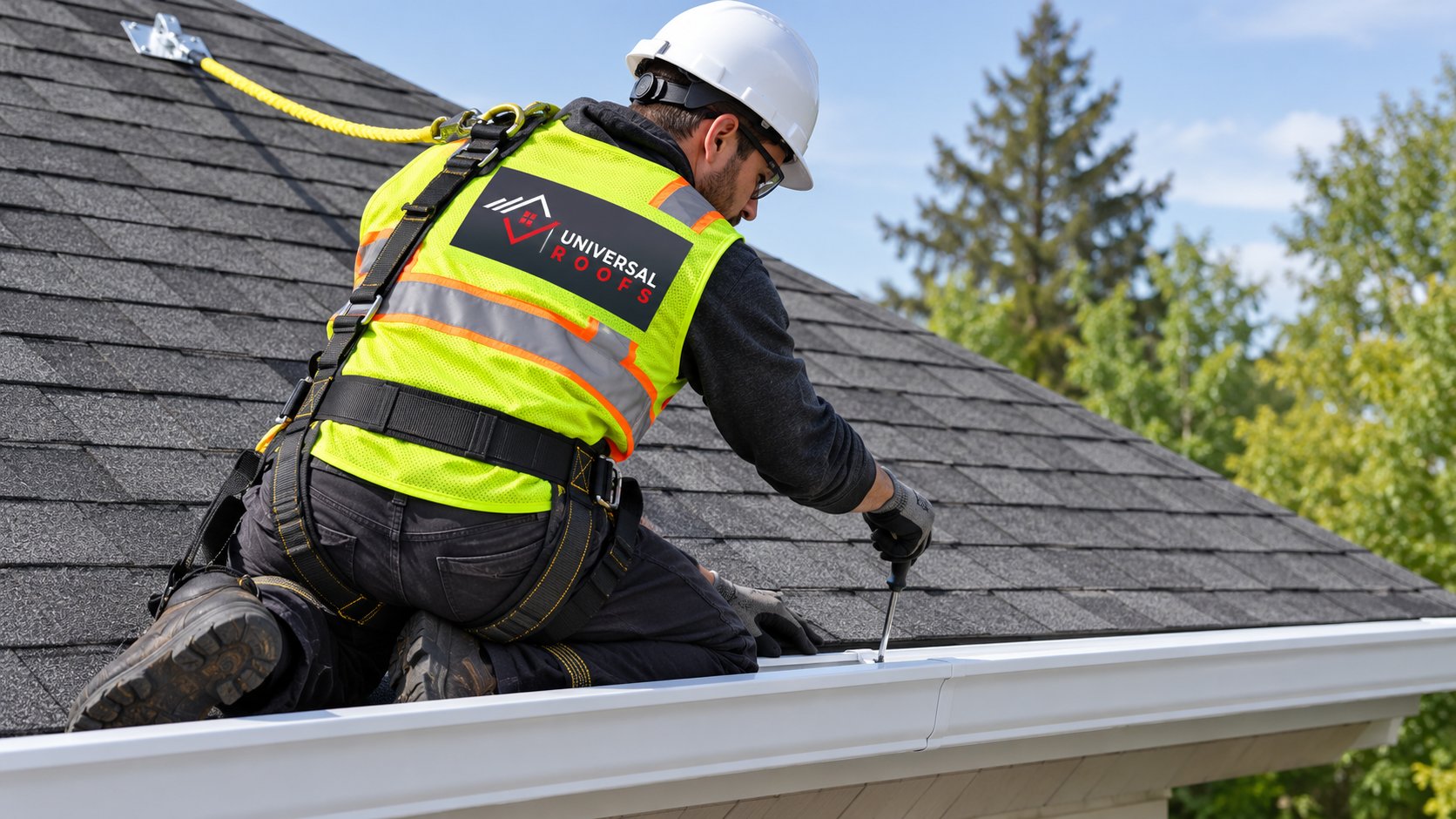
Gauge, Finish And Hangers: What To Specify
Two seamless eavestrough quotes can look identical on paper and perform very differently. These are the specification details worth pinning down.
Aluminum thickness
Residential seamless coil is sold in different thicknesses, commonly quoted in thousandths of an inch. Thicker coil resists dents from ladders, hail and falling branches, and it holds its shape better under snow load. Thinner coil is cheaper and perfectly serviceable on short, sheltered runs. Ask your installer which thickness they use and whether it differs between the trough and the downspouts. On two-storey homes, busy walls or anywhere ladders will lean for cleaning, heavier coil is money well spent.
Paint finish
Seamless coil is factory painted, typically with a baked finish on the visible face. Quality varies between coil suppliers. A better finish holds its colour and resists chalking longer, which matters on south and west faces that take the most sun. Finish warranties come from the coil manufacturer, not the installer, and terms vary, so ask for the product name and check the manufacturer’s current warranty document.
Hangers and spacing
Hidden hangers clip inside the front lip of the trough and screw through the back into the fascia. They replaced the old spike-and-ferrule method, where long nails driven through the trough worked loose over the years. Spacing is the detail to ask about. Many installers work at around 24 inches apart on residential troughs, tighter at corners, under valleys and where snow will load the trough. Screws must bite into sound wood; a hanger fastened into rotted fascia is only cosmetic.
Outlets and downspouts
Outlets should be cut at the low point of each run and sized to match the downspout. Seamless systems pair naturally with seamless or long-section downspouts, fastened to the wall with straps that allow for movement. Ask where each downspout will discharge and how far the extension will carry water from the foundation.
Slope, Length And Expansion On Long Runs
Because a seamless eavestrough can be formed to any length, it is tempting to run one piece across a very long wall. There are limits worth understanding.
Slope. Each run needs a gentle, even fall toward its outlet. Over a long wall, keeping enough fall without the low end dropping visibly below the fascia line becomes difficult. The usual answer is to split the run: high point in the middle and a downspout at each end, or high points at the ends and an outlet in the middle.
Expansion. Aluminum moves with temperature. On ordinary house walls this movement is absorbed by the hangers and end caps. On very long continuous runs, some installers add an expansion joint or break the run at a downspout so the metal can move without stressing corners. Ask your installer how they handle runs over roughly 40 feet.
Handling. Long seamless pieces can kink or twist if carried by one person. A crew that brings enough hands to lift long runs level is a good sign.
When A Sectional System Still Makes Sense
We install mostly seamless troughs, but sectional systems are not wrong in every case. They earn their place when:
- The run is very short. A small porch roof, shed or dormer with a 6-foot run has no mid-run joint anyway, so a sectional piece performs the same as seamless.
- You are repairing a short section of an existing sectional system. Replacing one damaged length to match the rest can be sensible if the remainder is sound.
- The material only comes in sections. Copper and many half-round profiles are typically sold in lengths and joined by soldering or riveting, which is a different and very durable kind of joint.
- It is a low, accessible outbuilding where an owner is comfortable doing the work and replacing it later is easy.
- Budget is the overriding constraint and the homeowner accepts that seams will need periodic resealing.
Vinyl sectional troughs are the one option we are cautious about on houses in this climate. Vinyl can become brittle in cold weather and may crack under ice or ladder pressure. It is inexpensive and easy to install, but on a full house the long-term cost of repairs usually closes the gap with aluminum.
Repair Or Replace? Reading Your Existing Troughs
Early autumn, before the leaves come down, is a good time to decide whether your current troughs have another season in them. Use this checklist on a rainy day and again on a dry one.
| What you notice | What it usually means | Typical next step |
|---|---|---|
| Drips at one or two seams only | Failed sealant at those joints | Clean, rivet and reseal the seams |
| Drips at most seams along the house | Sealant has reached end of life across the system | Consider seamless replacement |
| Water sitting in sections after rain | Sagging hangers or poor slope | Rehang and re-pitch, check fascia |
| Rust streaks or pinholes | Galvanized steel corroding from the inside | Replace; patching rarely lasts |
| Cracked or brittle vinyl sections | Cold and UV damage | Replace affected runs or the system |
| Soft, stained fascia behind seams | Long-term seepage at joints | Replace fascia before new troughs go up |
A few sealed joints on otherwise healthy troughs is maintenance. Widespread seam failure, corrosion, sagging or rotted fascia behind the trough line is usually the point where a seamless eavestrough replacement pays for itself in fewer callbacks and less water where it should not be.
What To Expect From A Seamless Installation
A typical full-house job follows a predictable sequence, and knowing it helps you judge a crew’s work.
| Stage | What happens | What to watch for |
|---|---|---|
| Measure and plan | Each wall measured, outlets and downspouts located | Clear plan for where water discharges |
| Remove old troughs | Old troughs, spikes and downspouts taken down | Old nail holes in fascia sealed or the board replaced |
| Fascia and drip edge check | Soft boards replaced, roof edge flashing checked | No new trough hung on rotted wood |
| Form and hang | Troughs roll-formed on site, hung on hidden hangers with slope | Even hanger spacing, visible fall toward outlets |
| Corners, caps and outlets | Mitres and end caps riveted and sealed, outlets cut | Neat laps running downhill, no smeared sealant |
| Downspouts and test | Downspouts strapped, extensions set, system water tested | Water reaches every outlet with nothing left standing |
Most single-family homes are completed in a day, weather permitting, though fascia repair or a complicated roofline can add time. Pricing depends on storeys, access, the number of corners and downspouts, and fascia condition. As a broad estimate that varies by house and scope, full seamless replacement on a typical detached home often falls somewhere in the low thousands of dollars. Our crews handle this work across the GTA, including roofing, eavestroughs and attic work across Peel Region, and a site visit is the only way to get a firm number.

Frequently Asked Questions
Do seamless eavestroughs never leak?
How long do seamless aluminum troughs last?
Can a seamless trough be repaired if it gets damaged?
Is thicker aluminum worth paying for?
Should I add gutter guards to new troughs?
Is autumn a good time to replace troughs?
Book A Seamless Eavestrough Assessment
If your troughs drip at the seams, sag between hangers or have left stains on the fascia, a seamless eavestrough system can remove most of the weak points in one visit. Universal Roofs measures every wall, repairs the fascia and roof edge where needed, and installs seamless troughs with carefully made corners and properly placed downspouts.
Call us today at (416) 732-2421 or request a free estimate.
Serving homeowners in Peel Region and across the wider GTA.