
Eavestroughs are the least glamorous part of a house and the first thing to cause expensive trouble when they fail. If you are searching for eavestrough repair Brampton homeowners can actually rely on, you are probably looking at one of three things right now: water pouring over the front lip during a storm, a section pulling away from the fascia, or a damp patch in the basement that shows up every time it rains hard. All three trace back to the same system, and all three are fixable long before they turn into rotted soffit, stained brick or a wet foundation.
This guide covers what eavestrough repair Brampton homeowners face in 2026: how the city’s mix of postwar bungalows, 1970s to 1990s subdivisions and newer estate homes creates different failure patterns, what repairs realistically cost this year, when a repair stops making sense and replacement takes over, and how to judge a contractor’s quote. Everything below is written for Brampton conditions specifically, because a 5 inch aluminium trough on a shallow bungalow roof and a 6 inch trough on a steep two storey subdivision home fail in completely different ways.
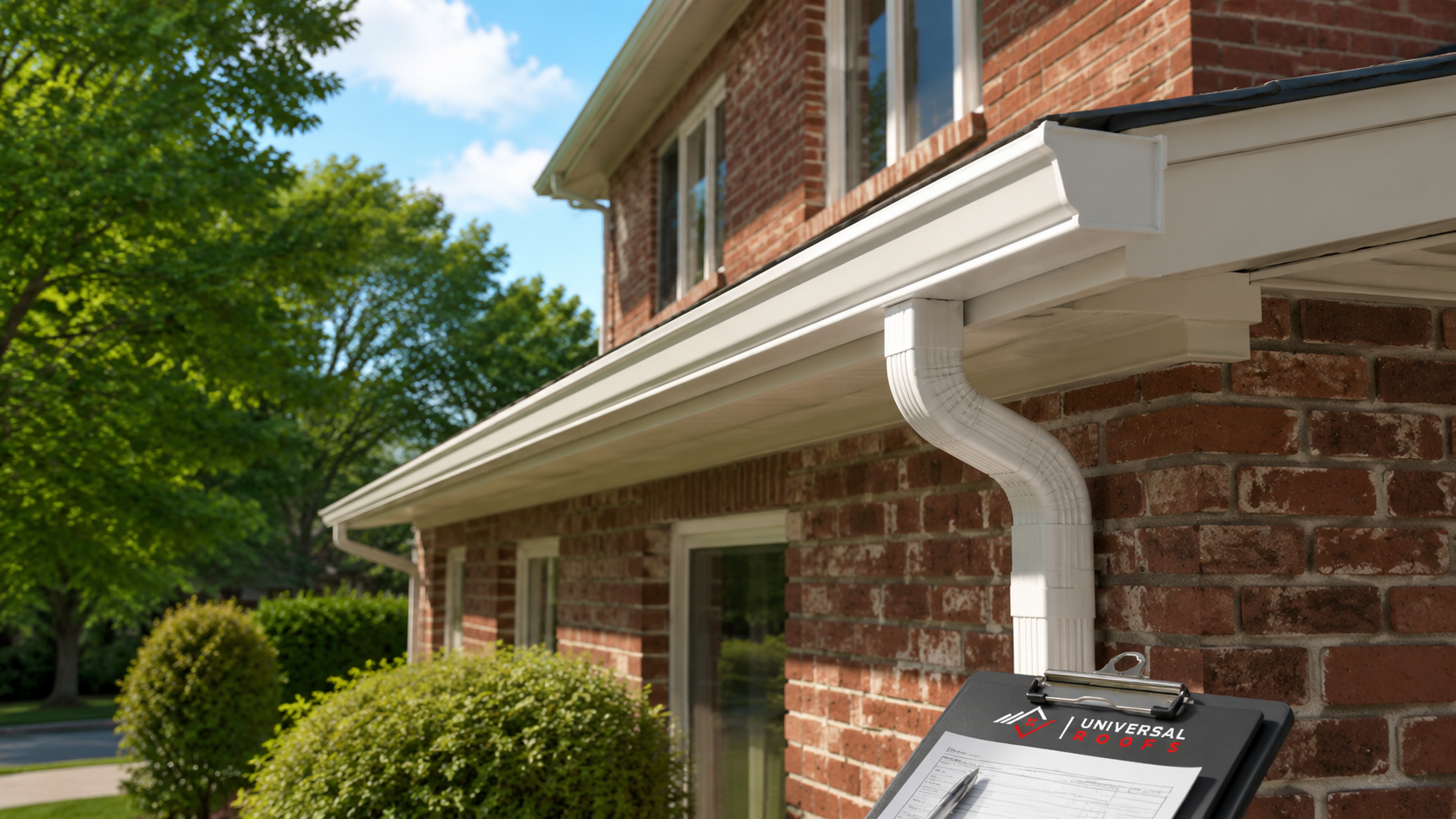
Eavestrough Repair Brampton Homeowners Actually Need
Most eavestrough repair Brampton properties require is not a rebuild. It is a targeted correction to one of five things: pitch, fastening, sealing, capacity or discharge. A good contractor diagnoses which of those has failed before quoting anything, because replacing a perfectly sound run of trough will not fix a downspout that is dumping water two feet from your basement wall.
Pitch is the slope of the trough toward the downspout. The working standard is roughly 6 mm of fall for every 3 metres of run, which is subtle enough that a trough can look level and still be draining backwards. Over years, fastener movement and ladder pressure flatten that slope, water sits in the low spot, the extra weight pulls the run down further, and the problem accelerates.
Fastening is how the trough attaches to the fascia. Older Brampton homes very often still have long spike and ferrule fasteners driven through the front lip into the rafter tails. Freeze and thaw cycles walk those spikes out a few millimetres per season until a section is effectively hanging on nothing. The modern fix is hidden hangers screwed into solid backing at roughly 600 to 750 mm spacing, tighter than that on runs that collect snow load. A large share of eavestrough repair Brampton crews perform on older homes begins and ends with this one item.
Sealing covers mitred corners, end caps and outlet collars. Sealant is a consumable, not a permanent bond. Most joint sealant on a GTA home has an honest service life somewhere between eight and fifteen years, after which it hardens, shrinks and lets a slow drip through. Resealing is the most common single line item on an eavestrough repair Brampton invoice.
Capacity is trough width and downspout count. A 5 inch trough with a single 2 by 3 inch downspout serving a long roof plane will overflow in a heavy summer cell no matter how clean it is. That is not a clog, it is a design limit, and the repair is a wider trough, a second downspout or a larger 3 by 4 inch outlet.
Discharge is where the water ends up. A trough can be flawless and still cause basement seepage if the downspout releases at the foundation. Getting the discharge point out to a properly graded area is frequently the single highest value item in an eavestrough repair Brampton quote.
How Brampton’s Housing Stock Shapes Eavestrough Problems
Brampton is not one housing type, and that matters for repair planning. The older neighbourhoods near the historic core hold postwar bungalows and brick storey and a half homes with shallow roof pitches, deep overhangs and original wood fascia. On those houses the recurring issue is fascia condition. Decades of small overflows soften the wood behind the trough, and once the backing is punky, no fastener holds. An honest eavestrough repair Brampton assessment on a house like that includes probing the fascia, not just looking at the aluminium.
The large subdivisions built through the 1970s, 1980s and 1990s brought two storey detached and semi detached homes with narrower side yards and more complex roof geometry: multiple valleys, dormers and roof planes that dump concentrated water into short trough runs. Valley discharge is a common failure point here. Water leaving a valley at speed can jump the trough entirely, which homeowners often misread as a clog. The correction is usually a valley splash guard plus verifying the trough sits under the roof edge line rather than set back from it. Any eavestrough repair Brampton estimate on these homes should account for valley flow rather than treating every run identically.
Newer estate lots and the more recent townhouse and detached developments in the north and east of the city tend to have 6 inch troughs and larger downspouts already, so raw capacity is less often the problem. What shows up instead is discharge and grading. Tight lot spacing, engineered lot grading and shared drainage swales mean a downspout aimed the wrong way sends water toward a neighbour’s property or back along your own foundation. Semi detached and freehold townhouse rows add a shared roofline complication: a trough run frequently crosses the property line, so a repair on one unit can leave a mismatched, badly sealed joint at the boundary if it is not planned properly.
Across all of these, the constant is Brampton’s clay heavy soil. Clay holds water and moves with moisture content, which is exactly why poorly discharged roof water becomes a foundation problem here faster than it would on sandy ground. If you want a broader picture of the work available locally, our overview of roofing services for Brampton homeowners covers how eavestrough work fits alongside shingles, flashing and attic ventilation.
Warning Signs That Call for Eavestrough Repair
Eavestrough failure gives plenty of notice. The table below maps the symptoms that lead to most eavestrough repair Brampton service calls to what is actually happening on the roof edge and how urgently it needs attention.
| Warning sign | Likely cause | Urgency | Typical repair approach |
|---|---|---|---|
| Water sheets over the front edge in heavy rain | Clog, undersized trough or too few downspouts | Moderate | Clear the run, then add or enlarge downspouts |
| A section sags or pulls away from the fascia | Spikes backing out, or rotted fascia backing | High | Re-hang on hidden hangers, replace fascia board if soft |
| Peeling paint or dark staining on fascia and soffit | Back pitch, missing drip edge, water wicking behind the trough | High | Reset pitch, install drip edge, seal the back edge |
| Steady drip at a corner or end cap | Failed sealant at a mitre or cap joint | Low to moderate | Strip old sealant, clean the surface, reseal with gutter grade sealant |
| Standing water or mosquito activity in the trough | Flat or reversed slope | Moderate | Re-pitch the run toward the outlet |
| Basement dampness or seepage after storms | Downspout discharging beside the foundation | High | Extend discharge 1.8 to 2.4 metres onto graded ground |
| Erosion, splash marks or mulch washout below a downspout | Missing extension or splash block | Low | Add an extension and re-establish grade |
Two of these deserve emphasis. Staining on fascia means water is already travelling behind the trough rather than through it, and that is the pathway to soffit rot and, eventually, decking damage at the roof edge. Basement seepage after storms deserves an eavestrough inspection before anyone starts quoting waterproofing, because roof water discharge is a far cheaper cause to rule out. Where water has already worked its way past the roof edge, the trough work often needs to be paired with professional roof repair at the eave and flashing so the fix addresses the whole water path rather than one visible symptom.
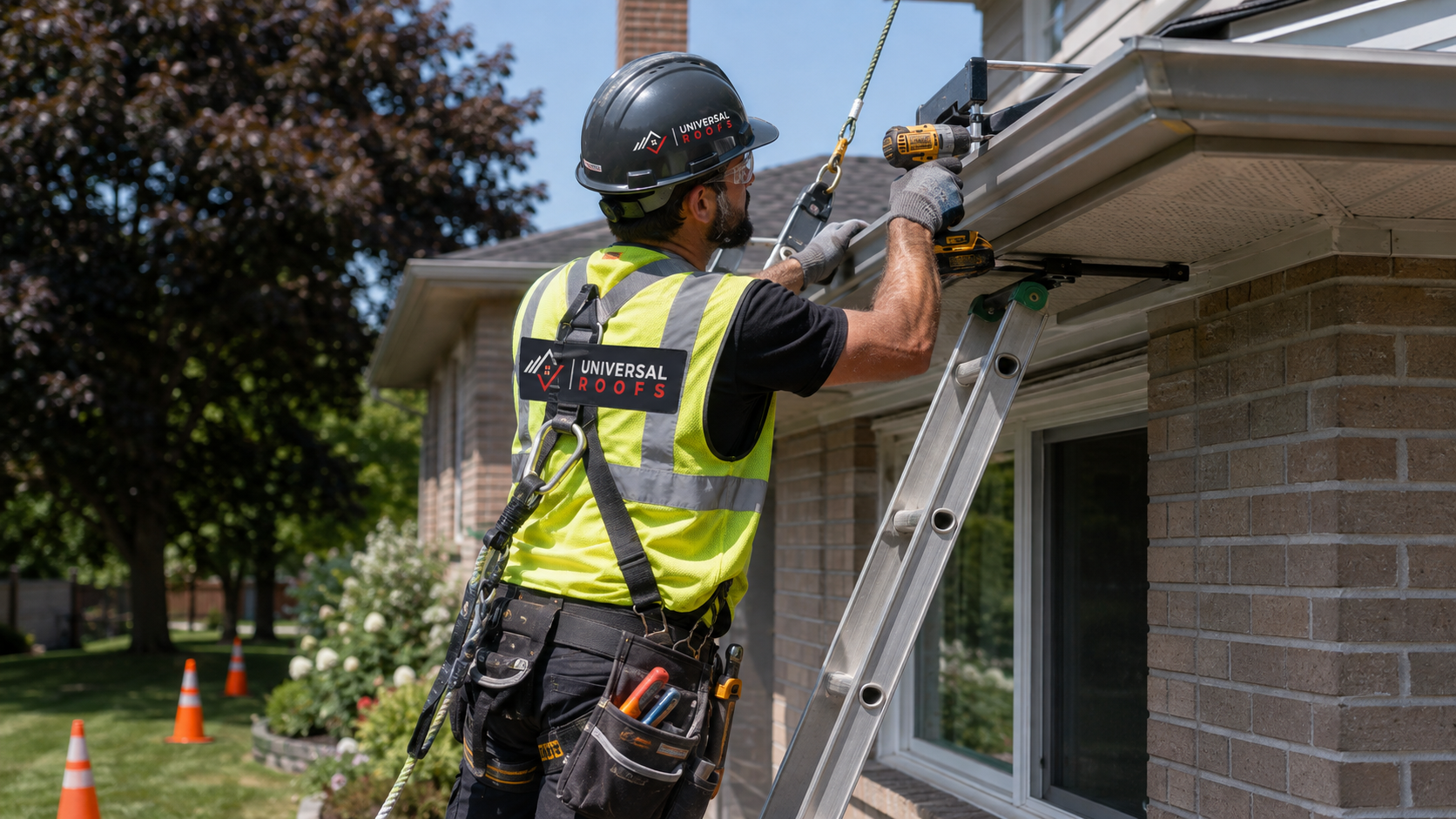
What Eavestrough Repair Costs in Brampton in 2026
Pricing for the eavestrough repair Brampton contractors quote in 2026 depends on height, access, run length and how much of the fascia is involved. Two storey work costs more than bungalow work because of staging and safety setup, not because the aluminium is different. The ranges below reflect typical Peel Region pricing for supplied and installed work on residential properties.
| Repair item | Typical 2026 price range | Time on site |
|---|---|---|
| Reseal a leaking mitre, joint or end cap (per joint) | $45 to $110 | Under 1 hour |
| Re-secure or replace hangers (per 3 metre section) | $60 to $150 | 1 to 2 hours |
| Re-pitch an existing run (up to 12 metres) | $180 to $450 | 2 to 3 hours |
| Replace a damaged trough section (per linear foot) | $12 to $22 | Half day for most runs |
| Replace or relocate a downspout (each) | $150 to $375 | 1 to 3 hours |
| Add a downspout extension or buried discharge line | $120 to $650 | 1 hour to half a day |
| Fascia board replacement (per linear foot) | $14 to $28 | Varies with extent |
| Full clean out and flush, two storey detached | $180 to $350 | 2 to 4 hours |
| Leaf guard or gutter screen (per linear foot) | $6 to $14 | Half day, typical home |
| Complete eavestrough replacement, typical detached home | $2,000 to $4,800 | 1 to 2 days |
A few notes on reading a quote. First, minimum service call charges are normal in this trade, generally in the $150 to $250 range, and a single $60 joint reseal will usually be billed at that minimum. Bundling small items into one visit is far more economical than calling three separate times. Second, be cautious with any eavestrough repair Brampton quote that prices only the visible symptom. If a trough sagged because the fascia is soft, re-hanging it without addressing the backing buys you one or two seasons at most. Third, HST applies on top of these figures, and disposal of removed aluminium is normally included but worth confirming in writing.
Repair or Replace: Where the Line Sits
The repair or replace decision drives most of the cost variation in eavestrough repair Brampton quotes, so it is worth understanding the threshold contractors use. If the failures are localised and the trough profile is adequate for the roof area, repair. If failures repeat along the length of the system, or the trough is undersized for the roof it serves, replace. Chasing leaks one joint at a time on a twenty five year old sectional system is how homeowners end up spending replacement money over three years and still owning an old system.
Repair makes sense when the aluminium is straight and unoxidised, fewer than roughly a quarter of the joints are leaking, the fascia is sound, and capacity is appropriate. Replacement makes sense when the trough is visibly wavy along its length, the metal is chalky and brittle, the system is sectional rather than seamless, the profile is too small for the drainage area, or you are already replacing the roof. That last case is the practical one: if shingles are coming off anyway, the drip edge and trough are exposed and accessible, and combining the work saves a second mobilisation. Homeowners planning a full roof replacement should always price eavestroughs in the same conversation.
Age alone is not the deciding factor. A well fastened seamless aluminium system installed twenty years ago with sound fascia behind it can be worth repairing. A ten year old sectional vinyl system with brittle joints usually is not. The other variable is how much you value quiet. Loose troughs and unsecured downspouts rattle in wind, and homeowners who have lived with that for a season are often surprised how much a proper re-hang improves things.
Materials, Sizing and Downspout Capacity
Almost every residential eavestrough repair Brampton crews perform involves seamless aluminium, formed on site by a roll former so that the only joints are at corners and outlets. It is the right default for this climate: it does not rust, it takes paint well, and it is light enough to hang without heavy structural backing. The variables worth understanding are width, gauge and profile.
| Material and profile | Typical thickness or gauge | Expected service life | 2026 supplied and installed, per linear foot |
|---|---|---|---|
| Aluminium, 5 inch K-style | 0.027 inch (about 0.68 mm) | 20 to 25 years | $9 to $15 |
| Aluminium, 6 inch K-style | 0.032 inch (about 0.81 mm) | 25 to 30 years | $12 to $19 |
| Pre-painted steel | 26 to 28 gauge | 20 to 25 years, rust risk at cut edges | $13 to $21 |
| Copper, half round | 16 to 20 ounce | 50 years or more | $35 to $65 |
| Vinyl or PVC, sectional | Not applicable | 10 to 15 years, brittle in cold | $5 to $10 |
On sizing, the practical rule is that a 5 inch K-style trough with 2 by 3 inch downspouts handles a moderate roof area on a simple gable. Once a single run collects from a large plane, a steep pitch, or two roof planes feeding a valley, 6 inch trough with 3 by 4 inch downspouts is the safer specification. Trough width is the eavestrough repair Brampton specification that matters most on homes with heavy tree cover, because the larger downspout carries substantially more volume and clogs far less readily under the mature maples and silver birches that overhang many local rooflines.
Downspout count is the item most often shortchanged on original builds. A useful benchmark is one downspout per 9 to 12 metres of trough run, tightened up where a valley concentrates flow. Adding a second downspout to an overflowing run is usually cheaper than upsizing the entire trough, and it solves the problem just as decisively.
Leaf guards deserve a realistic note. Screens and micro mesh reduce how often a trough needs clearing, but nothing eliminates maintenance. Fine debris such as shingle granules, seed pods and needles still accumulates on top of a guard, and a guard installed over a trough with bad pitch simply hides the underlying problem. Fix the pitch and the fastening first, then decide whether guards are worth it for your tree cover.
Drainage Rules, Codes and Permits
Eavestrough repair does not require a building permit in Brampton. Where the rules do apply is drainage. The Ontario Building Code requires roof drainage to be carried away from the building so that it does not saturate the foundation or discharge onto adjoining property, and municipal lot grading requirements across Peel Region are built on the same principle: stormwater from your roof stays on your lot and follows the approved grading pattern.
The practical consequences are straightforward. Downspouts should discharge onto a graded surface that slopes away from the house, with a clear fall over the first two metres. Discharge should not be directed at a neighbour’s foundation, into a shared walkway, or onto a driveway where it will freeze. In many newer subdivisions, discharge is expected to reach a rear or side swale rather than pool anywhere on the lot.
If your home has downspouts connected directly into a below grade drain, do not disconnect or reroute them without understanding where that line goes. Some connect to a storm system, some to a weeping tile, and the correct treatment differs. This is one of the details worth raising during any eavestrough repair Brampton site visit rather than deciding on your own, and a competent contractor will confirm the discharge path before touching the trough.
One more code adjacent point: drip edge. A properly installed metal drip edge at the roof perimeter directs water off the shingle edge and into the trough instead of letting it wick back onto the fascia. Many older Brampton homes were built without it. Adding drip edge during eavestrough work is inexpensive and removes an entire category of future problems.
Seasonal Timing and a Maintenance Schedule That Works
Late spring through early autumn is the best window for the eavestrough repair Brampton homeowners are planning. Sealants cure properly in warm weather, aluminium is easier to form and handle, and the work is safer without ice on the roof edge. Booking in the shoulder season also means you are not competing with the emergency calls that follow the first heavy autumn rain.
A workable maintenance rhythm for most Brampton homes looks like this. Clean twice a year at minimum, once in late spring after seeds and blossoms drop and once in late autumn after leaf fall is finished. Homes with mature trees directly overhead need a third clean in mid autumn. While cleaning, check that every downspout runs freely by flushing it, look for staining behind the trough, and confirm the extensions are still in place, because they get moved by lawn work constantly.
It is also worth walking the perimeter of the house during a hard rain once a season. Sixty seconds of watching where water actually goes tells you more than any inspection from a ladder on a dry day. Overflow points, back pitch and splash zones are all obvious when the system is under load, and nearly invisible when it is not.
During any roof related work, look at the eave system as a whole. Eavestroughs, drip edge, soffit and attic ventilation all interact at the roof edge, and a blocked soffit vent or a poorly ventilated attic changes how ice and condensation behave right where the trough attaches. If you are addressing eavestroughs and have never had the attic and ventilation assessed, it is worth doing at the same time.
How to Choose an Eavestrough Repair Brampton Contractor
The eavestrough trade has a low barrier to entry, which means quality varies enormously. When you compare quotes for eavestrough repair Brampton companies provide, the following details separate a durable fix from a cosmetic one.
- A written diagnosis, not just a price. The quote should say what failed and why, not simply list a quantity of trough.
- Proof of WSIB coverage and liability insurance. This is elevated work on your property. Ask for current certificates rather than assurances.
- Fastener specification in writing. Hidden hangers, the spacing used, and what they are screwed into. Vague language here usually means spikes.
- Fascia inspection included. A contractor who will not comment on the condition of the backing has not really looked at it.
- Clear scope on discharge. Where does the water go after the repair? If the quote is silent, the answer is often nowhere useful.
- A workmanship warranty with a defined term. Two to ten years is normal depending on scope. Lifetime claims on a sealant joint should be read sceptically.
- Photographs before and after. You cannot see the work from the ground, so ask for documentation of what was found and what was done.
Be wary of two patterns in particular. The first is the door to door offer to clean and reseal for an unusually low flat rate, which almost always means a bead of sealant run over dirty aluminium that fails within a year. The second is the quote that jumps straight to full replacement with no diagnosis at all, on a system that has three bad joints and otherwise sound metal.
Universal Roofs is based in the Toronto area and serves homeowners throughout Brampton and the wider GTA. Because eavestrough problems are so often symptoms of something happening at the roof edge, our crews assess the trough, the drip edge, the fascia and the discharge point together instead of quoting only the piece you happened to notice. You can read what other homeowners have said about that approach on our customer reviews page.
Frequently Asked Questions
How much does eavestrough repair in Brampton cost?
Can I repair a leaking eavestrough myself?
How long does an eavestrough repair take?
Do I need a permit for eavestrough work in Brampton?
Should I repair or replace my eavestroughs?
Will new eavestroughs stop my basement from leaking?
Book Your Eavestrough Repair Brampton Assessment Today
Eavestroughs fail slowly and then cause damage quickly. If you have seen overflow, sagging, staining on the fascia or dampness in the basement after a storm, an eavestrough repair Brampton inspection now is far cheaper than fascia and soffit work later. Universal Roofs assesses the entire eave system, trough, drip edge, fascia and discharge, then gives you a written scope explaining what failed and what it will take to fix it properly.
Call us today at (416) 732-2421 or request a free consultation. You will get a clear, itemised quote with no pressure and no upselling.
Universal Roofs proudly serves Brampton and communities across the Greater Toronto Area with professional roofing, eavestrough and roof repair services.