
Few exterior systems get ignored as consistently as the one that carries water off your roof, and few cause as much expensive damage when they fail. If you have noticed water sheeting over the front of your gutters during a summer downpour, a stripe of green algae running down your brick, or a soggy patch of lawn against the foundation, you are already looking at a candidate for eavestrough repair Mississauga homeowners deal with every season. This guide covers what actually breaks, what the fixes cost in 2026, when a repair stops making sense, and how the housing stock across Mississauga changes the answer.
Eavestroughs are simple in principle and unforgiving in practice. A 2,000 square foot roof sheds roughly 4,500 litres of water during a 25 millimetre rainfall. All of that volume has to reach a downspout, travel down the wall, and discharge far enough from the house that it does not find its way back to the footing. When a joint opens up, a hanger pulls loose, or a downspout plugs with granules and maple keys, that water goes somewhere it was never meant to go. That is the moment eavestrough repair in Mississauga moves from a maintenance item to an urgent one.
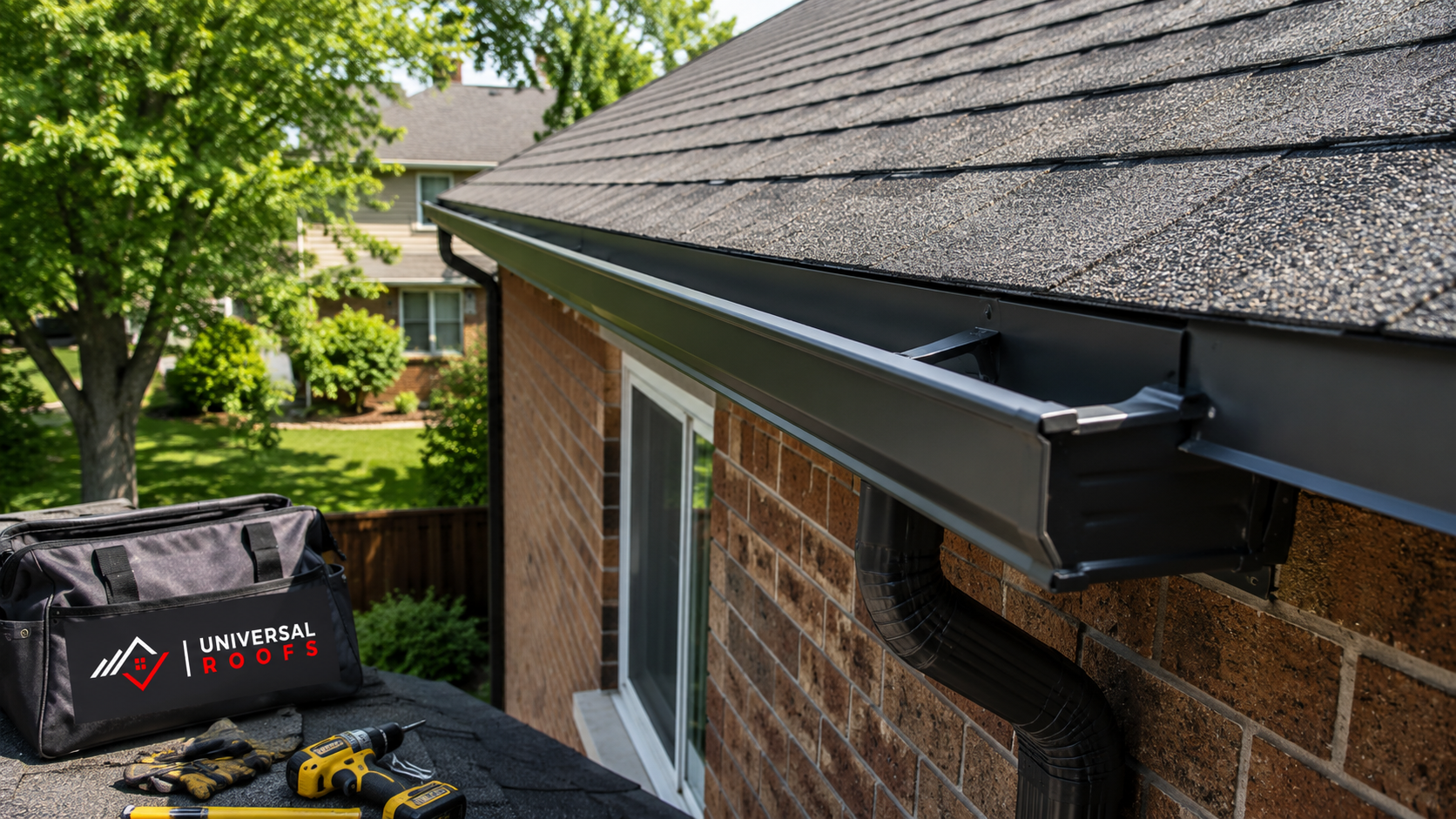
What Eavestrough Repair Mississauga Service Calls Actually Cover
The term covers a wide range of work. At the light end, eavestrough repair in Mississauga means resealing an end cap, replacing a handful of spikes with hidden hangers, or clearing a blocked downspout elbow. At the heavy end, it means removing and rehanging a full run because the fascia behind it has rotted and nothing will hold a fastener. Most calls land somewhere in between: one or two problem runs, a downspout that needs rerouting, and a general tune up of the rest while the ladder is already up.
A useful way to think about it is that an eavestrough is a three part system. There is the trough itself, which has to be pitched correctly and sealed at every seam. There is the fastening, which has to carry the weight of full troughs plus ice without tearing out of the fascia. And there is the discharge, which has to move water at least 1.5 to 2 metres away from the wall. A failure in any one part produces the same symptom, which is water where it should not be, so a proper diagnosis matters far more than a fast patch.
Because eavestroughs sit directly under the roof edge, a surprising amount of what looks like gutter trouble is actually roof trouble. Shingles that overhang too far, a missing drip edge, or a failed starter course will all send water behind the trough no matter how well the trough itself is sealed. That is why a competent eavestrough repair visit includes a look at the roof edge, the drip edge flashing, and the first metre of shingle. If those are compromised, the correct fix is professional roof repair at the eave line rather than more sealant on the gutter.
Why Mississauga Housing Stock Changes the Repair
Mississauga is not one housing type, and that matters. The city grew in distinct waves, and each wave left behind a different set of drainage problems, which is why no two eavestrough repair Mississauga quotes look quite alike.
The older southern and central areas hold a large stock of postwar bungalows and side split homes, many of them one and a half storeys with shallow roof pitches and short overhangs. These houses often still carry undersized 4 inch or early 5 inch troughs hung on spikes and ferrules, with a single downspout serving a long run. On homes like these, the most common eavestrough repair in Mississauga is refastening: the original spikes have worked loose from decades of freeze and thaw, the trough has sagged out of pitch, and water now pools in the middle of the run instead of draining to either end.
The subdivisions built from the 1970s through the 1990s across the west and northwest of the city introduced deeper eaves, more complex roof geometry, and far more valleys. Valleys concentrate enormous volumes of water into a very small section of trough. On those homes, the failure point is usually the trough directly below a valley, where the constant hammering of concentrated flow erodes sealant, overshoots the trough entirely during heavy rain, and eventually loosens the hangers. Fixing it properly often means adding a valley splash guard, not just resealing a seam.
Newer subdivisions built since the 2000s generally came with seamless 5 inch aluminum on hidden hangers, which is a much better starting point. The problems there tend to be workmanship and layout rather than age: downspouts that discharge onto a walkway, elbows that were never sealed, and troughs run tight against narrow side yards where two houses shed water into the same three metre gap. Estate properties with larger, more articulated rooflines have their own issue, which is that a single undersized downspout is frequently asked to drain a roof area two or three times larger than it can handle.
None of this changes the physics. It changes the diagnosis. A contractor who quotes eavestrough repair in Mississauga for a 1955 bungalow and a 2012 two storey at the same number, without looking at either, is guessing.
The Most Common Eavestrough Failures and How They Get Fixed
Across the GTA’s residential housing stock, the same handful of faults account for the large majority of eavestrough repair Mississauga calls. Recognising which one you are looking at tells you roughly what the work should cost and how long it should last.
Leaking seams, corners and end caps
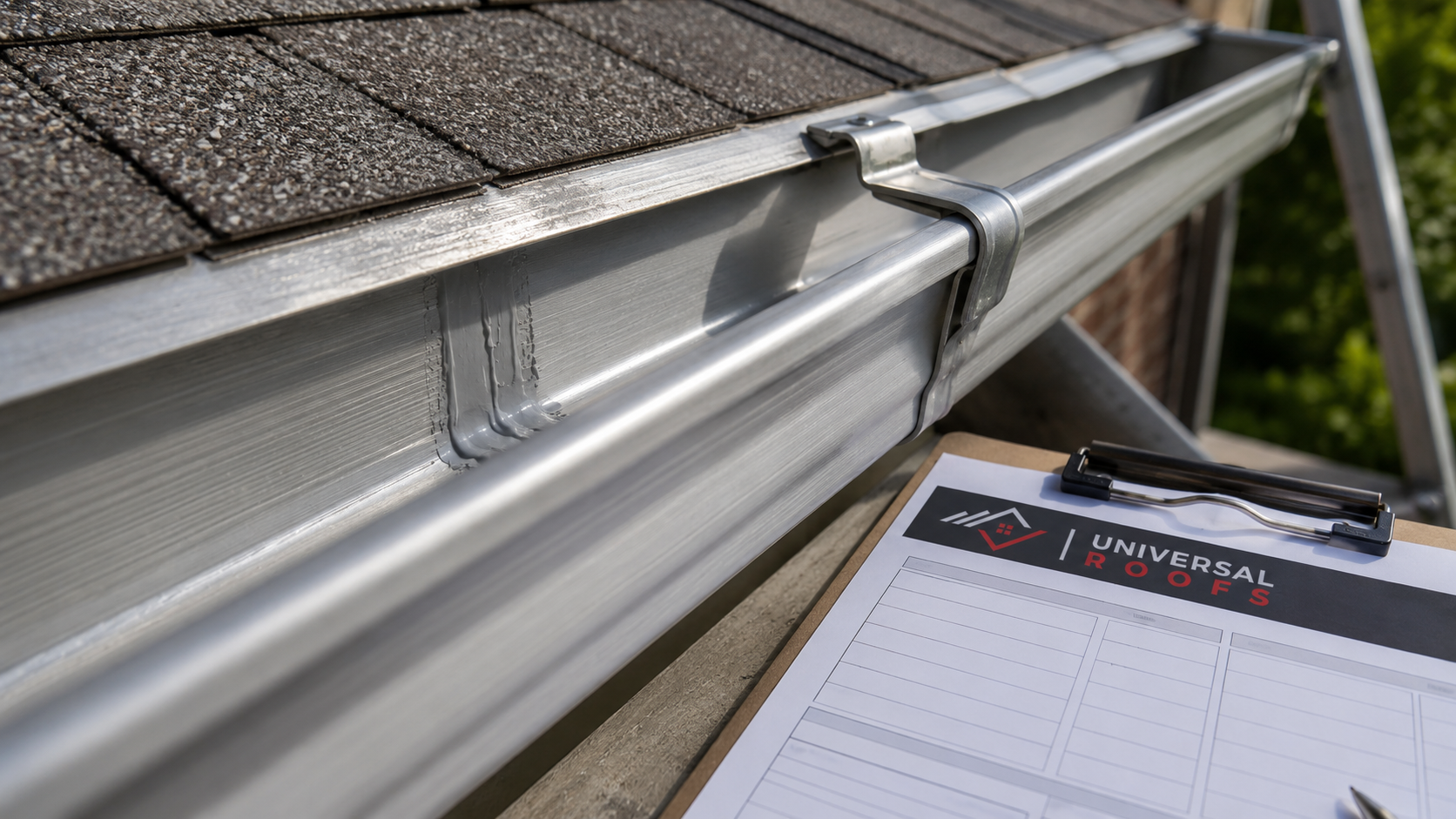
Sectional eavestroughs are joined with lapped seams and sealant. Aluminum expands and contracts measurably across an Ontario year, and that movement eventually breaks the sealant bond. Inside and outside corners are the worst offenders because they combine a seam with a change of direction. The correct repair is to clean the joint back to bare metal, remove all of the old compound, dry the surface, and apply a gutter sealant rated for exterior temperature swings. Smearing fresh sealant over old is the single most common reason a leak returns within a year.
Sagging runs and pulled hangers
Eavestroughs need roughly 5 to 10 millimetres of fall for every 3 metres of run. When hangers loosen, the trough flattens or reverses pitch and standing water sits in it. Standing water accelerates corrosion, breeds mosquitoes, and adds enormous weight, since water alone weighs a kilogram per litre before you add ice. The fix is to strip the old spikes, install hidden hangers at 600 to 900 millimetre spacing, and reset the pitch with a string line. If the fascia behind is soft, the fascia has to be replaced first, because no fastener holds in rotten wood.
Blocked and undersized downspouts
A downspout that backs up is often blamed on leaves, but in Mississauga the more frequent culprit is a mix of shingle granules, maple keys and roof grit that compacts into a plug at the first elbow. Capacity is the other half of the problem. A single 2 by 3 inch downspout handles a limited roof area; on larger or steeper roofs it is simply outmatched, and the honest answer is to add a second downspout or step up to 3 by 4 inch rather than to keep clearing the same blockage.
Fascia and soffit damage
By the time water has been running behind a trough for a couple of seasons, the fascia board is usually compromised. Signs include a trough that will not stay level, dark staining on the soffit, and screws that spin without biting. Replacing the affected fascia is not optional if you want the repair to last, and it is the item most often left out of a suspiciously cheap quote.
Ice damage
Winter is where a marginal system fails outright. Ice loading bends trough profiles, tears hangers out of the fascia, and separates seams. Much of that traces back to attic heat loss, which melts snow on the roof field and refreezes it at the cold eave. If your eavestrough repair in Mississauga has become an annual event every spring, the underlying problem is often attic insulation and ventilation rather than the trough itself.
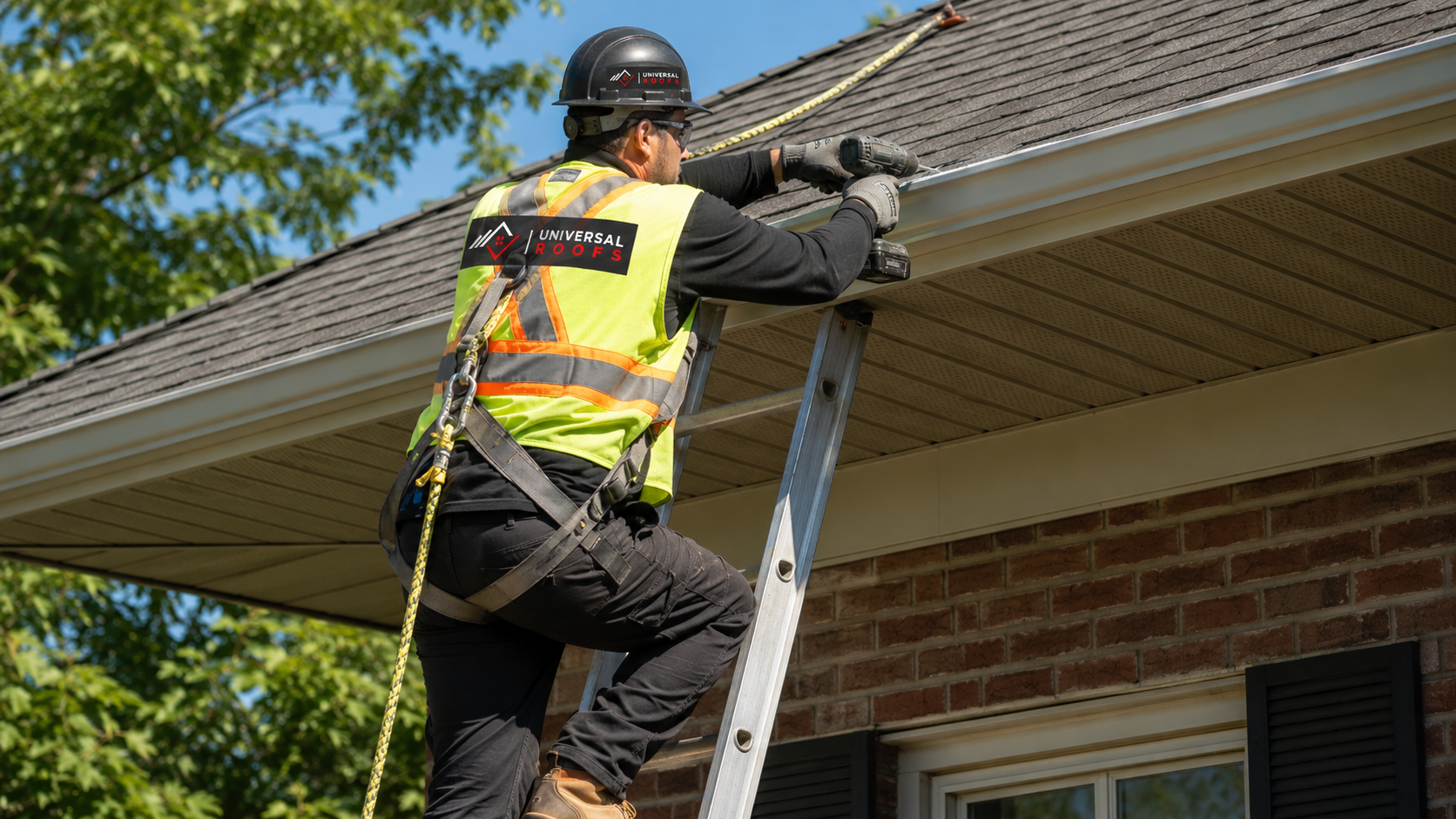
Eavestrough Repair Costs in Mississauga for 2026
Pricing varies with access, height, roof complexity, and how much of the surrounding fascia is involved. The ranges below reflect what GTA homeowners can reasonably expect to pay in 2026 for professional work carrying a workmanship warranty. Treat them as planning figures for eavestrough repair in Mississauga rather than as quotes.
| Repair Type | Typical 2026 Cost | What It Includes |
|---|---|---|
| Seam, corner or end cap reseal | $95 to $220 per joint | Strip old sealant, clean to bare metal, reseal |
| Refasten and re-pitch a sagging run | $180 to $450 per run | Hidden hangers, pitch reset, minor seam work |
| Downspout replacement or reroute | $120 to $400 each | New downspout, elbows, straps, extension |
| Section replacement, 3 to 6 metres | $280 to $750 | Seamless aluminum, hangers, sealed transitions |
| Fascia board repair behind trough | $18 to $40 per linear foot | Remove trough, replace fascia, rehang and reseal |
| Full clean and flush, average home | $160 to $360 | Hand clean, flush all downspouts, remove debris |
| Emergency or after hours call out | $250 to $500 minimum | Same day stabilisation of an active leak |
Two cost drivers surprise people. The first is height: work above the second storey needs longer ladders or staging, and it prices accordingly. The second is the service minimum. Almost every contractor has one, typically in the $200 to $350 range, because the cost of dispatching a two person crew does not shrink just because the repair is small. This is exactly why bundling several small items into a single visit delivers far better value than calling three separate times through the summer.
When Eavestrough Repair Stops Making Sense
Repair is almost always the right first answer. There is a point, though, where continuing to patch an old system is throwing money at a component that has reached the end of its service life. The test is straightforward: if the cost of the repairs approaches half the cost of replacing the affected runs, and the system is already past two thirds of its expected life, replacement is the better economics. A minority of eavestrough repair Mississauga inspections end with that recommendation, and when they do it is usually on original steel or early vinyl trough.
| Condition Observed | Recommended Action | Reasoning |
|---|---|---|
| One or two leaking seams, rest of system sound | Repair | Isolated failure, low cost, high success rate |
| Sagging on a single run, fascia still solid | Repair | Refastening restores pitch and full function |
| Multiple leaks across several runs, system over 20 years old | Replace affected elevations | Patch cost approaches replacement cost |
| Visible corrosion, pinholes or split seams in steel trough | Replace | The metal has failed, sealant will not hold |
| Chronic overflow despite clean troughs | Upsize rather than repair | Capacity problem, not a leak problem |
| Trough sound but water leaking behind it | Roof repair first | Water is bypassing the trough entirely |
One more scenario deserves mention. If your roof is within a few years of replacement, it is usually worth coordinating the two projects. Eavestroughs have to come off or be worked around during a reroof anyway, and doing both together avoids paying twice for the same access and the same staging. If an assessment suggests you are close, it is worth understanding your options for full roof replacement before spending significantly on trough work that will be disturbed shortly afterward.
Materials, Sizing and Drainage Capacity
Most residential eavestrough repair in Mississauga is carried out in aluminum, and for good reason. Seamless aluminum is formed on site to the exact length of the run, which eliminates the mid run seams that cause the majority of leaks. Gauge matters more than most homeowners realise: 0.032 inch aluminum resists ice deformation noticeably better than the 0.027 inch commonly used on builder installations.
| Material and Size | Installed Cost per Linear Foot | Expected Service Life | Best Suited To |
|---|---|---|---|
| 5 inch K-style aluminum, 0.027 gauge | $9 to $14 | 18 to 25 years | Standard bungalows and simple rooflines |
| 5 inch K-style aluminum, 0.032 gauge | $11 to $17 | 25 to 35 years | Homes with recurring ice loading |
| 6 inch K-style aluminum, 0.032 gauge | $14 to $22 | 25 to 35 years | Large roof areas and multiple valleys |
| Galvanised steel | $13 to $20 | 15 to 25 years | Heavy tree cover and impact exposure |
| Copper | $35 to $60 | 50 years or more | Heritage and estate properties |
| Vinyl, sectional | $5 to $9 | 8 to 15 years | Low budget, sheltered runs only |
On sizing, the practical rule is that a 5 inch trough paired with a 2 by 3 inch downspout comfortably serves a moderate roof area, while roofs with steep pitches, long valleys, or more than roughly 90 square metres draining to a single downspout should move to 6 inch trough with 3 by 4 inch downspouts. Upsizing is one of the few changes that permanently solves overflow instead of delaying it by a season.
Leaf protection is a fair question and deserves an honest answer: it reduces cleaning frequency but does not eliminate maintenance. Fine debris and shingle grit still pass through most screens, and a poorly chosen guard can make ice problems worse by holding a mat of wet material at the eave. Reverse curve and fine micro mesh products perform best under heavy tree cover, at roughly $8 to $22 per linear foot installed. Guards are worth discussing during an eavestrough repair visit, since the troughs are already open and accessible.
What a Professional Eavestrough Repair Visit Involves
A thorough eavestrough repair in Mississauga follows a predictable sequence, and knowing that sequence helps you judge whether a contractor is being thorough or simply quick.
- Full system inspection. Every run is checked for pitch with a level, every seam is inspected, and every downspout is flushed with water rather than eyeballed from the ground.
- Roof edge assessment. Drip edge, starter course and shingle overhang are checked, because water bypassing the trough will never be solved by working on the trough.
- Fascia probe. The wood behind the hangers is tested for softness at each fastener location before anything is refastened.
- Clean before repair. Sealant does not bond to grit. The trough is cleaned and dried first, every time.
- Mechanical fixes before sealant. Pitch, hangers and fasteners are corrected first, because sealant cannot hold a trough in position.
- Water test. The repaired section is flooded with a hose and watched, both at the trough and at the discharge point.
- Discharge check. Extensions are confirmed to carry water clear of the foundation, and not onto a neighbour’s property or a walkway.
Most single home repairs are completed in two to five hours. Work involving fascia replacement or several full runs typically takes a full day. Weather matters as well, since sealants have minimum application temperatures and quality work is not done on a wet or freezing surface.
Drainage Rules, Permits and Where the Water Goes
Eavestrough repair does not require a building permit in Ontario. The Ontario Building Code does, however, set the expectation that roof drainage is collected and discharged so that it does not accumulate against the building or cause damage to adjoining property. In practice that means two things for a Mississauga homeowner.
First, downspouts should discharge onto a permeable surface such as lawn or a garden bed, directed away from the foundation, with the water carried a minimum of 1.5 metres out and ideally further on lots where the grade falls back toward the house. Splash pads and hinged extensions are inexpensive and effective, and they are frequently the cheapest part of any eavestrough repair Mississauga homeowners pay for.
Second, be careful about buried connections. Many older Mississauga homes have downspouts tied into buried drains, and it is not always documented where those lines terminate. Before altering or capping a buried downspout connection, confirm with the City what is permitted on your property, since stormwater and sanitary connection rules are specific and change over time. Water that is redirected without thought has a way of becoming a property line dispute with the house next door.
Finally, remember that grading is part of the system. A perfect eavestrough discharging onto ground that slopes back toward the house solves nothing at all. If you have persistent basement moisture on the same elevation as an eavestrough problem, treat the two as one issue rather than two.
Seasonal Timing and Maintenance That Actually Helps
Spring and early autumn are the best windows for eavestrough repair in Mississauga. Spring lets you address whatever winter broke before the summer thunderstorm season arrives, and autumn lets you clean and repair before leaf drop and freeze up. Summer is perfectly workable and often has better contractor availability, with the added advantage that sealants cure properly in warm, dry conditions.
A realistic maintenance routine for most Mississauga properties looks like this. Clean twice a year, in late spring and again in November once the leaves are down, with a third pass for homes under mature maples. While cleaning, run a hose through every downspout and watch the discharge. Check seams for hairline cracking in the sealant. Look at the ground below each downspout after a heavy rain, because a scoured trench or a mud splash pattern on the siding tells you the extension is too short. Once a year, walk the perimeter and look up at the fascia for staining, which is the earliest visible sign that water is getting behind the trough. Catching it at that stage keeps eavestrough repair in Mississauga in the low hundreds rather than the low thousands.
Homeowners across Peel benefit from bundling this with a broader exterior check, and if you want a single point of contact for the roof, eaves and attic together, our Mississauga roofing services page explains how those pieces fit together on a typical property.
Choosing a Contractor for Eavestrough Repair Mississauga Homeowners Can Trust
Eavestrough work is unlicensed in Ontario, which means the quality range in the market is very wide. A few filters separate the reliable from the rest.
- WSIB coverage and liability insurance. Ask for current certificates rather than verbal assurance. Ladder work carries real risk, and an uninsured injury on your property becomes your problem.
- A written scope. The quote should name which runs and which elevations, the material and gauge, the hanger type and spacing, and whether fascia work is included or billed separately.
- Diagnosis before price. Anyone quoting eavestrough repair in Mississauga over the phone, without seeing the roof edge, is guessing at the cause.
- Workmanship warranty in writing. Two years on repair labour is a reasonable benchmark; anything under one year suggests low confidence in the fix.
- Roofing capability. Because so many gutter symptoms originate at the roof edge, a contractor who also does roofing can address the actual cause instead of handing you off to someone else.
Be cautious with pricing that sits far below the ranges in this article. Cheap eavestrough repair usually means fresh sealant smeared over a dirty joint and old spikes driven back into the same tired holes. It looks fine for a season, fails in exactly the same place, and you end up paying twice for one repair.
How much does eavestrough repair in Mississauga cost?
Can I repair a leaking eavestrough myself?
Why does my eavestrough overflow even though it is clean?
How long does an eavestrough repair take?
Do I need a permit to repair or replace eavestroughs?
Should I repair my eavestroughs or replace them?
Book Your Eavestrough Repair Mississauga Estimate Today
Water damage is cumulative and quiet. A seam that drips today becomes stained brick, soft fascia and a damp basement corner over a few seasons, and every one of those repairs costs considerably more than timely eavestrough repair in Mississauga would have. Universal Roofs is a Toronto area roofing contractor serving homeowners throughout Mississauga and the wider GTA, and because we work on roofs as well as eaves, we can tell you whether you have an eavestrough problem, a roof edge problem, or both, before anyone quotes a price.
Call us today at (416) 732-2421 or request a free consultation. We will inspect the full system, water test the problem areas, and give you a written scope that spells out exactly which runs are being repaired and why.
Universal Roofs proudly serves Mississauga and communities across the Greater Toronto Area with roofing, eavestrough and attic services backed by written workmanship warranties.