
Enquiries about metal roofing Mississauga suppliers and contractors can actually deliver have grown sharply over the past few years, and the reasons are practical rather than fashionable. Asphalt shingle prices have climbed, replacement cycles feel shorter than they used to, and a growing number of Mississauga households plan to stay in the same house for decades instead of five years. A properly installed steel roof lasts two to three times longer than an architectural shingle roof, sheds snow and ice more predictably, and holds its appearance far better on the wide, visible roof planes that define so much of the city’s housing stock.
This guide covers what metal roofing in Mississauga actually costs in 2026, which systems suit which house types, what the Ontario Building Code requires, how metal compares with asphalt over a realistic ownership horizon, and how to judge whether a contractor knows how to install a metal system correctly. Nothing here is a sales pitch. Metal is the right answer for many Mississauga roofs and the wrong answer for some, and the difference usually comes down to roof geometry, budget horizon and installer skill.
Metal Roofing Mississauga Homeowners Choose: Why Demand Is Rising
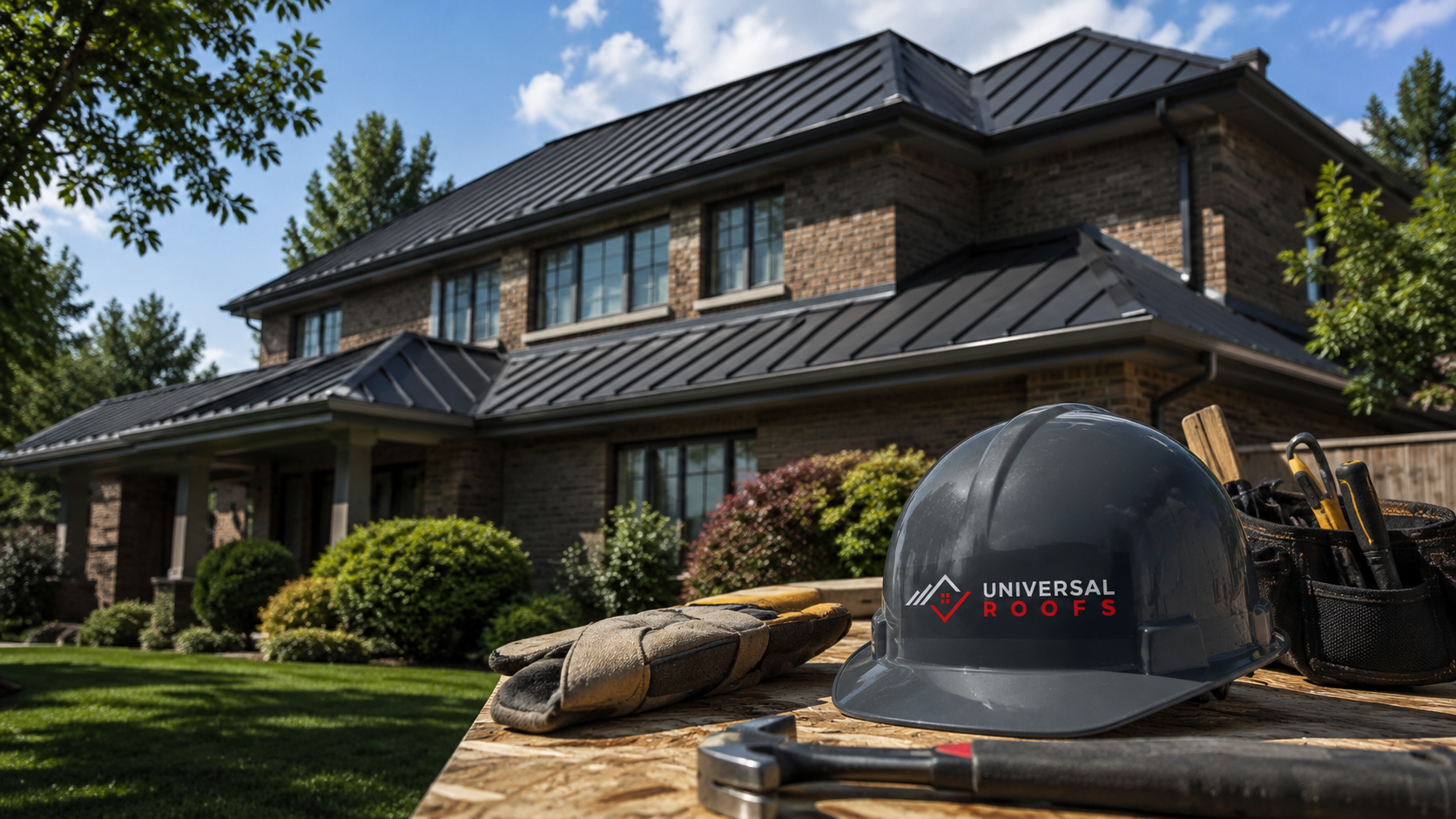
Mississauga’s housing stock is unusually varied for a single municipality. Postwar bungalows and side-splits with simple gable roofs sit a short drive from 1980s and 1990s subdivisions with steep pitches and multiple valleys, and from newer infill and estate homes with complex rooflines, dormers and large chimneys. Each of those roof shapes behaves differently in the wind, sheds water differently and costs a different amount to cover in metal.
Three things drive most metal enquiries. The first is lifespan. A 30-year architectural shingle in the GTA realistically delivers 18 to 25 years of trouble-free service depending on ventilation, sun exposure and installation quality. A 24-gauge steel roof with a quality paint finish is a 45 to 60 year assembly. For a homeowner in their forties buying what they intend to be their last roof, that arithmetic matters.
The second is winter performance. Mississauga sits close enough to Lake Ontario to get repeated freeze and thaw cycles rather than one long deep freeze, which is exactly the pattern that produces ice dams. Smooth metal panels shed snow load sooner and give meltwater fewer places to refreeze, though metal is not an automatic cure for ice damming: the underlying cause is almost always heat loss into the attic, which is why attic insulation and ventilation work belongs in the same conversation.
The third is maintenance fatigue. Shingle roofs shed granules, lift at the edges and need periodic patching. Metal roofing in Mississauga typically requires an annual visual check, gutter cleaning and occasional fastener inspection, and little else for decades.
How Mississauga’s Housing Stock Shapes the Right Metal System
Roof geometry drives the cost of metal roofing in Mississauga far more than square footage does. A simple gable bungalow roof in an older Mississauga neighbourhood can be covered in standing seam with long, uninterrupted panel runs and very few penetrations, which is the cheapest metal work a crew can do per square foot. A 1990s subdivision home with five valleys, three dormers, a chimney cricket and a bay window roof needs dozens of custom flashings, and the labour cost can rise by a third or more for the same roof area.
Older brick homes with shallow eaves and undersized soffit venting often need ventilation corrected before any new roof goes on. Newer estate homes frequently combine steep front elevations with low-slope rear sections over sunrooms or additions, and those low-slope areas may need a different assembly altogether. Where a section falls below the minimum slope for a mechanically seamed panel, a membrane system is the honest answer, and a good contractor will say so rather than force metal onto a slope it was not designed for.
Townhouses and semi-detached homes bring a separate consideration. Shared roof planes, party walls and condominium or freehold covenant rules can restrict colour and profile, so confirm what is permitted before ordering material with a long lead time.
The Main Metal Roofing Systems Used Across the GTA
The phrase metal roof covers several genuinely different products, and quotes for metal roofing Mississauga contractors issue are often not comparing the same system at all. Understanding which product a quote refers to is the single most useful thing a homeowner can do before comparing prices.
Standing seam
Vertical panels with raised, interlocking seams and concealed clips. No exposed fasteners on the field of the roof, which removes the most common long-term leak path. Panels float on clips so the steel can expand and contract with temperature. This is the premium residential system and the one most people picture when they think of a modern metal roof.
Exposed fastener ribbed panels
Corrugated or ribbed sheets screwed directly through the panel face with gasketed screws. Much cheaper and faster to install, common on garages, shops, barns and some rural homes. The neoprene washers under the screw heads degrade over roughly 15 to 20 years and need replacement, so this system trades a lower purchase price for a maintenance obligation.
Metal shingles, tiles and slate profiles
Pressed steel or aluminum panels stamped to imitate cedar shake, slate or tile, installed in interlocking courses with hidden fasteners. These suit heritage-influenced homes and neighbourhoods where a vertical seam would look out of place, and they handle complex roof shapes more gracefully than long panels.
Stone-coated steel
Steel panels finished with a bonded stone granule surface. The texture reads much closer to a traditional roof from the ground, muffles rain noise slightly and resists visible denting better than smooth painted steel. It sits in the middle of the price range.
Aluminum, copper and zinc
Aluminum will not rust and is a sensible choice for homes near salt exposure or with persistent condensation issues, though it dents more easily than steel. Copper and zinc are architectural materials with very long lifespans and prices to match, generally reserved for accent roofs, bay windows, porch roofs and custom homes.
| System | Typical lifespan | Minimum slope | Best suited to | Main drawback |
|---|---|---|---|---|
| Standing seam steel (24 ga) | 45 to 60 years | 2:12, some profiles 1:12 | Simple to moderately complex gable and hip roofs | Highest steel labour cost, oil canning on flat pans |
| Exposed fastener ribbed steel | 25 to 40 years | 3:12 | Garages, shops, outbuildings, budget projects | Screw gaskets need replacement at 15 to 20 years |
| Metal shingle or slate profile | 40 to 50 years | 3:12 | Complex rooflines, heritage-influenced elevations | More pieces, more labour on cut-heavy roofs |
| Stone-coated steel | 40 to 50 years | 3:12 | Homeowners wanting a traditional look with metal durability | Granule surface can shed slightly over time |
| Aluminum standing seam | 50 years or more | 2:12 | Coastal or high-condensation conditions | Softer metal, dents more readily |
| Copper or zinc | 75 years or more | 3:12 | Accent roofs, dormers, custom architecture | Cost, and a limited pool of skilled installers |
What Metal Roofing in Mississauga Costs in 2026
Pricing for metal roofing Mississauga homeowners receive varies more widely than shingle pricing, so it helps to know the ranges before the first quote arrives. The figures below reflect installed cost including tear-off of one existing shingle layer, disposal, new underlayment, flashings, trims, ventilation and cleanup. They are ranges rather than fixed figures because roof complexity, storey height, access and the number of penetrations move the number considerably. Quotes at the very bottom of these ranges usually indicate thinner gauge steel, a cheaper paint system, or a plan to install over the existing shingles.
| Material | Installed cost per sq ft | Bungalow, 1,400 sq ft roof area | Two-storey detached, 2,100 sq ft roof area |
|---|---|---|---|
| Architectural asphalt shingle (reference) | $6.50 to $9.50 | $9,000 to $13,500 | $14,000 to $20,000 |
| Exposed fastener ribbed steel | $9 to $13 | $12,500 to $18,000 | $19,000 to $27,500 |
| Stone-coated steel | $13 to $18 | $18,000 to $25,000 | $27,500 to $38,000 |
| Metal shingle or slate profile | $14 to $19 | $19,500 to $26,500 | $29,500 to $40,000 |
| Standing seam steel, 24 gauge | $16 to $23 | $22,500 to $32,000 | $34,000 to $48,000 |
| Aluminum standing seam | $19 to $27 | $26,500 to $38,000 | $40,000 to $56,500 |
Several extras appear regularly on quotes for metal roofing in Mississauga. Removing a second layer of shingles adds disposal cost and time. Replacing deteriorated plywood or plank sheathing is charged per sheet and cannot be priced honestly until the old roof is off. Snow guards over entries, walkways and driveways are strongly recommended on steep metal roofs and add to the total. Upgraded ridge and soffit ventilation, new eavestrough and skylight replacement are all commonly bundled into the same project because the access is already paid for.
If a metal roof is out of range this year, a high-quality asphalt roof replacement remains a sound investment, and it is better to install a good shingle roof properly than to stretch for a metal system installed by the cheapest available crew.
Metal Versus Asphalt Over a Realistic Ownership Horizon
The fairest way to compare is not purchase price but cost per year of service, including the reroofing cycles a shingle roof will need over the life of one metal roof. The table below models a mid-size Mississauga home over 50 years using current pricing, without attempting to predict future material inflation.
| Factor | Architectural asphalt | Standing seam steel |
|---|---|---|
| Up-front cost, 2,100 sq ft roof | $14,000 to $20,000 | $34,000 to $48,000 |
| Service life in GTA conditions | 18 to 25 years | 45 to 60 years |
| Replacements needed in 50 years | 2 to 3 | 0 to 1 |
| Indicative 50-year outlay | $34,000 to $58,000 | $34,000 to $50,000 |
| Typical maintenance demand | Periodic repairs, granule loss, edge lifting | Annual inspection, fastener and sealant checks |
| Weight on the structure | Roughly 250 to 350 lb per square | Roughly 100 to 150 lb per square |
| End-of-life material | Largely landfill | Fully recyclable steel |
The honest conclusion is that metal roofing in Mississauga tends to break even against asphalt somewhere in the second shingle cycle. If you plan to sell within five years, you will not recover the full premium at resale, though a new metal roof is a strong listing feature. If you intend to stay fifteen years or more, the economics move steadily in favour of metal, and the avoided disruption of two future tear-offs has real value on its own.
Installation, Permits and Ontario Building Code Requirements
Permitting for metal roofing in Mississauga follows the same rules as any other covering. A straightforward reroof that replaces the covering without altering the structure generally does not require a building permit. A permit is required once structural framing is modified, sheathing is replaced beyond minor repair, or the work forms part of an addition or a conversion such as adding dormers. Confirm with the City before work begins, because the answer depends on scope rather than material.
The Ontario Building Code governs the assembly underneath the panels. Eave protection is required along the lower edge of sloped roofs, extending up the slope past the inner face of the exterior wall, and in practice most GTA contractors run a self-adhered ice and water membrane well beyond that minimum and into valleys and around penetrations. Underlayment must be appropriate to the covering, and for metal a high-temperature synthetic underlayment is the correct choice because standard felt degrades under the heat that builds beneath a dark panel in July.
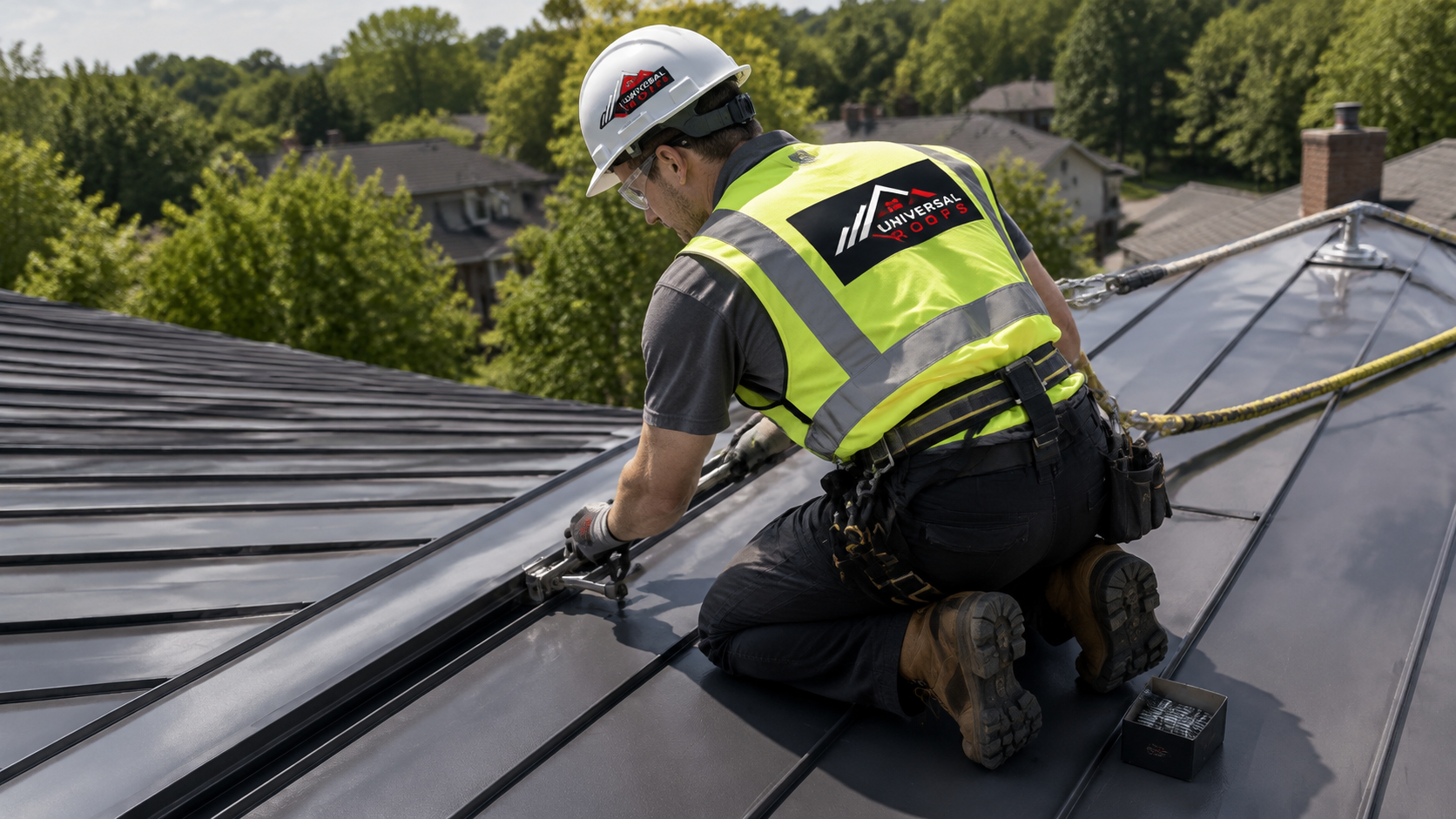
Three installation details separate a metal roof that lasts fifty years from one that fails in twelve:
- Thermal movement. Steel panels expand and contract measurably over long runs. Concealed clips must allow that movement, and panels beyond a certain length require floating clip systems rather than fixed ones.
- Dissimilar metals. Copper, steel and aluminum in contact, or copper runoff draining onto a steel panel, causes galvanic corrosion. Fasteners, flashings and drip edges must be compatible with the panel material.
- Flashing and penetrations. Valleys, sidewalls, chimneys, plumbing stacks and skylight curbs are where metal roofs leak. Every one of them needs a formed metal flashing detail, not a bead of sealant.
Ask whether the crew installing your roof does metal work regularly or mostly installs shingles. Metal is a sheet-metal trade as much as a roofing trade, and brake work, seaming and custom flashing are learned skills.
Snow, Ice, Wind and Noise: Performance Realities
Snow shedding is the most misunderstood benefit of metal roofing in Mississauga. A metal roof does release accumulated snow, but it releases it suddenly and in large sheets. Over a front entry, a walkway, a driveway parking area, a deck or a gas meter, that is a hazard, which is why snow guards or snow rails are not an upsell but a safety requirement on steep panels above any of those areas.
Ice damming improves with metal but is not eliminated. Dams form when heat escaping through the ceiling melts snow that then refreezes at the cold eave. If the attic is under-insulated or poorly ventilated, a metal roof simply gives the meltwater a slicker surface to travel on. Correcting attic insulation and ventilation at the same time as the roof is almost always worth doing.
Wind resistance is generally excellent. Mechanically seamed standing seam systems on properly spaced clips outperform most shingle assemblies against the wind loads the GTA sees, provided the perimeter details and edge metal are fastened to specification, since roof failures usually start at the edges.
Noise is the objection raised most often and the one with the least substance on a modern house. A metal roof over solid sheathing, synthetic underlayment, an air space and an insulated ceiling is not meaningfully louder in rain than an asphalt roof. The drumming people remember comes from panels screwed to open purlins on a barn or shed, which is a different assembly entirely.
Hail and denting deserve a mention. Steel in 24 gauge resists the hail typically seen in southern Ontario. Softer aluminum and thinner 29 gauge panels are more likely to show cosmetic dimples after a severe storm, though function is rarely affected.
Maintenance, Warranties and What Actually Voids Them
Metal roofing Mississauga homeowners install is low maintenance, not no maintenance. A sensible routine is an annual visual inspection from the ground or with binoculars, gutter and valley clearing each autumn, and a closer look at sealed penetrations every three to five years. Exposed fastener systems need a fastener survey at roughly the fifteen year mark.
Warranties come in three layers, and homeowners often conflate them. The paint finish warranty covers fade and chalk, and a PVDF finish typically carries 35 to 40 years against a silicone-modified polyester at 25 to 30. The substrate warranty covers perforation of the steel itself. The workmanship warranty covers the installation, and it is the one that matters most, because most metal roof problems are installation problems. Ten years of workmanship coverage from an established contractor is a reasonable benchmark.
Things that quietly void coverage include walking on panels outside the designated support points, pressure washing a granule-coated surface, installing satellite mounts or holiday light clips that pierce the panel, letting copper or treated lumber drain onto steel, and allowing debris to sit in valleys until it holds moisture against the finish. Keep the original documentation, since most manufacturer warranties are transferable once and that transfer is a selling point.
Choosing a Contractor for Metal Roofing in Mississauga
The quality gap between metal installers is much wider than it is between shingle installers, because the trade requires equipment and practice that not every roofing company has. Anyone shopping for metal roofing in Mississauga should assume the quotes on the table represent very different levels of experience. Before signing anything, work through a short list of checks.
- Ask to see completed metal roofs in the GTA, ideally ones five or more years old rather than photographs from last month.
- Confirm the gauge, substrate and finish in writing. A quote that says only steel roof is not a quote. It should name the gauge, the Galvalume or galvanized substrate, the paint system and the panel profile.
- Verify WSIB coverage and liability insurance and ask for current certificates rather than a verbal assurance.
- Check that the crew is trained for working at heights under Ontario regulations, and expect to see harnesses and anchor points in use on your roof.
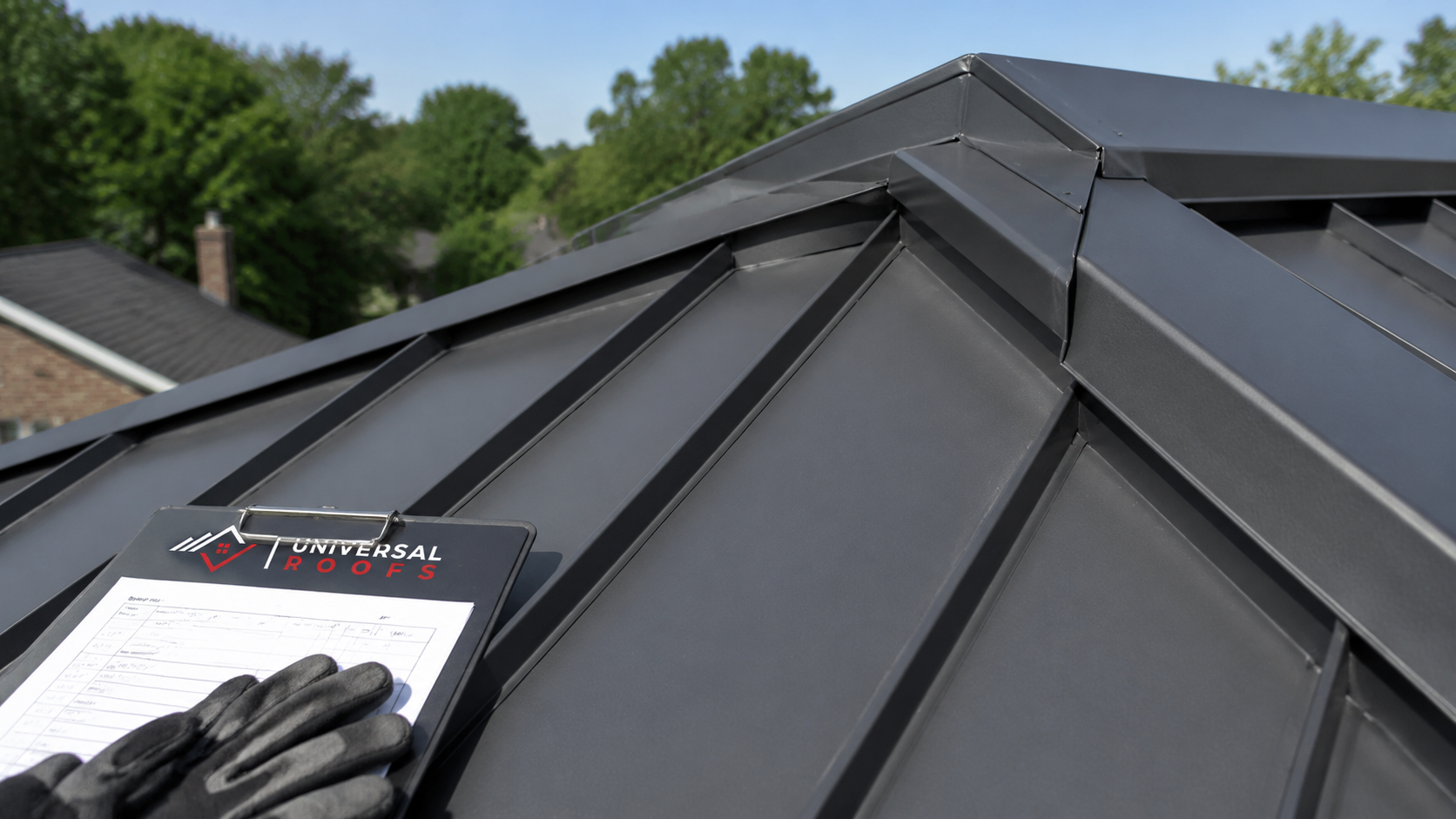
- Read the flashing scope. The quote should list valleys, sidewall, chimney, stack and skylight details individually.
- Be wary of install-over-shingles proposals. It is occasionally acceptable but it hides deck condition, complicates ventilation and can shorten the assembly’s life.
Universal Roofs is based in the Toronto area and works throughout Peel, including full Mississauga roofing services covering inspection, repair and complete replacement. Homeowners comparing companies can review our customer reviews and our roofing FAQ before booking an assessment, and if the existing roof only needs targeted work, a roof repair is often the more sensible first step.
How much does a metal roof cost in Mississauga?
How long does a metal roof last in Ontario’s climate?
Do I need a building permit for a metal roof in Mississauga?
Is a metal roof noisy when it rains?
Can metal roofing be installed over existing shingles?
Does a metal roof stop ice dams?
Get a Metal Roofing Mississauga Quote From Universal Roofs
Choosing between metal roofing Mississauga systems is much easier once someone has measured your roof, checked the deck and ventilation, and priced the specific flashings your house needs. Universal Roofs is a Toronto-based roofing contractor serving Mississauga and the surrounding Peel communities, and our assessments cover both metal and asphalt options so you can compare the real numbers for your own home rather than general ranges.
Call us today at (416) 732-2421 or request a free consultation. We will walk the roof, document what we find, and give you a written quote that names the gauge, substrate, finish and flashing scope so you can compare it fairly against any other bid.
Universal Roofs serves Mississauga, Brampton, Toronto and communities across the Greater Toronto Area with roof inspection, repair, replacement and metal roofing systems.