
Replacing a roof is one of the largest single expenses most homeowners ever take on, and the cost of roofing Brampton properties has moved steadily upward through the past few budget cycles. Shingle prices settled after the volatility of the early 2020s, but labour rates, landfill disposal fees and code-driven upgrades have kept quoted totals climbing. If you are planning work in 2026, the ranges in this guide reflect what Peel Region homeowners are actually being quoted, not national averages that ignore Ontario labour costs, our freeze and thaw cycles, or the narrow spring and autumn windows when crews are busiest.
Below you will find real price ranges broken out by home type, material and complexity, an explanation of why two houses on the same street can receive quotes that differ by several thousand dollars, and a practical walkthrough of the permits, timelines and questions worth settling before you sign anything. Good roofing Brampton work is not complicated, but it is detailed, and the details are where quotes diverge.
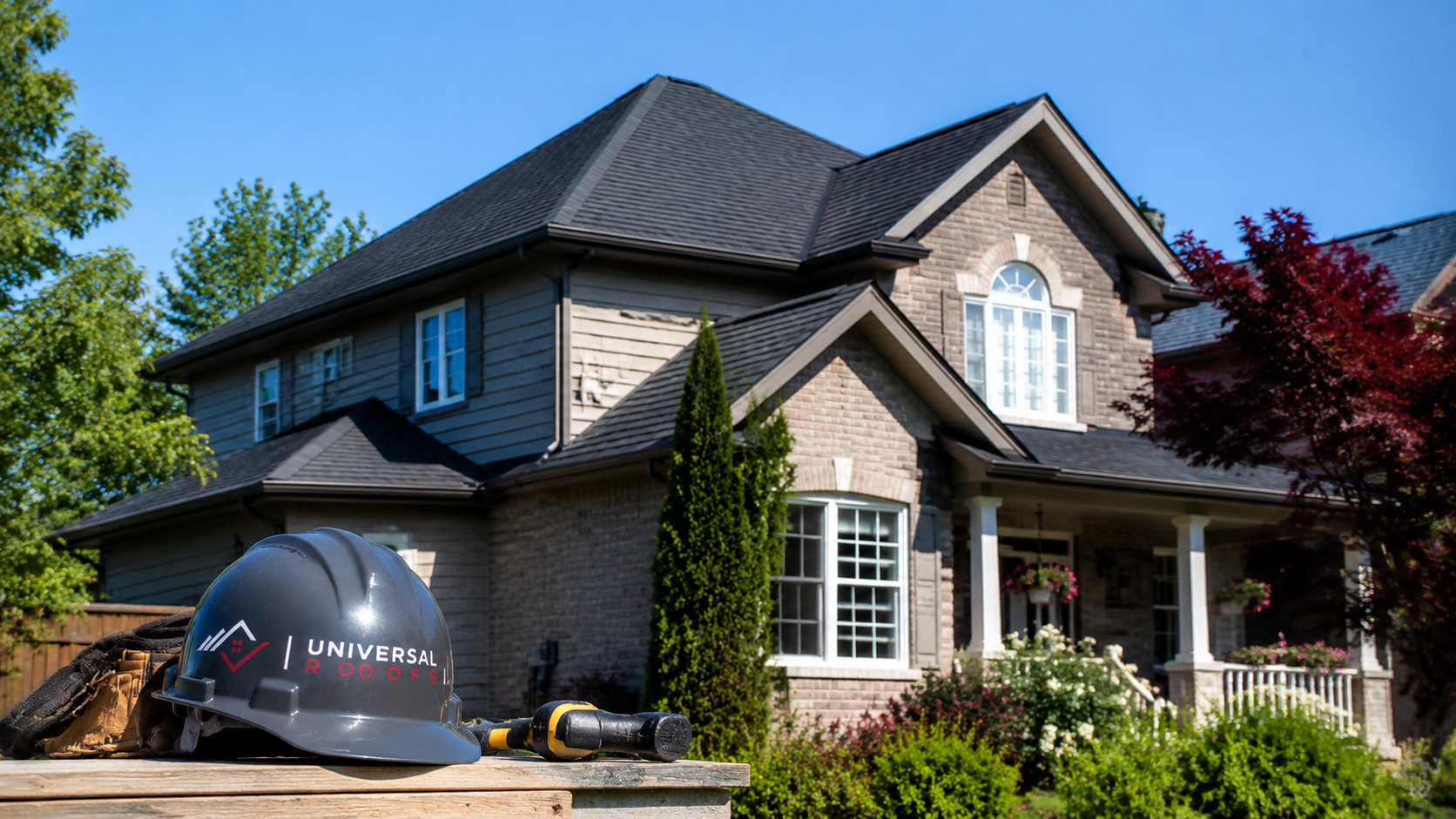
What Roofing Brampton Homes Costs in 2026: The Short Answer
For a straightforward tear-off and replacement using quality architectural asphalt shingles, most homeowners in the city are landing between $6.00 and $9.00 per square foot of roof area installed, all in. That figure covers removal of the old shingles, disposal, new underlayment, ice and water protection at the eaves and valleys, drip edge, new vents, flashing work and cleanup. Roof area is not the same as the square footage of your house: a two-storey home with a 1,000 square foot footprint and a moderate pitch typically carries 1,500 to 1,800 square feet of roof surface once slope and overhangs are counted.
The table below gives realistic 2026 totals for the housing types most common across the city. Treat them as planning ranges rather than quotes. Anyone offering a firm number over the phone without measuring or looking at the deck is guessing, and that guess almost always moves in one direction once the work starts.
| Home type | Approximate roof area | Architectural asphalt, installed |
|---|---|---|
| Townhouse or semi-detached | 700 to 1,100 sq ft | $6,500 to $11,000 |
| Postwar or 1960s bungalow | 1,100 to 1,600 sq ft | $9,000 to $15,000 |
| Two-storey subdivision detached | 1,500 to 2,100 sq ft | $12,000 to $19,500 |
| Large executive home | 2,200 to 3,000 sq ft | $17,500 to $28,000 |
| Estate-lot home with complex roofline | 3,000 sq ft and up | $26,000 to $48,000 |
Repairs sit in a very different bracket, and they make up a large share of all roofing Brampton work booked each year. A localised leak repair, a handful of replaced shingles, a re-flashed vent stack or a resealed chimney counter-flashing generally runs $450 to $1,800 depending on access and how much investigation the crew has to do to find the true source of the water. Emergency call-outs after a wind event carry a premium, and any repair on a roof already past twenty years is money spent on borrowed time.
How Brampton’s Housing Stock Shapes a Roofing Quote
The city’s building history is unusually varied for a single municipality, and that variety is the biggest reason roofing Brampton quotes scatter so widely. Knowing which category your home falls into tells you a great deal about what a crew will find once the old shingles come off.
Older central bungalows and brick homes
The postwar and mid-century housing near the older core tends to have small, simple gable roofs with few penetrations, which keeps labour hours down. The complications are underneath. Many of these homes still have original plank sheathing rather than plywood, with gaps between the boards that no longer hold fasteners reliably. Some are carrying a second or even third layer of shingles from re-roofs done before full tear-off became standard practice. Attic ventilation on houses of that vintage is frequently undersized by current standards, and masonry chimneys often need their counter-flashing cut back into fresh mortar rather than simply resealed with caulk.
Subdivision homes from the 1990s through the 2010s
This is the largest share of the city’s housing and the largest share of roofing Brampton work in any given season. These roofs are steeper, larger and far more cut up than the older stock: multiple valleys, dormers, front gable returns and sometimes a small flat section over a bonus room or garage. The first generation of these roofs is now reaching the end of a builder-grade shingle’s realistic service life, which in our climate is usually eighteen to twenty-two years rather than the thirty printed on the wrapper. Steeper pitches slow crews down and often require additional fall protection staging, which shows up directly in the labour line.
Estate-lot and executive homes
Larger properties bring bigger footprints, more elevation changes, occasional cedar or metal accent sections, and roof geometry that can add twenty to thirty per cent to the labour hours compared with a simple gable of the same area. Long ground-to-eave heights also change the equipment picture, sometimes requiring a conveyor or boom for material handling rather than carrying bundles up a ladder.
Newer builds and townhome blocks
The newest subdivisions are generally still on their original roofs, so most roofing Brampton activity there is warranty-adjacent: wind-lifted shingles, poorly sealed vent boots, or ridge cap fastened short. These are repair jobs rather than replacements, and they are worth documenting carefully with photographs in case the builder’s warranty period still applies.
Roofing Materials and What They Actually Cost Installed
Material choice moves the total more than any other single decision. Asphalt accounts for the overwhelming majority of roofing Brampton installations, and it dominates for good reason: it performs well through Ontario freeze and thaw cycles, every competent crew knows how to install it correctly, and replacement material is never hard to source. There are still cases where paying more up front is defensible, particularly on a house you intend to keep for decades.
| Material | Installed cost per sq ft | Realistic service life in the GTA | Best suited to |
|---|---|---|---|
| Three-tab asphalt | $4.75 to $6.50 | 15 to 20 years | Rentals, short holds, budget replacements |
| Architectural (laminate) asphalt | $6.00 to $9.00 | 22 to 30 years | Most detached and semi-detached homes |
| Premium or designer asphalt | $9.00 to $13.00 | 28 to 38 years | Executive homes, high wind exposure |
| Metal shingle or tile profile | $11.00 to $18.00 | 40 to 50 years | Long-hold owners wanting an asphalt-like look |
| Standing seam metal | $14.00 to $24.00 | 40 to 60 years | Modern builds, low-slope to steep transitions |
| Cedar shake | $15.00 to $25.00 | 25 to 35 years with maintenance | Heritage-style and estate properties |
| Modified bitumen (torch-down) | $11.00 to $17.00 | 18 to 25 years | Flat sections over additions and garages |
| EPDM or TPO single ply | $10.00 to $16.00 | 20 to 30 years | Larger flat areas and rear extensions |
Plenty of homes in the city are hybrids: a sloped main roof with a flat section over a rear addition, sunroom or garage. Those transitions are where leaks concentrate, and they need to be detailed properly rather than shingled over and hoped for. If your property includes a low-slope area, ask specifically how the crew intends to terminate the membrane into the sloped assembly, and confirm they handle flat roofing systems in house rather than subcontracting that portion to whoever is free that week.
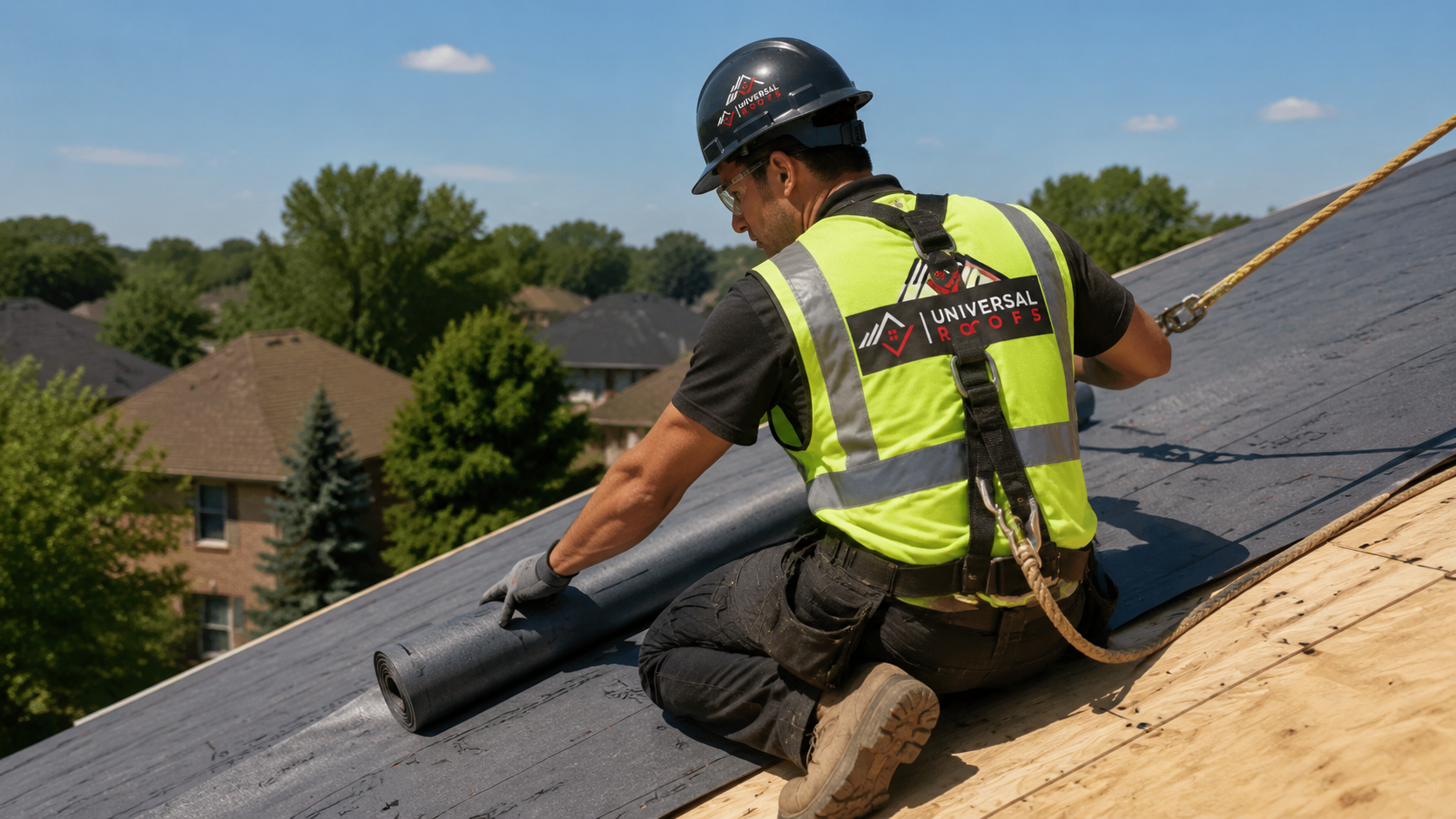
Repair or Replace: Making the Call Honestly
The most common question we field about roofing Brampton homes is whether a single leak justifies a full replacement. There is no universal answer, but there is a reliable framework.
Repair makes sense when the roof is under fifteen years old, the damage is localised, the deck underneath is sound, and the shingles still hold their granules and stay flexible. Wind damage along one ridge, a failed plumbing vent boot, a lifted section of step flashing against a wall, or ice damming confined to a single eave are all repairable problems. A well-executed roof repair on a mid-life roof can buy five to ten more years at a small fraction of replacement cost.
Replacement becomes the better value when shingles are curling or shedding granules across broad areas, when leaks appear at multiple separate points, when the deck feels soft underfoot, or when the roof is simply past twenty years. Patching a roof in that condition is throwing good money after bad, because every repair disturbs adjacent shingles that are already brittle. Homeowners planning a complete roof replacement usually find that bundling other roof-plane work into the same mobilisation, such as vents, skylights or eavestrough, costs meaningfully less than treating each as a separate visit later.
One more consideration is specific to our climate: interior damage from a slow leak often costs more to remediate than the roof work itself. Insulation that has been wetted repeatedly loses R-value permanently, and drywall staining and mould remediation add up quickly. If you already have visible ceiling stains, the clock is running.
Permits, the Ontario Building Code and Local Requirements
For a like-for-like re-shingle where nothing structural changes, a building permit is generally not required in Ontario. Replacing a roof covering, underlayment and flashing on an existing house is treated as maintenance rather than construction. That changes as soon as the work touches structure or alters the building envelope more substantially.
Expect to need a permit when the job involves replacing or altering roof trusses or rafters, changing the roof pitch or line, adding a dormer, cutting a new skylight opening into the structure, or converting an attic to habitable space. Any roofing Brampton project that includes structural repair to a damaged truss falls into this category. Confirm the requirement with the City of Brampton building division before work starts, because the answer depends on the specifics of your house and the scope you are genuinely undertaking.
Code requirements that apply to essentially every replacement are worth knowing regardless of permits:
- Ice and water protection must run from the eave edge to a point measured beyond the interior face of the exterior wall, which in practice usually means one full membrane course and often two on lower-slope roofs.
- Attic ventilation must provide roughly one square foot of net free vent area for every 300 square feet of insulated ceiling area, balanced between intake at the soffits and exhaust near the ridge.
- Drip edge and eave protection belong at all eaves and rakes, with the underlayment lapped correctly relative to the metal rather than tucked the wrong way.
- Fastening patterns must meet the shingle manufacturer’s requirement, normally six nails per shingle on steeper pitches and in high wind exposure rather than the four many crews default to.
Ventilation deserves particular attention. Blocked soffits are extremely common in older homes where insulation was blown in without baffles, and no amount of ridge vent compensates for missing intake air. If your quote does not mention verifying intake ventilation, ask about it. Correcting it during a re-roof is inexpensive, and it directly affects both shingle life and ice damming. An attic insulation and ventilation assessment carried out alongside the roof work is usually the cheapest moment to fix the problem permanently.
What Pushes a Roofing Brampton Quote Up or Down
Two identical-looking houses can produce quotes thousands of dollars apart, and the reasons are almost always in the details below rather than in the shingle brand on the cover page. Reputable contractors list these as separate line items or clearly stated allowances so nothing surprises you mid-project.
| Cost factor | Typical 2026 impact | When it applies |
|---|---|---|
| Removing a second or third shingle layer | $0.75 to $1.60 per sq ft | Older homes re-roofed before tear-off was standard |
| Replacing deteriorated sheathing | $95 to $170 per 4×8 sheet installed | Water damage, plank decking, soft spots |
| Extended ice and water membrane | $1.00 to $2.00 per sq ft covered | Low slopes, wide valleys, chronic ice damming |
| Chimney flashing rebuilt and reglet cut | $500 to $1,500 per chimney | Masonry chimneys, previous tar patch repairs |
| New roof vents or continuous ridge venting | $85 to $250 per unit | Nearly every replacement |
| Skylight replaced during the re-roof | $1,400 to $3,600 per unit | Units older than 15 years, seal failure |
| Steep pitch premium (8/12 and above) | 15 to 30 per cent added labour | Many two-storey subdivision homes |
| Difficult access or restricted staging | $500 to $1,600 | Tight lots, townhome blocks, tall elevations |
Sheathing is the item that most often surprises homeowners budgeting for roofing Brampton replacements, because nobody can see the deck until the shingles are off. A fair contract states a per-sheet rate up front and replaces only what is genuinely rotten, with the old sheets left on site for you to inspect. Be sceptical of any quote that assumes zero sheathing replacement on a house over thirty years old, and equally sceptical of one that pre-bills for a dozen sheets before anyone has looked.
If your roof carries skylights, plan for them in the same scope. Reusing a fifteen-year-old unit under a brand new roof is the single most common source of leaks in an otherwise flawless installation, and replacing skylights while the surrounding field is open costs far less than returning to do it as a standalone job two winters later.
Timelines: What a Roofing Brampton Project Looks Like Start to Finish
Most residential replacements are a one-day or two-day event on site, but the surrounding calendar runs longer than homeowners expect during peak season.
Estimate and measurement normally happens within a few days of your enquiry. A proper assessment includes walking the roof where it is safe to do so, checking the attic from inside, photographing problem areas and measuring rather than pulling numbers from satellite imagery alone. Any roofing Brampton estimate that skips the attic is only half an estimate. Expect thirty to sixty minutes on site, and expect questions about the age of the house, past repairs and where you have seen water.
Scheduling is the real variable. Through April and May, and again from late August into October, good crews are booked three to six weeks out. Mid-summer and late autumn often carry shorter lead times. Shingles can be installed through much of the winter, but adhesive strips do not seal until temperatures rise and hand-sealing adds labour, so the shoulder seasons remain the practical sweet spot for roofing Brampton properties.
Installation day starts early. Tear-off, deck inspection and dry-in of the exposed area all happen the same day, because no responsible crew leaves a deck open overnight. On a typical detached home, a crew of five to seven finishes tear-off by late morning and completes the field by late afternoon. Larger or more complex roofs run into a second day, with the first day’s work fully weathered in before anyone leaves.
Cleanup and the final walkthrough should include magnetic sweeps of the lawn, driveway and garden beds, removal of the disposal bin, and a review of the finished work with photographs of everything you cannot see from the ground. Warranty paperwork, both the manufacturer’s material warranty and the contractor’s workmanship warranty, should arrive in writing rather than as a verbal assurance at the truck door.
How to Compare Roofing Brampton Quotes Without Getting Burned
Three quotes on the same house can differ by forty per cent, and the cheapest is not automatically the worst nor the dearest automatically the best. What separates them is usually scope rather than honesty. Compare the following line by line:
- Underlayment specification. Synthetic underlayment across the full deck, not felt only at the eaves, plus the stated width of ice and water membrane.
- Sheathing allowance. A stated per-sheet price and a commitment to show you what was replaced and why.
- Ventilation plan. Whether intake ventilation is being verified at the soffits, not just exhaust vents counted on the roof.
- Flashing. New step flashing and counter-flashing versus reusing existing metal, which is a frequent hidden difference between two otherwise similar quotes.
- Warranty terms. The length of the workmanship warranty and whether it transfers if you sell the house.
- Insurance and WSIB. Ask for current certificates. Roofing carries real liability and you do not want it landing on your homeowner’s policy.
It is also fair to ask how long a contractor has been doing this kind of work and where else they operate. Universal Roofs is based in the Toronto area and works throughout Peel and York Region, including full roofing services for Brampton homeowners as well as neighbouring communities such as Vaughan and Markham. Reading recent customer reviews and the answers on our roofing FAQ page tells you more about how a company behaves after the invoice is paid than any sales visit ever will.
Finally, be sceptical of pressure. Legitimate roofing Brampton contractors provide a written quote that stays valid for a reasonable period, do not demand a large deposit before materials are ordered, and do not tell you the price expires tonight. Storm-chasing operations appear across Peel Region after every significant wind event, and the tell is always the same: unsolicited door-knocking, manufactured urgency, cash discounts and no verifiable local history you can check.
How much does a full roof replacement cost in Brampton in 2026?
Do I need a building permit for roofing Brampton work?
What is the best time of year to schedule roofing Brampton projects?
How long should an asphalt roof last in Peel Region?
Is it cheaper to shingle over an existing roof?
How do I know whether I need a repair or a full replacement?
Get a Straight Estimate for Your Roofing Brampton Project
A good roof is not the one with the most impressive brochure. It is the one that was measured properly, ventilated correctly and detailed carefully at the flashings by people who will still answer the phone in five years. Universal Roofs works throughout Peel and York Region from our Toronto base, and every estimate begins with an on-site assessment that includes the attic, not a satellite photo and a phone call.
Call us today at (416) 732-2421 or request a free consultation. We will walk your roof, show you photographs of what we find, explain the options at each price point, and give you a written quote with the sheathing rate, ventilation plan and warranty terms stated clearly.
Universal Roofs proudly serves homeowners in Brampton, Mississauga, Vaughan, Markham, Richmond Hill and communities across the Greater Toronto Area.