
Durham Region sits on the eastern edge of the Greater Toronto Area, and the homes here take a different kind of beating than the ones closer to the downtown core. Lake Ontario sits directly to the south, the open farmland north of Highway 407 does nothing to slow the wind, and the freeze and thaw cycle runs harder here than it does in the sheltered inner city. Anyone comparing quotes for roofing Durham Region properties should understand those conditions before signing anything, because the same shingle package that performs well on a semi-detached house in midtown Toronto can fail early on an exposed two storey home in north Whitby. This guide covers what roofing Durham Region homeowners in Ajax, Pickering, Whitby and Oshawa should expect in 2026: realistic costs, material choices, permit rules, ventilation requirements and the seasonal timing that decides how fast a crew can actually get on your roof.
Universal Roofs is based in the Toronto area and works across the eastern GTA, so the guidance below reflects what we see on Durham roofs rather than generic national averages. Prices are quoted in Canadian dollars and reflect 2026 material and labour conditions in Ontario. Every figure is given as a range, because roof pitch, storey height, access, layer count and deck condition move the number more than most homeowners expect.

Why Roofing Durham Region Homes Differs From Downtown Toronto Work
The first thing that separates roofing Durham Region houses from work in the older core is exposure. Much of Durham was built out as open subdivisions on former farmland, which means there is very little mature tree cover or neighbouring building mass to break the wind. Winter gusts coming off Lake Ontario hit south Ajax and south Pickering roofs directly, and the newer estate developments north of Taunton Road sit on high open ground with the same problem. Wind uplift at the ridge, at hips and along rake edges is a recurring failure point, and it is the reason starter strip installation and correct nailing patterns matter more here than almost anywhere else in the GTA.
The second difference is snow and ice load. Durham typically picks up more accumulation than the lakeshore neighbourhoods of Toronto proper, particularly in the northern municipalities. That accumulation sits on the roof longer, melts against a warm attic and refreezes at the cold eave, which is the classic ice dam mechanism. Roofs with shallow soffit overhangs and undersized attic ventilation build dams almost every winter.
The third difference is the age spread of the housing stock. A roofing Durham Region contractor can drive fifteen minutes and go from a 1950s Oshawa bungalow with plank sheathing and a single layer of old organic shingle, to a 2015 Whitby two storey with engineered trusses, complex valley geometry and a factory installed vent package. Those two jobs need different pricing, different crews and different material specifications. Any quote that treats them the same is a quote worth questioning.
The Housing Stock Across Ajax, Pickering, Whitby and Oshawa
Understanding what sits above your ceiling is the fastest way to understand your quote. Below is an honest picture of the general housing character in each of the four largest Durham municipalities, described in broad terms rather than by specific streets or subdivisions.
Oshawa
Oshawa carries the largest share of older housing in Durham. Postwar bungalows and one and a half storey homes are common, often with original board sheathing rather than plywood, shallow eaves and attics that were insulated to a much lower standard than current code. On these roofs, tear off frequently reveals soft or spaced decking, and the sheathing replacement allowance becomes a real line item rather than a formality. Older Oshawa homes also tend to have simple gable geometry, which keeps labour costs down, and chimneys that need proper flashing rather than the surface caulking that has often been applied over the years.
Whitby
Whitby spans a wide range. There is older housing near the historic core, a large band of 1980s and 1990s subdivisions through the centre of town, and newer developments toward the north. The 1990s stock is now firmly in replacement territory: those roofs have generally had one shingle life already, and many are on their second. Newer Whitby homes tend to have steeper pitches and more complex rooflines, with multiple valleys, dormers and front gable features that add labour hours and increase the amount of ice and water membrane required.
Pickering
Pickering mixes established south end neighbourhoods with substantial newer development to the north and east. The south end includes many 1960s and 1970s homes with the exposure issues described above, while the newer areas bring larger footprints, higher wall heights and attached garages that create long unbroken slope runs. Larger executive homes in Pickering push cost upward mostly because of square footage, staging and the need for safe access at height.
Ajax
Ajax has grown quickly and holds a heavy concentration of 1990s through 2010s subdivision housing, plus older stock closer to the lake. Two storey homes with attached garages, moderate to steep pitches and multiple roof planes are the standard here. These homes usually have adequate original ventilation design, but many have had bathroom fans, kitchen fans or dryer lines vented into the attic instead of through the roof or wall, which shows up as premature deck deterioration during tear off.
What Roofing Durham Region Projects Cost in 2026
The table below shows typical installed cost ranges for a complete asphalt shingle replacement on common Durham home types. Each range assumes tear off of one existing layer, disposal, new synthetic underlayment, code compliant eave protection, new flashings at penetrations, ridge venting and cleanup. Second layer removal, deck replacement, chimney work and steep or high access add to these figures.
| Home type | Typical roof area | 2026 installed range | Common extras |
|---|---|---|---|
| Postwar bungalow, simple gable | 14 to 20 squares | $7,000 to $11,500 | Plank deck replacement, chimney flashing |
| One and a half storey older home | 16 to 24 squares | $8,500 to $14,000 | Dormer flashing, low headroom venting |
| Two storey subdivision home, 1990s to 2010s | 22 to 34 squares | $11,000 to $18,500 | Extra valleys, steep pitch surcharge |
| Large executive or estate home | 35 to 60 squares | $18,000 to $34,000 | Multiple roof planes, staging, skylight curbs |
| Detached garage or single addition | 4 to 8 squares | $2,500 to $5,500 | Tie in flashing to main roof |
A few notes on how these numbers behave in practice. Deck replacement is usually quoted per sheet, commonly in the range of $95 to $160 per sheet of plywood installed, and an honest contractor tells you that number in writing before starting rather than discovering it on day one. Steep pitch, generally anything above an 8 in 12 slope, adds roughly 10 to 20 percent to labour. Third storey access and tight side yards add staging time. Any roofing Durham Region estimate that omits these variables is not a fixed price, it is an opening number.
Homeowners weighing repair against replacement should also price the alternative honestly. Targeted repair work on a roof with five or more years of service life left is often the right financial decision, and a professional roof repair on a localized leak typically lands in the several hundred to low thousands range depending on access and the extent of the damaged area. Replacing a roof that still has life left is wasted money, and replacing one that is past its service life on an emergency basis in February costs far more than planning the same roof replacement for a summer week.
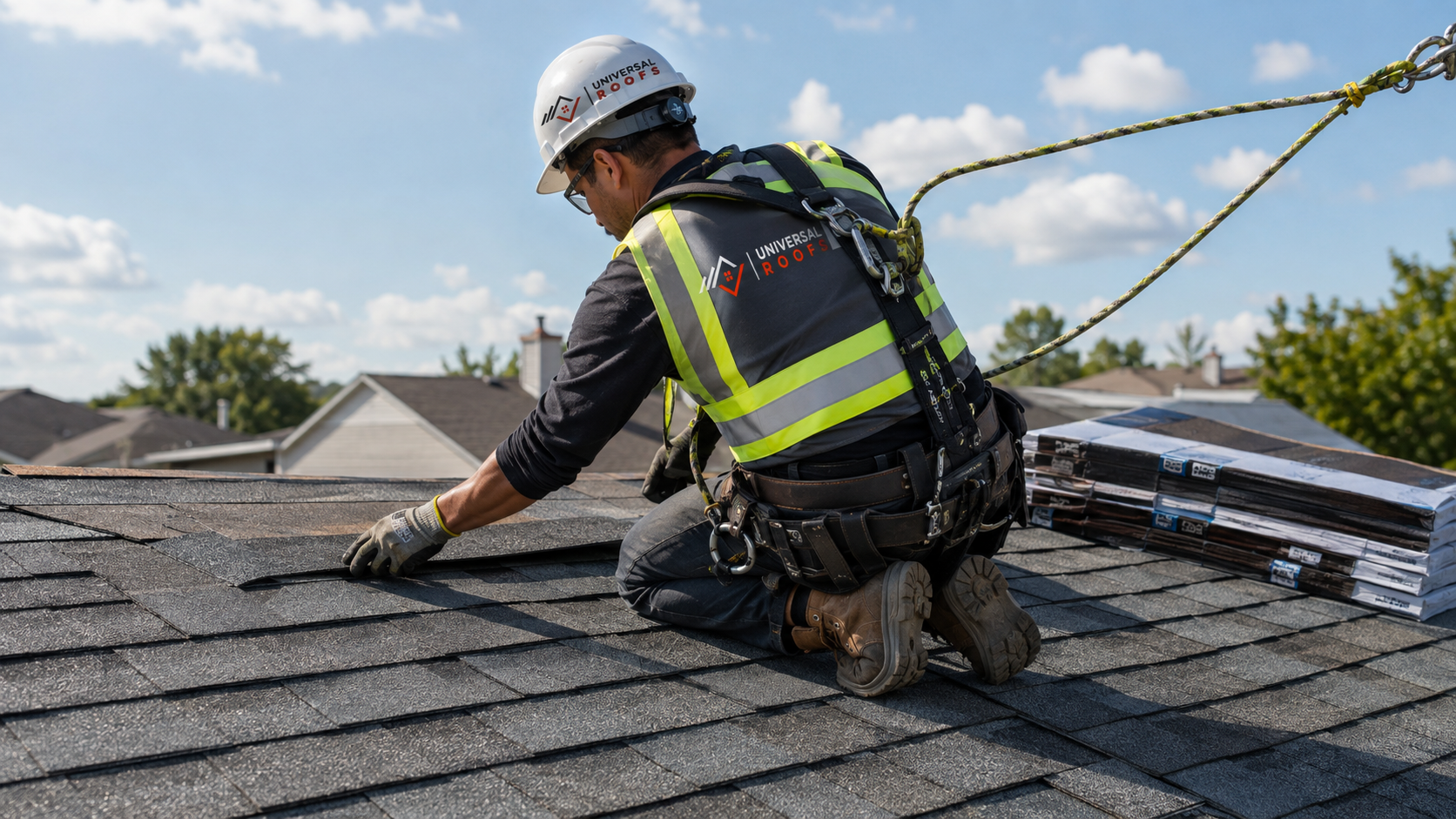
Materials That Suit Roofing Durham Region Conditions
Asphalt shingle remains the default across Durham for good reasons: it is cost effective, widely stocked, repairable and well understood by every crew in the region. That said, the gap between a builder grade three tab product and a modern laminated architectural shingle is significant on exposed Durham roofs, and the price difference is smaller than most homeowners assume once labour is factored in. Labour is the same either way, so upgrading the shingle typically moves the total project cost by a modest percentage while adding meaningful wind and impact performance.
| Material | Installed cost per square (100 sq ft) | Realistic service life | Best suited to |
|---|---|---|---|
| Three tab asphalt shingle | $450 to $600 | 15 to 20 years | Budget projects, sheltered low exposure roofs |
| Architectural laminated shingle | $550 to $800 | 25 to 30 years | Most Durham homes, the practical default |
| Premium or designer asphalt | $750 to $1,100 | 30 to 40 years | High exposure sites, long term ownership |
| Metal shingle or tile profile | $1,000 to $1,600 | 40 to 50 years | Homeowners wanting one final roof |
| Standing seam metal | $1,400 to $2,400 | 50 years plus | Simple slopes, modern or rural properties |
| EPDM or TPO single ply | $1,100 to $1,900 | 20 to 30 years | Flat sections, additions, rear extensions |
Many Durham homes have a mixed roof: a sloped main roof over the house and a low slope or flat section over a rear addition, sunroom or garage. Shingles do not belong on anything below roughly a 2 in 12 pitch, and a surprising number of leaks we investigate come from shingles installed on slopes that were never suited to them. Those areas need a membrane system, and combining shingle work with a properly detailed flat roofing section in a single project avoids a seam between two contractors, which is where responsibility tends to get lost.
If your home has skylights, replace them during the roof project rather than after. Reusing a twenty year old skylight under a new roof means opening the finished roof again when the unit eventually fails, and modern skylight installation with an integrated flashing kit performs far better than the site built curbs common on older Durham homes.
Permits, Ontario Building Code and Municipal Rules in Durham
Straightforward shingle replacement, meaning tear off and re roof with no structural change, generally does not require a building permit in Ontario municipalities including Ajax, Pickering, Whitby and Oshawa. A permit becomes necessary when the work goes beyond the roof covering: replacing or altering trusses or rafters, changing the roof structure or pitch, adding a dormer, cutting a new skylight opening in some cases, or building an addition. If a contractor tells you a simple re roof needs a costly permit they arranged, verify that directly with your municipality’s building department before paying anything.
Code requirements that do apply to every re roof are worth knowing, because they separate compliant work from cheap work:
- Eave protection. The Ontario Building Code requires eave protection, in practice a self adhering ice and water membrane, running from the roof edge up the slope to a line measured at least 900 mm inside the inner face of the exterior wall. On a low slope roof or a deep overhang, that means more than one course. Membrane applied only to the first metre of a wide overhang does not satisfy this.
- Valley and penetration protection. Valleys, chimney perimeters, sidewalls and plumbing stacks all need membrane and correctly lapped metal flashing, not surface sealant.
- Attic ventilation. Unobstructed vent area of not less than 1 to 300 of the insulated ceiling area is the general requirement for most residential roofs, split between intake at the soffit and exhaust near the ridge.
- Fastening. Shingles are fastened per the manufacturer’s specification, which for most laminated products in a wind exposed area means six nails per shingle rather than four, placed in the nailing zone.
Written proof of WSIB coverage and commercial general liability insurance should be attached to any roofing Durham Region contract before work begins. Ask for the certificates directly rather than accepting a verbal assurance, and confirm the policy dates cover your scheduled installation window.
Ventilation, Insulation and the Ice Dam Problem
More Durham roofs fail from below than from above. A warm humid attic cooks the underside of the sheathing, shortens shingle life from the back, and drives the melt and refreeze cycle that builds ice at the eave. A new roof installed over a poorly ventilated attic is a shorter roof, no matter how good the shingle is.
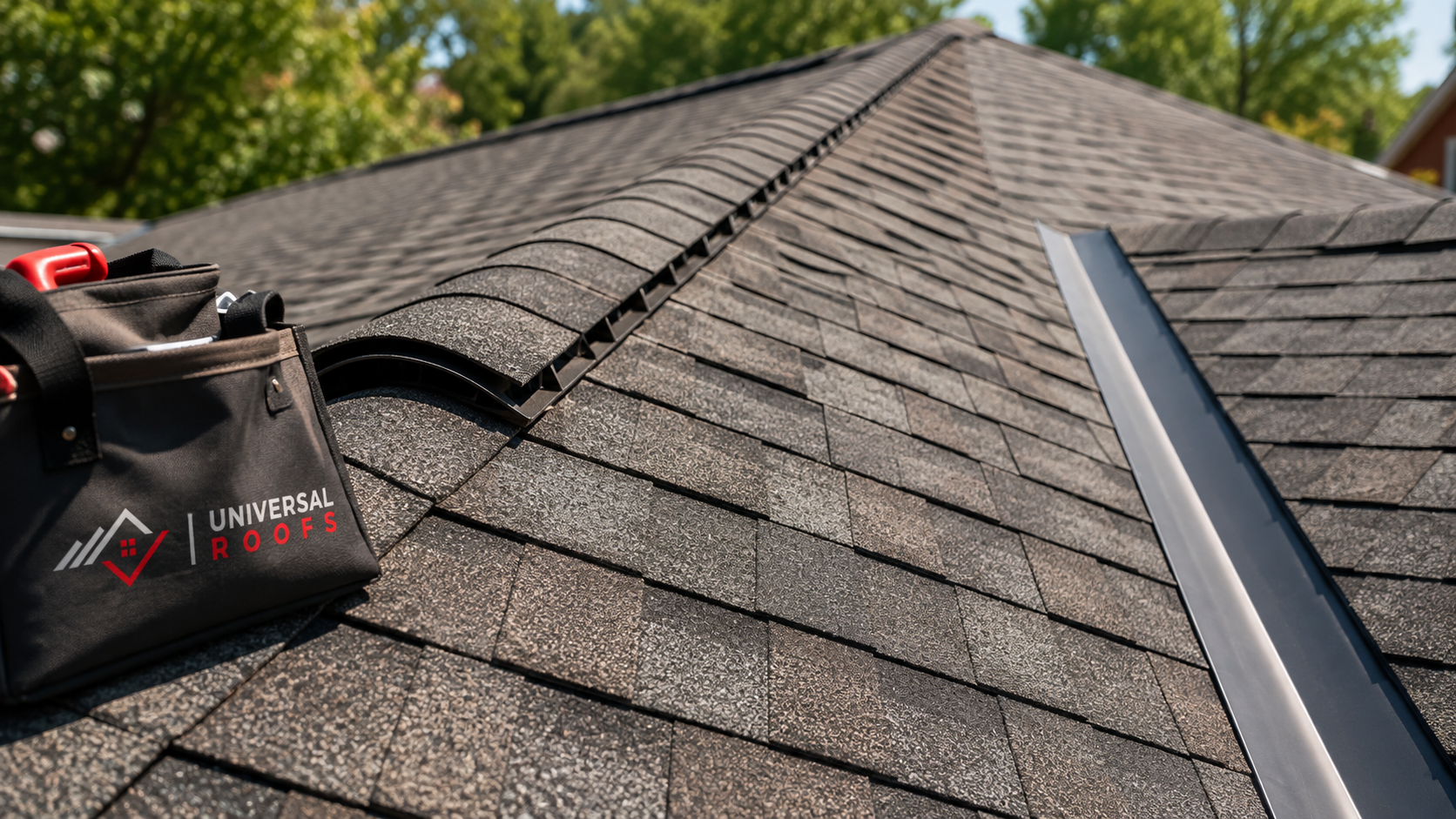
The two failures we find most often are blocked intake and mixed exhaust. Blocked intake happens when attic insulation was topped up and pushed into the soffit cavity, cutting off the airflow the ridge vent depends on. Baffles at the eaves solve it, and they should be installed whenever insulation is added. Mixed exhaust happens when a ridge vent is installed while old box vents, turbines or gable vents are left open, which short circuits the airflow: the ridge vent pulls from the nearest opening rather than from the soffits, and the far end of the attic gets no movement at all. Choose one exhaust strategy and close the others.
Insulation depth matters just as much. Many older Durham attics still hold the original insulation at a fraction of the current recommended level. Bringing an attic up to a modern standard alongside a roof replacement is usually the single best value add on available, since the access is already there. Combining the roof with an attic insulation and ventilation upgrade addresses ice damming at the cause instead of managing the symptom every February with roof rakes and heat cables.
Bathroom and kitchen exhaust fans deserve a specific check. Any fan that terminates inside the attic instead of through a roof cap or exterior wall is pumping moist air directly into the coldest part of the house. During tear off this is easy to correct, and it is a common finding on the newer Ajax and Whitby subdivision homes described earlier.
Timing, Seasons and How Long the Work Takes
Most residential roofing Durham Region jobs are one to three days of on site work for a full crew, weather permitting. A simple bungalow can be torn off and completed in a single day. A large two storey with multiple planes, several skylights and deck repairs runs two to three days. Complex estate roofs and any project involving structural repair take longer, and any contractor promising a complicated roof in one day is either bringing a very large crew or cutting steps.
| Season | Crew availability | Pricing pressure | Installation notes |
|---|---|---|---|
| Early spring, March to April | Good | Lower | Wet weather delays; shingles need warmth to seal fully |
| Late spring, May to June | Moderate | Moderate | Excellent conditions; books up quickly |
| Summer, July to August | Tight | Highest | Best sealing conditions; early starts avoid peak heat |
| Fall, September to October | Very tight | High | Peak demand season; book several weeks ahead |
| Late fall and winter, November to February | Available | Lower | Hand sealing required in cold; emergency repairs prioritized |
The practical takeaway for anyone planning roofing Durham Region work in 2026 is to get quotes in late winter or early spring for a summer installation. Homeowners who wait until the first leak in September compete with everyone else who waited, and the shortest lead time is rarely the best crew. If a leak forces the issue in cold weather, a competent temporary repair to carry the roof through to spring is usually smarter than a rushed full replacement in January.
How to Compare Roofing Quotes Without Getting Burned
Three quotes on the same house in Durham can differ by thousands of dollars, and the spread usually comes from scope rather than greed. Put the quotes side by side and check that each one names the same things:
- Number of layers being removed. One layer or two changes disposal cost and labour meaningfully.
- Underlayment type and coverage. Synthetic underlayment across the full deck, or felt only in places?
- Ice and water membrane extent. Eaves, valleys, chimneys, sidewalls and around every penetration, or eaves alone?
- Flashing. New step flashing and counter flashing where required, or reuse of existing metal?
- Ventilation. What is being installed, and what is being removed or sealed?
- Deck repair rate. A stated per sheet price, not an open ended allowance.
- Warranty. Manufacturer material warranty and a separate written workmanship warranty, with the term stated in years.
Warning signs are consistent across the industry: pressure to sign the same day, a large deposit demanded before materials are ordered, no written scope, no WSIB certificate, a quote given without anyone climbing onto the roof or entering the attic, and door to door solicitation after a storm. A legitimate roofing Durham Region contractor will inspect the attic, photograph the problem areas and hand you a scope you can compare against anyone else’s. Reading verified customer feedback also helps, and our customer reviews and roofing FAQ answer many of the questions homeowners raise before booking.
Maintenance That Extends a Durham Roof
A roof that is inspected and maintained lasts materially longer than one that is ignored until it leaks. For roofing Durham Region homes, a sensible routine looks like this: a visual inspection each spring and fall from the ground with binoculars, gutters cleared twice a year, overhanging branches trimmed back, attic checked after heavy rain for staining or damp insulation, and sealant at flashings reviewed every few years. Look specifically for lifted or missing tabs after high wind events, granule accumulation at downspout outlets, dark streaking that suggests moisture retention, and any sagging along the ridge or between rafters.
Inside the house, watch for ceiling stains near exterior walls, peeling paint at the top of interior walls, and musty smells in upstairs closets. Those symptoms often show up months before water appears on a ceiling, and catching them early is the difference between a flashing repair and a deck rebuild. Homeowners in neighbouring municipalities can find the same guidance applied to their area through our regional service pages, including York Region roofing services for those north and west of Durham.
For a full picture of what we handle across the eastern GTA, our Durham Region roofing services page outlines the repair, replacement, flat roof and attic work available in Ajax, Pickering, Whitby, Oshawa and the surrounding municipalities.
Frequently Asked Questions About Roofing in Durham Region
How much does a new roof cost in Durham Region in 2026?
Do I need a permit to replace my roof in Ajax, Pickering, Whitby or Oshawa?
What is the best time of year for roofing Durham Region homes?
How long does a roof replacement take?
Why do ice dams keep forming on my roof?
Should I repair or replace my roof?
Book Your Roofing Durham Region Estimate Today
Universal Roofs is based in the Toronto area and serves homeowners across Durham Region, bringing the same crews, materials and workmanship standards to Ajax, Pickering, Whitby and Oshawa that we bring to the rest of the GTA. Every roofing Durham Region estimate starts with a full inspection of the roof and the attic, followed by a written scope you can compare line by line against any other quote.
Call us today at (416) 732-2421 or request a free consultation. We will assess the condition of your roof, explain what needs doing and what can wait, and give you a firm price with no pressure to sign on the spot.
Universal Roofs provides roof repair, roof replacement, flat roofing, skylight and attic services throughout Durham Region and the Greater Toronto Area.