
Most roofs do not fail all at once. They fail at one flashing joint, one lifted shingle course, one cracked vent boot, and the damage spreads quietly through the attic for a season or two before anyone notices a stain on a ceiling. That is why roof repair in Pickering is usually a question of catching a small defect early rather than replacing an entire roof, and why the cost gap between a homeowner who inspects annually and one who waits for a leak is often several thousand dollars. This guide covers the problems we see most often on Pickering homes, what repairs realistically cost in 2026, and how to tell the difference between a roof worth fixing and a roof at the end of its service life.
Pickering has an unusually varied housing stock for a Durham Region municipality. There are postwar bungalows and storey-and-a-half homes on mature, treed lots in the older south end near the lake, sprawling subdivisions of two-storey homes built through the 1980s, 1990s and 2000s, newer developments in the north with steeper pitches and more complex rooflines, and rural estate properties on large lots further from the lakeshore. Each of those categories fails in a slightly different way, and a sensible approach to roof repair in Pickering starts with knowing which one you own.

Why Roof Repair in Pickering Has Its Own Local Pressures
Roofs in this part of Durham Region deal with a specific combination of conditions. Pickering sits on the north shore of Lake Ontario, and homes closer to the water see steadier wind loading and more frequent freeze and thaw cycling through late winter than properties further inland. Wind is the single most common cause of shingle damage we are called out for. It does not usually tear a roof off. It lifts the leading edge of a shingle course just enough to break the factory seal strip, and once that seal is broken the shingle flexes with every gust and eventually cracks or slides.
The second pressure is ice. Toronto and Durham winters produce repeated melt and refreeze conditions rather than one long deep freeze, which is the worst case for ice damming. Meltwater runs down a warm roof plane, refreezes at the cold eave overhang, and backs up under the shingles. Any roof repair in Pickering that follows an ice dam has to address the cause in the attic, not just the symptom on the roof, or the same repair will be needed the following spring.
The third is trees. Older parts of Pickering have genuinely mature tree canopy, which is pleasant to live under and hard on shingles. Overhanging limbs abrade the surface granules, shade slows drying and encourages moss and algae growth, and falling debris clogs valleys and gutters. A roof under heavy canopy typically needs more frequent attention than the same roof on an open lot in a newer subdivision.
The Most Common Roof Problems We Find on Pickering Homes
After enough inspections, the failure patterns become predictable. The following are the issues that generate the majority of roof repair in Pickering calls, roughly in order of how often we encounter them.
Failed or Undersized Flashing
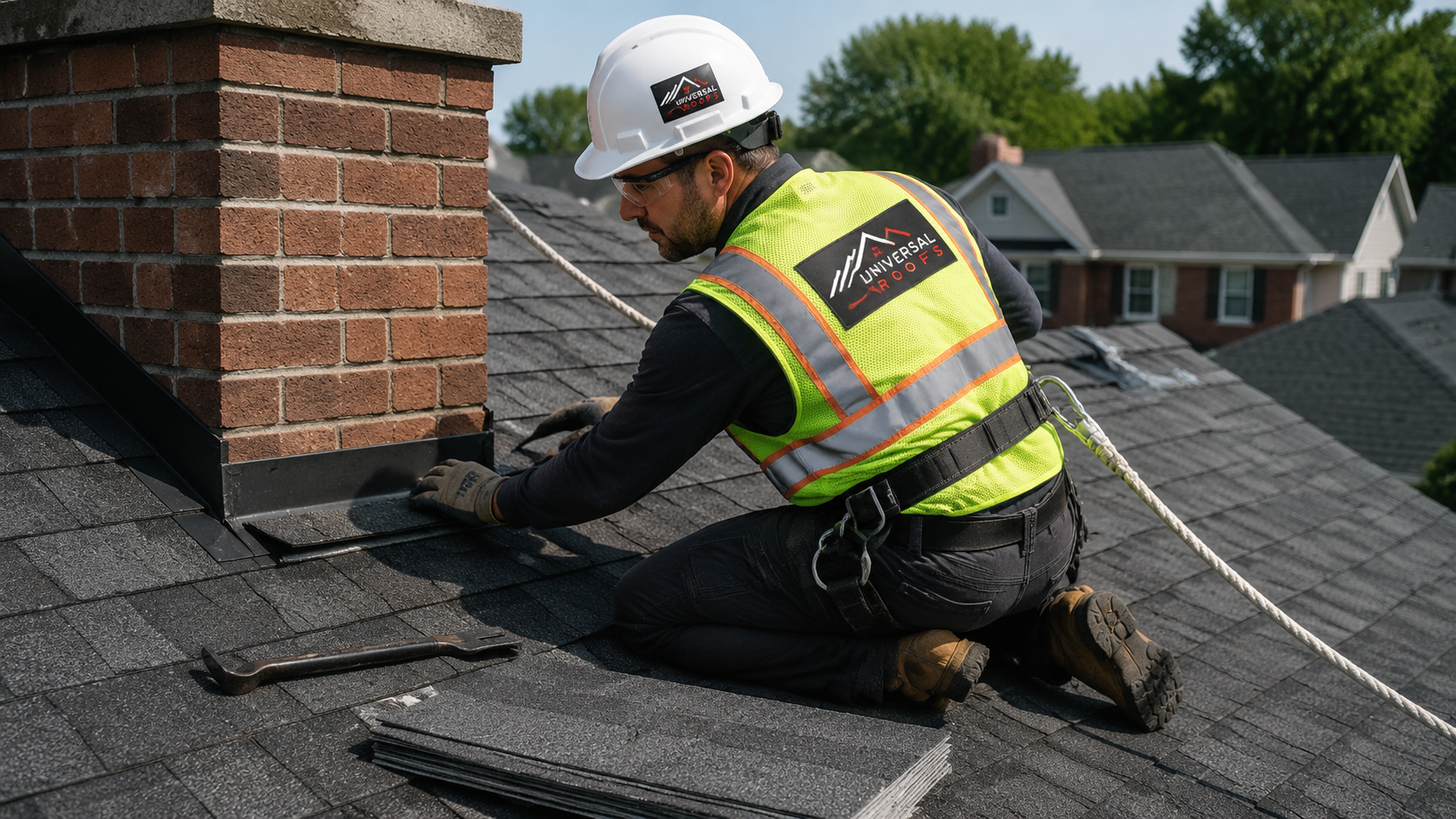
Flashing is the sheet metal that seals the joints where a roof meets something else: a chimney, a wall, a skylight, a dormer. It is the most common leak source on any roof and the most common thing done badly on a reroof. We regularly find chimneys sealed with nothing but caulking where proper step flashing and counter flashing should be, and where the caulking has cracked, the leak follows. Correct flashing work is the highest-value form of roof repair in Pickering on most homes because it fixes the actual failure point instead of covering it.
Valley Deterioration
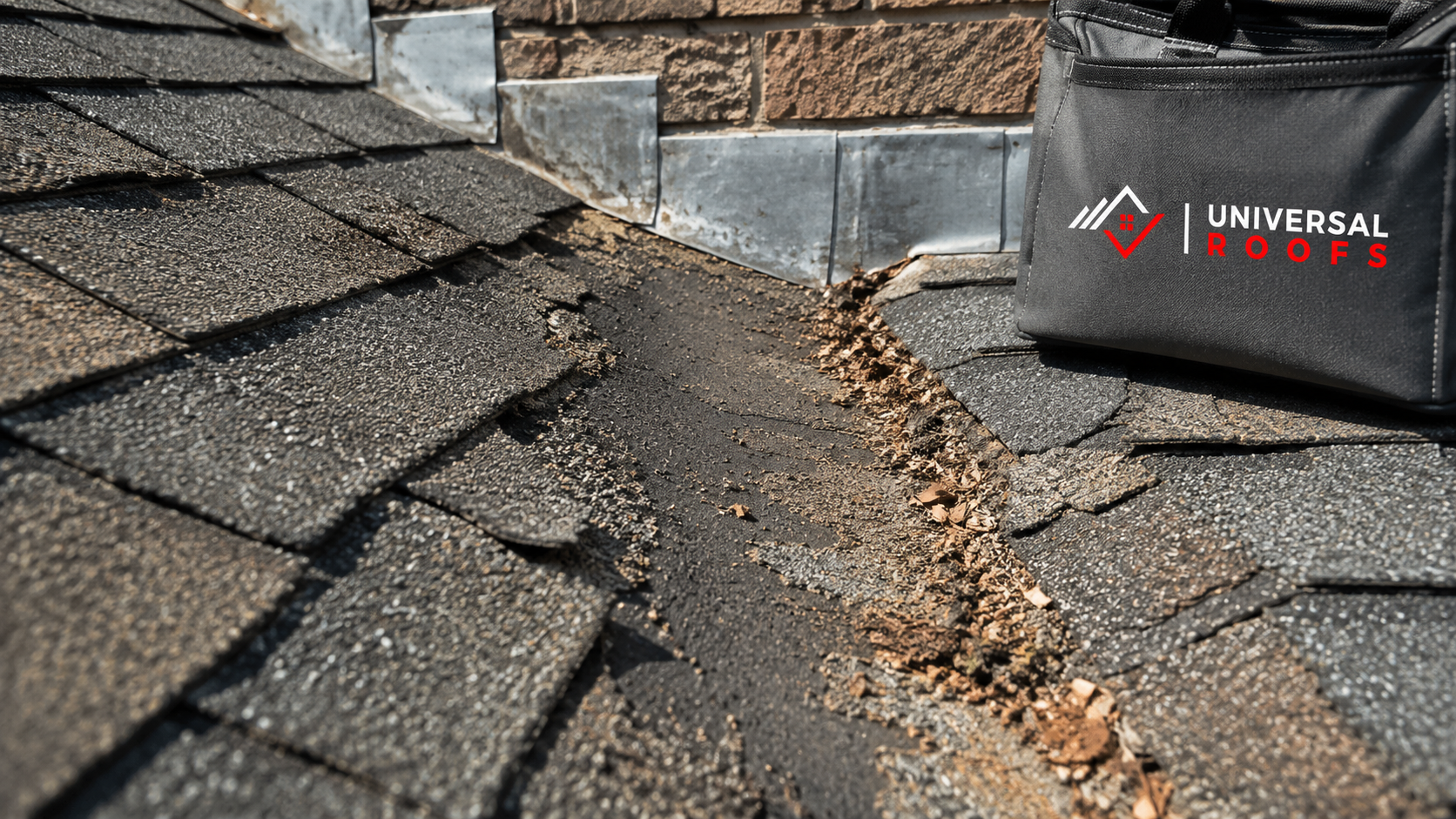
Valleys carry the concentrated runoff from two roof planes, so they wear faster than anywhere else. On homes with complex rooflines, which describes a lot of the 1990s and 2000s builds in Pickering, valleys are also where debris collects. Granule loss, exposed asphalt and lifted shingle edges along a valley are early warnings worth acting on.
Cracked Plumbing Vent Boots
The rubber collar around a plumbing stack hardens and splits under ultraviolet exposure, usually somewhere between year eight and year fifteen. This is a small, cheap repair that causes disproportionate damage when ignored, because the water enters directly above living space and tracks along the ceiling before it becomes visible.
Wind-Lifted and Missing Shingles
Usually concentrated on the exposed side of the roof, most often near ridges, rakes and eaves. A few missing shingles are a straightforward roof repair in Pickering. Widespread seal failure across an entire slope is a different conversation.
Inadequate Attic Ventilation
Not a roof defect exactly, but a cause of them. Under-ventilated attics run hot in summer, which cooks shingles from below and shortens their service life, and run warm in winter, which drives ice damming. If we find premature shingle curling on a roof that should have years left, ventilation is the first thing we check.
Ridge Cap and Ridge Vent Failure
Ridge caps take the most direct weather exposure and often fail before the field shingles. Older ridge vents can also lift or separate at the joints, opening a path for wind-driven rain and snow.
| Problem | Typical Warning Sign | Risk If Left | 2026 Repair Range |
|---|---|---|---|
| Chimney flashing failure | Stain on ceiling near chimney chase | Rotted sheathing, framing damage | $550 to $1,400 |
| Cracked plumbing vent boot | Damp patch in an upstairs ceiling | Insulation and drywall damage | $250 to $550 |
| Valley deterioration | Exposed asphalt, granules in gutters | Leak into interior wall cavity | $800 to $2,400 |
| Wind-damaged shingles | Missing tabs, lifted courses after a storm | Progressive slope failure | $400 to $1,200 |
| Skylight leak | Water tracking down the skylight shaft | Mould in the light well | $700 to $1,900 |
| Ice dam damage at eaves | Winter drips at exterior walls | Soffit, fascia and wall rot | $1,400 to $4,500 |
What Roof Repair in Pickering Costs in 2026
Pricing for roof repair in Pickering depends on four things: access, height, the size of the affected area, and whether anything under the shingles has to be replaced. A single-storey bungalow with a walkable pitch is far cheaper to work on than a three-storey home with a steep roof requiring extensive fall protection setup, even if the repair itself is identical.
The other variable that moves quotes is hidden damage. Nobody quoting roof repair in Pickering can see the condition of the plywood or plank sheathing until the shingles come off. A reputable contractor quotes the visible repair and states a per-sheet rate for any decking that turns out to be rotted, rather than pretending the question does not exist.
| Repair Type | 2026 Price Range | Typical Time on Site | Notes |
|---|---|---|---|
| Minor shingle replacement (up to 10 shingles) | $350 to $700 | 1 to 2 hours | Colour match on older roofs is approximate |
| Plumbing vent boot replacement | $250 to $550 | Under 1 hour | Often bundled with other work |
| Chimney re-flashing | $900 to $2,200 | Half day | Higher if masonry repointing is needed |
| Valley rebuild (one valley) | $1,100 to $2,600 | Half to full day | Open metal valley costs more than closed cut |
| Skylight re-flash and reseal | $700 to $1,900 | Half day | Unit replacement is priced separately |
| Sheathing replacement | $120 to $260 per sheet | Added to base repair | Only known once shingles are removed |
| Partial slope re-shingle | $2,400 to $6,800 | 1 to 2 days | Depends on slope area and access |
| Emergency tarp and temporary seal | $400 to $950 | 1 to 2 hours | Credited against permanent repair by some firms |
For context, a full asphalt shingle replacement on a typical Pickering two-storey home generally runs from roughly $9,000 to $19,000 in 2026 depending on roof area, pitch, complexity and shingle grade. That figure matters because it sets the ceiling on what a repair is worth spending. Details on the full process are covered on our roof replacement page.
How Pickering’s Housing Stock Changes the Repair Approach
The right approach to roof repair in Pickering is not the same on every street, because the homes are not the same age or the same shape. Broadly, there are four categories worth separating.
Postwar bungalows and older brick homes in the south end. Simple gable or hip roofs, shallow to moderate pitch, often with plank sheathing rather than plywood. These are the least expensive roofs to work on because access is easy and there is little complexity, but they are also the ones most likely to have original or near-original decking, minimal eave membrane, and undersized ventilation. Roof repair in Pickering on these homes frequently uncovers a bigger issue underneath.
Late-1980s and 1990s subdivision homes. Two storeys, moderate pitch, a handful of valleys and usually one chimney. Most are on their second roof by now. The typical repair is flashing or valley work rather than field shingle failure.
2000s and newer subdivision and estate homes. Steeper pitches, multiple dormers, longer valley runs, more penetrations, and sometimes low-slope sections over garages or bonus rooms. More complexity means more joints, and more joints means more places to leak. Steep pitch also raises labour cost because everything takes longer with full fall protection in place.
Rural and larger lot properties in the north. Bigger roof areas, more wind exposure without the shelter of dense subdivision housing, and often outbuildings with their own roofing needs. Access for materials and equipment is generally easier, which offsets some of the added area.
If you want a fuller picture of how we handle work across this part of Durham Region, our Pickering roofing services page sets out what we cover locally.
Emergency Versus Planned Roof Repair in Pickering
There are two very different kinds of roof repair calls. Understanding which one you have keeps you from overpaying and from underreacting.
An emergency is active water entering the building, or structural exposure after a storm: shingles stripped from a slope, a tree limb through the deck, flashing torn loose. In those cases the immediate goal is to stop water ingress, usually with a tarp or a temporary seal, and to schedule the permanent repair once conditions allow. Working on a roof in high wind or during a storm is not safe and no responsible contractor will do it.
A planned repair is everything else: the stain you noticed months ago, the missing shingles you can see from the driveway, the valley that looks worn. Planned roof repair in Pickering should be scheduled in the dry months, which in the GTA means roughly May through October, when sealant cures properly and shingles are flexible enough to lift without cracking. Attempting shingle work below about five degrees Celsius risks breaking the shingles you are trying to save and prevents the seal strips from bonding.
One practical note on timing: booking roof repair in Pickering in late summer or early autumn is usually easier than trying to book in the two weeks after the first major storm of the season, when every roofer in Durham Region has a waiting list.
Repair or Replace: How to Make the Call
The honest answer is that repair makes sense when the roof still has meaningful life left and the damage is localised. It stops making sense when you are repeatedly patching a roof that is failing generally. Spending $2,000 on a roof with two years left is money that should have gone toward the replacement.
| Roof Age | Extent of Damage | Sensible Action | Reasoning |
|---|---|---|---|
| 0 to 10 years | Localised leak or storm damage | Repair | Plenty of service life remains; check warranty coverage |
| 10 to 15 years | One or two problem areas | Repair | Cost-effective; begin budgeting for replacement |
| 15 to 20 years | Multiple areas, granule loss visible | Repair or partial replacement | Depends on shingle grade and overall condition |
| 20 to 25 years | Widespread curling, cracking, bare spots | Replace | Repairs no longer hold; further patching wastes money |
| Any age | Sagging roof plane or soft decking | Inspect structurally, then replace affected area | Indicates sheathing or framing failure |
| Any age | Third leak in the same season | Full assessment | Pattern suggests a systemic problem |
Two further tests are useful. First, look at the total: if the quoted repair is approaching thirty percent of a full replacement, replacement is usually the better value. Second, look at your attic on a bright day. Daylight visible through the sheathing, damp insulation, or dark staining on the underside of the deck all point to problems a surface repair will not solve. Our attic and insulation work often runs alongside roof repairs for exactly this reason.
Permits, Building Code and Insurance in Pickering
Straightforward roof repair in Pickering, meaning replacing shingles and flashing on an existing roof without altering the structure, generally does not require a building permit. Permits typically come into play when structural work is involved: replacing rafters or trusses, altering the roof line, adding a dormer, or making structural changes to the deck. Because interpretation varies and requirements change, confirm with the City of Pickering building division before any work that goes beyond like-for-like repair.
The Ontario Building Code sets several requirements that matter directly to repair quality. Eave protection, commonly an ice and water shield membrane, is required along the lower edge of the roof and must extend a minimum distance up the slope past the inner face of the exterior wall. Underlayment is required over the sheathing. Attic ventilation must meet a minimum ratio of vent area to insulated ceiling area, generally one to three hundred for most residential roofs, split between intake at the soffits and exhaust near the ridge. A repair that ignores these does not meet code even if it stops the leak temporarily.
On insurance: Ontario home policies generally cover sudden and accidental damage such as a windstorm or a fallen tree, but do not cover wear, age or deferred maintenance. If a storm has damaged your roof, photograph everything before any temporary work, keep the date, and call your insurer before authorising permanent repairs. A written contractor assessment describing the cause of damage makes claims considerably smoother.
Choosing a Roof Repair Contractor in Pickering
Roofing has a low barrier to entry, which means quality varies widely among firms offering roof repair in Pickering. A few checks separate a real contractor from a truck and a ladder.
- WSIB coverage and liability insurance. Ask for current certificates, not verbal assurance. If an uninsured worker is injured on your property, the exposure is yours.
- A written scope, not a number on a business card. The quote should state exactly what is being repaired, what materials are used, how sheathing replacement is priced, and what is excluded.
- A workmanship warranty in writing. Manufacturer warranties cover the shingle. Only the contractor’s own warranty covers the installation, which is where most failures actually originate.
- Photographic evidence. Any competent roofer can photograph the problem before and after. Be cautious about a diagnosis you are never shown.
- Local presence and verifiable reviews. Storm-chasing operations appear after severe weather and are gone before the warranty matters. Check customer reviews and look for a track record in the GTA.
- Refusal to pressure you. Same-day-only discounts and scare tactics are sales techniques, not diagnostics.
Get more than one assessment on anything substantial. If two contractors describe completely different problems, a third opinion is cheaper than the wrong repair. You can read more about our approach and scope on our roof repair services page.
Maintenance That Reduces Future Repair Costs
Almost every expensive roof repair in Pickering started as an inexpensive one. A modest amount of routine attention keeps that progression from happening.
- Inspect twice a year, in spring after the freeze and thaw season and in autumn before winter. Binoculars from the ground are safer than a ladder and catch most visible issues.
- Clean gutters and downspouts at least twice yearly, more often under heavy tree cover. Blocked drainage backs water up under the shingle courses at the eaves.
- Trim overhanging branches back from the roof surface to reduce abrasion, debris and shade.
- Check the attic after heavy rain and during a cold snap. Frost on the underside of the sheathing indicates a moisture and ventilation problem before it becomes a rot problem.
- Keep soffit vents clear. Blown-in insulation pushed into the eaves blocks intake airflow and is a common cause of premature shingle failure.
- Address moss and algae early. Growth holds moisture against the shingle surface. It should be treated, not scraped or pressure washed.
- Document the roof’s history. Keeping dates, invoices and photos makes the repair-versus-replace decision far easier when the time comes, and supports any warranty or insurance claim.
A professional roof repair in Pickering assessment every few years is worth the modest cost, particularly on roofs past the ten-year mark. Most serious problems are visible to someone who knows what to look for long before they are visible from the ground.
How much does roof repair in Pickering cost in 2026?
Do I need a permit for roof repair in Pickering?
What is the most common cause of roof leaks on Pickering homes?
Can roofs be repaired during a Pickering winter?
How long does a typical repair take?
Will repairing my roof void the shingle manufacturer’s warranty?
Book Your Roof Repair in Pickering Assessment
A roof problem caught early is a few hundred dollars. The same problem found two winters later, after the sheathing has softened and the insulation is wet, is a different number entirely. Universal Roofs is based in the Toronto area and serves homeowners throughout Pickering and the wider Durham Region, and we will tell you honestly whether a repair makes sense or whether your money is better spent on replacement.
Call us today at (416) 732-2421 or request a free consultation. We will inspect the roof, photograph what we find, and give you a written scope with clear pricing before any work begins.
Universal Roofs proudly serves Pickering, Ajax, Whitby, Oshawa and communities across the Greater Toronto Area with professional roof repair, replacement and maintenance.