
Summer in Toronto brings long, sunny days that make algae streaks, black staining and grimy shingles impossible to ignore on almost every street in the GTA. If you have started comparing roof soft wash vs pressure wash cleaning to figure out how to get your roof looking fresh again without shortening its lifespan, you are asking exactly the right question before hiring anyone. The wrong cleaning method can strip protective granules off asphalt shingles, force water beneath flashing, or crack ageing membrane on a flat roof, while the right method can add years to your roof’s service life and restore your home’s curb appeal in a single afternoon. At Universal Roofs, our crews field calls every July and August from homeowners across Toronto, Mississauga, Brampton, Vaughan, Markham and Oakville who want their roof cleaned properly but are worried about hiring the wrong contractor for the job. This guide breaks down exactly how soft washing and pressure washing differ, which method belongs on which roof type, what it costs in the GTA, and how to avoid the mistakes that turn a simple cleaning job into an expensive repair bill.
Why the Roof Soft Wash vs Pressure Wash Cleaning Debate Matters for Toronto Homes
Every summer we inspect roofs where a well-meaning homeowner, or an inexperienced cleaning company, used the wrong technique and left permanent damage behind. The roof soft wash vs pressure wash cleaning decision is not a matter of personal preference the way choosing a paint colour might be. It is a structural decision that affects the warranty on your shingles, the watertightness of your flashing, and the lifespan of your membrane if you have a flat roof. Toronto’s humid summers create ideal conditions for algae (usually the black-streaking Gloeocapsa magna), moss in shaded valleys, and lichen on north-facing slopes, all of which homeowners understandably want gone quickly. But “quickly” is exactly where the trouble starts, because a high-pressure wand can blast through decades of protective granule coating in seconds, while a properly applied soft wash treatment dissolves the same growth chemically over a slightly longer dwell time without touching the shingle surface at all.
Understanding the roof soft wash vs pressure wash cleaning difference also matters because most residential roofing material manufacturers explicitly void their warranty if high-pressure washing is used on asphalt shingles. Homeowners rarely read the fine print on their shingle warranty until they need to make a claim, at which point a technician can often identify pressure-washing damage from the pattern of missing granules alone. Getting this decision right the first time protects both your roof’s function and your ability to make a warranty claim later if a manufacturing defect appears.
What Is Soft Washing and How Does It Work?
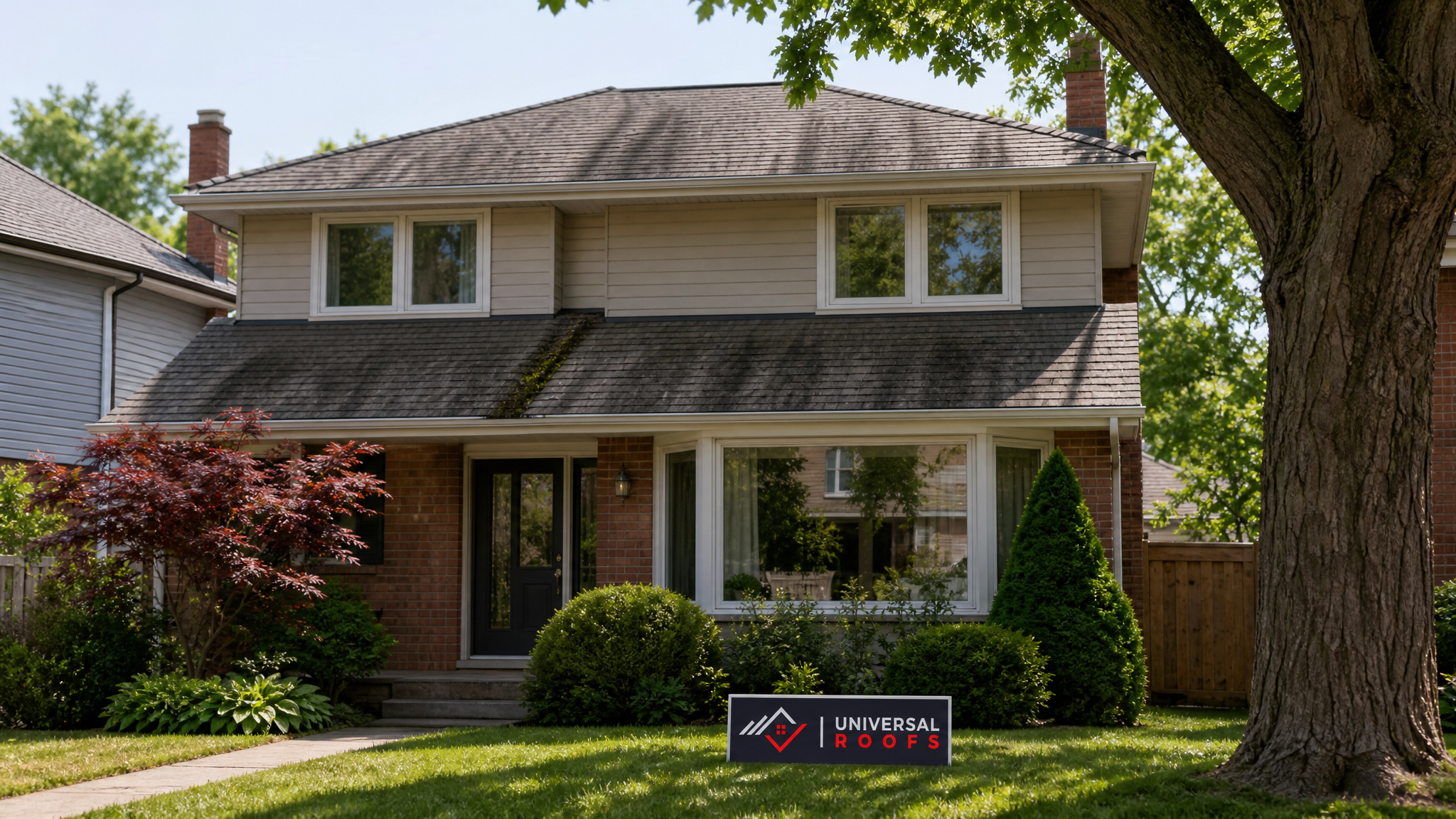
Soft washing is a low-pressure cleaning method, typically operating below 500 psi, that relies on a specially formulated cleaning solution rather than mechanical force to remove algae, moss, lichen and airborne grime. The solution, usually a diluted blend of sodium hypochlorite and a surfactant designed to help it cling to a sloped surface, is applied to the roof and left to dwell for a set period, breaking down organic growth at the root. A gentle rinse afterward removes the dissolved residue without disturbing the mineral granules that protect asphalt shingles from UV degradation. When homeowners ask us to explain the roof soft wash vs pressure wash cleaning difference in the simplest possible terms, we tell them soft washing cleans the way a stain remover works on fabric, chemically, patiently, and without scrubbing hard enough to damage the material underneath.
Soft washing is also the only method most manufacturers, including major shingle producers, recommend as safe for asphalt, wood shake, and many tile roofs. Because it does not rely on mechanical force, soft washing is far less likely to lift shingle tabs, drive water under flashing, or dislodge granules that are already loosely bonded on an older roof. It typically takes a bit longer to complete than pressure washing because of the required dwell time, but the payoff is a roof that looks clean without any of the physical wear that comes from blasting the surface.
What Is Pressure Washing and Why It Carries More Risk for Shingles
Pressure washing uses mechanical force, often in the 1,500 to 3,000 psi range for consumer-grade equipment and sometimes higher for commercial units, to physically blast dirt, algae and debris off a surface. It works extremely well on driveways, concrete patios and brick, all materials engineered to withstand that kind of abrasive force. Asphalt shingles were never designed for it. The granules that give a shingle its colour and its UV resistance are only lightly embedded in the asphalt coating, and a pressure washer’s concentrated stream can strip them away in a single pass, exposing the underlying asphalt to direct sun and accelerating shingle failure by years.
This is the core of the roof soft wash vs pressure wash cleaning debate: pressure washing can look effective immediately, because the algae disappears along with a layer of the shingle itself, but the long-term cost is a roof that ages faster, leaks sooner, and may no longer be covered under manufacturer warranty. Pressure washing can also force water up and under flashing, shingle laps and skylight curbs, since the stream is aimed directly at a surface that was engineered to shed water downward, not resist it under pressure from the side or below. On a flat roof with a membrane surface, pressure washing risks opening seams or puncturing an already-thin membrane, which is why our teams almost never recommend it for the flat roofing systems we install and service across the GTA.
There are limited situations where controlled, low-pressure rinsing (well below what most people mean by “pressure washing”) plays a supporting role, such as a final rinse after a soft wash treatment on a hard, non-porous surface like a metal roof panel. But as a primary cleaning method for asphalt shingles, tile or flat membrane, high-pressure washing is a shortcut that usually costs more in repairs than it ever saved in cleaning time.
Comparing Roof Soft Wash vs Pressure Wash Cleaning Side by Side
The table below summarizes the practical differences homeowners care about most when weighing roof soft wash vs pressure wash cleaning for their own property. We built this comparison from what our technicians see across hundreds of GTA roof inspections every year, not from manufacturer marketing material.
| Factor | Soft Washing | Pressure Washing |
|---|---|---|
| Typical operating pressure | Under 500 psi | 1,500–3,000+ psi |
| Primary cleaning agent | Chemical solution with dwell time | Mechanical water force |
| Risk to asphalt shingle granules | Very low | High |
| Manufacturer warranty compatibility | Generally accepted | Often voids warranty |
| Suitability for flat/membrane roofs | Recommended with roof-safe solution | Not recommended, seam and puncture risk |
| Time on site for an average roof | 2–4 hours including dwell time | 1–2 hours |
As the comparison shows, the roof soft wash vs pressure wash cleaning question almost always resolves in favour of soft washing once a homeowner understands what is actually happening to the shingle surface during each process. The extra hour or two that soft washing takes is a small price for protecting a roof that likely cost tens of thousands of dollars to install.
Which Cleaning Method Suits Your Toronto Roof Type?
Not every roof in the GTA is the same, and the right side of the roof soft wash vs pressure wash cleaning decision can shift depending on the roofing material and system you have. Asphalt shingle roofs, by far the most common type on Toronto homes, should almost always be soft washed. Flat and low-slope flat roofing systems, whether modified bitumen, TPO or EPDM, should also be soft washed with a membrane-safe solution rather than pressure washed, since seams and flashing details around vents, drains and any skylights are especially vulnerable to forced water intrusion.
Concrete and clay tile roofs sit in a bit of a grey zone. Some tile manufacturers permit low-pressure washing on the tile face itself, but our technicians still favour soft washing because tile roofs are old enough in most GTA neighbourhoods that mortar and fasteners can be more fragile than they appear, and pressure can dislodge tiles outright. Metal roofing is the one material where a careful, low-pressure rinse is sometimes appropriate for a final rinse step, but even then, a soft wash pre-treatment is what actually removes algae and staining; the rinse is just for removing residue.
| Roof Material | Recommended Method | Key Reason | Frequency Suggested |
|---|---|---|---|
| Asphalt shingles | Soft wash | Protects granule coating and warranty | Every 2–3 years |
| Flat/membrane roofing | Soft wash (membrane-safe solution) | Avoids seam and puncture risk | Every 1–2 years |
| Concrete/clay tile | Soft wash | Prevents dislodged tiles and mortar wear | Every 2–3 years |
| Metal roofing | Soft wash plus gentle low-pressure rinse | Removes staining without denting or scarring | Every 2–4 years |
| Wood shake | Soft wash only | Pressure can splinter and lift shakes | Every 1–2 years |
Homeowners with a mixed roofline, for example a primary asphalt shingle roof with a flat roof section over a garage or addition, need a contractor who evaluates each section separately rather than applying one method across the entire property. This is one of the most common oversights we correct during inspections booked through our Toronto service area.
Cost and Frequency: What Roof Soft Wash vs Pressure Wash Cleaning Looks Like in the GTA
Cost is usually the second question homeowners ask right after the roof soft wash vs pressure wash cleaning safety question. Pricing depends on roof size, pitch, accessibility and how much organic growth has accumulated, but the table below gives a realistic range based on typical GTA roof cleaning jobs.
| Roof Size | Soft Wash Cost Range (CAD) | Typical Turnaround | Recommended Reclean Interval |
|---|---|---|---|
| Under 1,500 sq ft | $350–$550 | Same day | 2–3 years |
| 1,500–2,500 sq ft | $500–$800 | Same day | 2–3 years |
| 2,500–4,000 sq ft | $750–$1,200 | 1 day | 2 years |
| Over 4,000 sq ft / steep or complex roofline | $1,100–$1,800+ | 1–2 days | 1–2 years |
Because soft washing takes slightly more labour time than pressure washing due to the required dwell period, some homeowners are surprised the quote is not lower for the “gentler” option. But when you weigh the roof soft wash vs pressure wash cleaning cost against the price of a premature shingle replacement, often $10,000 or more for an average Toronto home, the modest cleaning fee is one of the best-value maintenance investments a homeowner can make.
Signs Your Roof Needs Cleaning This Summer
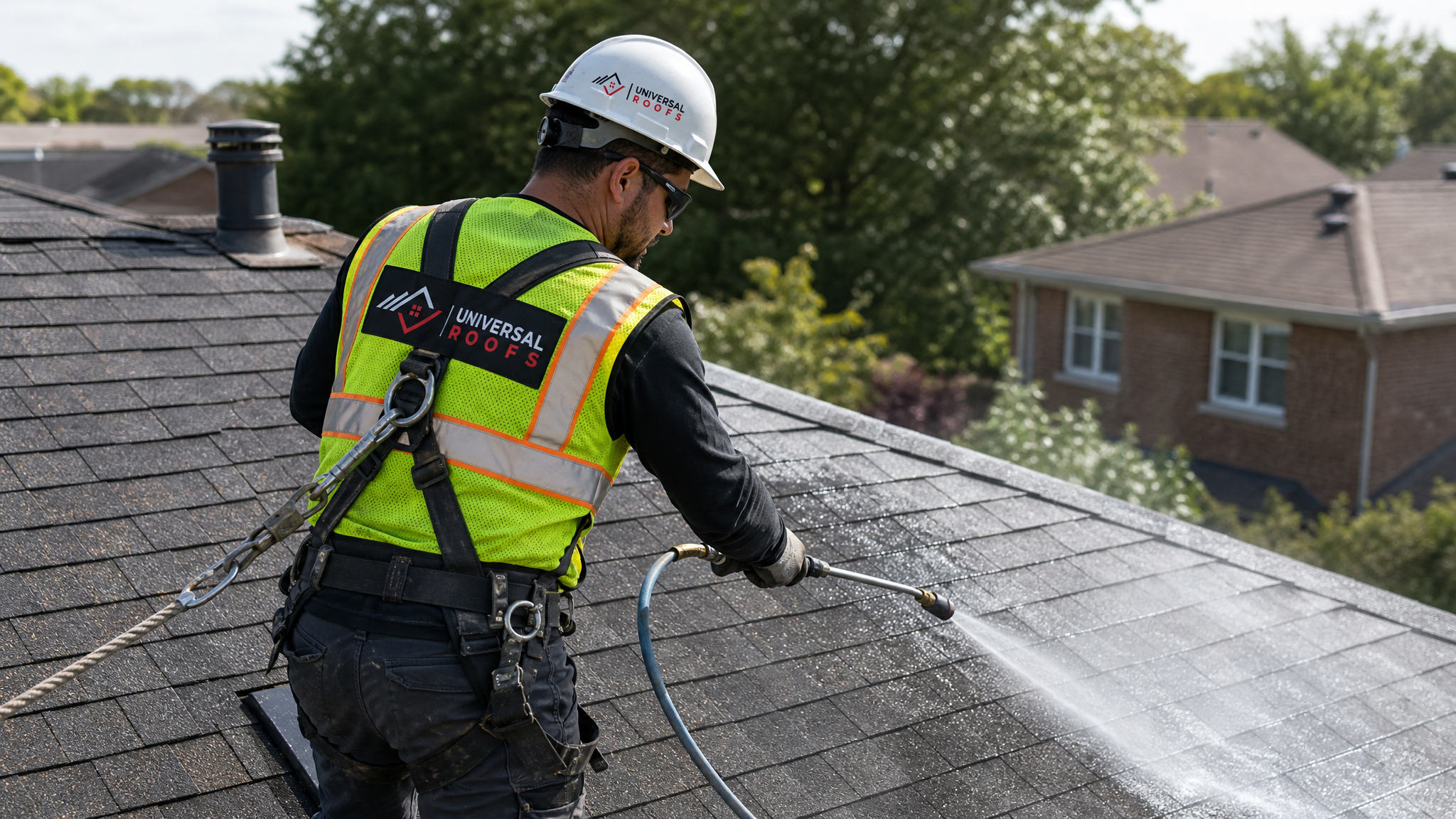
Most Toronto homeowners do not think about roof soft wash vs pressure wash cleaning until they notice visible black or greenish streaking running down from the ridge toward the eaves. That staining is typically algae, and while it looks alarming, it is largely a cosmetic issue in its early stages, though left untreated for years it can trap moisture against the shingle surface and shorten its life. Moss is a more serious warning sign because its root structure lifts shingle edges as it grows, allowing water to work its way underneath during heavy summer rain. If you notice moss clumps in shaded valleys or on the north-facing slope of your roof, that section should be prioritized before it spreads.
Granule loss showing up in your eavestroughs, especially after a storm, is a sign that your roof may already be aging past the point where any cleaning method will restore it, and a soft wash treatment at that stage is more about slowing further decline than reversing existing damage. A pre-listing clean before selling a home, a pre-inspection clean before a warranty claim, or simply an annual refresh before hosting a summer backyard gathering are all excellent reasons to book a cleaning, provided it is done with the correct method for your specific roof type.
We also recommend a full roof inspection alongside any cleaning, since a technician on your roof is well positioned to catch early flashing separation, damaged vents, or the kind of hairline cracking that eventually needs roof repair. Catching these issues during a routine soft wash appointment, rather than waiting for a leak, is one of the most cost-effective habits a homeowner can build into their annual maintenance routine.
Common Mistakes Homeowners Make in the Roof Soft Wash vs Pressure Wash Cleaning Decision
The single most common mistake is hiring a general power-washing company that primarily services driveways and siding and treats a roof the same way. These companies are not always familiar with the roof soft wash vs pressure wash cleaning distinction and may default to whatever equipment they already own, which is almost always a pressure washer. Always ask directly what psi range and chemical solution a company plans to use on your roof before booking, and be wary of any quote that seems unusually fast or unusually cheap relative to the ranges above, since that speed often comes from skipping the dwell time that makes soft washing effective and safe.
Another frequent mistake is DIY cleaning attempted with a rented pressure washer, which combines the highest-risk method with the least experienced operator, a combination that accounts for a large share of the shingle damage our inspectors see each summer. Climbing onto a wet, sloped roof without proper fall protection is also a serious safety risk that should be left to insured, trained professionals. Finally, homeowners sometimes assume that once their roof is cleaned, it is permanently protected, when in reality Toronto’s climate means algae and moss growth will return over time, which is why the reclean intervals in the tables above exist as genuine guidelines rather than upsells.
Frequently Asked Questions About Roof Soft Wash vs Pressure Wash Cleaning
What is the main difference in roof soft wash vs pressure wash cleaning?
Will pressure washing void my shingle warranty?
How often should a Toronto roof be soft washed?
Is soft washing safe for flat roofs and skylights?
How much does roof soft wash vs pressure wash cleaning cost in the GTA?
Can I pressure wash my own roof to save money?
Book Your Roof Soft Wash vs Pressure Wash Cleaning Consultation Today
Deciding between roof soft wash vs pressure wash cleaning does not need to be a guessing game. Universal Roofs has cleaned and maintained roofs across the GTA for nearly two decades, and our technicians know exactly which method protects your specific shingle, tile, metal or flat roofing system while removing summer algae, moss and staining for good. We also carry out full roof inspections during every cleaning visit, checking flashing, skylights and attic ventilation so small issues never turn into costly roof repair jobs down the road. You can read what past GTA homeowners have said about our crews on our reviews page, and browse common questions on our FAQ page before you call.
Call us today at (416) 732-2421 or request a free inspection to get started.
Universal Roofs proudly serves Toronto, Mississauga, Brampton, Vaughan, Markham, Oakville and the GTA since 2005.