
If you have noticed dark streaks or black smudges creeping across your roof, you are not alone. Homeowners across Toronto, Mississauga, and the wider GTA ask the same question every summer when the sun hits their shingles just right: why do algae stains on shingles occur, and is it something to actually worry about? The short answer is that a hardy, airborne organism called Gloeocapsa magna has found a comfortable home on your roofing granules, and Ontario’s humid summers and freeze-thaw winters give it everything it needs to spread.
The good news is that algae staining is largely cosmetic in its early stages, but left unchecked for years it can shorten shingle lifespan, trap moisture against the roof deck, and make a home look neglected right when you are trying to sell it or simply keep it looking sharp. In this guide we will walk through exactly what causes those stains, why some roofs get them and others do not, how to tell algae apart from moss and lichen, safe cleaning methods, prevention options, and when it is time to bring in a professional rather than reach for a garden hose and a bottle of bleach.
This article draws on what our crews at Universal Roofs see on a weekly basis while inspecting and maintaining roofs across the Toronto area, so the advice here reflects real GTA conditions rather than generic national content.
What Actually Causes Algae Stains on Shingles
The dark streaks that appear on asphalt shingles are almost always caused by a blue-green algae species called Gloeocapsa magna. Despite the name, this organism does not look green on a roof. Instead, it produces a dark, UV-protective pigment as it matures, which is why the stains appear black, brown, or charcoal grey rather than the bright green you might picture when you hear the word “algae.”
The algae feeds on the limestone filler used in the manufacturing of asphalt shingles, and it spreads primarily through airborne spores carried by wind, birds, and even squirrels moving between roofs in a neighbourhood. Once a spore lands on a shingle surface that stays damp for extended periods, it begins to colonize the granules. Over months and years, colonies expand and multiply, creating the streaked or blotchy dark patches most homeowners recognize.
Several environmental and structural factors combine to determine why algae stains on shingles occur on one house and not on the one next door:
- Moisture retention — North-facing roof slopes, shaded sections under mature trees, and areas that dry slowly after rain are prime real estate for algae growth.
- Humidity and rainfall patterns — Toronto’s humid summers, combined with frequent spring and autumn precipitation, keep shingle surfaces damp longer than in drier climates.
- Poor attic ventilation — A hot, poorly ventilated attic raises shingle surface temperature and moisture cycling, which can accelerate granule degradation and make shingles more hospitable to algae colonies.
- Tree cover and organic debris — Overhanging branches drop leaves, pollen, and organic matter that both shade the roof and provide extra nutrients for algae and moss.
- Shingle composition — Older shingles and certain economy-grade products lack algae-resistant granules, making them far more susceptible than newer algae-resistant shingle lines.
Understanding these root causes matters because it changes how you approach both the cleaning and the long-term prevention strategy. A homeowner who simply power-washes the stains away without addressing shade, ventilation, or drainage will likely see the streaks return within a year or two.
Why Toronto and GTA Homes Are Especially Prone to Algae Growth
Southern Ontario’s climate is almost tailor-made for algae proliferation on roofing. Summers in Toronto bring long stretches of high humidity, and lake-effect moisture off Lake Ontario keeps overnight dew heavier than in drier inland regions. That dew sits on shingles well into the morning, especially on north- and east-facing slopes that get less direct sun exposure.
Winters bring their own contribution. Freeze-thaw cycles are common through a typical GTA winter, and each cycle can create tiny fractures in shingle granules, giving algae spores more surface area and micro-crevices to anchor into. By the time spring arrives, a roof that endured several freeze-thaw cycles is more vulnerable than it was the previous autumn.
Neighbourhood density is another factor unique to urban and suburban GTA settings. Because algae spreads by airborne spore transfer, tightly packed subdivisions in areas like Mississauga, Brampton, Vaughan, Markham, and Oakville often see clusters of affected homes on the same street, particularly where older shingles were installed around the same time by the same builder.
We regularly inspect roofs across the Toronto, Peel Region, York Region, Halton Region, and Durham Region areas, and the pattern is consistent: homes with heavy tree canopy, north-facing exposures, and roofs older than 12 to 15 years show the most pronounced staining.
| Factor | Why It Increases Algae Risk | Common in Which GTA Areas | Homeowner Action |
|---|---|---|---|
| High summer humidity | Keeps shingle surface damp longer after rain or dew | Lakeside neighbourhoods, low-lying areas | Improve attic ventilation, trim overhangs |
| Heavy tree canopy | Shades roof, drops organic debris that feeds algae | Established neighbourhoods in Toronto, Oakville, Markham | Prune branches back from roofline annually |
| North-facing slopes | Receives less direct sun, dries slowly | Any home regardless of city | Consider algae-resistant shingles on replacement |
| Freeze-thaw winters | Cracks granules, creating anchor points for spores | All GTA regions | Schedule spring roof inspection annually |
| Older, non-resistant shingles | Lack copper or zinc granules that inhibit algae | Homes with roofs 12+ years old | Ask about algae-resistant products at replacement time |
Algae, Moss, and Lichen: How to Tell Them Apart
Not every dark or discoloured patch on a roof is algae. Homeowners frequently confuse three very different organisms, and the treatment for each is not identical. Getting the diagnosis right the first time saves money and prevents damage from using the wrong cleaning approach.
Algae typically appears as dark streaks or diffuse blotches that follow the pattern of water runoff, often starting near the ridge or a roof valley and streaking downward. It is flat against the shingle surface and does not have texture you can feel with your hand.
Moss is a raised, green, carpet-like growth that you can usually see and feel as a distinct texture standing up off the shingle. Moss holds moisture directly against the shingle and roof deck, and it is more physically damaging than algae because it can lift shingle edges and hold water long-term.
Lichen is a combination organism (algae plus fungus) that appears as crusty, greenish-grey or white patches that are firmly bonded to the granule surface. Lichen is the hardest of the three to remove and the most likely to damage granules during removal, since it actually grows into the surface rather than sitting on top of it.
| Growth Type | Appearance | Texture | Typical Removal Difficulty |
|---|---|---|---|
| Algae (Gloeocapsa magna) | Dark streaks or blotches following water flow | Flat, smooth | Low to moderate |
| Moss | Green, carpet-like clumps | Raised, spongy | Moderate |
| Lichen | Crusty grey-green or white patches | Bonded, crusty | High — risk of granule loss |
| Dirt or pollution staining | Uniform grey-brown film | Flat, dusty | Low |
Does Algae Staining Actually Damage Your Roof?
This is the question we hear most often, and the honest answer is nuanced. In the early stages, algae staining is primarily an aesthetic issue. It does not eat through the asphalt mat, and it will not cause an active leak on its own. However, over several years, unchecked algae colonies can contribute to accelerated wear in a few specific ways.
First, dark algae colonies absorb more solar heat than clean shingle granules, which can raise shingle surface temperature on a hot July or August afternoon. Elevated surface temperature over years contributes to premature granule loss and brittleness, particularly on shingles that are already approaching the end of their service life.
Second, algae growth is often accompanied by moisture retention, since the very conditions that let algae take hold (shade, poor drainage, limited airflow) also keep the shingle surface damp. Prolonged dampness is the same condition that invites moss, and moss is genuinely damaging because it can lift shingle tabs and let water track underneath.
Third, and most relevant for resale, algae staining is one of the top reasons a roof “looks old” well before its warranty has expired. Buyers, inspectors, and appraisers often flag streaked shingles as a sign of deferred maintenance, even when the underlying roof deck and structure are perfectly sound. If your shingles are otherwise healthy but stained, a professional cleaning is far more cost-effective than a premature roof replacement.
That said, if algae staining is showing up alongside curling shingle edges, granule loss visible in your gutters, soft spots on the roof deck, or interior ceiling stains, those are signs of a roof nearing the end of its life rather than a simple cleaning issue, and a full roof repair assessment is the right next step.
Safe Cleaning Methods for Algae-Stained Shingles
Once you understand why algae stains on shingles occur, the next logical question is how to remove them without damaging the roofing material. Not all cleaning methods are created equal, and some popular DIY approaches actually shorten shingle lifespan.
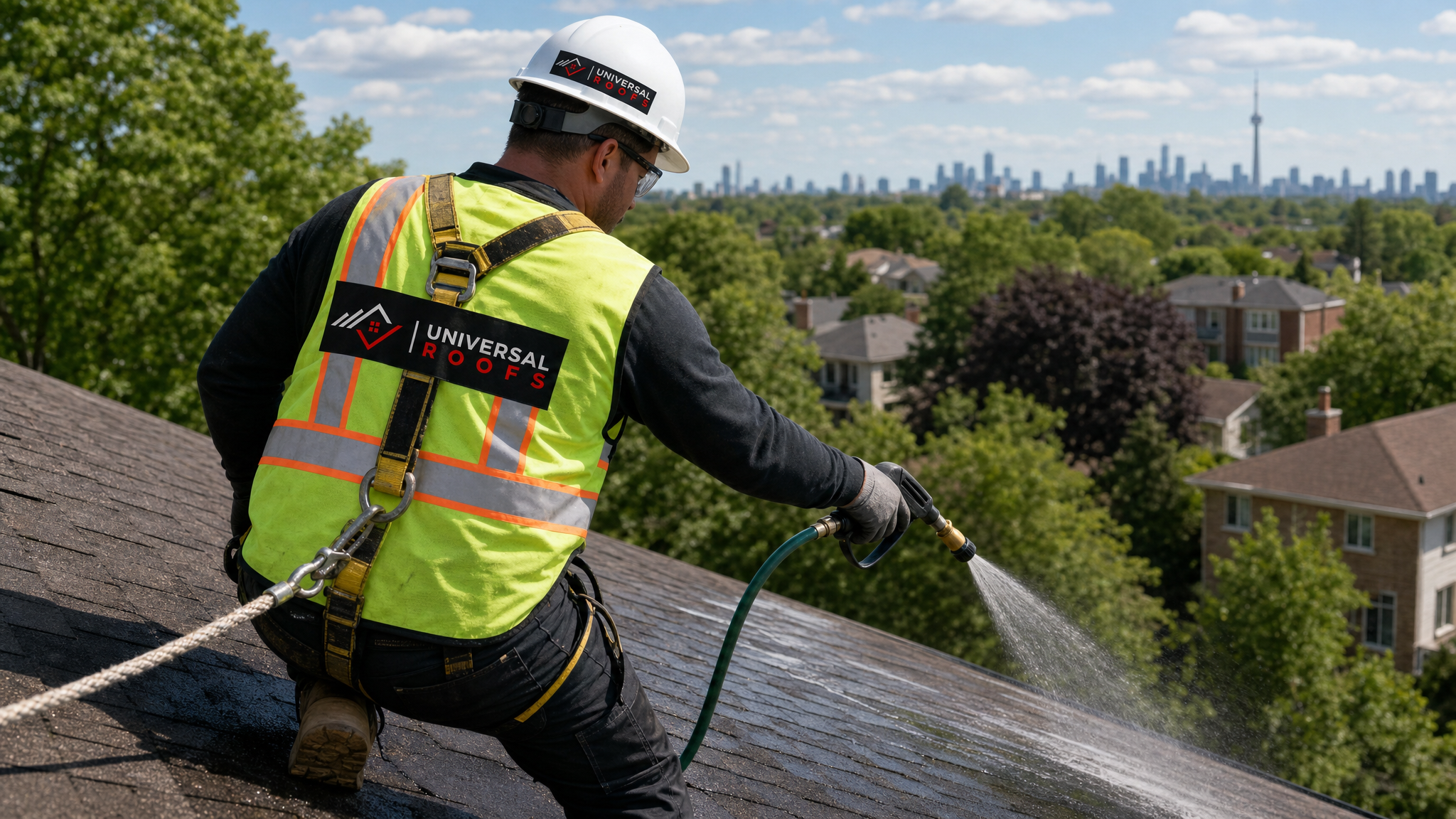
Never use a high-pressure power washer directly on asphalt shingles. This is the single most damaging mistake homeowners make. Pressure washing strips protective granules right off the shingle surface, exposing the asphalt mat to UV degradation and dramatically shortening the roof’s remaining service life. Once granules are gone, they do not grow back.
The safest and most widely recommended method is a low-pressure soft wash using a solution of roughly 50 percent water and 50 percent household bleach (sodium hypochlorite), or a purpose-made roof cleaning solution, applied with a garden sprayer and rinsed gently from a low-pressure hose. This approach kills the algae at the surface without disturbing the granules.
Chlorine-based cleaners are effective against algae specifically, but they can also damage landscaping, discolour eavestrough and siding, and pose a slip hazard on a sloped roof. If you are not fully comfortable working at height with chemical solutions, this is a job best left to a professional crew with the right harness systems and roof-safe application techniques.
| Cleaning Method | Effectiveness on Algae | Risk to Shingles | Recommended For |
|---|---|---|---|
| High-pressure power washing | High (removes stains fast) | Severe — strips granules | Not recommended, ever |
| Low-pressure soft wash (bleach solution) | High | Low, if rinsed properly | DIY-capable homeowners or professionals |
| Oxygen bleach / non-chlorine cleaner | Moderate | Very low | Homeowners with pets, gardens, or sensitive landscaping nearby |
| Copper or zinc sulfate treatment | Moderate, preventative | Low | Ongoing prevention between deep cleans |
| Manual scrubbing with a brush | Low to moderate | Moderate — can dislodge granules | Small, isolated spots only |
Timing matters too. Late spring through early autumn is generally the best window for cleaning in the GTA, since shingles are dry, temperatures are warm enough for cleaning solutions to work effectively, and there is enough remaining daylight and dry weather to let the roof fully dry afterward. Cleaning in the depths of winter is both unsafe and largely ineffective, since cold temperatures slow the chemical reaction and ice makes rooftop work dangerous.
Preventing Algae Stains From Coming Back
Cleaning removes existing algae, but prevention is what keeps stains from returning year after year. A combination of physical, structural, and material changes gives the best long-term results.
Improve airflow and reduce shade. Trimming back overhanging branches lets more sunlight and airflow reach the roof surface, speeding up drying time after rain. Even a modest pruning of branches within a few metres of the roofline can noticeably reduce shaded, damp zones where algae thrives.
Check attic ventilation. A balanced intake-and-exhaust ventilation system keeps the underside of the roof deck at a more consistent temperature, which reduces the condensation cycling that contributes to surface moisture. If you are unsure whether your attic ventilation is adequate, a professional inspection can identify whether soffit vents are blocked by insulation or whether additional ridge or roof venting would help.
Install copper or zinc strips. One of the most cost-effective long-term prevention methods is installing a narrow strip of copper or zinc flashing just below the ridge on each slope. As rain washes over the metal, it carries trace metal ions down the roof surface, which naturally inhibit algae growth for years at a very low cost compared to repeated cleanings.
Choose algae-resistant shingles at replacement time. Most major shingle manufacturers now offer algae-resistant (AR) shingle lines that embed copper or zinc granules directly into the shingle during manufacturing. If your current roof is approaching the end of its lifespan and already shows heavy staining, upgrading to AR shingles during a roof replacement largely eliminates the recurring problem.
Keep gutters and valleys clear. Debris buildup in gutters and roof valleys holds moisture against the shingle edge and creates an ideal microclimate for both algae and moss. A simple seasonal gutter cleaning, especially after autumn leaf drop, goes a long way toward keeping those zones dry.
Cost Considerations: Cleaning vs. Prevention vs. Replacement
Homeowners often want a straightforward comparison of what each option costs relative to the others, since the right choice depends heavily on the age and condition of the existing roof.
| Option | Typical Lifespan of Result | Relative Cost | Best For |
|---|---|---|---|
| Professional soft-wash cleaning | 2–4 years before recurrence | Low | Roofs under 10 years old with cosmetic staining only |
| Copper/zinc strip installation | 10–15+ years of ongoing prevention | Low to moderate, one-time | Any roof, ideally installed alongside a cleaning or new install |
| DIY cleaning kits and sprays | 1–2 years, variable results | Very low | Small, isolated staining, low-slope accessible roofs only |
| Algae-resistant shingle replacement | Full new roof lifespan (25–30+ years) | High, but bundled with needed replacement | Roofs already near end of life with heavy, recurring staining |
As a general rule, if your roof is less than halfway through its expected lifespan and structurally sound, a professional cleaning paired with copper or zinc strip installation is the most economical path. If the roof is already old, has granule loss, or shows other wear alongside the algae, it usually makes more financial sense to fold algae resistance into a full roof replacement rather than spending repeatedly on short-term cleanings.
Special Considerations for Skylights, Flat Roofs, and Complex Rooflines
Algae staining is not limited to standard sloped asphalt shingle roofs. Homes with skylights, dormers, and multiple roof valleys often see algae concentrate around these features because they create additional shade and slow water drainage. When cleaning around a skylight, extra care is needed to avoid directing cleaning solution or high-pressure water at the flashing seals, since a damaged seal can cause a leak that has nothing to do with the algae itself. If your skylight flashing is older or already showing wear, it is worth having it assessed during the same visit, and in some cases a skylight replacement resolves both the leak risk and the staining around that feature at once.
Flat roofing systems are less prone to the classic streaked algae staining seen on sloped shingles, since their membrane materials are different, but they can develop their own organic growth in areas of ponding water. If you notice green or black discolouration on a flat roof, that is more often a drainage issue than a shingle-algae issue, and it should be assessed separately since the causes and remedies differ substantially from sloped shingle roofs.
When to Call a Professional Roofing Contractor
Many homeowners can safely manage small, early-stage algae staining themselves with a gentle, low-pressure approach. However, there are clear signs that it is time to bring in a professional rather than continue with DIY treatments:
- The stained area covers most of the roof, or has spread significantly since last season
- You notice curling, cracked, or missing shingles alongside the staining
- There is visible granule buildup in your gutters or at downspout outlets
- The roof is steep, high, or otherwise unsafe to access without fall-protection equipment
- You are unsure whether the discolouration is algae, moss, lichen, or something else entirely
- Previous DIY cleaning attempts have not slowed the return of the stains
A professional inspection also gives you an honest, unbiased read on whether your roof simply needs a clean or is closer to needing a full replacement. You can see examples of the kind of work and homeowner feedback we get on our reviews page, and our FAQ page covers many of the other common roofing questions we field from GTA homeowners.
Frequently Asked Questions About Algae Stains on Shingles
Why do algae stains on shingles occur in the first place?
Are algae stains on shingles harmful to my roof?
Can I remove algae stains with a pressure washer?
How can I stop algae stains from coming back after cleaning?
Is algae staining different from moss or lichen on a roof?
Should I replace my roof if it has heavy algae staining?
Need Help With Why Do Algae Stains?
Understanding why do algae stains on shingles occur is only half the equation — knowing how to safely clean, prevent, and, when necessary, replace affected roofing is what actually protects your home’s value. The team at Universal Roofs has been inspecting, cleaning, and replacing roofs across the GTA since 2005, and we can tell you honestly whether your roof needs a simple wash or a longer-term fix.
Call us today at (416) 732-2421 or request a free inspection to get started.
Universal Roofs proudly serves Toronto, Mississauga, Brampton, Vaughan, Markham, Oakville and the GTA since 2005.