
A hailstorm rolling through the Greater Toronto Area can leave a roof looking untouched from the ground while hiding real damage above. When homeowners start searching for the best options for roof hail damage repair near me, they are usually facing one of two situations: a recent storm has just passed through Mississauga, Brampton, Vaughan, or Markham, or a home inspection or insurance adjuster has flagged suspected hail impact on an older roof. Either way, knowing what your repair options actually are, how much they cost, and how quickly you need to act can save thousands of dollars and prevent a small problem from becoming a leaking ceiling.
Hail damage is deceptive because it rarely punches a hole through a roof the way a falling branch does. Instead, it bruises asphalt shingles, cracks the mat beneath the granules, dents metal flashing, and chips away at the protective coating that keeps water out. That damage might not leak on day one. It leaks eighteen months later, after freeze-thaw cycles and UV exposure finish what the hailstones started. This guide walks through every realistic repair option available to GTA homeowners, what each one costs, how long it takes, and how to tell which approach is right for your specific roof.
We will also cover how insurance typically handles hail claims in Ontario, the difference between spot repairs and full replacement, and the questions you should ask any contractor before signing a work order. This is the kind of decision that benefits from a second opinion, so we have tried to make this as close to that second opinion as possible.
How to Tell If Your Roof Actually Has Hail Damage
Before you can choose a repair option, you need an accurate diagnosis. Hail damage on asphalt shingles typically shows up as random, irregularly shaped dark spots where granules have been knocked loose, exposing the black asphalt mat underneath. Unlike wear-related granule loss, which tends to follow a pattern along the shingle edges or in high-traffic areas, hail impacts are scattered and random in size, matching the size of the hailstones that fell.
On metal components such as flashing, vents, and gutters, hail damage looks like small, shiny dents, often clustered on the side of the roof that faced the storm. Soft metals like aluminum flashing and vent caps dent more easily than the shingles themselves, which is why a roofer will often check these components first as a quick diagnostic shortcut. If the vents and flashing are dented but the shingles look fine, further inspection is still warranted, since shingle bruising is harder to see from the ground.
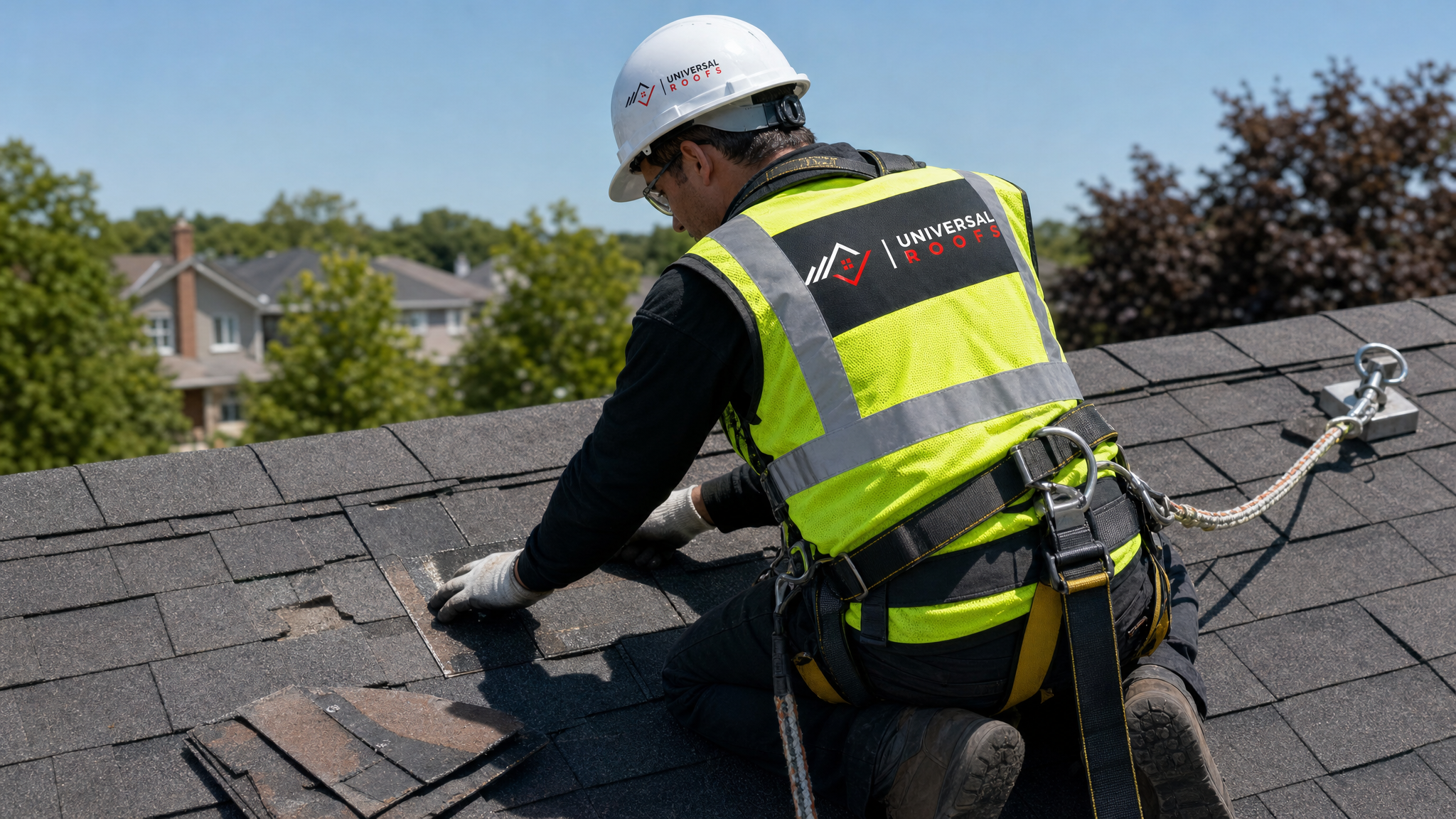
A proper inspection involves walking the roof deck, checking multiple test squares on each roof slope, and documenting damage with photos and chalk markings, which is the same method insurance adjusters use. If you are not comfortable getting on a ladder, a professional roof repair assessment is the safer route, particularly on steep-slope roofs or anything above a single storey.
| Damage Indicator | Hail-Related Cause | Wear-Related Cause | Urgency |
|---|---|---|---|
| Random dark bruising on shingles | Direct hailstone impact fracturing the mat | Not typical of normal aging | Moderate to high |
| Dented metal flashing or vent caps | Hail striking soft metal components | Rare from normal weathering | Moderate |
| Granule accumulation in gutters | Impact knocking granules loose | Gradual shingle aging | Low to moderate |
| Cracked or split shingles | Large hail (25mm+) on brittle shingles | Thermal cycling over many years | High |
| Soft spots underfoot on roof deck | Long-term leak from unresolved hail cracks | General moisture intrusion | Urgent |
Option One: Spot Repairs for Isolated Hail Damage
When hail damage is limited to a small area, such as one slope of the roof or a cluster of a dozen shingles, spot repair is often the most cost-effective option. This involves removing and replacing individual damaged shingles, resealing flashing, and patching any exposed underlayment. Spot repairs typically make sense when the roof is under ten years old, the shingles are otherwise in good condition, and the storm produced small to moderate hail.
The advantage of spot repair is cost and speed. A qualified crew can usually complete targeted repairs in a single day, and the cost is a fraction of a full replacement. The downside is a colour and texture mismatch, since even shingles from the same product line can weather differently after a few years of sun exposure. Most homeowners find this an acceptable trade-off, especially on roof slopes that are not highly visible from the street.
It is worth noting that spot repairs are not always eligible for insurance coverage if an adjuster determines the storm caused widespread damage across the whole roof, since insurers generally prefer to settle on a full slope or full roof basis rather than approve a patchwork of small fixes. This is one of several reasons to get a professional opinion before deciding how to proceed.
Option Two: Full Slope or Full Roof Replacement
When hail damage is spread across most or all of a roof slope, or when the shingles were already near the end of their service life, full replacement is usually the more practical and often the more economical long-term option. Replacing an entire slope, or the entire roof, eliminates the patchwork problem, ensures consistent material warranty coverage, and gives you the opportunity to upgrade to a more impact-resistant shingle class.
In the GTA, most asphalt shingle roofs last between 20 and 25 years for standard three-tab products, and up to 30 years for laminated architectural shingles. If your roof was already past the 15-year mark when the hailstorm hit, replacement usually makes more financial sense than repeated spot repairs, since the remaining shingles will likely need replacing within a few years regardless. A full roof replacement also resets your warranty clock, which matters if you plan to stay in the home long term or are preparing it for resale.
For homes with flat or low-slope sections, such as additions, garages, or rear extensions common in older Toronto neighbourhoods, hail can also affect membrane roofing. In these cases, the repair approach is different from shingle repair, and a specialist in flat roofing systems should assess whether the membrane needs patching or full replacement.
| Repair Approach | Best For | Typical Cost Range (CAD) | Timeline |
|---|---|---|---|
| Spot shingle repair | Isolated damage, roof under 10 years old | $350 – $1,200 | 1 day |
| Single slope replacement | Concentrated damage on one exposure | $2,500 – $6,000 | 1 – 2 days |
| Full roof replacement (asphalt) | Widespread damage or aging roof | $8,500 – $18,000+ | 2 – 4 days |
| Flat roof membrane patch | Localized puncture or bruising on low-slope sections | $400 – $1,800 | 1 day |
| Flashing and vent replacement only | Dented metal components, shingles unaffected | $250 – $900 | Half day |
Impact-Resistant Shingles: Worth the Upgrade?
If your roof was damaged by hail once, it can happen again. Southern Ontario sees several hail events every summer, and while most produce small hail under 15mm, the region has had storms with golf-ball-sized hail capable of cracking even quality shingles. This has pushed many homeowners to ask about impact-resistant shingles when repairing or replacing their roof.
Impact-resistant shingles are rated using the UL 2218 Class 4 standard, which involves dropping a steel ball onto the shingle and checking for cracking on the underside. Class 4 shingles use a reinforced fibreglass mat and a more flexible asphalt formulation that absorbs impact energy rather than fracturing. They cost more upfront, typically 10 to 20 percent above standard architectural shingles, but many insurers in Ontario offer a premium discount for Class 4 roofing, which can offset the extra cost over several years.
For homeowners who have already filed one hail claim, upgrading to impact-resistant shingles during replacement is one of the more sensible long-term decisions, particularly for west and northwest-facing slopes that tend to catch the brunt of storms moving through the region from that direction.
Working With Your Home Insurance Provider
Most Ontario home insurance policies cover hail damage to roofing under the standard peril coverage, but the process of getting a claim approved and paid out has its own set of steps. After a storm, homeowners typically have a window of time, often one year, to file a claim, though documenting damage promptly gives you the strongest case. Insurers will send an adjuster to inspect the roof, and it is common practice for the adjuster to work alongside a roofing contractor’s assessment rather than relying solely on their own inspection.
Having your own contractor’s report, with photos, test-square documentation, and a written estimate, gives you leverage if the adjuster’s initial assessment undervalues the damage. It is not unusual for an insurer’s first offer to cover only cosmetic repair when the underlying damage justifies full replacement. A second opinion from an independent roofing company, separate from any contractor the insurer recommends, protects your interests in that negotiation.
Keep in mind that most policies have a deductible, and if your estimated repair cost is close to or below that deductible, filing a claim may not be worthwhile since it could affect future premiums. This is another reason to get an accurate cost estimate before deciding whether to go through insurance or pay out of pocket for a smaller repair.
| Step | What Happens | Typical Timing | Your Role |
|---|---|---|---|
| 1. Document damage | Photograph shingles, flashing, gutters, and any interior water stains | Within 48 hours of storm | Take photos, note storm date |
| 2. Get a contractor assessment | Independent roofer inspects and documents test squares | Within 1 week | Schedule inspection |
| 3. File the claim | Submit claim with photos and contractor report to insurer | As soon as possible | Contact your insurance provider |
| 4. Adjuster inspection | Insurance adjuster visits to verify damage and scope | 1 – 3 weeks after filing | Be present if possible |
| 5. Approval and repair | Insurer approves scope, contractor schedules the work | 2 – 6 weeks total | Choose your contractor |
DIY Hail Damage Checks vs. Calling a Professional
It is reasonable for homeowners to want to check their own roof after a storm before calling anyone, and there is a limited amount you can safely assess from the ground or from a stable second-storey window. Using binoculars, look for shiny dents on any visible metal flashing, vent caps, or gutters, and check for granules collecting at downspout outlets after rain. These are useful early indicators.
What you should not do is climb onto a steep-slope roof to inspect shingle bruising yourself. Hail-bruised shingles are more fragile than they look, and foot traffic on a damaged roof can turn a repairable bruise into a crack, effectively causing more damage while trying to assess the existing damage. This is especially true in summer heat, when asphalt shingles soften and are more prone to scuffing or granule displacement underfoot.
A professional inspection also carries more weight with insurers, since a documented assessment from a licensed roofing contractor is treated as credible evidence in a claim, whereas a homeowner’s own photos from the ground are often considered inconclusive on their own. If you are unsure whether your situation calls for a repair or a full inspection, reviewing common questions on our FAQ page is a good starting point before booking a site visit.
What to Look For in a Hail Damage Repair Contractor
Storm season tends to bring out temporary “storm chaser” roofing operations that go door to door in affected neighbourhoods immediately after a hailstorm. These crews are not always local, may not carry proper insurance, and often disappear before warranty issues surface. Choosing an established, local contractor with a verifiable track record protects you from this risk.
Before hiring anyone, ask for proof of Workplace Safety and Insurance Board coverage, liability insurance, and manufacturer certifications for the shingle brands they install. Ask how they document hail damage for insurance purposes, and request to see photos from a recent, comparable job. A reputable local roofer will also be transparent about when a repair is sufficient and will not push for a full replacement if a smaller repair genuinely solves the problem.
Checking a contractor’s customer reviews and asking about their experience working directly with insurance adjusters can also tell you a great deal about how smoothly your claim and repair process will go. A company that has been serving the same region for close to two decades will have handled dozens of hail claims and knows exactly what documentation adjusters expect to see.
Related Roof Components Hail Can Affect
Hail damage assessments should not stop at the shingles. Skylights, particularly older acrylic dome units, are vulnerable to cracking from hail impact, and even glass skylight units can develop stress fractures that are not immediately visible. If your home has a skylight and you experienced a significant hailstorm, it is worth having it checked alongside the roof, since a compromised skylight seal can lead to leaks just as easily as damaged shingles. Our skylight replacement and skylight service pages outline what that inspection and repair process involves.
Attic ventilation components, including roof-mounted vents, are also commonly dented by hail. A dented vent may still function, but a cracked one will not, and undetected leaks around a damaged vent can lead to attic moisture problems that are far more expensive to fix than the vent itself. If you notice any musty smell or visible moisture in your attic after a storm, it is worth having your attic checked in addition to the roof surface.
Regional Considerations Across the GTA
Hail patterns are not perfectly uniform across the Greater Toronto Area. Storm cells often track from the southwest, meaning communities in Peel Region, including Mississauga and Brampton, sometimes see hail activity before it reaches the core of Toronto. Storms tracking further north can bring hail through York Region communities like Vaughan, Markham, and Richmond Hill, while Halton Region municipalities such as Oakville and Burlington sometimes catch the edge of lake-effect storm patterns off Lake Ontario. Homes further east in Durham Region can also see significant hail from storms that intensify as they move across the GTA.
This regional variability is one reason a roofing company with GTA-wide experience is valuable. A contractor who has repaired hail damage across multiple municipalities has a broader sense of how different storm tracks tend to behave and which roof exposures in each area are most commonly affected, which helps in both diagnosing damage and setting realistic expectations for insurance claims.
Frequently Asked Questions
What are the best options for roof hail damage repair near me if the damage is only cosmetic?
How much does roof hail damage repair typically cost in the GTA?
Will my home insurance cover roof hail damage repair?
How do I know if I need a full replacement instead of a repair?
Are impact-resistant shingles a good option after hail damage?
Can I inspect my own roof for hail damage instead of hiring someone?
Need Help With What Are the Best?
Choosing between a spot repair, a full slope replacement, or a complete roof overhaul depends on details that are hard to judge from the ground, which is why a proper inspection matters so much after any hailstorm. Universal Roofs has been assessing and repairing storm damage across the GTA since 2005, and we can walk you through every option available for your specific roof.
Call us today at (416) 732-2421 or request a free inspection to get started.
Universal Roofs proudly serves Toronto, Mississauga, Brampton, Vaughan, Markham, Oakville and the GTA since 2005.