
A metal roof is one of the best investments a Toronto-area homeowner can make. It can last 40 to 70 years, shrug off wind and hail, and shed our heavy spring snowmelt with almost no maintenance. But “almost no maintenance” is not the same as “no maintenance,” and when a metal roof does develop a problem — a leaking seam, a loose fastener, a dented panel from a summer hailstorm — the repair has to be done correctly the first time. Metal roofing does not forgive sloppy work the way asphalt shingles sometimes do.
This is where the advantages of hiring metal roof repair professionals become obvious. A metal roof system is an interconnected assembly of panels, seams, fasteners, flashing, and underlayment that all have to work together to stay watertight. Get one detail wrong — the wrong sealant, an over-driven screw, mismatched metal that causes galvanic corrosion — and a small problem becomes a large, expensive one within a season or two. Toronto’s freeze-thaw cycles, humid summers, and heavy autumn rain make correct repair technique even more important here than in milder climates.
In this guide, we will walk through exactly why professional metal roof repair outperforms the DIY route, what the actual repair process looks like, how much different repair approaches cost, and how to tell when your metal roof needs attention before a small issue becomes a structural one.
Why Metal Roof Repair Is Different From Other Roofing Work
Asphalt shingle repair is forgiving. You can pull a damaged shingle, slide in a new one, and nail it down with a reasonable margin of error, and the roof will still perform. Metal roofing does not offer that same margin. Panels are interlocked or seamed together under specific tension, fasteners need to be torqued to precise depths, and sealants have to be compatible with the metal’s coating to avoid a chemical reaction that eats away the finish.
A few of the technical realities that make professional metal roof repair different:
- Thermal movement. Metal expands and contracts far more than asphalt across our seasonal temperature swings, so fasteners and seams need clearance built in, or repeated expansion cycles will work a repair loose within a year.
- Galvanic corrosion risk. Mixing incompatible metals — for example, using plain steel screws on an aluminum panel — creates a corrosion reaction that eats through metal from the inside, often invisibly, until a leak appears.
- Fastener over-driving. A screw driven too far compresses and cracks the rubber washer underneath it, creating a leak point that will not show up until the next heavy rain.
- Panel-specific sealants. Standing seam, corrugated, and stone-coated steel systems each call for different sealant chemistries matched to the panel’s factory coating.
None of this is obvious from the ground, and none of it is intuitive to someone who has not been trained on metal systems specifically. That is the core reason professional metal roof repair consistently outperforms a DIY patch job or a general handyman repair.
The Core Advantages of Hiring Metal Roof Repair Professionals
When homeowners weigh the advantages of hiring metal roof repair professionals against attempting a repair themselves, the calculation almost always favours a professional once the real risks are accounted for. Here is what a properly trained metal roofing crew brings to the job that a DIY attempt or a generalist contractor typically cannot.
1. Correct Diagnosis, Not Just a Patch
Most metal roof leaks do not originate where the water shows up inside the house. Water can travel along a panel seam or down a rafter for several metres before it drips through the ceiling. A trained technician traces the leak to its actual source — often a failed seam, a cracked pipe boot, or corroded flashing at a roof-wall intersection — rather than simply caulking the spot above where the stain appeared.
2. Panel-Matched Materials
Professionals carry or can source colour-matched panels, gauge-matched fasteners, and coating-compatible sealants. A mismatched patch is not just a cosmetic problem; dissimilar metals in direct contact accelerate corrosion, and mismatched sealant chemistries can degrade a panel’s factory finish within a few seasons.
3. Proper Safety Equipment and Training
Metal roofs are significantly more slippery than shingled roofs, especially when damp or coated in morning dew, which is common in the GTA even in summer. Professional crews work with fall-protection harnesses, anchor points, and roof-specific footwear, and they are trained in how to move safely across a metal surface without denting panels or losing footing.
4. Warranty Protection
Most metal roofing manufacturers require repairs to be performed by a licenced, qualified contractor in order to keep the product warranty valid. A DIY repair, or one done by an unqualified handyman, can unintentionally void decades of remaining warranty coverage on an otherwise sound roof.
5. Code-Compliant Flashing and Ventilation
Toronto and the surrounding municipalities have specific building code requirements around flashing details, ice-and-water shield placement, and attic ventilation. A professional repair accounts for these requirements automatically; a DIY repair frequently does not, which can create problems during a future home sale or insurance claim.
6. Long-Term Cost Savings
A repair done right the first time typically costs less over five years than a cheaper DIY fix that fails and needs to be redone, especially once you factor in the cost of interior water damage from a leak that was not properly traced and sealed.
| Repair Approach | Typical Lifespan of Fix | Warranty Impact | Risk of Recurring Leak |
|---|---|---|---|
| DIY caulk-over-leak patch | 1–2 seasons | Often voids remaining warranty | High |
| Generalist handyman repair | 2–4 seasons | Usually voids warranty | Moderate–High |
| Licensed roofing contractor (non-metal specialist) | 3–6 seasons | May partially preserve warranty | Moderate |
| Certified metal roof repair professional | 10+ years, often life of roof | Preserves manufacturer warranty | Low |
Common Metal Roof Problems and the Professional Fix
Understanding what typically goes wrong on a metal roof helps explain why the repair method matters so much. Here are the issues our crews see most often across Toronto, Mississauga, Brampton, and the wider GTA.
Loose or Backed-Out Fasteners
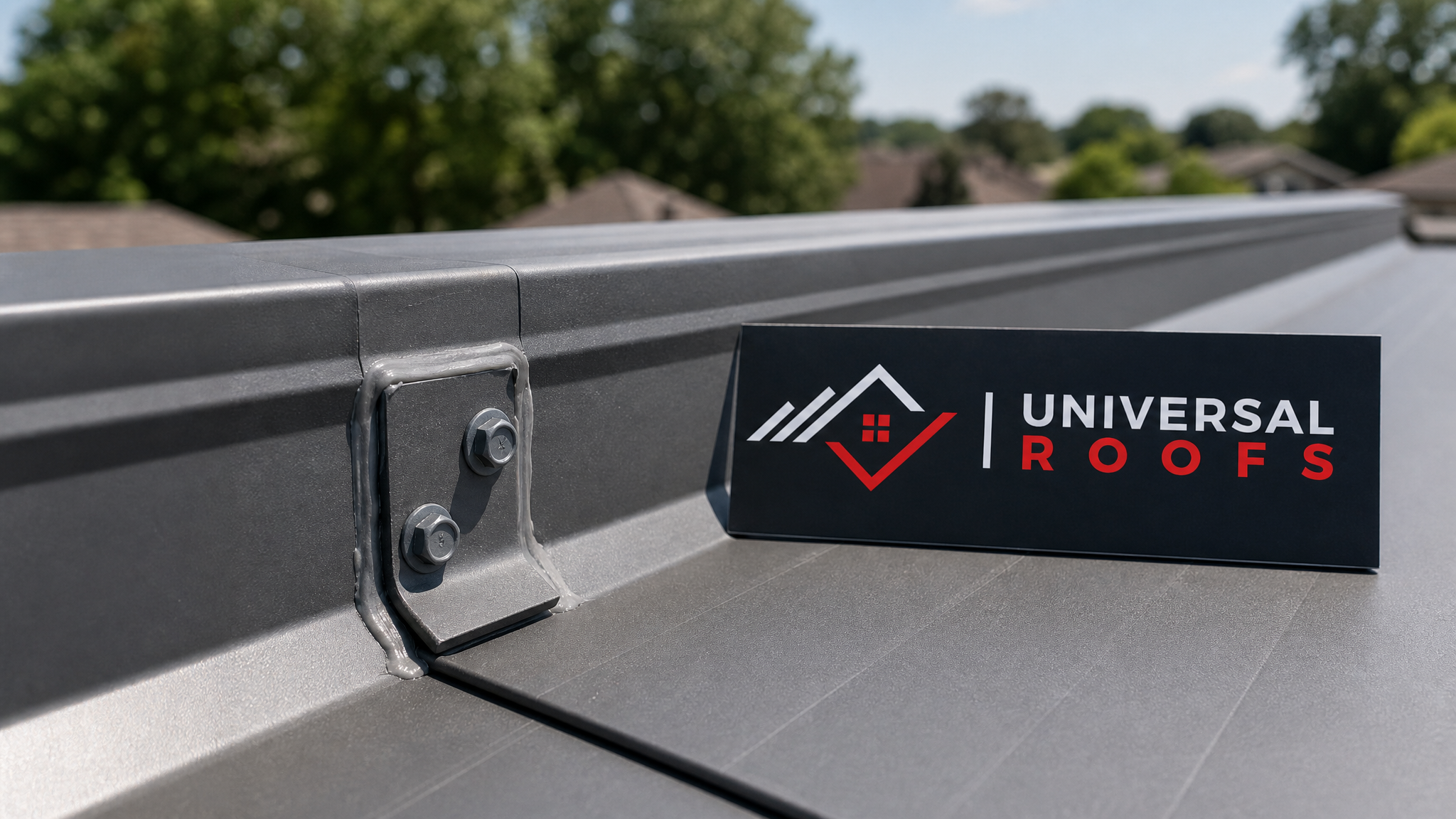
Over years of thermal expansion and contraction, exposed fasteners can back out slightly, cracking their rubber washers and allowing water in around the screw shaft. The professional fix is to remove the fastener entirely, fill and seal the old hole with a butyl-based sealant, and reinstall a slightly larger, colour-matched fastener in a fresh location rather than simply re-tightening the original screw, which rarely re-seats properly.
Seam Separation
Standing seam panels rely on a mechanically folded or clipped seam to stay watertight. If a seam begins to separate — often from wind uplift or age — it needs to be re-crimped with the correct seaming tool and resealed with a compatible sealant. Attempting to force a seam back together by hand, or simply caulking over the gap, almost never holds.
Flashing Failure at Penetrations
Chimneys, plumbing vents, and skylights are the most common leak points on any roof, metal or otherwise. If your home has a skylight and you are noticing moisture around the frame, it is worth having both the roof flashing and the unit itself assessed — our skylight and skylight replacement teams frequently coordinate with roof repair crews on exactly this kind of combined issue.
Panel Denting From Hail or Debris
Summer hailstorms and falling branches can dent individual panels. Small dents are usually cosmetic, but larger dents can crack the factory coating, exposing bare metal to moisture and starting a corrosion point. Professionals assess whether a dent needs a full panel replacement or can be treated with a coating touch-up.
Rust and Corrosion at Cut Edges
Any place a panel was field-cut during original installation — around a valley, hip, or penetration — is more vulnerable to corrosion because the protective coating does not extend over a raw cut edge. Professional repair includes re-coating exposed cut edges, a step that is frequently missed in DIY repairs.
| Problem | Common Cause | Professional Repair Method | Estimated Repair Time |
|---|---|---|---|
| Loose fasteners | Thermal cycling, age | Remove, reseal hole, reinstall matched fastener | 1–2 hours |
| Seam separation | Wind uplift, poor original install | Re-crimp seam, apply compatible sealant | 2–4 hours |
| Flashing failure | Sealant breakdown, movement | Remove and replace flashing, integrate underlayment | 3–6 hours |
| Panel denting | Hail, falling debris | Panel replacement or coating repair | Half day to full day |
| Cut-edge corrosion | Unsealed field cuts | Clean, treat, and recoat exposed edge | 1–3 hours |
What a Professional Metal Roof Repair Inspection Actually Involves
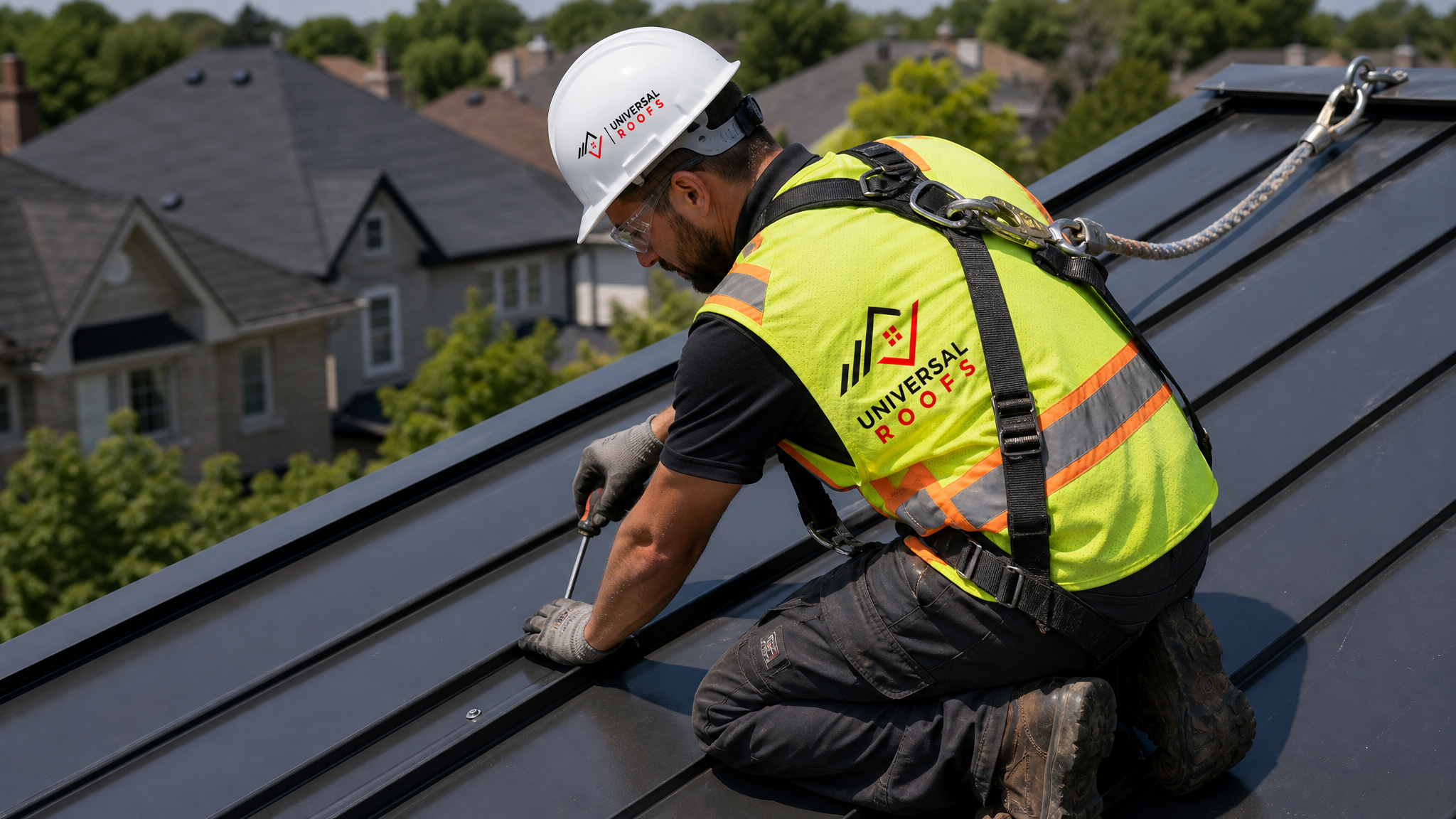
A thorough repair starts with a proper inspection, not a quick look from the ladder. When our technicians assess a metal roof for repair, the process generally covers:
- Exterior panel survey — checking every panel for denting, coating damage, seam integrity, and fastener condition.
- Flashing and penetration check — chimneys, vents, skylights, and any roof-wall intersections are inspected closely, since these account for the majority of leaks.
- Attic inspection — checking the underside of the deck for staining, moisture, or insulation damage, and confirming ventilation is functioning correctly (poor attic ventilation accelerates condensation-related damage from the inside).
- Fastener and seam torque check — sampling fasteners across the roof to identify backed-out screws before they cause a leak.
- Written scope and quote — a clear explanation of what needs repair, what is preventative, and what can wait, along with transparent pricing.
This kind of systematic approach is exactly why a proper roof repair assessment catches problems that a rushed patch job misses. In some cases, an inspection reveals that the roof has aged past the point where repair makes financial sense, and a conversation about full roof replacement is more appropriate — a professional will tell you honestly which situation you are in rather than defaulting to the more profitable option.
Repair Versus Replacement: How Professionals Help You Decide
One of the most valuable things a metal roof repair professional provides is an honest, experience-based recommendation on whether a repair is worthwhile or whether the roof has reached the point of diminishing returns. Several factors go into that decision.
| Factor | Favours Repair | Favours Replacement |
|---|---|---|
| Roof age | Under 25 years | Approaching or past 40–50 years |
| Extent of damage | Isolated to one or two areas | Widespread corrosion or coating failure |
| Underlying deck condition | Solid, no rot | Soft spots, visible rot in attic inspection |
| Original installation quality | Installed to manufacturer spec | Known installation errors throughout |
| Cost of repeated repairs | Occasional, low-cost fixes | Repairs needed multiple times per year |
If you are unsure which category your roof falls into, that is precisely the judgment call a qualified inspection is designed to answer. It is worth reading through homeowner experiences on our reviews page to see how this kind of repair-versus-replace conversation has played out for other GTA homeowners, and our FAQ page covers several related questions in more depth.
The Cost of DIY Mistakes on a Metal Roof
It is worth being specific about what can go wrong when a metal roof repair is attempted without the right training, because the failure modes are not always obvious right away.
- Voided manufacturer warranty. Many metal roofing warranties explicitly require repairs by a licenced contractor familiar with that specific panel system. A DIY fix, even a well-intentioned one, can nullify years of remaining coverage.
- Hidden leaks that reappear elsewhere. Caulking over a visible symptom without tracing the actual water path often just relocates the leak a few feet away, where it may not be noticed until it has caused interior damage.
- Coating damage that spreads. Walking on a metal roof in the wrong footwear, or using the wrong tools, can scratch the factory coating in new spots, creating additional corrosion starting points.
- Fall injuries. Metal roofs are considerably more slippery than asphalt shingles, particularly on lower-slope sections common on flat-roofed additions — an area where our flat roofing team frequently handles combined metal-and-membrane repairs.
- False economy. A DIY repair kit might cost $40 at a hardware store, but a failed repair that leads to interior water damage, mould remediation, or a full panel replacement can cost thousands of dollars more than a professional repair would have in the first place.
How Toronto’s Climate Affects Metal Roof Repair Timing
Seasonal timing matters for metal roof repairs in the GTA. Summer, like right now, is genuinely one of the best times to schedule a repair: sealants cure properly in warm, dry conditions, panels are easier and safer to walk on without ice or frost, and any issues can be fully resolved before autumn’s heavy rain and the freeze-thaw cycles of a Toronto winter arrive.
Waiting until late autumn or winter to address a known issue is one of the most common — and most avoidable — homeowner mistakes we see. A minor seam separation identified in July can be repaired in a single visit; the same issue left through a Toronto winter often develops into ice damming, water infiltration into the attic, and a considerably larger repair scope by spring.
What to Look For When Choosing a Metal Roof Repair Company
Not every roofing contractor has genuine metal roofing experience, and this is where homeowners should be selective. A few things worth confirming before hiring:
- Manufacturer training or certification on the specific panel system installed on your roof.
- Proof of insurance and WSIB coverage for all crew members working at height.
- A written, itemized quote rather than a vague verbal estimate.
- Local references from homeowners in Toronto, Peel Region, York Region, Halton Region, or Durham Region who can speak to actual results.
- A clear explanation of what caused the problem, not just what will be done to fix it.
Homeowners across Toronto and the surrounding GTA regions have come to rely on Universal Roofs for exactly this kind of transparent, technically sound approach to metal roof repair, built on nearly two decades of hands-on experience with residential and commercial roofing systems across the region.
What are the advantages of hiring metal roof repair professionals instead of doing it myself?
How much does professional metal roof repair typically cost in Toronto?
Can a DIY metal roof repair void my warranty?
How do I know if my metal roof needs repair or full replacement?
Is summer a good time to schedule metal roof repair in the GTA?
What should I ask a contractor before hiring them for metal roof repair?
Need Help With The Advantages of Hiring?
Whether your metal roof has a single loose fastener or a more significant seam and flashing issue, the team at Universal Roofs has the training, tools, and local experience to repair it correctly the first time.
Call us today at (416) 732-2421 or request a free inspection to get started.
Universal Roofs proudly serves Toronto, Mississauga, Brampton, Vaughan, Markham, Oakville and the GTA since 2005.