
When a flat roof starts to feel spongy underfoot, or a ceiling stain keeps reappearing no matter how many times it is painted over, the problem is rarely the membrane alone. More often, the real damage is hiding beneath it, in the wood or steel decking that gives the whole roof its structure. Reviving your flat roof essential decking repairs is the unglamorous but absolutely critical work that separates a roof that lasts another 20 years from one that fails quietly, plank by plank, until a contractor’s boot goes straight through it.
In the Greater Toronto Area, decking problems are almost always tied to moisture. Freeze-thaw cycles through the winter, spring meltwater, and the humid stretches of a Toronto summer all conspire to push water into seams, fastener holes, and flashing details. Once water reaches the deck, rot, delamination, and corrosion set in long before anyone notices a leak inside the building. By the time a homeowner sees a brown ring on the ceiling, the deck underneath has often been wet for months.
This guide walks through how to recognize failing decking, what the repair process actually involves, how it compares to a full roof replacement, and what it costs to do it properly. Whether you are dealing with a garage, a commercial low-slope roof, or the flat sections tying into a sloped residential roofline, the principles are the same: find the wet wood, cut it out, and rebuild a solid, dry substrate before a new membrane ever goes down.
Why Flat Roof Decking Fails in the First Place
Flat roof decking, whether plywood, oriented strand board (OSB), or in some older commercial buildings a corrugated steel or lightweight concrete deck, is designed to stay dry. The membrane above it, whether modified bitumen, TPO, EPDM, or built-up asphalt and gravel, is the only thing standing between that deck and the weather. Once the membrane is compromised, even by a pinhole, water finds its way in and rarely finds its way back out.
The most common failure points we see across Toronto, Mississauga, and the wider GTA include:
- Membrane seams that have separated due to age, poor original installation, or thermal movement.
- Flashing details around parapet walls, vents, and drains that were never properly sealed or have pulled away over time.
- Ponding water sitting in low spots for 48 hours or more after rain, slowly saturating the membrane and the deck below.
- Fastener backout, where mechanically attached membranes loosen and create tiny puncture points.
- Ice damming at roof edges in winter, which forces meltwater backward under the membrane instead of off the roof.
Ontario’s climate makes this worse than in many other regions. The freeze-thaw cycle that runs from November through March means water that gets into a seam can freeze, expand, and physically pry the membrane further open. By the time spring arrives, a small issue from the previous autumn has often become a much larger one. This is why so many decking repair calls come in in April and May, right as the snow melts and the full extent of winter damage becomes visible.
Signs Your Flat Roof Deck Needs Repair
Because the deck sits under the membrane and, in most residential and commercial buildings, under insulation as well, homeowners and property managers rarely see the damage directly. Instead, they see the downstream symptoms. Knowing what to look for can be the difference between a straightforward decking repair and a full structural rebuild.
| Warning Sign | What It Usually Means | Urgency Level | Recommended Action |
|---|---|---|---|
| Soft or spongy spots underfoot | Wood decking has absorbed water and is beginning to rot | High | Schedule an inspection within days, not weeks |
| Ceiling stains or discolouration | Active or historical leak has reached the interior finish | High | Book a roof repair assessment immediately |
| Visible sagging in the roofline | Deck or supporting structure has lost load-bearing capacity | Severe | Contact a professional the same week; avoid roof access |
| Bubbling or blistering membrane | Trapped moisture or gas beneath the membrane surface | Moderate | Monitor and plan repair before next rainy season |
| Musty odour in top-floor rooms | Mould growth from sustained moisture in the deck or insulation | Moderate to High | Investigate promptly; mould can spread quickly |
| Rust streaks near metal deck seams | Corrosion on a steel deck, common on older commercial roofs | Moderate | Have a contractor probe the deck at seams |
Not every sign points to catastrophic damage. A single blister on a membrane that has otherwise performed well for years might simply need a localized patch. But when several of these signs appear together, especially sagging combined with soft spots, it is a strong indicator that the deck itself, not just the membrane, has been compromised.
The Decking Repair Process, Step by Step
A proper decking repair is not a quick membrane patch. It is a structural intervention, and skipping steps to save time almost always leads to a repeat failure within a year or two. Here is how a thorough repair typically unfolds:
- Locate the source of water intrusion. This usually means a moisture scan or a series of test cuts through the membrane, rather than assuming the leak originates directly above the interior stain. Water travels laterally along the deck before it drips through, so the entry point can be metres away from the visible damage.
- Remove the membrane and insulation over the affected area. This exposes the deck fully and allows an accurate assessment of how far the rot or corrosion has spread.
- Probe the deck. A screwdriver or moisture meter is used to test the wood for softness, or a visual and tactile check is done on metal decking for rust-through and structural thinning.
- Cut out and remove all compromised material. This is the step most often rushed by less experienced crews. Any wood that shows discolouration, softness, or delamination needs to come out, even if it means removing more than the initial estimate anticipated.
- Install new decking material, properly fastened and levelled. New plywood or OSB is cut to match the existing deck thickness and fastened according to code spacing, tying into the surrounding structure so there is no differential movement.
- Address the underlying cause. If ponding water caused the failure, tapered insulation or additional drains may be added. If flashing failure was the cause, that flashing is rebuilt correctly this time.
- Reinstall insulation and a new membrane section, properly lapped and sealed into the surrounding roof system so the repair is invisible and watertight.
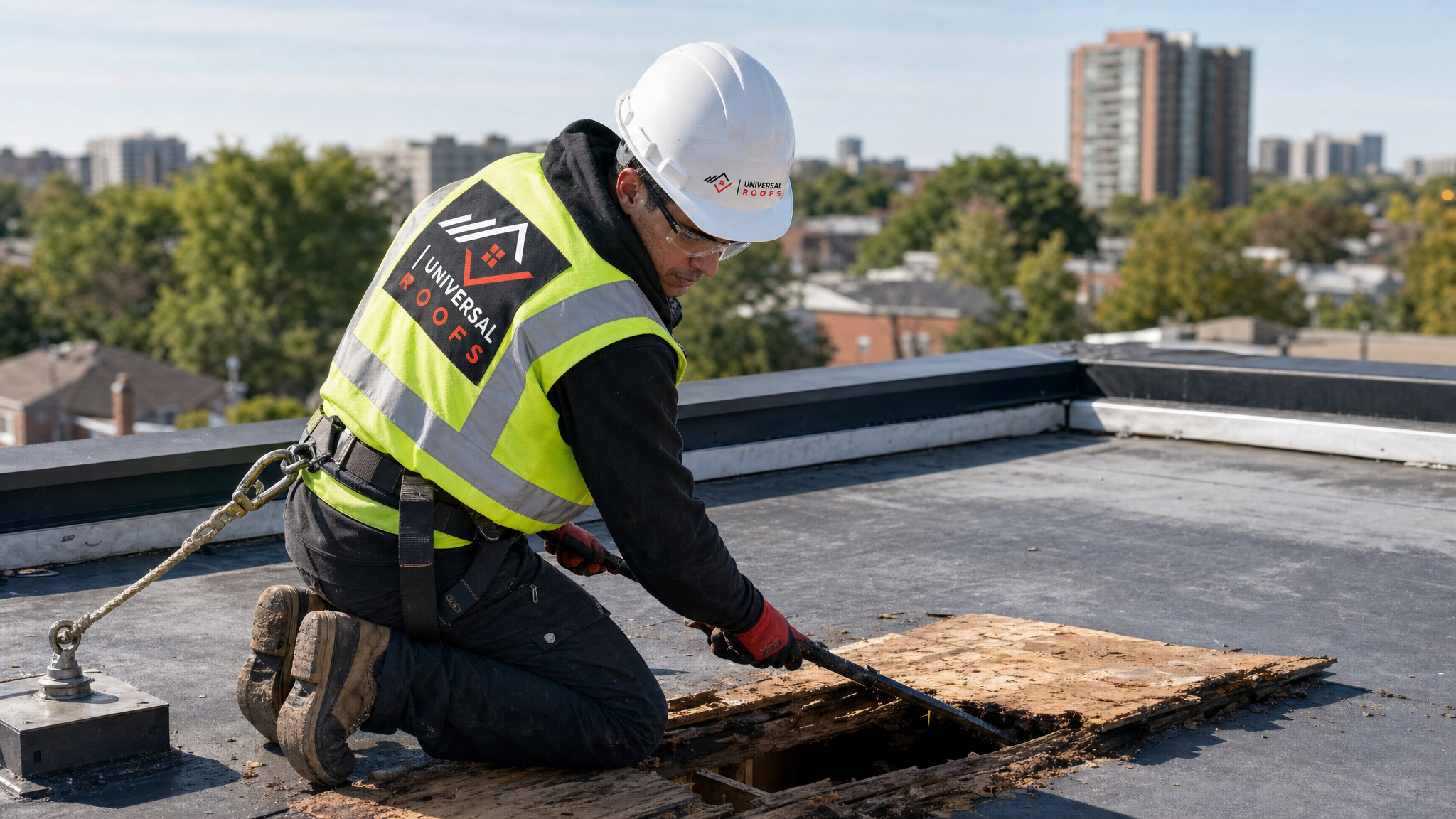
This process is inherently more involved than a simple membrane patch, which is exactly why decking repairs should never be treated as a quick weekend fix. Anyone working at height on a flat roof, especially near an open deck section, should be tied off with a proper fall-protection harness and anchor point, since the removed sections create real fall hazards that are easy to underestimate from the ground.
Decking Materials: What Goes Back In and Why It Matters
Not all replacement decking is created equal, and the material chosen has a direct impact on how long the repair lasts. Toronto’s humidity swings and freeze-thaw cycles punish inferior materials quickly.
| Decking Material | Typical Use | Moisture Resistance | Expected Lifespan |
|---|---|---|---|
| Standard OSB (oriented strand board) | Budget residential repairs | Low to moderate; swells if exposed | 10-15 years under a well-maintained membrane |
| Exterior-grade plywood | Most residential and light commercial repairs | Moderate to good | 20-25 years under a well-maintained membrane |
| Pressure-treated plywood | Areas prone to recurring moisture exposure | Good | 25+ years |
| Galvanized steel decking | Commercial and industrial low-slope roofs | Good, but vulnerable to rust at seams | 30-40 years with proper coating maintenance |
| Lightweight structural concrete | Institutional and larger commercial buildings | Excellent | 40+ years |
For most Toronto-area homes with a flat roof section, whether over a garage, a rear addition, or a modern flat-roof design, exterior-grade or pressure-treated plywood is the standard choice. It offers a reasonable balance of cost, workability, and resistance to the moisture cycles this climate produces. Whatever material is used, it should always match or exceed the thickness of the original deck to maintain proper fastener holding power for the new membrane.
Decking Repair vs. Full Roof Replacement
One of the most common questions homeowners ask is how to know whether a decking repair is enough, or whether the whole roof needs to come off. The honest answer depends on how widespread the damage is, not just how bad it looks in one spot.
As a general guideline, if less than 25 to 30 percent of the total deck area is compromised, a targeted repair is usually the more economical and practical path. Beyond that threshold, the labour of patching multiple sections, plus the disruption of repeatedly removing and reinstalling membrane, often costs more than simply committing to a full roof replacement with new decking installed across the entire surface.
| Factor | Favours Decking Repair | Favours Full Replacement |
|---|---|---|
| Extent of deck damage | Isolated, under 30% of total area | Widespread or affecting multiple sections |
| Age of existing membrane | Membrane has 10+ years of life left | Membrane is near or past its rated lifespan |
| Number of prior repairs | First significant repair on this roof | Third or fourth patch in the same general area |
| Ponding water history | No chronic ponding issues | Recurring ponding suggests a design or slope problem |
| Budget timeline | Limited budget, needs a near-term fix | Planning ahead, wants to avoid repeat costs |
It is also worth factoring in how the roof is used. A commercial rooftop with HVAC units and regular foot traffic sees far more wear than a small residential flat-roof addition, so the calculus around repair versus replacement can shift even with a similar percentage of deck damage. A licensed contractor should always inspect the full roof, not just the visibly damaged section, before recommending either path.
What Decking Repairs Cost in the GTA
Costs vary by the extent of damage, the decking material chosen, and accessibility of the roof, but homeowners and property managers in the Toronto area can use the following as a general planning reference for 2026 pricing. These figures assume the membrane repair is included, since decking work is never done in isolation from the roofing system above it.
| Repair Scope | Approximate Area | Estimated Cost Range (CAD) | Typical Timeline |
|---|---|---|---|
| Localized spot repair | Under 10 square metres | $800 – $2,200 | 1 day |
| Moderate section repair | 10 – 30 square metres | $2,200 – $6,000 | 1-2 days |
| Extensive multi-area repair | 30 – 60 square metres | $6,000 – $12,000 | 3-5 days |
| Full deck replacement (small flat roof) | Entire roof, under 100 square metres | $12,000 – $25,000+ | 1-2 weeks |
These ranges assume straightforward access and standard plywood or OSB decking. Steel deck repairs on commercial buildings, or situations requiring structural engineering sign-off, will run higher. The only reliable way to get an accurate number for a specific property is an on-site assessment, since hidden damage is often more extensive than what is visible from a single test cut.
Preventing Decking Damage Before It Starts
Reviving a flat roof’s decking is far more disruptive and costly than preventing the damage in the first place. A handful of maintenance habits go a long way toward protecting the investment in a new or repaired deck:
- Schedule a professional inspection twice a year, ideally in late spring after the freeze-thaw season and again in early autumn before winter sets in.
- Clear drains and scuppers regularly. Blocked drainage is the single biggest contributor to ponding water, which is itself the leading cause of premature deck failure.
- Address ponding water promptly rather than assuming it will evaporate; standing water that lasts more than 48 hours after a rain event should be flagged to a contractor.
- Inspect flashing annually, particularly around parapet walls, skylights, and roof penetrations, since these details fail long before the membrane field does.
- Keep an eye on interior ceilings below flat roof sections for the earliest possible warning signs, since interior symptoms often show up well before exterior ones are obvious.
- Don’t defer small repairs. A membrane seam that has lifted slightly is a five-minute fix today and a full decking replacement in three years if ignored.
Attic ventilation also plays a supporting role here. Poor airflow beneath a roof deck traps humidity and accelerates wood deterioration from below, even when the membrane above is performing well. If a property has ongoing moisture issues that do not seem tied to an obvious leak, it is worth having the attic and ventilation system reviewed alongside the roof itself, since the two systems work together to keep decking dry.
How Universal Roofs Approaches Decking Repairs
Every decking repair Universal Roofs performs starts with a full inspection of the roof system, not just the visibly damaged section. This means checking flashing, drainage, membrane condition, and, where accessible, insulation moisture content before recommending a scope of work. We have been serving the GTA since 2005, and the pattern is consistent across nearly every job: the deck damage is almost always larger than what a homeowner can see from an interior stain or a soft spot underfoot.
Our crews document deck condition with photos at every stage, from initial exposure through to the new membrane installation, so property owners can see exactly what was found and what was replaced. We only use exterior-grade or pressure-treated decking material rated for the specific application, and we never re-cover compromised wood with a fresh membrane just to save time, since that approach guarantees a repeat call within a year or two.
For roofs where decking issues are tied to a skylight curb or an ageing skylight unit, we also handle skylight and skylight replacement work as part of the same project, since skylight curbs are one of the most common places for decking rot to originate. Addressing the roof deck without also correcting a failing skylight seal simply moves the same water intrusion problem a metre to the left.
Serving the Greater Toronto Area
Flat roof decking problems don’t respect municipal boundaries, and neither do we. Universal Roofs provides inspection and decking repair services across Toronto, the Peel Region including Mississauga and Brampton, the York Region including Markham and Vaughan, the Halton Region including Oakville and Burlington, and the Durham Region. Local climate patterns are broadly similar across these areas, but drainage design, building age, and prior workmanship vary enough that an on-site assessment is always the right starting point.
If you’re unsure whether your flat roof’s issues stem from the membrane, the flashing, or the deck itself, our roof repair team can walk the roof with you and explain exactly what is happening and why. You can also read what past clients have said about our work on our reviews page, or check our FAQ page for answers to more general roofing questions.
What does reviving your flat roof essential decking repairs actually involve?
How do I know if my flat roof needs decking repair instead of just a membrane patch?
How much do flat roof decking repairs typically cost in the GTA?
Can I repair flat roof decking myself?
How long does a flat roof decking repair take to complete?
Does ponding water really cause decking damage on a flat roof?
Need Help With Reviving Your Flat Roof?
Soft spots, stubborn ceiling stains, and sagging membrane sections are signals worth acting on, not ignoring. Universal Roofs has been diagnosing and repairing flat roof decking across the GTA since 2005, and we would rather find a small problem today than a structural one next spring.
Call us today at (416) 732-2421 or request a free inspection to get started.
Universal Roofs proudly serves Toronto, Mississauga, Brampton, Vaughan, Markham, Oakville and the GTA since 2005.