
Asphalt shingles are engineered to handle a lot: driving rain, summer heat that softens the sealant strip, winter freeze-thaw cycles, and gusting winds off Lake Ontario. Yet every roofing crew in the Greater Toronto Area sees the same patterns of premature failure, year after year, on roofs that should have another decade of life left in them.
Understanding what actually damages shingles — versus what homeowners assume is damaging them — is the difference between a $400 repair and a $12,000 early replacement. This expert analysis breaks down the true causes of shingle damage in Toronto and the GTA, how to recognize each one on your own roof, and what steps actually slow or stop the deterioration.
We have inspected thousands of roofs across Toronto, Mississauga, Brampton, Vaughan, Markham, and Oakville since 2005, and the causes below account for nearly all of the shingle failures we document. Some are preventable with routine maintenance. Others are simply the cost of doing business in a climate that swings from -20°C to +35°C in the same calendar year.
Why Shingle Damage Analysis Matters Before You Call a Contractor
Most homeowners notice shingle damage only after it has already caused a secondary problem — a stained ceiling, a damp attic, or a spike in heating bills. By the time the damage is visible from inside the house, the shingles themselves have usually been compromised for one to three years. An expert analysis of the causes of shingle damage lets you catch the problem while it is still a surface-level repair rather than a structural one.
There is also a financial reason to understand the causes of shingle damage before booking an inspection. Insurance adjusters, roofing estimators, and home inspectors all categorize shingle damage differently depending on its origin. Wind damage, hail damage, and age-related wear are treated very differently on an insurance claim, and knowing which category your roof falls into changes what you should ask for — and what you should expect to pay out of pocket.
Finally, the cause dictates the fix. A roof suffering from poor attic ventilation needs airflow correction, not just new shingles — because new shingles installed over the same ventilation problem will fail again in a fraction of the expected lifespan. This is a mistake we see constantly on roof replacement jobs where a previous contractor simply re-shingled without diagnosing the underlying issue.
UV Radiation and Thermal Cycling: The Silent, Universal Cause
Every asphalt shingle roof in Ontario is degrading from ultraviolet exposure the moment it is installed, whether or not any other cause is present. UV radiation breaks down the asphaltic binders that hold the mineral granules to the fibreglass or organic mat underneath the shingle. As the binder oxidizes and hardens, the shingle loses flexibility and the granules begin to shed — you will often see this as dark grit collecting in your eavestroughs.
Thermal cycling compounds the UV damage. Toronto summers regularly push unshaded roof surfaces above 60°C, while winter nights can drop the same surface below -20°C. That is an 80-degree swing that shingles expand and contract through, sometimes multiple times in a single 24-hour period during shoulder seasons. Each cycle stresses the seal strips and the nail line, gradually loosening fasteners and cracking the asphalt mat at stress points, particularly around vents, chimneys, and valleys.
South- and west-facing roof slopes in the GTA consistently show more granule loss and earlier cracking than north-facing slopes on the same house, because they absorb more direct summer sun. If you are noticing colour fading or bald patches concentrated on one side of the roof, this is almost always the explanation, and it is a normal part of asphalt shingle aging rather than a manufacturing defect.
Wind Uplift and Wind-Driven Damage
Wind is one of the most common causes of acute shingle damage we are called out for in the GTA, especially after the spring storm season and late-summer thunderstorm systems. Asphalt shingles rely on a factory-applied adhesive seal strip that bonds each shingle to the one below it once the roof has been exposed to a few days of summer heat. Until that thermal seal forms, and anywhere the seal has already failed from age, wind can get underneath the shingle tab and lift it.
Once a shingle tab lifts even slightly, it flexes back and forth in every subsequent windstorm, which fatigues the asphalt at the fold line and eventually cracks or tears it off completely. This is why wind damage tends to appear in clusters rather than as a single missing shingle — if one shingle’s seal has failed, its neighbours installed in the same batch, on the same day, in the same conditions, are often on the same trajectory.
Roof geometry also plays a significant role. Ridge lines, hips, and the edges of the roof experience wind speeds that can be 20-40% higher than open-field wind speed ratings due to the way wind wraps around a building. This is precisely why manufacturers require special starter strips and ridge cap fastening patterns at these locations, and why poorly installed ridge caps are disproportionately represented in our wind-damage repair calls. If your roof has taken wind damage, our roof repair team can typically match and replace the affected courses without a full tear-off, provided the shingles are not already past their expected service life.
Hail Impact Damage in the GTA
Southern Ontario sits within a recognized hail corridor, and the Greater Toronto Area sees multiple significant hail events most summers, with the most severe storms concentrated in June through August. Hail damages shingles by bruising the mat, fracturing the granule surface, and in more severe impacts, cracking through the asphalt layer entirely. The damage is frequently not visible from the ground and is easy to miss even from a casual look at the roof edge.
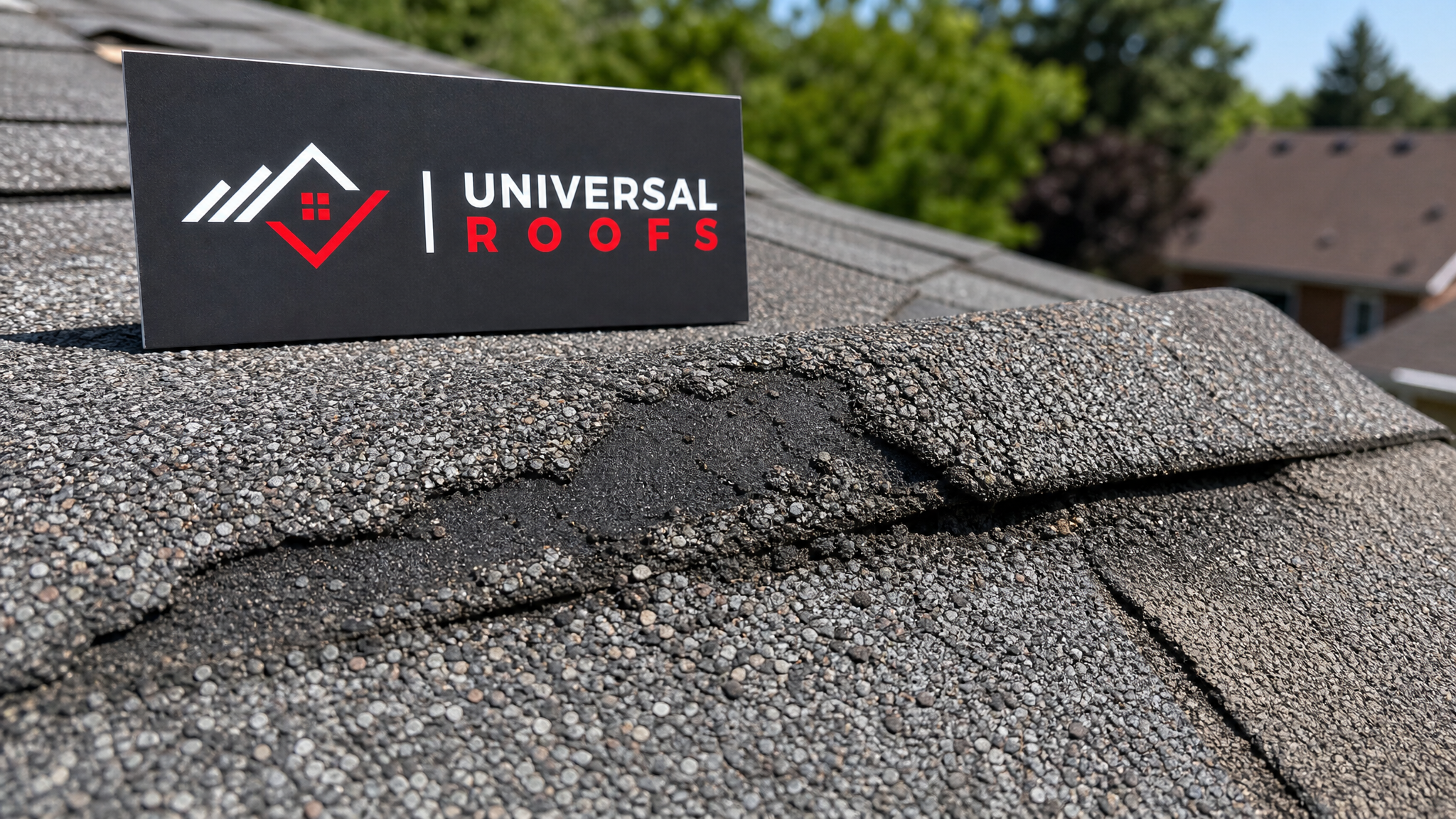
The telltale signs of hail damage include random, non-linear granule loss (as opposed to the more even, gradual granule loss from UV aging), soft or spongy spots when the shingle surface is pressed, and exposed black asphalt mat showing through where granules have been knocked away. Metal flashing, vent caps, and gutters on the same slope usually show corresponding dents, which is a useful cross-check when hail damage is suspected but not obviously visible on the shingles themselves.
Hail damage matters even when it does not immediately cause a leak, because every impact site becomes a weak point where UV radiation and thermal cycling will accelerate future granule loss and cracking. A roof that took a moderate hailstorm two summers ago and looks fine today may fail five to ten years earlier than its rated lifespan at exactly the impact points. This is a major reason insurance carriers in Ontario cover hail damage inspections promptly after storm events — the damage compounds silently if it is not documented and addressed.
Poor Attic Ventilation and Heat/Moisture Damage
Attic ventilation problems are among the most under-diagnosed causes of shingle damage because the damage originates from below the shingle, not above it. When an attic lacks adequate intake and exhaust airflow, heat builds up beneath the roof deck in summer, which bakes the underside of the shingles and accelerates the same oxidation process that UV exposure causes from above — effectively doubling the thermal stress on the shingle.
In winter, poor ventilation combined with insufficient attic insulation allows warm, moist household air to rise into the attic and condense against the cold roof deck. This moisture can saturate the wood sheathing, cause the shingle nails to corrode and lose their grip, and contribute directly to ice dam formation at the eaves — a problem that both damages shingles through repeated freeze-thaw cycling at the roof edge and forces water backward under the shingle courses.
Manufacturers’ shingle warranties are explicit about this: inadequate attic ventilation is one of the most common reasons a warranty claim gets denied, because the manufacturer can point to heat damage that originated from the attic side rather than a material defect. If your GTA home has a roof less than 10 years old already showing curling or granule loss across the whole field (not just south-facing slopes), have your attic ventilation assessed before assuming the shingles themselves are defective.
Improper Installation and Fastening Errors
A significant share of the “premature shingle failure” cases we investigate trace back to installation error rather than the shingle product or the weather. Common mistakes include nails driven too high (missing the reinforced nailing strip), nails driven at an angle so the head cuts into the shingle instead of sitting flush, overdriven nails that crush the mat, and insufficient nails per shingle for the local wind exposure category.
Incorrect shingle exposure — the amount of each course left visible to the weather — is another frequent culprit. If courses are laid with too much exposure, the shingles are thinner at the point of maximum weather contact than the manufacturer designed for, which shortens their service life significantly. Improper flashing integration at valleys, chimneys, and sidewalls also forces water to travel across or under shingles in ways they were never meant to shed, which accelerates rot and granule washout at those points specifically.
Because installation errors are baked into the roof from day one, they tend to produce damage patterns that repeat identically across the whole roof rather than the localized, storm-linked patterns you see with wind or hail. If you are seeing the same type of cracking or lifting at every third or fourth course, in the same position relative to each shingle, installation is the far more likely explanation than weather.
Comparing the Major Causes of Shingle Damage
| Cause | Typical Damage Pattern | Onset Speed | Repair vs. Replace Threshold |
|---|---|---|---|
| UV radiation & thermal cycling | Even granule loss, curling, colour fade on sun-facing slopes | Gradual, over 10-25 years | Replace when granule loss is widespread |
| Wind uplift | Lifted or missing tabs, clustered by installation batch | Sudden, storm-linked | Repair if isolated; replace if seal strips failing roof-wide |
| Hail impact | Random bruising, exposed mat, soft spots | Sudden, single-event | Repair for isolated hits; insurance replacement for widespread bruising |
| Poor attic ventilation | Uniform curling/heat damage across whole field, not just sun-facing side | Gradual, over 5-15 years | Fix ventilation first, then assess shingle condition |
| Installation error | Repeating pattern at same course position, early seal failure | Can appear within 1-5 years | Often requires full replacement due to widespread nailing errors |
| Moss and organic growth | Dark streaking, raised patches trapping moisture | Gradual, over 3-10 years | Repair/clean if caught early; replace if mat has rotted beneath growth |
Moss, Algae, and Organic Growth Damage
Toronto’s humid summers and shaded, tree-lined neighbourhoods create favourable conditions for algae and moss growth on north-facing slopes and anywhere shade limits how quickly a roof dries after rain. Blue-green algae (often visible as dark streaking) primarily affects appearance rather than shingle integrity in its early stages, but moss is more destructive: its root structure lifts shingle edges as it grows, holding moisture against the mat continuously rather than allowing normal drying cycles.
Prolonged moisture retention under moss accelerates granule loss, promotes wood rot in the deck below, and in freeze-thaw conditions, expanding ice within the moss layer can physically pry shingle tabs loose. We routinely find that roofs with heavy moss coverage are losing structural shingle life two to three times faster than a clean roof of the same age and product line, purely from this moisture-retention effect.
Zinc or copper strips at the ridge, improved tree canopy trimming for airflow, and prompt gentle cleaning (never high-pressure washing, which strips granules) are the standard preventive measures. Homeowners frequently ask us whether cleaning alone can restore a moss-damaged roof; the honest answer depends on how long the moss was established, which is a judgment call best made during an in-person inspection.
Physical and Mechanical Damage
Beyond weather and ventilation, shingles suffer routine mechanical damage from overhanging tree branches that scrape the surface in wind, foot traffic from satellite dish installers, holiday light installers, or previous contractors walking on the roof in a way that dislodges granules, and falling debris from nearby trees during storms. Squirrels and raccoons are also a legitimate, frequently underestimated cause of localized shingle damage in the GTA, particularly around roof edges and near tree-adjacent access points.
This category of damage is usually the easiest to prevent, since it is largely a function of maintenance decisions rather than weather exposure. Trimming back branches to at least 3 metres of clearance, restricting non-essential roof access, and promptly addressing any signs of animal entry at soffits or fascia boards will eliminate most mechanical damage before it starts.
Because mechanical damage tends to be localized and irregular in shape (as opposed to the more geometric patterns from installation error or the storm-wide patterns from hail), it is often the most straightforward category to repair without a full section replacement, provided it is caught before water intrusion reaches the deck.
Shingle Lifespan by Damage Cause and Climate Exposure
| Roof Exposure | Expected Lifespan (3-Tab) | Expected Lifespan (Architectural) | Primary Damage Driver |
|---|---|---|---|
| South/west-facing, full sun | 15-18 years | 20-22 years | UV radiation and thermal cycling |
| North-facing, shaded | 18-20 years | 23-25 years | Moss and organic growth |
| Open exposure, high wind zone | 14-17 years | 18-21 years | Wind uplift at seal strips |
| Poorly ventilated attic | 10-14 years | 14-18 years | Heat/moisture from below |
| Properly maintained, balanced ventilation | 18-22 years | 24-28 years | Normal age-related wear only |
Diagnostic Checklist: Identifying Your Cause
| Observation | Most Likely Cause | Recommended Next Step |
|---|---|---|
| Granules in gutters, even fading, mostly south/west slopes | UV/thermal aging | Schedule a full roof age assessment |
| Missing tabs after a windstorm, clustered together | Wind uplift | Book a same-week repair inspection |
| Random dents in gutters/flashing plus soft shingle spots | Hail impact | Document with photos, contact insurer and roofer |
| Curling across the whole roof, hot upstairs rooms | Attic ventilation | Request an attic airflow evaluation |
| Same defect repeating at identical course position | Installation error | Request a full roof inspection with photos |
| Dark streaks or raised green patches, mostly north-facing | Moss/algae growth | Arrange a soft-wash cleaning assessment |
How to Slow Down Shingle Damage on Your GTA Roof
While you cannot stop UV exposure or eliminate every summer hailstorm, several maintenance habits measurably extend shingle life. Keep gutters clear so water sheds properly at the eaves rather than backing up under the first courses. Trim tree branches back from the roofline to reduce both mechanical abrasion and shaded moss growth. Schedule a professional inspection after any significant wind or hail event, even if you see no obvious damage from the ground, since much of the damage discussed above is not visible from a casual glance.
Balanced attic ventilation is arguably the single highest-leverage fix available to most homeowners, because it addresses damage from below the shingle that no amount of surface maintenance can prevent. A quick attic check for adequate soffit intake, functioning ridge or roof vents, and appropriate insulation depth will tell you whether your attic is working with your shingles or quietly working against them.
Finally, an annual or biennial visual inspection, ideally in spring after winter freeze-thaw cycling and again in early autumn before winter sets in, catches most of the causes above while they are still isolated and repairable. Waiting until a leak appears inside the house means the damage has already progressed from the shingle layer through the underlayment and into the deck.
What is the single most common cause of shingle damage in Toronto and the GTA?
How can I tell if my shingle damage is from hail or normal wear?
Can poor attic ventilation really cause shingle damage on its own?
Is moss on my roof actually damaging the shingles or just cosmetic?
How often should I have my roof inspected to catch shingle damage early?
Does the cause of shingle damage affect whether I need a repair or a full replacement?
Need Help With Top Causes of Shingle?
If any of the damage patterns above sound familiar, the safest next step is a professional assessment rather than guesswork from the ground. Universal Roofs has been diagnosing and repairing shingle damage across the GTA since 2005, and we can tell you within one visit whether you are looking at a simple repair, a ventilation fix, or a roof that has reached the end of its service life.
Call us today at (416) 732-2421 or request a free inspection to get started.
Universal Roofs proudly serves Toronto, Mississauga, Brampton, Vaughan, Markham, Oakville and the GTA since 2005.