
Cedar shake roofing has a distinctive, handcrafted look that many older Toronto and GTA homes were built to showcase, but cedar does not last forever. After 25 to 40 years of freeze-thaw cycles, summer humidity, and winter ice, even well-maintained cedar shakes eventually curl, split, and lose their ability to shed water. When that happens, replacement is usually the safer and more cost-effective choice compared to another round of patch repairs. The essential tips for cedar shake roof replacement in this guide are drawn from decades of hands-on roofing work across the GTA’s varied climate zones, from the lakeside humidity of Toronto to the more exposed, wind-driven conditions in Halton and Durham Region.
Replacing a cedar shake roof is not a project to rush into without a plan. The decisions you make about timing, materials, and code compliance will affect how long your new roof lasts, how much it costs, and whether your insurance company is willing to keep covering wood roofing at all. This guide walks through the three most important considerations for any GTA homeowner planning a cedar shake roof replacement, along with the surrounding details, cost ranges, and troubleshooting information you need to have an informed conversation with your roofing contractor.
Whether you are restoring a heritage property in old Toronto, maintaining a executive home in Oakville, or dealing with a cottage-style cedar roof in the outer suburbs, the fundamentals are the same. Get the timing right, choose the correct materials and installation method for our climate, and confirm the work meets current fire and building code requirements. Get those three things right and a new cedar shake roof can comfortably outlast the one it replaced.
Tip 1: Know When Your Cedar Shakes Actually Need Replacing (Not Just Repairing)
The single most common mistake homeowners make with cedar shake roofs is waiting too long to make the call between repair and full roof replacement. Cedar shakes fail gradually, and it is tempting to keep patching individual shakes as they crack or blow off. But past a certain point, spot repairs stop being cost-effective and can even mask more serious problems underneath.
Cedar shakes degrade in a fairly predictable pattern. In the first 15 to 20 years, the wood simply weathers and turns silvery-grey, which is cosmetic and not a concern. Between years 20 and 30, individual shakes begin to curl, split along the grain, and lose granular surface texture. This is the window where a good roof repair program, including selective shake replacement and moss treatment, can meaningfully extend the roof’s service life. Past year 30, especially on roofs facing south or west exposure where UV exposure is most intense, shakes begin failing in clusters rather than individually, and that is a strong signal that full replacement is more economical than continued repair.
There are a few specific warning signs that tell you it is time to stop repairing and start planning a full replacement. Widespread curling and cupping across more than 20 percent of the roof surface indicates the wood has lost its structural flexibility. Soft or spongy sections when walked on (which should only ever be assessed by a professional, never a homeowner on a ladder) usually mean water has penetrated to the sheathing. Moss and lichen growth that returns within a single season of cleaning suggests the wood is retaining moisture rather than shedding it, which accelerates rot. And if you are seeing daylight through the roof deck from inside the attic, or your attic insulation shows water staining, the roof has already failed structurally in that area.
| Cedar Shake Roof Age | Typical Condition | Recommended Action | Approximate Cost Range (CAD) |
|---|---|---|---|
| 0–15 years | Weathering to silver-grey, minor moss | Routine cleaning and inspection | $300–$800 |
| 15–25 years | Scattered curling, occasional splits | Selective shake repair | $1,200–$4,000 |
| 25–35 years | Widespread curling, soft spots forming | Full evaluation; partial or full replacement | $15,000–$35,000 |
| 35+ years | Structural failure, active leaks | Full tear-off and replacement | $18,000–$40,000+ |
One detail specific to our region: Toronto’s freeze-thaw cycle is harder on aging cedar than most homeowners expect. Water that soaks into split or curled shakes in the fall freezes and expands over winter, widening existing cracks. By spring, a roof that looked marginal in October can have twice as many failed shakes. If your roof is already showing multiple warning signs heading into fall, it is worth getting a professional assessment before winter rather than waiting until spring leaks force the issue. This is also why timing your replacement for late spring through early autumn, when the wood, sealants, and underlayment all install and cure properly, matters so much for long-term performance.
Tip 2: Choose the Right Cedar Grade, Underlayment, and Installation Method
Not all cedar shakes are the same, and the installation method underneath the visible wood matters just as much as the shakes themselves. This is where a large share of premature cedar roof failures actually originate, not from bad wood, but from the wrong assembly underneath it.
Cedar shakes and shingles are graded by the Cedar Shake and Shingle Bureau, and the grade you choose has a direct effect on lifespan. Number 1 grade, sometimes called “Blue Label,” is 100 percent heartwood, edge-grain, and free of defects; this is the grade we recommend for any main roof replacement in the GTA. Number 2 grade allows some flat grain and limited sapwood, and while it costs less, it typically has 20 to 30 percent shorter service life in our climate. Number 3 grade is generally suitable only for secondary structures like sheds, not primary residential roofs. Buying a lower grade to save money upfront is one of the most common regrets homeowners raise a decade into a cedar roof’s life.
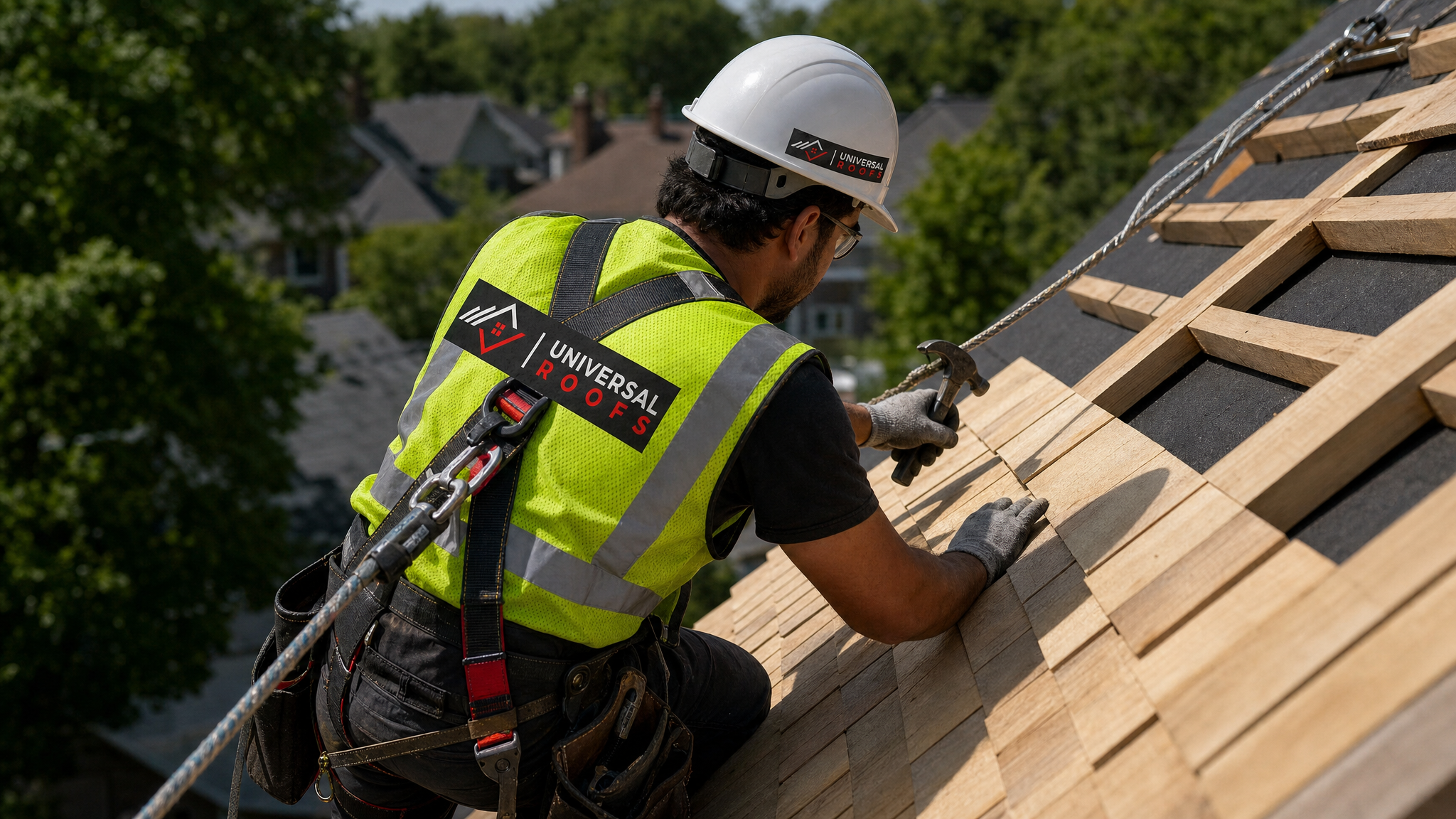
Underneath the shakes, the installation method has evolved considerably. Older cedar roofs were often installed directly over solid board sheathing with basic felt underlayment, which traps moisture against the back of the shakes and shortens their life. Modern best practice uses spaced sheathing, or solid sheathing with a ventilated batten system, combined with a breathable synthetic underlayment. This allows air to circulate behind each shake, drying out moisture from both sides rather than just the top, which is the single biggest factor in extending shake lifespan in humid climates like ours.
| Installation Method | Ventilation Behind Shakes | Typical Lifespan (GTA Climate) | Relative Cost |
|---|---|---|---|
| Solid sheathing + felt underlayment | Poor | 18–22 years | Lowest |
| Solid sheathing + synthetic breathable underlayment | Moderate | 22–28 years | Moderate |
| Spaced sheathing (skip sheathing) | Good | 28–35 years | Moderate-High |
| Solid sheathing + ventilated battens + synthetic underlayment | Excellent | 30–40 years | Highest |
Fastener choice is another detail worth insisting on. Cedar shakes should always be installed with stainless steel or hot-dip galvanized ring-shank nails. Standard electro-galvanized nails corrode within a decade in our humid summers and salty winter road spray, and corroded fasteners are one of the leading causes of shakes blowing off in wind storms well before the wood itself has failed. If your contractor’s quote does not specify fastener material, ask directly, it is a small cost difference that has an outsized effect on durability.
Ventilation at the attic level matters just as much as ventilation behind the shakes themselves. A cedar roof installed over a poorly ventilated attic will see condensation form on the underside of the sheathing during winter, which rots the deck from below regardless of how well the exterior roofing was installed. Before any cedar shake replacement, it is worth having your attic ventilation and insulation levels assessed alongside the roof itself. This is also a good opportunity to check for any secondary roof penetrations, such as older skylights, that may need flashing upgrades or a full skylight replacement to match the new roofing assembly, since poorly flashed penetrations are a common leak point on cedar roofs.
Tip 3: Confirm Fire Rating, Building Code, and Insurance Requirements Before You Start
This is the tip homeowners are most likely to overlook, and it is the one that can cause the most expensive problems if skipped. Cedar shake is a combustible roofing material in its natural state, and municipalities across the GTA, along with home insurance providers, have increasingly specific requirements around fire-rated assemblies for wood roofing.
Untreated cedar shakes carry no fire rating on their own. To meet most current municipal building codes and insurance requirements in Ontario, cedar shake roofing must be installed as part of a Class A, B, or C fire-rated assembly. This is typically achieved one of two ways: using shakes that have been pressure-treated with a fire-retardant chemical at the mill, or installing an approved fire-rated underlayment system (sometimes a layer of gypsum board or a specialized fire-rated membrane) beneath standard shakes. Which approach applies to your project depends on your specific municipality and, in many cases, on what your home insurance policy requires for continued wood roof coverage.
Insurance is a genuinely practical concern here, not just a regulatory checkbox. A growing number of insurers in Ontario have tightened their underwriting on cedar shake roofs over the past several years, either declining new policies on homes with untreated cedar, requiring proof of fire-retardant treatment, or applying a premium surcharge. If you are replacing a cedar roof, it is worth calling your insurance provider before the project starts to confirm exactly what documentation they will require, and making sure your contractor provides a certificate or manufacturer documentation confirming the fire-retardant treatment used.
| Fire Rating Class | Typical Assembly | Common Insurance Outcome | Relative Material Cost |
|---|---|---|---|
| Untreated cedar, no rated underlayment | Standard shakes, standard underlayment | Often declined or surcharged by insurers | Lowest |
| Class C | Standard shakes over approved fire-rated underlayment | Generally accepted with documentation | Moderate |
| Class B | Fire-retardant treated shakes over standard underlayment | Generally accepted, sometimes preferred | Moderate-High |
| Class A | Fire-retardant treated shakes over fire-rated underlayment | Broadly accepted, best insurance terms | Highest |
Beyond fire rating, building permits are typically required for a full cedar shake tear-off and replacement in most GTA municipalities, since the scope involves structural sheathing inspection and, often, updated ventilation work. A reputable contractor will pull the permit as part of the project rather than leaving that step to you, and will be familiar with the specific requirements in your municipality, whether that is Toronto, the Peel Region, York Region, Halton Region, or Durham Region. Skipping the permit step might save a small amount of time upfront, but it can create real problems later, from difficulty selling the home to disputes over insurance claims if a fire or storm event occurs.
Planning Your Cedar Shake Roof Replacement Timeline
Summer is generally the most reliable season for cedar shake replacement in the GTA, since the wood, adhesives, and underlayment membranes all install and cure best in warm, dry conditions. A typical residential cedar shake tear-off and replacement takes between five and ten working days, depending on roof complexity, pitch, and the number of penetrations like chimneys, vents, and skylights.
Booking early matters more with cedar than with asphalt shingles, because cedar shake crews and quality mill stock are both in shorter supply than standard roofing materials. If you notice warning signs of failure during a spring inspection, it is worth getting quotes and scheduling the work for July or August rather than waiting until fall, when contractor calendars fill up quickly and any delay pushes the project dangerously close to the point where curing conditions become unreliable.
| Season | Suitability for Cedar Shake Replacement | Key Consideration |
|---|---|---|
| Spring (April–June) | Good | Best for inspection and early booking; some rain delays possible |
| Summer (July–August) | Excellent | Ideal curing conditions; book early, high demand |
| Fall (September–October) | Good, with limits | Workable through mid-October; cooler nights slow curing |
| Winter (November–March) | Not recommended | Adhesives and membranes do not cure reliably below freezing |
Common Cedar Shake Problems and How Replacement Addresses Them
It helps to understand exactly what a full replacement fixes that a repair cannot, so you know what you are paying for. Curling shakes happen when the wood dries unevenly, usually from a combination of age and inadequate rear ventilation, and replacement with a properly vented assembly directly addresses the root cause rather than just swapping the wood. Splitting along the grain is largely a function of shake grade and moisture cycling; upgrading to Number 1 grade heartwood shakes with a breathable underlayment reduces the moisture swings that cause splits. Moss and algae growth thrives in constant shade and moisture retention, so replacement is a chance to improve airflow and, where practical, address overhanging tree branches that keep sections of the roof perpetually damp.
Persistent leaks around chimneys, vents, and skylights are almost always a flashing problem rather than a shake problem, and this is exactly why a full tear-off, rather than a series of patch repairs, is the right time to replace aging flashing details with current copper or aluminum systems designed to move with the roof over decades. If your home also has a lower-slope section, such as a porch roof or addition, this is a good time to have it assessed separately, since those areas are sometimes better served by a dedicated flat roofing system rather than an extension of the cedar shake assembly.
| Symptom | Likely Cause | Repair-Level Fix | Replacement-Level Fix |
|---|---|---|---|
| Curling shakes | Uneven drying, poor rear ventilation | Spot replace worst shakes | Full vented batten assembly |
| Grain splitting | Lower shake grade, moisture cycling | Seal and monitor | Upgrade to Number 1 heartwood grade |
| Recurring moss | Shade, poor airflow, moisture retention | Clean and treat annually | Improve ventilation, trim overhanging branches |
| Leaks at flashing points | Aged or corroded flashing | Reseal existing flashing | Replace with new copper/aluminum flashing |
Budgeting Realistically for a Cedar Shake Replacement
Cedar shake replacement costs more upfront than asphalt shingle replacement, typically running 2 to 3 times higher per square, but the value proposition changes significantly when you factor in lifespan and curb appeal. A well-installed cedar roof using Number 1 grade shakes over a properly ventilated assembly can last 30 to 40 years in the GTA climate, compared to 20 to 25 years for standard architectural asphalt shingles, and cedar consistently commands stronger resale value on character homes where it is architecturally appropriate.
Total project cost depends heavily on roof size, pitch, number of penetrations, and the fire-rated assembly required by your municipality and insurer. A straightforward, moderately pitched roof around 2,000 to 2,500 square feet typically falls in the $20,000 to $30,000 range for a full tear-off and replacement with Number 1 grade fire-treated shakes and a properly vented assembly. Steeper roofs, complex rooflines with multiple valleys and dormers, or roofs requiring extensive deck repair before new shakes go on will run higher. Getting two or three detailed quotes that each specify shake grade, fastener type, underlayment system, and fire rating is the best way to compare like with like, since a lower quote is often lower because it specifies a cheaper grade or assembly, not because the labour is discounted.
If your budget does not allow for a full replacement this season, a well-executed roof repair program targeting the worst 20 to 30 percent of shakes, combined with moss treatment and a ventilation check, can reasonably buy another 3 to 5 years of service life on a roof that is not yet showing widespread structural failure. This is a legitimate strategy, not a stopgap to be embarrassed about, as long as it is paired with an honest assessment of when full replacement will become unavoidable.
Working With a Roofing Contractor You Can Trust
Cedar shake work is a specialty within roofing, and not every roofing company installs it regularly. When evaluating contractors for a cedar shake replacement, ask specifically about their experience with wood roofing, how many cedar projects they complete per year, and whether they can show recent, local examples. Ask to see their fire-retardant treatment documentation process and how they handle municipal permitting, since both are easy for a less experienced crew to overlook.
It is also worth reading through a contractor’s reviews specifically for feedback on wood roofing projects rather than general roofing work, since the skill sets do not always overlap. A contractor with a strong general roofing reputation is not automatically the right choice for cedar shake, and vice versa. Reading through a few frequently asked questions pages can also give you a sense of how transparent a company is about pricing, timelines, and warranty terms before you ever pick up the phone.
Since 2005, our team has replaced cedar shake roofs across every corner of the GTA, and the projects that go smoothly almost always share the same pattern: an honest inspection up front, a clear explanation of shake grade and assembly options, and full documentation of fire-rated materials for insurance purposes. You can learn more about our background and approach on our about page, or reach out directly for a project-specific assessment.
What are the most essential tips for cedar shake roof replacement in Toronto?
How long does a cedar shake roof last in the GTA climate?
Do cedar shake roofs need to be fire-retardant treated?
What is the best time of year for cedar shake roof replacement?
How much does cedar shake roof replacement cost compared to asphalt shingles?
Can I repair individual cedar shakes instead of replacing the whole roof?
Need Help With 3 Essential Tips for?
Planning a cedar shake roof replacement is easier with an experienced team walking you through grade selection, ventilation design, and fire code compliance from the start. Universal Roofs has been assessing and replacing cedar shake, asphalt, and flat roofing systems across the GTA since 2005, and we are happy to provide a straightforward, no-pressure evaluation of your current roof’s condition.
Call us today at (416) 732-2421 or request a free inspection to get started.
Universal Roofs proudly serves Toronto, Mississauga, Brampton, Vaughan, Markham, Oakville and the GTA since 2005.