
Every summer, homeowners across the Greater Toronto Area look up at their roofs and notice the same things: dark algae streaking down the shingles, moss creeping along shaded valleys, and a thick layer of leaf debris packed into the gutters. The instinct is to grab a ladder, a pressure washer, and a Saturday afternoon. That instinct is exactly how most roof cleaning injuries happen. Roof cleaning sits at an odd intersection of routine maintenance and genuinely dangerous work, and the safety precautions that matter most are rarely the ones people think of first.
This guide walks through the real, practical safety precautions that matter before, during, and after cleaning a roof — whether you are hiring a contractor, supervising a maintenance crew, or seriously considering doing limited cleaning yourself. We will cover fall protection, chemical handling, ladder setup, weather timing, and the specific hazards that come with Toronto’s freeze-thaw climate and mixed housing stock of steep Victorian-era roofs and lower-pitched postwar bungalows.
We will also be direct about where the line sits between “a homeowner can reasonably do this” and “this needs a licenced professional.” Roof cleaning is one of those tasks where the cost of a mistake — a fall, a chemical burn, a stripped shingle warranty — is far higher than the cost of doing it properly the first time.
Why Roof Cleaning Safety Deserves Its Own Checklist
Roof cleaning gets lumped in with general home maintenance, but it shares almost nothing in common with cleaning a deck or washing windows. You are working at height, on a sloped and often slippery surface, frequently while operating pressurized water equipment or handling chemical cleaning solutions. The Workplace Safety and Insurance Board (WSIB) in Ontario consistently ranks falls from height among the leading causes of serious injury and fatality in the construction and property maintenance trades, and residential roof work is a disproportionate contributor.
The core problem with roof cleaning specifically, compared to roof repair, is complacency. A homeowner planning a repair usually treats the job with appropriate caution because they know something is broken. Cleaning feels cosmetic, so people underestimate the risk. But a wet, algae-covered shingle is dramatically more slippery than a dry one, and cleaning almost always involves introducing water or cleaning solution to the exact surface you are standing on. That combination — height plus a deliberately wetted, slick walking surface — is why roof cleaning top safety precautions for repair and maintenance need to be treated as seriously as any structural repair task.
There is also a maintenance dimension that homeowners overlook: cleaning done incorrectly can create the very damage that later requires roof repair. Pressure washing at the wrong PSI strips protective granules from asphalt shingles, and aggressive scraping to remove moss can lift shingle tabs and break the seal strips that keep wind from getting underneath. Safety, in this context, protects both the person on the roof and the roof itself.
Fall Protection: The Non-Negotiable First Step
Before any cleaning solution touches the roof, fall protection needs to be planned and physically set up. This is the single precaution that prevents the most serious outcomes, and it is also the one most frequently skipped by homeowners and unlicensed operators alike.
A proper fall-protection setup for pitched-roof cleaning includes a full-body harness (never a simple waist belt, which can cause severe internal injury in a fall arrest), a rope grab or self-retracting lifeline, and an anchor point rated for fall arrest — not a vent pipe, chimney cap, or satellite mount, which are not structurally rated for the dynamic load of a fall. Anchors should be installed into rafters or trusses, not just decking, and ideally by someone trained to identify structural members from the attic side.
For roofs with a pitch steeper than about 6:12 (a rise of 6 inches for every 12 inches of horizontal run), fall protection is not optional under any reasonable safety standard, and for anything approaching Toronto’s older steep-slope Victorians and Edwardians — often 9:12 or steeper — a harness and rope system, roof jacks, or full staging should be considered baseline equipment, not extra precaution. Even on lower-slope roofs in the 3:12 to 5:12 range common on postwar bungalows, wet or algae-covered shingles can behave like a steeper roof when cleaning solution is applied, so the same standard should apply.
Ladder Setup and Access Point Safety
More roof cleaning injuries happen on the ladder getting up to and down from the roof than on the roof surface itself. A poorly set ladder is often the actual root cause even when the incident report says “fell from roof.”
The ladder needs to extend at least one metre above the roof edge or gutter line so there is something stable to grip while stepping off, and it should be set at the correct climbing angle — roughly a 4:1 ratio, meaning the base sits one unit away from the wall for every four units of height. Both feet need solid, level ground contact; on the uneven soil, sloped driveways, and garden beds common around GTA homes, this frequently means using ladder levellers or having a second person stabilize and foot the base throughout the climb.
The ladder should also be tied off or secured at the top wherever possible, and never leaned against gutters, which are not structurally intended to bear a ladder’s weight and can bend or detach. If a second access point such as a roof hatch or dormer window is available, it should be evaluated as an alternative, since it removes the ladder-transition hazard entirely.
Chemical and Cleaning Solution Handling
Most professional roof cleaning today uses a soft-wash method: a low-pressure application of a cleaning solution, typically a diluted sodium hypochlorite (bleach-based) or specialized biocide mix, that kills algae, moss, and lichen at the root without the mechanical force of pressure washing. This is safer for the shingles, but it introduces a different category of hazard — chemical exposure and runoff.
Anyone handling roof cleaning chemicals needs eye protection rated for splash (not just standard safety glasses), chemical-resistant gloves, and ideally a respirator or at minimum a well-fitted mask when working in enclosed valleys or near intake vents where fumes can concentrate. Wind direction matters more than most people expect — cleaning solution can drift and damage landscaping, discolour siding, or irritate skin on anyone standing below, so ground-level bystanders should be kept well clear of the work zone.
Runoff is also an environmental and municipal concern. Many GTA municipalities have bylaws restricting what can enter storm drains, and undiluted bleach-based runoff reaching a storm sewer, garden pond, or neighbouring property can create liability beyond the roof itself. Professional crews typically pre-wet and cover sensitive plantings, use a properly diluted solution ratio, and rinse thoroughly to neutralize residue before it reaches the ground.
Pressure Washing: Why It Is Usually the Wrong Tool
High-pressure washing is the most common roof cleaning mistake homeowners make, and it is worth calling out specifically as a safety and durability issue rather than just a technique preference. Pressure exceeding roughly 1,500 PSI directed at asphalt shingles strips the protective mineral granules that shield the asphalt layer from UV degradation. Once granules are gone, that section of shingle ages far faster and may not be covered under the manufacturer’s warranty, since most warranties explicitly exclude damage from improper cleaning methods.
Pressure washing also forces water upward under shingle tabs and flashing, which can push moisture into the underlayment and eventually the attic space, contributing to the kind of hidden moisture damage that later shows up as a need for attic ventilation work or full roof replacement years ahead of schedule. On the operator side, pressure washer wands have real recoil force, and using one while balanced on a sloped, wet roof surface is a significant added fall risk compared to a low-pressure soft-wash sprayer.
| Cleaning Method | Typical PSI / Approach | Shingle Impact | Recommended Use |
|---|---|---|---|
| Soft-wash chemical treatment | Under 100 PSI, garden-hose pressure | Minimal to none; preserves granules | Standard method for asphalt shingle roofs |
| Manual brushing / hand removal | No pressure, physical scraping | Risk of lifted tabs and broken seal strips if done aggressively | Spot moss removal on small isolated areas only |
| High-pressure washing | 1,500+ PSI | Strips granules, drives water under tabs, voids most warranties | Not recommended on asphalt shingles |
| Zinc or copper strip prevention | Passive, no active cleaning | None; prevents future algae growth | Long-term prevention, installed at ridge |
| Professional soft-wash with rinse | Low pressure plus thorough rinse | None when diluted and rinsed correctly | Recommended for algae, moss, and lichen removal |
Weather, Timing, and Seasonal Considerations for GTA Roofs
Timing a roof cleaning around Toronto’s climate is a safety precaution in its own right, not just a scheduling preference. Cleaning should never be attempted in high wind, since wind affects both worker stability at height and chemical drift, and it should be avoided in direct, intense midday heat, when cleaning solution can flash-dry on the shingle surface before it has time to work, forcing re-application and extending time spent on the roof.
Summer, like now, is genuinely a strong window for roof cleaning in the GTA: temperatures are warm enough for cleaning solutions to work effectively and for the roof to dry quickly afterward, and there is no risk of the frost or black ice that makes late fall and winter roof access dangerous. Spring, right after snowmelt, is when algae and moss are often most visible, but roofs can still be damp from spring rain, so a dry stretch of at least 24 to 48 hours before cleaning is worth confirming.
Ontario’s freeze-thaw cycle also has a direct bearing on why cleaning matters beyond appearance. Moss and algae retain moisture against the shingle surface. When temperatures swing below freezing overnight, as they still occasionally do in shoulder-season months, that trapped moisture can freeze, expand, and accelerate granule loss and shingle cracking. Keeping the roof clean is genuinely a preventative maintenance step, not purely cosmetic, in a climate like Toronto’s.
Personal Protective Equipment: The Full List
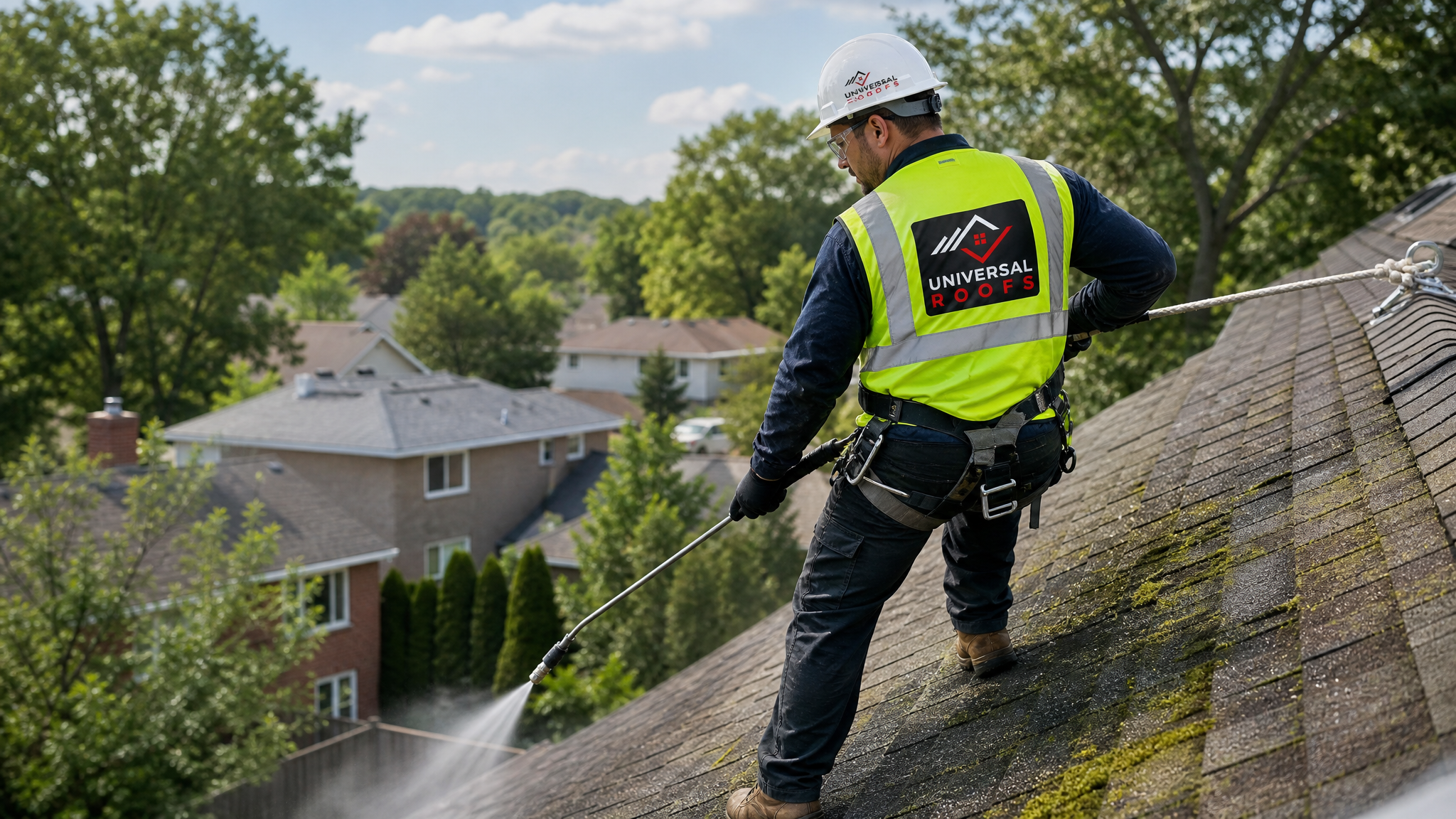
Beyond fall-arrest harnesses, a complete PPE list for roof cleaning work includes several items that are easy to overlook when the job is framed as “just cleaning” rather than construction work:
- A hard hat, particularly relevant when a second person is working below or when debris (branches, old shingle granules, gutter debris) may fall during the process
- Non-slip, soft-soled footwear with good tread — steel-toe boots designed for roofing work grip differently than standard work boots and matter more on a wet surface than on a dry repair job
- Splash-rated eye protection, not standard safety glasses, whenever chemical solution is in use
- Chemical-resistant gloves rated for the specific cleaning agent, changed if they show signs of degradation
- A properly fitted respirator or mask when working in low-airflow areas such as tight valleys, or when concentrated fumes are a concern
- High-visibility clothing, especially useful when a crew is working with a ground-support person managing hoses, ropes, or a safety monitor role
Weather-appropriate layering also matters more than people expect. Overheating in direct summer sun while wearing full PPE and a harness is a real contributor to fatigue-related mistakes, so scheduled breaks, hydration, and shaded staging areas for equipment are part of a genuinely complete safety plan.
Roof Surface Hazards Specific to Toronto Housing Stock
The GTA’s building stock spans more than a century of construction styles, and each era brings its own roof cleaning hazards. Older Toronto homes, particularly in neighbourhoods like Cabbagetown, Riverdale, and the Annex, often have steep, complex roof lines with multiple valleys, dormers, and sometimes original wood or slate elements mixed with later asphalt shingle re-roofing. These roofs demand more anchor points, more careful footing, and often specialized low-slope or steep-slope access equipment rather than a standard single-ladder setup.
Postwar bungalows and 1960s to 1980s suburban builds across Mississauga, Brampton, and Scarborough tend to have simpler, lower-pitch roof lines, which reduces fall risk somewhat but often means larger unbroken roof planes where moss can spread extensively in shaded, north-facing sections. Newer GTA builds increasingly include architectural shingle profiles with deeper shadow lines, which trap more organic debris in the recesses and can make full coverage during cleaning more time-consuming, extending total exposure time on the roof.
Flat and low-slope roofs, common on additions, garages, and increasingly on modern infill builds, present an entirely different hazard set. These require different footing considerations (ballasted membranes can shift underfoot) and different edge-protection needs, since there is often no gutter line or eave to signal the roof edge visually. Anyone maintaining a flat roofing system should treat parapet-less edges as a fall hazard requiring guardrails, warning lines, or harness anchor points, even though the walking surface itself feels more stable than a pitched roof.
Working Around Skylights, Vents, and Roof Penetrations
Roof penetrations deserve their own mention because they are a common source of both slip hazards and structural surprises during cleaning. Skylights, particularly older single-pane or aging double-pane units, can be more fragile underfoot than the surrounding roof deck, and stepping on or too close to a skylight frame during cleaning has caused serious falls when the glazing or frame failed under weight it was never designed to bear.
Anyone cleaning around a skylight should treat the unit as a no-step zone, working around rather than over it, and should inspect flashing and seals visually during the cleaning pass since this is often the easiest time to spot early signs of failure that would otherwise require a separate skylight replacement inspection later. Plumbing stacks, bathroom exhaust vents, and roof-mounted mechanical equipment similarly should never be used as handholds or footholds, since they are typically only lightly secured to the deck and not load-rated for a person’s full weight.
Gutters deserve the same caution. Leaning on a gutter for balance, or worse, using it as a step, is one of the most common causes of falls during cleaning specifically, because gutters look sturdy but are fastened with hangers rated for the weight of water and debris, not a person.
| Roof Feature | Common Cleaning Hazard | Safe Practice |
|---|---|---|
| Skylights | Stepping on frame or glazing causes fall-through risk | Treat as no-step zone; clean edges only from adjacent decking |
| Gutters and eaves | Used as handhold or step; hangers not load-rated for body weight | Never bear weight on gutters; use ladder stabilizers instead |
| Roof vents and stacks | Lightly fastened; can shear off under load | Avoid using as handholds; step around, not on |
| Valleys and dead valleys | Concentrated moisture and debris; extra slippery when wet | Clean last, use extra footing caution, avoid standing directly in valley |
| Chimney flashing | Not a rated anchor point despite looking sturdy | Use rafter-anchored fall protection only, never chimney straps |
When to Call a Professional Instead of DIY Cleaning
There is a reasonable case for a homeowner clearing debris from a single-storey, low-pitch roof from a stable ladder without ever stepping onto the roof surface itself. Beyond that scenario, the balance of risk shifts quickly toward hiring a professional, and it is worth being honest about where that line sits.
Any roof steeper than roughly 6:12 pitch, any roof requiring chemical application rather than simple debris clearing, any two-and-a-half or three-storey home where a fall distance becomes life-threatening rather than merely injurious, and any roof with skylights, multiple valleys, or existing damage are all situations where professional equipment, training, and insurance meaningfully change the risk profile. Licensed roofing contractors carry liability insurance specifically for height work, use commercial-grade fall-protection systems anchored correctly into the structure, and know how to read early warning signs — soft decking, lifted shingle tabs, deteriorating flashing — that an untrained eye will miss during a cleaning pass.
There is also a maintenance-history benefit to using the same trusted contractor for cleaning that you would use for repairs. A crew that has serviced a roof before knows its quirks — where the soft spots are, which valley collects the most debris, where a previous repair was made — and can flag developing issues before they become a leak. Homeowners across Toronto, Peel Region, York Region, Halton Region, and Durham Region often find that a combined cleaning-and-inspection visit is more cost-effective than treating the two as separate services, since much of the access setup and time on the roof is shared between both tasks.
Recommended Safety Equipment Checklist by Task
Different stages of a roof cleaning project call for different combinations of protective gear. The table below summarizes the minimum equipment recommended for each stage of the job.
| Task Stage | Required PPE | Additional Equipment | Skill Level Needed |
|---|---|---|---|
| Ground-level inspection | Sturdy footwear, work gloves | Binoculars, ladder stabilizer | Homeowner-friendly |
| Ladder access to roof edge | Hard hat, gloves, non-slip footwear | Ladder stabilizer, second person spotting | Caution advised |
| Working on the roof surface | Harness, anchor point, non-slip roofing shoes, safety glasses | Safety rope, roof brackets | Professional recommended |
| Applying cleaning chemicals | Chemical-resistant gloves, eye protection, respirator mask | Ventilated container, rinse water on hand | Professional recommended |
| Working near skylights or edges | Full harness system, hard hat | Guardrail or warning line system | Professional required |
This checklist reinforces a simple point: as the task moves from ground-level observation to actual roof-surface work, the required equipment and skill level both increase substantially, which is exactly why most GTA homeowners are better served scheduling a professional cleaning rather than assembling this gear themselves for a once-a-year job.
Post-Cleaning Inspection and Ongoing Maintenance
Safety precautions do not end when the last section of roof has been rinsed. A thorough post-cleaning walk-through, ideally from the ground with binoculars plus a careful visual check from the access ladder, should confirm that no shingle tabs were lifted or displaced, no granules were visibly stripped in streaks (a sign pressure was too high), gutters are running clear rather than clogged with dislodged moss and debris, and flashing around chimneys, skylights, and vents still sits flush and undisturbed.
Any tab that has lifted or cracked during the cleaning process should be resealed or replaced promptly, since a lifted tab left exposed through a windy Toronto autumn is an open invitation for wind-driven rain to get underneath. This is also the right moment to check the attic from the inside for any new signs of moisture intrusion, particularly if pressure washing was used at any point, since trapped moisture under shingles does not always show as an immediate exterior leak.
Ongoing prevention is far cheaper than repeat cleaning. Zinc or copper control strips installed along the ridge release trace metal ions with each rainfall that inhibit algae and moss regrowth for years, trimming overhanging tree branches reduces the shade and debris that feed moss growth in the first place, and keeping gutters clear year-round prevents the standing moisture that gives algae a foothold at the eaves. A well-maintained roof, checked twice a year and cleaned as needed rather than left until streaking is severe, requires gentler cleaning methods each time and carries lower risk with every visit.
What are the top safety precautions for roof cleaning and maintenance?
Is pressure washing safe for cleaning an asphalt shingle roof?
What safety gear is required for roof cleaning at height?
When is the best time of year to clean a roof in Toronto?
Can I clean my roof myself or should I hire a professional?
How do I know if roof cleaning has damaged my shingles?
Need Help With Roof Cleaning Top Safety?
Roof cleaning done safely protects both the people doing the work and the roof itself, and getting it wrong on either front can be costly. Universal Roofs brings trained crews, proper fall-protection equipment, and shingle-safe soft-wash methods to every cleaning and maintenance visit, so you get a roof that looks clean and stays sound.
Call us today at (416) 732-2421 or request a free inspection to get started.
Universal Roofs proudly serves Toronto, Mississauga, Brampton, Vaughan, Markham, Oakville and the GTA since 2005.