
If your attic feels like a sauna in July or your shingles seem to be curling years ahead of schedule, poor airflow above your ceiling could be the culprit. Understanding the benefits of roof ventilation is one of the most overlooked ways Toronto homeowners can protect their roof investment, cut cooling costs, and avoid costly moisture damage.
A properly ventilated attic works like a chimney: cooler air is drawn in through intake vents at the eaves, moves across the underside of the roof deck, and exits through exhaust vents near the ridge. This continuous exchange keeps attic temperatures closer to outdoor conditions year-round, which matters enormously in a climate like the GTA’s, where summer heat waves and winter freeze-thaw cycles both put stress on a roof system.
At Universal Roofs, we’ve inspected thousands of attics across Toronto, Mississauga, Brampton, and the surrounding regions since 2005, and ventilation problems are among the most common — and most fixable — issues we find. This guide breaks down exactly why ventilation matters, how to tell if yours is failing, and what a correctly balanced system looks like.
What Roof Ventilation Actually Does
Roof ventilation is a system, not a single component. It relies on a balance of intake (usually soffit vents along the lowest edge of the roof) and exhaust (ridge vents, roof vents, or gable vents near the peak). Air enters low, warms as it rises, and exits high, carrying heat and moisture out of the attic space continuously.
When this balance exists, several things happen simultaneously: attic temperatures drop closer to outdoor ambient levels, moisture from everyday household activities (showers, cooking, laundry) is carried outside instead of condensing on the underside of the roof deck, and the temperature of the roof deck itself stays more consistent from eave to ridge. Each of these outcomes directly supports the core benefits of roof ventilation that we cover below.
Without balanced airflow, attics can reach 60°C or higher on a hot July afternoon, and in winter, trapped moist air condenses on cold surfaces, creating conditions for wood rot, mould, and ice damming. Neither extreme is good for the structure sitting above your family’s heads.
The Core Benefits of Roof Ventilation
Homeowners often ask us to explain, in plain terms, what they actually gain by upgrading or repairing their attic ventilation. Here is the honest breakdown, based on what we see in the field across the GTA.
1. Longer shingle lifespan. Asphalt shingles are rated by manufacturers assuming adequate attic ventilation. Excess heat trapped under the roof deck accelerates the breakdown of asphalt oils, causing premature curling, cracking, and granule loss. A shingle rated for 25-30 years can fail in half that time in a poorly ventilated attic that regularly bakes at extreme temperatures through Toronto summers.
2. Lower cooling costs in summer. A superheated attic radiates heat downward into living spaces below, forcing your air conditioner to work harder. Homeowners who correct ventilation problems often notice a measurable drop in summer cooling bills, particularly in homes with finished space directly under the roof.
3. Prevention of ice damming in winter. This is arguably the single biggest reason GTA homeowners should care about ventilation. When warm attic air escapes through the roof deck (because the attic is too hot due to poor ventilation and inadequate insulation), it melts snow on the upper roof. That meltwater runs down and refreezes at the cold eaves, building an ice dam that forces water backward under the shingles and into the home. Balanced ventilation keeps the roof deck cold and uniform, so snow melts evenly from the sun rather than from heat loss.
4. Moisture and mould control. Attics accumulate humidity from bathroom exhaust fans that terminate in the attic instead of outside, from cooking, and from normal air leakage through ceiling penetrations. Ventilation carries that moisture out before it condenses on rafters, sheathing, and insulation, which is critical for preventing wood rot and mould growth that can compromise indoor air quality.
5. Protection of structural wood components. Roof decking and rafters exposed to chronic condensation soften over time, lose nailing strength, and can eventually require full replacement. Good airflow keeps wood moisture content low and stable.
6. Extended service life of insulation. Damp insulation loses much of its R-value. Ventilation that keeps the attic dry protects your insulation investment and keeps your home’s thermal envelope performing as designed.
7. Reduced risk of warranty voids. Most shingle manufacturers require documented minimum ventilation ratios for their warranties to remain valid. A roof installed without adequate intake and exhaust balance may have a shortened or void warranty even if installation workmanship was flawless.
How to Tell If Your Attic Is Poorly Ventilated
Most ventilation problems are invisible from the street. Here are the signs we tell Toronto homeowners to watch for, inside and out.
- Ice dams or icicles forming along the eaves in winter, even on modestly sloped roofs
- Visible frost or condensation on the underside of the roof deck when you check the attic on a cold morning
- Musty odours or visible mould spots on rafters, sheathing, or insulation paper
- Shingles that appear to be curling, cracking, or losing granules well ahead of their rated lifespan
- Noticeably hotter upstairs rooms in summer compared to the rest of the house
- Soffit vents that are painted over, blocked by insulation, or covered by bird nests
- Higher-than-expected summer cooling bills relative to comparable homes nearby
If any of these sound familiar, it’s worth having a professional assessment. Our team can evaluate your attic as part of a broader roof repair visit or a standalone attic inspection through our attic services.
Types of Roof Ventilation Systems
Not every ventilation system looks the same, and the right combination depends on your roof’s shape, attic layout, and existing intake capacity. The table below compares the most common options we install and service across the GTA.
| Vent Type | Function | Typical Location | Best For |
|---|---|---|---|
| Soffit vents | Intake — draws cool outdoor air in | Underside of roof eaves | Nearly every home; foundational intake source |
| Ridge vents | Exhaust — continuous outlet along the peak | Along the roof ridge | Homes with a clear ridge line and adequate soffit intake |
| Roof (box/turtle) vents | Exhaust — passive outlet points | Scattered across upper roof slopes | Roofs without a usable ridge or as a ridge vent supplement |
| Gable vents | Exhaust or cross-ventilation | Triangular wall sections at roof ends | Older homes with gable-end attics |
| Powered attic fans | Active exhaust, thermostat or humidity controlled | Roof deck or gable wall | Attics with limited natural airflow options |
| Baffles (rafter vents) | Keeps intake path clear at eaves | Installed between rafters at soffit | Homes with insulation prone to blocking soffit intake |
In practice, most Toronto-area homes perform best with a combination of continuous soffit intake and ridge vent exhaust, supplemented with baffles to keep insulation from blocking the intake path. Powered fans can help in tricky layouts but should never be used as a substitute for adequate passive intake — running a powered fan without enough intake can actually pull conditioned air out of the living space instead of attic air, increasing energy costs.
Balancing Intake and Exhaust: The Math That Matters
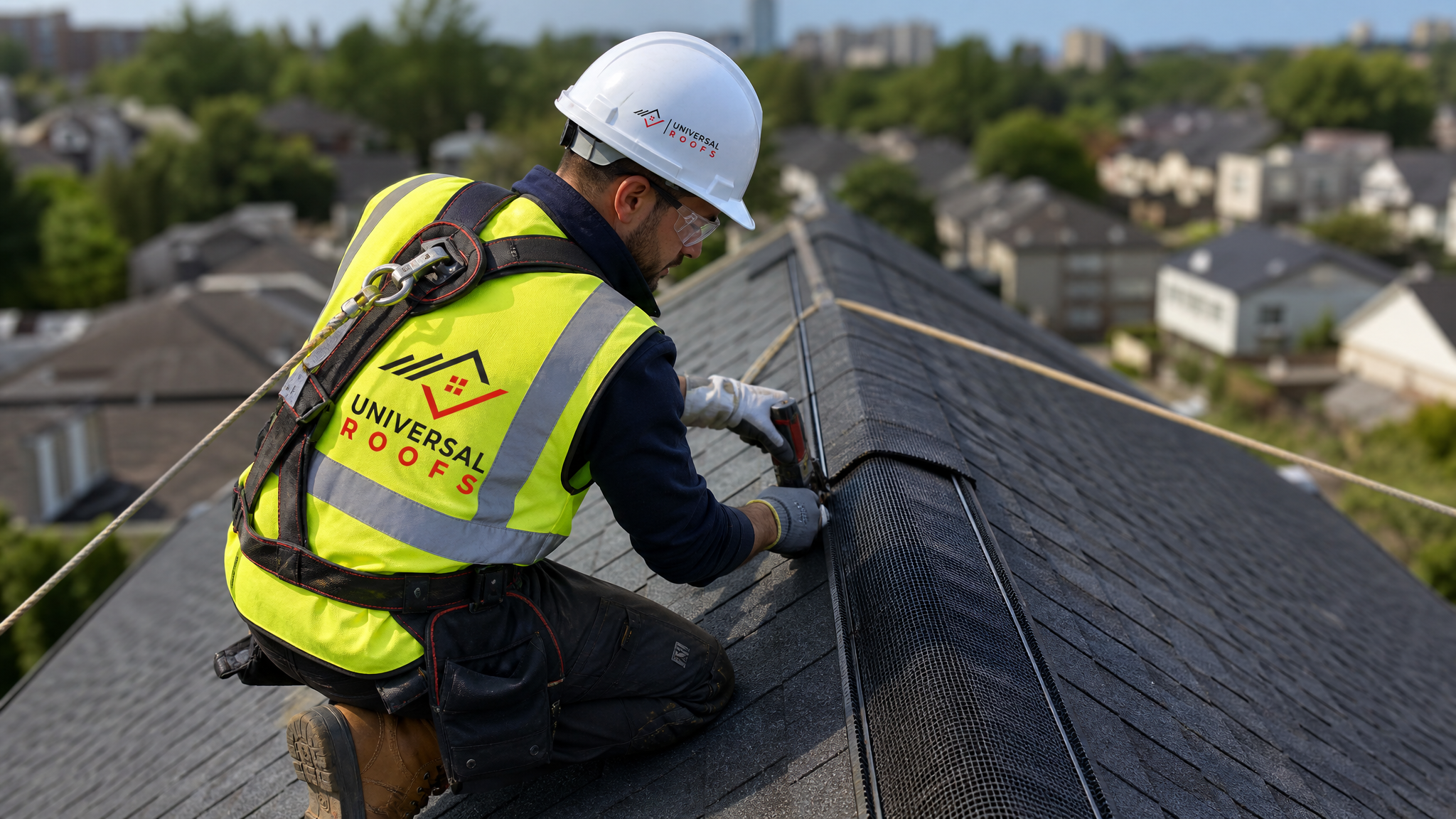
Ventilation isn’t just about adding more vents — it’s about balance. Building codes and manufacturer guidelines generally call for a minimum ratio of net free ventilation area (NFVA) to attic floor area, commonly around 1:300 when a vapour barrier is present, or 1:150 without one. Just as important is the split between intake and exhaust: most roofing professionals aim for a roughly 50/50 balance, or slightly more intake than exhaust, so exhaust vents aren’t starved for air.
Common mistakes we see during inspections include exhaust vents installed with no matching soffit intake (which can actually pull conditioned indoor air into the attic through ceiling gaps), insulation stuffed directly against the roof deck blocking the soffit-to-attic airflow path, and mixing ridge vents with gable vents or powered fans in a way that short-circuits the intended airflow pattern. Getting this right typically requires a site-specific assessment rather than a generic rule of thumb, which is why we recommend a professional evaluation before adding or modifying vents.
Roof Ventilation and Ice Dams: A Toronto-Specific Concern
Few climates make the case for proper ventilation as clearly as the GTA’s freeze-thaw winters. Toronto sees repeated cycles of snowfall, partial melting, and refreezing throughout the winter months, and an attic that isn’t cold and dry makes every one of those cycles worse.
Here’s the mechanism in simple terms: heat escaping from living space into an under-insulated or poorly ventilated attic warms the underside of the roof deck unevenly. Snow near the ridge melts from that trapped heat, while snow at the cold eaves stays frozen. The meltwater runs down, hits the cold eave section, and refreezes into an ice dam. Once that dam forms, subsequent meltwater has nowhere to go but backward, under the shingles, and potentially into the attic or ceiling below.
Ventilation alone won’t solve an ice dam problem if insulation is also inadequate — the two systems work together. But a cold, well-ventilated attic combined with proper attic insulation is the most reliable long-term prevention strategy, far more effective than reactive measures like heat cables or manual snow removal after a storm.
Ventilation Upgrades vs. Full Roof Replacement
Homeowners often want to know whether ventilation issues can be fixed on their own, or whether they signal a need for more extensive roofing work. The answer depends on the condition of the existing roof deck, shingles, and how long the problem has gone unaddressed.
| Scenario | Recommended Approach | Typical Timeline | Relative Cost |
|---|---|---|---|
| Roof and shingles in good condition, ventilation simply unbalanced | Add/adjust soffit and ridge venting during a service visit | 1 day | Low |
| Some shingle damage from heat, deck still sound | Targeted roof repair plus ventilation correction | 1-2 days | Low to moderate |
| Widespread shingle failure, minor deck softening | Roof replacement with ventilation redesign built in | 2-4 days | Moderate to high |
| Rotted decking, mould in attic, structural concerns | Deck replacement, full re-ventilation, possible insulation upgrade | 3-6 days | High |
| Flat or low-slope roof with condensation issues | Specialized venting compatible with flat roofing systems | 1-3 days | Moderate |
If you’re already planning a re-roof, it’s the ideal time to correct ventilation deficiencies, since the roof deck is fully exposed and adding soffit baffles, ridge vents, or additional intake is far more straightforward than retrofitting through a finished roof.
Ventilation Considerations for Skylights and Flat Roofs
Homes with skylights or flat/low-slope sections need extra attention. Skylight wells can interrupt the natural airflow path between soffit and ridge, so proper flashing and, in some cases, dedicated venting around the skylight shaft are necessary to avoid trapped condensation. If you’re considering a new skylight installation or are due for a skylight replacement, ask about how the ventilation path around the unit will be maintained.
Flat roofs work differently since they typically lack the traditional soffit-to-ridge airflow of a pitched roof. Instead, they rely on tapered insulation systems, vapour barriers, and sometimes mechanical venting to manage condensation. If you have a low-slope section combined with a pitched attic, it’s worth having both systems assessed together, since moisture from one area can sometimes migrate into the other.
Seasonal Timing: Why Summer Is a Good Time to Address Ventilation
While ice damming is a winter symptom, mid-summer is actually one of the best times to correct ventilation problems in the GTA. Attics are at their hottest right now, which makes it easy for a technician to confirm whether airflow is adequate, locate blocked soffit vents, and measure real-world temperature differentials. Correcting the system now — before autumn leaf debris clogs intake vents and before the first snowfall — means your attic goes into winter already balanced, reducing the odds of ice dams and condensation issues months from now.
It also means any shingle or deck damage caused by a hot attic this summer gets addressed before winter moisture has a chance to make it worse.
DIY Checks vs. Professional Assessment
There’s a limit to what a homeowner can safely and accurately evaluate. Below is a comparison of what you can reasonably check yourself versus what warrants a professional visit.
| Task | DIY Feasible? | Tools Needed | When to Call a Professional |
|---|---|---|---|
| Visual check for blocked soffit vents from outside | Yes | None (binoculars helpful) | If vents appear painted over or covered by debris |
| Attic walkthrough for frost, mould, or odours | Partially | Flashlight, mask | Any visible mould, soft decking, or structural concerns |
| Measuring net free ventilation area | No | Specialized calculations | Always — requires professional measurement and code knowledge |
| Installing additional roof or ridge vents | No | Roofing tools, fall protection | Always — improper cuts can void warranty or cause leaks |
| Diagnosing recurring ice dams | No | Thermal imaging, attic assessment | Always — requires combined insulation and ventilation analysis |
We always recommend leaving vent installation and cutting into an existing roof deck to licenced professionals. Improperly sized or placed vents can do more harm than good, including creating new leak points or violating manufacturer warranty terms.
Working With a Professional Roofing Team
Ventilation problems rarely show up in isolation — they’re often connected to insulation gaps, flashing issues, or the general age and condition of the roofing system. That’s why we approach every ventilation assessment as part of a broader look at the roof and attic together, rather than treating vents as an isolated add-on.
Our technicians serve homeowners throughout Toronto, Peel Region, York Region, Halton Region, and Durham Region, and we’ve seen how differently ventilation needs can play out depending on roof age, attic design, and even how a home’s soffits were originally built. You can read about other homeowners’ experiences with our team on our reviews page, and browse common questions on our FAQ page.
We’ve also put together more background on who we are and how long we’ve been serving the GTA on our about page, if you’d like to learn more before booking an assessment.
Maintaining Ventilation Once It’s Corrected
Ventilation isn’t a one-time fix — it needs occasional upkeep to keep performing. A few habits go a long way:
- Clear leaves and debris from soffit vents each autumn and after major windstorms
- Avoid adding insulation that blocks the soffit-to-attic airflow path during future upgrades
- Check bathroom and kitchen exhaust fans terminate outside the attic, not inside it
- Schedule a periodic attic check during routine roof inspections, especially after severe weather
- Watch for new ice dams each winter as an early warning sign that something has shifted
A quick annual check, ideally paired with a general roof inspection, is usually enough to keep a properly designed system working as intended for the life of the roof.
What are the benefits of roof ventilation for a Toronto home?
How do I know if my attic ventilation is inadequate?
What is the ideal ratio of intake to exhaust ventilation?
Can poor roof ventilation cause ice dams?
Does roof ventilation affect my shingle warranty?
Is summer a good time to fix roof ventilation problems?
Need Help With What Are the Benefits?
Proper attic airflow protects everything from your shingles to your ceilings, and it’s one of the most cost-effective upgrades a homeowner can make. Universal Roofs has been assessing and correcting ventilation systems across the GTA since 2005, and we can tell you exactly where your attic stands in under an hour.
Call us today at (416) 732-2421 or request a free inspection to get started.
Universal Roofs proudly serves Toronto, Mississauga, Brampton, Vaughan, Markham, Oakville and the GTA since 2005.