
If your flat or low-slope roof is nearing the end of its lifespan, ripping off the old membrane and starting from scratch isn’t always the only option. A growing number of Toronto and GTA property owners are choosing seamless roof coatings instead, and for good reason. A properly applied seamless coating can add 10 to 15 years of protection to an existing roof at a fraction of the cost and disruption of a full tear-off and replacement.
At Universal Roofs, we’ve been coating, repairing, and replacing roofs across the Toronto area since 2005, and we get the same question almost every week: is a seamless roof coating actually worth it, or is it just a temporary patch dressed up in marketing language? The honest answer is that when a roof is a good candidate, the benefits are substantial and measurable. When it isn’t a good candidate, no amount of coating will fix underlying structural problems.
This guide breaks down exactly what seamless roof coatings are, the real benefits they deliver, how they compare to other options, and how to know whether your roof is a good fit. We’ll also cover cost ranges, application methods, maintenance expectations, and the questions our estimators hear most often on job sites from Etobicoke to Markham.
What Is a Seamless Roof Coating?
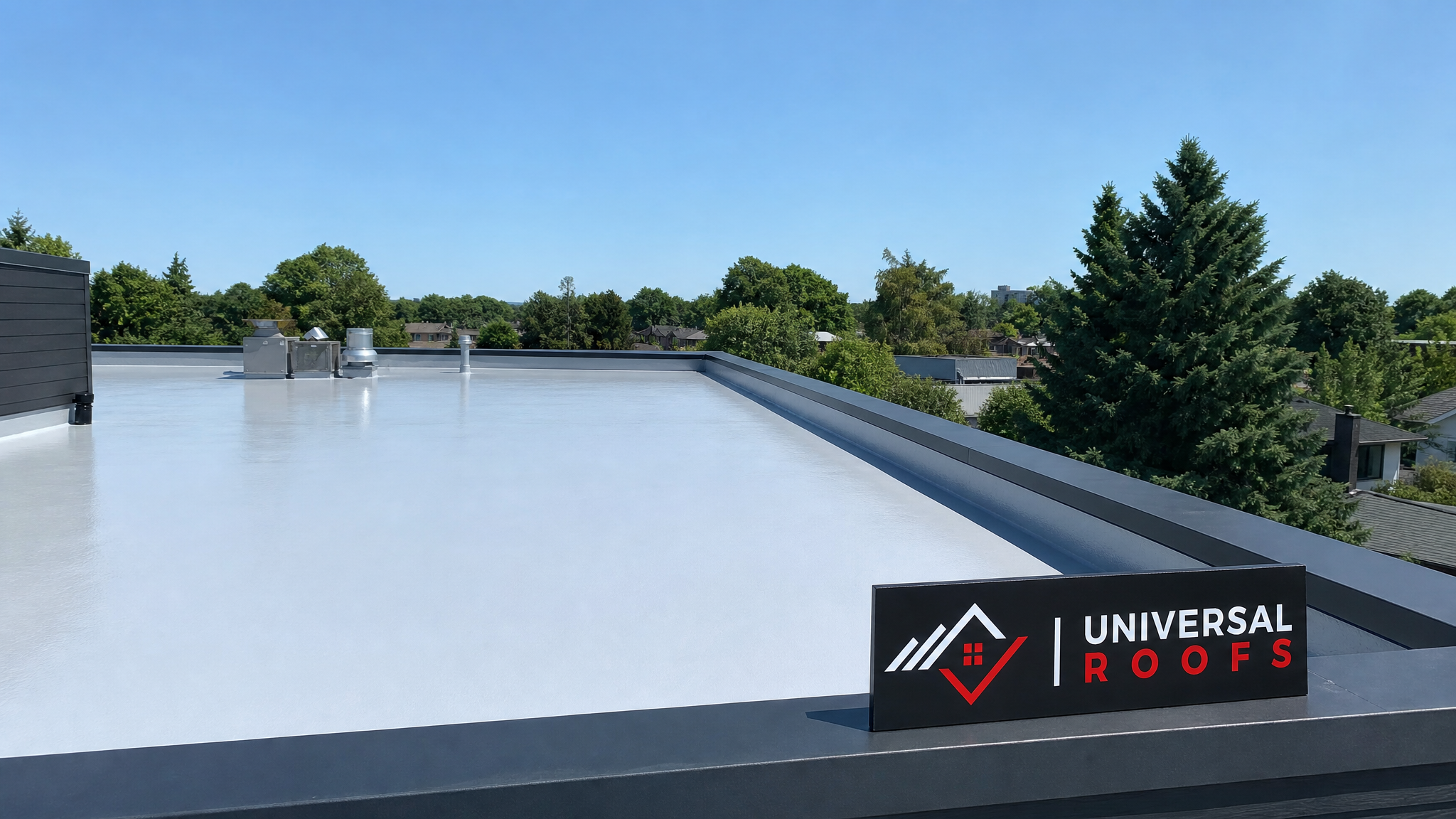
A seamless roof coating is a fluid-applied membrane that’s sprayed, rolled, or squeegeed directly onto an existing roof surface, where it cures into a single continuous layer with no laps, seams, or fasteners. Unlike traditional roofing systems built from overlapping sheets, shingles, or membrane rolls, a seamless coating forms one monolithic skin that follows every contour, penetration, and drain on the roof.
This is the core reason seamless coatings perform so well on flat and low-slope roofs. Traditional flat roofing is a system of joints: seams between membrane sheets, seals around vents and skylights, flashing details at parapet walls. Every joint is a potential entry point for water. A seamless coating eliminates that vulnerability by chemically bonding into one continuous surface, so there’s no seam to fail, no lap to lift in the wind, and no fastener to back out over time.
Common seamless coating chemistries used on Toronto roofs include silicone, acrylic, polyurethane, and elastomeric coatings. Each has different strengths depending on ponding water tolerance, UV exposure, foot traffic, and the substrate underneath (modified bitumen, EPDM, built-up roofing, or metal). Our flat roofing team assesses substrate condition first, because the coating is only as good as what it’s bonded to.
The Core Benefits of Seamless Roof Coatings
Homeowners and property managers choose seamless coatings for a combination of financial, performance, and environmental reasons. Here are the benefits that consistently show up in the field.
1. Extends Roof Life Without a Full Replacement
The single biggest draw is lifespan extension. A roof that’s showing surface wear, minor cracking, or the early stages of membrane fatigue, but that still has sound decking and insulation underneath, can often be restored rather than torn off. In our experience across Toronto, Mississauga, and Vaughan properties, a well-installed coating system adds another 10 to 15 years of service life to a roof that might otherwise need full replacement within 2 to 5 years.
2. Genuinely Seamless — No Weak Points
Because the coating cures as one continuous membrane, there are no overlapping seams for water to work its way under. This matters enormously in freeze-thaw climates like the GTA, where trapped moisture that freezes and expands is one of the most common causes of membrane failure. A seamless surface removes that failure mode almost entirely.
3. Reflects Heat and Lowers Cooling Costs
Most seamless coatings, especially white acrylic and silicone formulations, have high solar reflectance and thermal emittance. On a hot July afternoon, an uncoated dark membrane can reach surface temperatures well above 70°C, while a reflective coated roof stays dramatically cooler. That translates into lower attic and top-floor temperatures and a measurable reduction in air conditioning demand during Toronto summers. If you’re also managing attic heat buildup, our attic ventilation services pair well with a reflective coating project.
4. Minimal Disruption Compared to Tear-Off
A tear-off and full roof replacement means dumpsters, debris, noise, and days of exposed roof deck. A coating project, by comparison, is applied directly over the cleaned and prepared existing surface. There’s no demolition, no landfill waste from tear-off debris, and significantly less noise and disruption for occupants, tenants, or neighbours.
5. Lower Upfront Cost
Because a coating restoration uses far less material and labour than a full replacement, the upfront cost is typically 30 to 60 percent lower per square metre than tearing off and reinstalling a new roof system. For commercial property owners managing large flat roof areas, that difference can represent tens of thousands of dollars in capital deferred.
6. Waterproofing and Ponding Water Resistance
Many flat roofs in the GTA develop ponding water due to minor deck deflection or inadequate slope to drains. Silicone and certain elastomeric coatings are specifically formulated to withstand prolonged ponding without breaking down, unlike some traditional membranes that degrade quickly under standing water. A coating applied correctly, with attention to drainage detailing, can significantly reduce recurring ponding issues.
7. Environmentally Lower Impact
Restoring a roof with a coating instead of a full replacement keeps the existing membrane, insulation, and decking out of the landfill. It also typically involves lower embodied energy than manufacturing and transporting an entirely new roofing system. For property owners tracking sustainability targets, roof coating restoration is one of the more straightforward wins available.
Types of Seamless Roof Coatings Compared
Not every coating chemistry suits every roof. The table below outlines the main categories our estimators evaluate for GTA properties.
| Coating Type | Best For | Ponding Water Tolerance | Typical Lifespan |
|---|---|---|---|
| Silicone | Roofs with existing ponding water issues | Excellent | 15-20 years |
| Acrylic (white/reflective) | Sloped or well-drained roofs, heat reduction focus | Fair (not recommended for standing water) | 10-15 years |
| Polyurethane | High foot traffic, mechanical durability | Good | 12-18 years |
| Elastomeric (butyl/rubber-based) | Flexible substrates, wide temperature swings | Good | 10-15 years |
Seamless Coating vs. Full Roof Replacement
The decision between coating and replacement comes down to the condition of what’s underneath the surface. A coating restores and protects; it cannot fix rotted decking, saturated insulation, or structural sag. Here’s how the two approaches compare on the factors that matter most to owners.
| Factor | Seamless Roof Coating | Full Roof Replacement |
|---|---|---|
| Upfront cost | 30-60% lower per square metre | Higher, full system cost |
| Disruption level | Low — no tear-off or demolition | High — dumpsters, noise, exposed deck |
| Added lifespan | 10-15 years typically | 25-40+ years depending on system |
| Best candidate condition | Sound deck and insulation, surface-level wear only | Saturated insulation, rotted deck, structural issues |
| Environmental impact | Lower — existing materials retained | Higher — full tear-off and disposal |
If you’re unsure which category your roof falls into, an inspection is the only reliable way to know. Our roof repair team can identify whether isolated repairs, a full coating restoration, or replacement is the right path before any work begins.
Is Your Roof a Good Candidate for a Seamless Coating?
A coating restoration only performs as promised if the roof underneath is structurally sound. Before recommending a coating, we look for the following:
- No saturated or waterlogged insulation beneath the membrane
- No significant deck deflection, rot, or delamination
- Existing membrane is cracked, chalking, or UV-degraded but still intact
- Drains and scuppers are functional or can be corrected during prep
- Fewer than two prior roofing layers already in place
If any of these red flags are present, particularly saturated insulation, a coating will trap moisture rather than solve the problem, and a full roof replacement becomes the more responsible recommendation. This is why every legitimate coating project should start with a moisture scan and a physical inspection, not just a visual walk-around.
The Seamless Coating Application Process
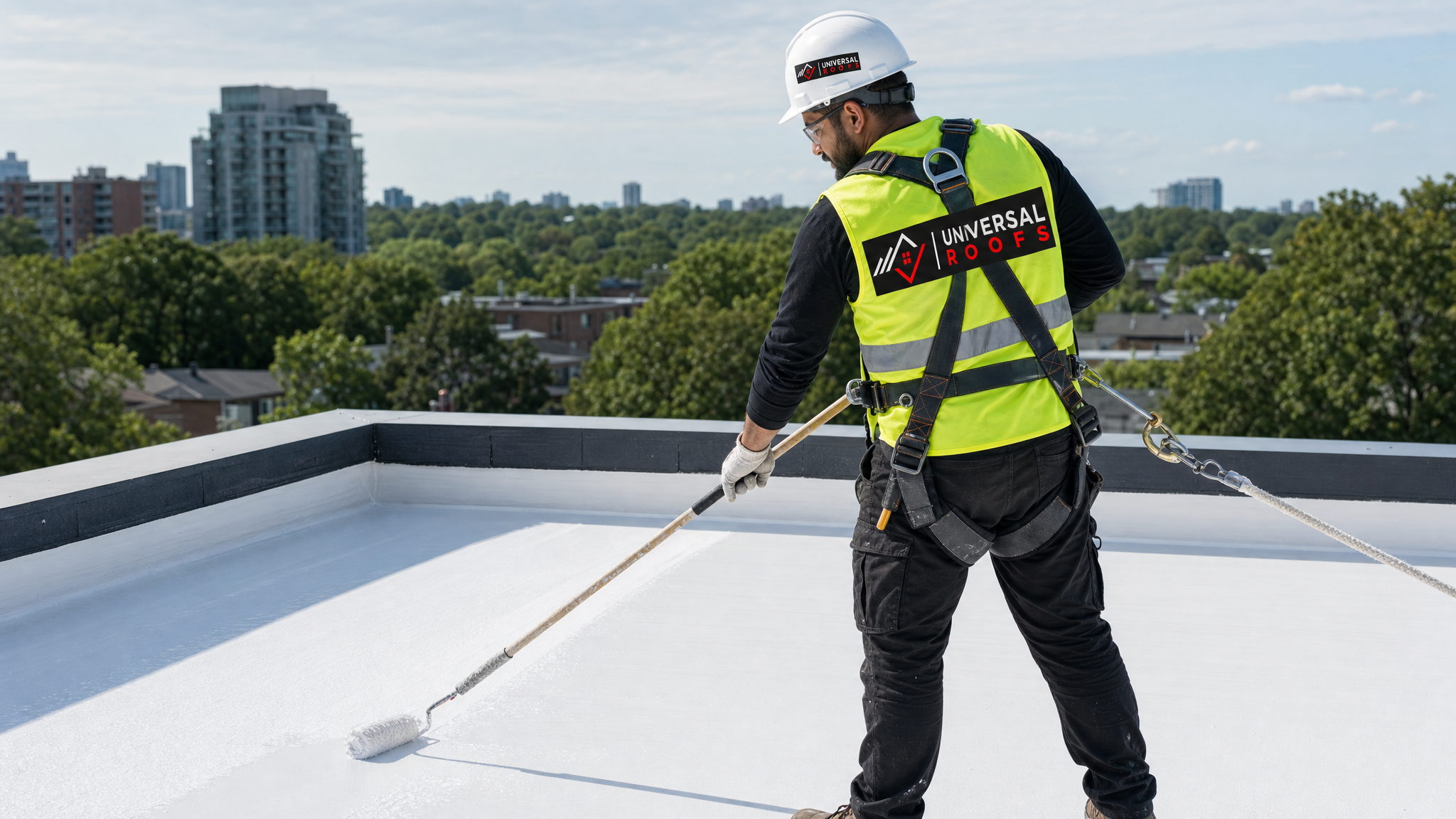
A durable coating job depends far more on surface preparation than on the coating product itself. Here’s the general sequence our crews follow on GTA flat roof projects.
| Step | What Happens | Why It Matters |
|---|---|---|
| 1. Inspection and moisture scan | Infrared or capacitance moisture testing across the field | Identifies wet insulation that must be addressed before coating |
| 2. Cleaning and pressure washing | Removes dirt, chalking, algae, and loose debris | Coatings need a clean substrate to properly bond |
| 3. Repairs and detailing | Patch splits, reseal flashing, correct minor ponding areas | A coating can’t bridge existing structural gaps |
| 4. Primer application (if required) | Bonding primer applied to certain substrates | Improves adhesion on modified bitumen or metal |
| 5. Base coat application | First fluid-applied layer, often reinforced at seams and penetrations | Builds the waterproofing foundation |
| 6. Top coat application | Final reflective layer applied at manufacturer-specified thickness | Provides UV protection and finished appearance |
| 7. Final inspection | Thickness verification and detail check at drains, curbs, and edges | Confirms coverage meets warranty requirements |
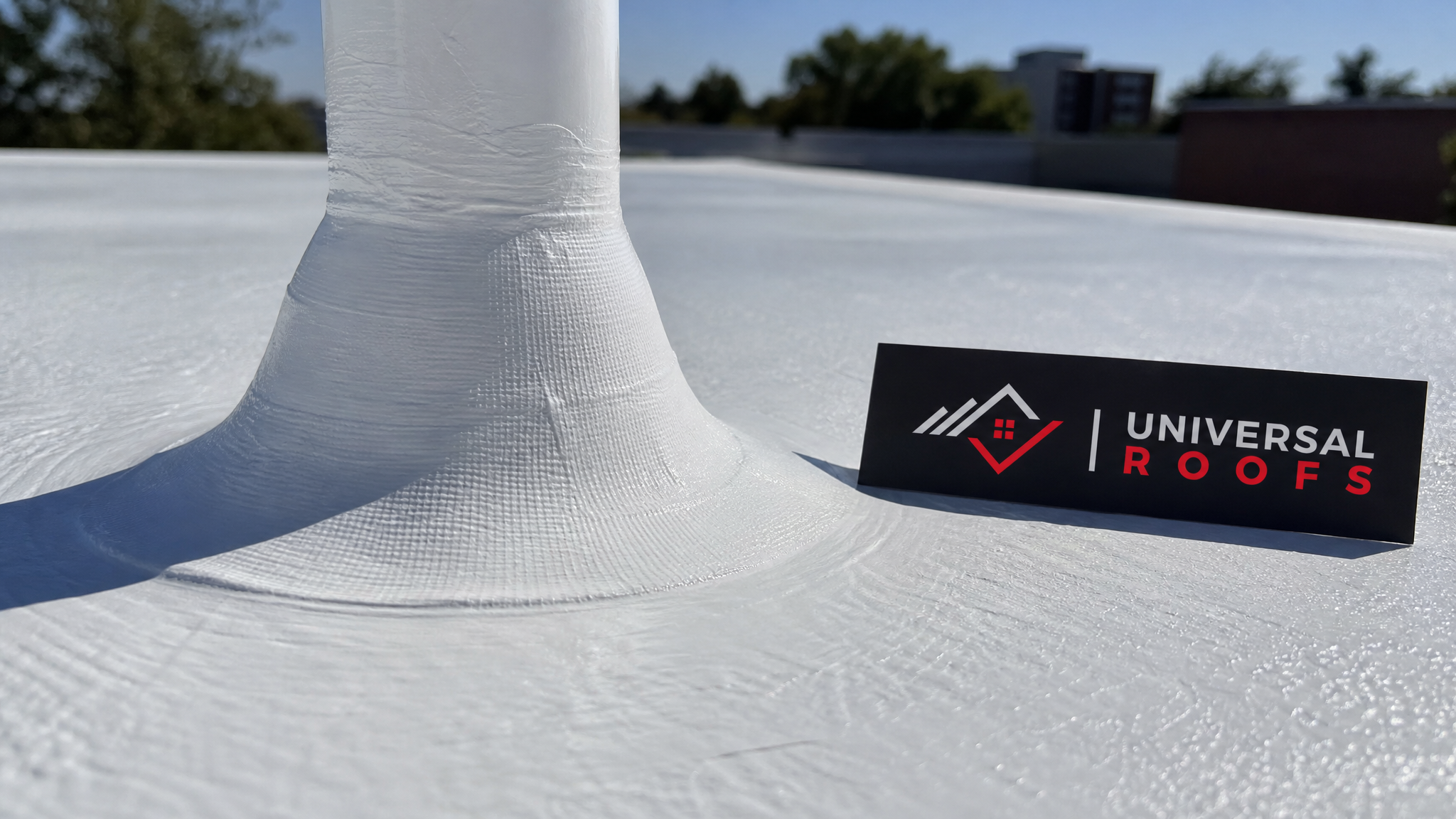
Reinforcing fabric is typically embedded at seams, drains, and penetrations — the highest-stress points on any flat roof — before the top coat goes down. Skipping this step is one of the most common shortcuts that leads to premature coating failure, so it’s worth asking any contractor directly whether reinforcement is included in the scope.
Cost Considerations for GTA Property Owners
Coating costs vary based on roof size, substrate condition, coating chemistry, and how much prep and repair work is needed before application. As a general guide for Toronto-area flat roofs:
- Acrylic coatings tend to be the most budget-friendly option for roofs with good drainage
- Silicone coatings cost more per square metre but are the right investment for roofs with chronic ponding
- Extensive prep and repair work (deteriorated flashing, multiple penetrations, deck repairs) can add meaningfully to the total
- Warranty length generally scales with coating thickness — thicker application, longer manufacturer warranty
Because pricing depends so heavily on roof-specific conditions, we always recommend an on-site assessment rather than a phone estimate. You can see how past projects turned out for other GTA property owners on our reviews page.
Maintenance and Long-Term Care
One underrated benefit of seamless coatings is how easy they are to maintain compared to traditional membrane systems. Because there’s no seam network to monitor, maintenance mostly comes down to keeping the surface clean and catching minor damage early.
| Maintenance Task | Recommended Frequency | Purpose |
|---|---|---|
| Visual inspection | Twice yearly (spring and fall) | Catch punctures, debris buildup, or coating wear early |
| Drain and scupper clearing | Seasonally, especially after autumn leaf drop | Prevent ponding from blocked drainage |
| Debris and moss removal | As needed | Prevents surface degradation and staining |
| Recoat/maintenance top coat | Every 8-10 years depending on coating type | Renews UV protection and extends total lifespan |
Regular maintenance is what allows a coated roof to reach the upper end of its lifespan range. Skipping inspections is the most common reason a coating underperforms its expected service life.
Common Problems and How Seamless Coatings Solve Them
Homeowners across Etobicoke, Scarborough, and the surrounding regions typically come to us with one of a handful of recurring flat roof problems. Seamless coatings address most of these directly:
- Ponding water: Silicone coatings resist breakdown under standing water far better than the aging membrane underneath
- UV degradation and chalking: A fresh reflective top coat renews UV protection and stops the surface from continuing to break down
- Seam failures: A seamless application removes the seam network entirely, eliminating the most common leak point on modified bitumen and built-up roofs
- Excess heat gain: Reflective white coatings can significantly reduce roof surface temperature and downstream cooling costs
- Minor cracking and surface wear: Reinforced coating application bridges hairline cracks and restores a continuous waterproof layer
If your roof also has aging skylights, it’s worth having those inspected at the same time as a coating project, since skylight curbs and flashing are common leak points that a roof-level coating alone won’t fully resolve. Our skylight replacement and skylights teams often work alongside our coating crews on combined projects.
Serving Property Owners Across the GTA
Seamless roof coating needs look a little different depending on the building stock and climate exposure in each part of the region. We regularly complete coating restorations for homeowners and commercial property managers in Toronto, Peel Region, York Region, Halton Region, and Durham Region. Because flat and low-slope roofs are common across both residential additions and commercial buildings throughout these areas, our crews see the full range of substrate conditions and can match the right coating system to each one.
Summer is genuinely the best season for coating work in this climate. Warm, dry conditions allow proper curing and adhesion, and completing the project before autumn rain and winter freeze-thaw cycles arrive maximizes the coating’s first-year performance.
What are the benefits of seamless roof coatings compared to a traditional membrane?
How long do seamless roof coatings last?
Can a seamless coating be applied over any existing roof?
Do seamless roof coatings actually reduce energy costs?
How much do seamless roof coatings cost compared to replacement?
Is a seamless roof coating a good fit for a flat roof with ponding water?
Need Help With What Are the Benefits?
Choosing between a coating restoration and a full replacement isn’t something to guess at from a photo or a rough estimate over the phone. The team at Universal Roofs inspects the substrate, checks for hidden moisture, and gives you a straight answer on whether a seamless coating will genuinely extend your roof’s life or whether replacement is the more responsible investment.
Call us today at (416) 732-2421 or request a free inspection to get started.
Universal Roofs proudly serves Toronto, Mississauga, Brampton, Vaughan, Markham, Oakville and the GTA since 2005.