
If your home inspector or roofer just told you that you have damaged roof decking (also called sheathing), you are probably wondering who is qualified to fix it and how to avoid getting overcharged or underserved. Roof decking repair is not a job for a general handyman or a shingle-only crew — it involves structural wood, moisture-damaged framing, and proper fastening patterns that affect the safety of everything installed above it. Hiring the wrong contractor can mean rot returning within a year, sagging rooflines, or a warranty that turns out to be worthless.
This guide walks through exactly what to look for when hiring a roof decking repair contractor in the Toronto area: the licensing and insurance you should demand, the red flags that signal a corner-cutting crew, how to read and compare quotes, and what a real workmanship warranty should say. Whether you found rot during a re-roof, after a leak, or during a home inspection, these tips will help you hire with confidence.
What Is Roof Decking and Why Does Repair Quality Matter So Much?
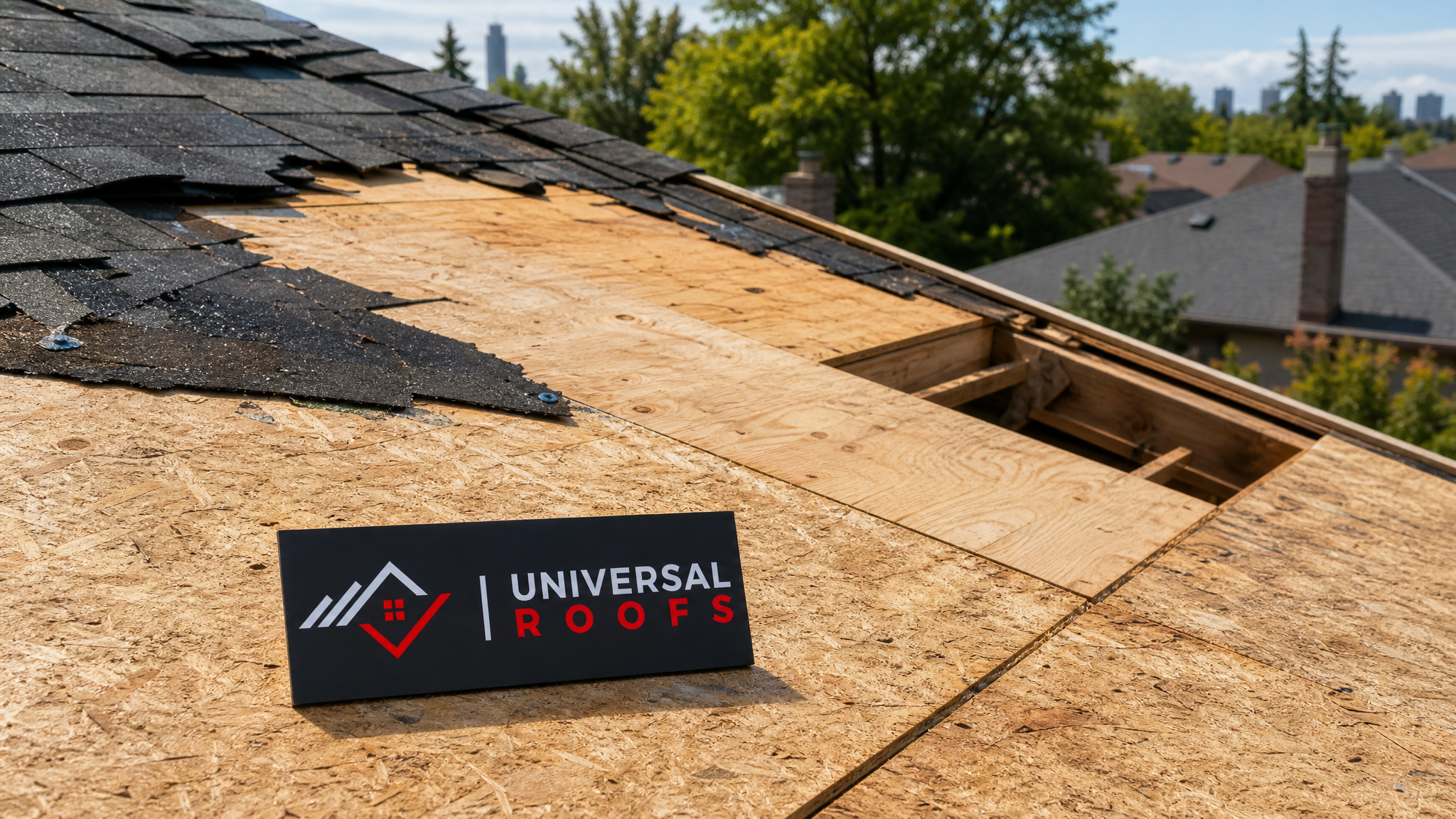
Roof decking (sheathing) is the layer of plywood or oriented strand board (OSB) fastened directly to your roof trusses or rafters. It is the structural platform that everything else — underlayment, shingles, flashing, skylights — sits on top of. When decking rots from a slow leak, ice damming, or poor attic ventilation, it loses its structural integrity. A soft, spongy, or delaminated deck can no longer hold fasteners securely, which means shingles blow off more easily and new leaks form faster than before.
Because decking repair happens underneath the visible roofing surface, it is one of the easiest places for a dishonest or inexperienced contractor to cut corners. Homeowners rarely see the finished deck once shingles go back down, so a contractor hoping to save time might reuse compromised wood, skip proper fastening spacing, or fail to address the moisture source that caused the rot in the first place. This is precisely why the vetting process for hiring a decking repair contractor deserves more scrutiny than choosing someone for a cosmetic renovation.
A qualified roof repair contractor will always inspect the full extent of the damage before quoting, because decking problems are frequently larger than what is visible from the attic or from a single missing shingle. Rot spreads along the grain of the wood and often extends further than the original leak point.
Licensing, Insurance, and WSIB: The Non-Negotiables
Before you let anyone near your roof deck, confirm three things in writing. Skipping this step is the single most common regret homeowners report after a bad roofing experience.
- Business licensing — the company should be a registered business in Ontario, not an individual working under the table.
- Liability insurance — a minimum of $2 million in general liability coverage protects your home if something goes wrong during the repair, such as accidental damage to siding, gutters, or interior ceilings.
- WSIB coverage — the Workplace Safety and Insurance Board clearance certificate confirms that if a worker is injured on your property, you are not personally liable for their medical costs or lost wages.
Any legitimate contractor will provide a current WSIB clearance certificate and proof of insurance without hesitation, usually within minutes by email or a link to a lookup portal. If a contractor becomes vague, defensive, or says “don’t worry about it” when you ask for this documentation, treat that as a serious warning sign and move on to the next quote.
It is also worth confirming how long the company has actually been operating under its current name. Roofing companies that dissolve and re-register every few years under a new name are often trying to escape a trail of complaints or unresolved warranty claims. A company with a long, continuous operating history — Universal Roofs has served the Toronto area since 2005 — has a reputation it needs to protect, which tends to translate into more careful workmanship.
| Document to Request | What It Protects You From | How to Verify | Red Flag If Missing |
|---|---|---|---|
| Certificate of insurance | Property damage or injury during the repair | Call the broker listed to confirm it is active | Contractor refuses or provides an expired copy |
| WSIB clearance certificate | Liability if a worker is hurt on your roof | Look up the number directly on the WSIB website | “We’re covered, trust us” with no certificate |
| Business registration | Recourse if the company disappears | Search the Ontario business registry | Only a personal name, no registered business |
| Manufacturer certification | Ensures proper installation for warranty validity | Ask which shingle/decking manufacturer they are certified with | Vague answer or no named manufacturer |
| Local references | Confirms real, recent work in your area | Call at least two references and ask about the decking work specifically | Only offers reviews, never actual phone references |
Red Flags That Signal a Corner-Cutting Contractor
Roof decking problems are expensive to get wrong twice, so it pays to recognize warning signs before you sign anything. The following behaviours should make you pause and consider other quotes.
- Door-to-door storm chasers who claim they “noticed damage from the street” and pressure you to sign same-day.
- Refusal to get on the roof before quoting — a legitimate decking quote requires a physical inspection of the deck, not just a drive-by estimate.
- Vague scope of work that says “repair decking as needed” without specifying square footage, board thickness, or fastening pattern.
- Unusually low price compared to every other quote — this almost always means reused wood, thinner OSB, or fewer fasteners per board.
- Cash-only or largely upfront payment demands before any work has started.
- No written contract, or a contract that does not name the decking thickness, fastener type, or spacing.
One of the most overlooked red flags is a contractor who never explains why the decking failed in the first place. If the crew simply swaps rotten boards without diagnosing the moisture source — a failed pipe boot, poor attic ventilation, ice damming at the eaves, or a flashing failure — the same rot will return within a few seasons. A trustworthy contractor treats decking repair as a diagnostic job, not a swap-and-go task.
How to Read and Compare Roof Decking Repair Quotes
Once you have two or three quotes in hand, resist the urge to compare only the bottom-line number. Decking repair quotes vary enormously based on what is actually included, and the cheapest number on paper is often the most expensive outcome once problems resurface.
A thorough quote should specify the decking material (typically 5/8″ plywood or OSB to meet current building code for re-roofing), the estimated square footage of replacement, the fastening schedule, and whether the price includes disposal of the old, rotted wood. It should also state clearly whether the price is a fixed quote or a “not-to-exceed” estimate with a per-sheet rate for additional rot discovered once the old material is removed — this is common and reasonable, since the true extent of decking damage is rarely visible until the shingles come off.
| Quote Element | What a Fair Quote Includes | Why It Matters |
|---|---|---|
| Decking material grade | Named thickness (e.g. 5/8″ plywood/OSB) meeting Ontario Building Code | Thinner or lower-grade material fails faster under weight and moisture |
| Per-sheet overage rate | A stated dollar amount per additional sheet of rot found | Prevents surprise change orders once the roof is opened up |
| Fastening pattern | Ring-shank nails or screws at code-specified spacing | Improper fastening leads to squeaking, movement, and shingle blow-off |
| Disposal and cleanup | Removal of old rotted wood and job-site debris included | Avoids leftover hazardous, mould-affected material on your property |
| Timeline | Realistic start date and expected duration in writing | Protects you from open decking sitting exposed to weather |
Always ask each contractor to walk you through their quote line by line rather than simply emailing a total. The way a contractor explains their pricing tells you almost as much as the number itself — a company confident in its workmanship will happily explain every line, while one hoping you won’t ask questions will rush past the details.
Questions to Ask Before You Sign Anything
Bring this list to every estimate appointment. A contractor who answers these clearly and specifically is far more likely to deliver quality work than one who gives vague reassurances.
- How many sheets of decking do you expect to replace, and what happens if you find more rot once you open the roof?
- What thickness and grade of plywood or OSB will you use, and does it meet current Ontario Building Code?
- What caused this decking to fail, and will you address that root cause as part of the repair?
- Will the same crew that inspects the roof also perform the repair, or is this quoted by a salesperson?
- What does your workmanship warranty cover, and for how long?
- Can I get two recent local references for decking repair specifically, not just full re-roofs?
If you are also dealing with related issues — a leak near a skylight, ongoing flat roof ponding, or a full roof replacement down the line — ask whether the decking repair will be coordinated with that future work so you are not paying to open the same section of roof twice.
What a Real Workmanship Warranty Should Include
Warranty language is where many homeowners get burned, because “warranty” can mean almost anything depending on how it is worded. A manufacturer’s material warranty on the plywood or OSB itself is not the same as a workmanship warranty on the installation, and you need both.
At minimum, ask for the workmanship warranty in writing with a specific term (commonly 2 to 10 years depending on the contractor and scope), a clear statement of what voids it, and confirmation of whether it transfers to a new homeowner if you sell the property. Verbal promises of “lifetime warranty” mean very little if the company is not still in business in five years, which circles back to why longevity and a verifiable track record matter so much when choosing who touches your roof’s structure.
| Warranty Type | Covers | Typical Length | What to Confirm |
|---|---|---|---|
| Workmanship warranty | Installation errors, fastening, water intrusion from poor workmanship | 2-10 years | Get it in writing with the contractor’s name and licence number |
| Material warranty | Defects in the plywood/OSB or shingle product itself | Varies by manufacturer | Ask which manufacturer and request the documentation |
| Labour warranty | Callbacks for issues traced to installation labour | 1-5 years | Confirm whether it is prorated over time |
| Transferability | Whether warranty passes to the next homeowner | N/A | Ask for this in writing, not verbally |
Why Local Experience in the GTA Climate Matters
Toronto’s freeze-thaw cycles, ice damming, and humid summers put unique stress on roof decking compared to drier or more temperate climates. A contractor with deep, continuous local experience understands which neighbourhoods tend to have older plywood decking that needs full sheets replaced versus newer OSB that may only need partial sections, and which attic ventilation issues are common in specific home styles built across different decades in the GTA.
This local knowledge also affects scheduling. Decking repair should never be left exposed to rain or snow overnight, so a contractor familiar with Toronto’s weather patterns will plan the job in sections small enough to dry-in the same day, rather than opening more roof than the crew can close before dark or before a forecasted storm arrives.
Universal Roofs has repaired and replaced roof decking across the greater Toronto area since 2005, which means our crews have seen thousands of decks in every condition, from minor localized rot around a vent stack to full structural replacement after long-term neglect. That depth of experience is exactly what you should be looking for when vetting any contractor for this kind of structural repair.
What should I look for when hiring a roof decking repair contractor?
How much does roof decking repair typically cost?
What are the biggest red flags when hiring for decking repair?
Do I need a workmanship warranty for roof decking repair specifically?
Why does roof decking rot in the first place?
Should I hire the same contractor for decking repair and a full roof replacement?
Need Help With Roof Decking Repair?
Structural repairs like roof decking replacement are not the place to gamble on an unproven crew. Universal Roofs has been diagnosing and repairing damaged decking across the GTA since 2005, with the licensing, insurance, and documented workmanship warranty to back every job.
Call us today at (416) 732-2421 or request a free inspection to get started.
Universal Roofs proudly serves Toronto, Mississauga, Brampton, Vaughan, Markham, Oakville and the GTA since 2005.