If you have wood shake shingles and you have noticed dark streaking, green patches, or a soft, spongy texture creeping across the north-facing slope of your roof, you are looking at one of the most common problems facing shake roofs across the GTA. Removing moss and algae from wood shake roofs is not just a cosmetic chore — left unchecked, moss and algae trap moisture against the wood, accelerate rot, and shorten the life of a roofing system that should otherwise last decades.
Toronto’s climate is particularly hard on wood shakes. Humid summers, shaded tree canopies in older neighbourhoods, and long damp shoulder seasons in spring and autumn create ideal growing conditions for moss, algae, and lichen. Add in the freeze-thaw cycles of a Canadian winter, and any organic growth that has taken hold over the summer becomes a wedge that splits and lifts shingles once temperatures drop.
In this guide, we will walk through why moss and algae grow on wood shakes, how to identify the difference between the two (they require different treatment), the safest cleaning methods for cedar and other shake materials, the products that work versus the ones that damage your roof, and how to prevent regrowth so you are not repeating this project every couple of summers.
Why Moss and Algae Take Hold on Wood Shake Roofs
Wood shakes are porous by nature. Unlike asphalt shingles, cedar and other shake materials absorb and release moisture as part of their normal lifecycle, which is part of what gives a shake roof its distinctive weathered look over time. That same porosity, however, gives algae spores and moss rhizoids something to grip onto and root into.
Algae (usually the blue-green species Gloeocapsa magma) feeds on the limestone filler and organic material in roofing surfaces and typically appears as dark grey, brown, or black streaking. Moss, on the other hand, is a small flowerless plant that needs constant moisture and shade to establish itself, and it shows up as raised green or yellow-green cushions, usually concentrated in the shaded valleys, along the north slope, or under overhanging tree branches.
Several conditions common to GTA homes accelerate this growth:
- Overhanging tree canopy — mature maples and oaks common in older Toronto neighbourhoods drop leaves and organic debris that retain moisture against the shakes.
- North-facing slopes — these receive far less direct sun, so shakes stay damp longer after rain or dew.
- Poor attic ventilation — when warm, moist air from the house is not properly vented, it condenses on the underside of the roof deck and keeps shakes damp from below. If you suspect this is contributing to growth on your roof, it is worth having your attic ventilation assessed alongside any exterior cleaning.
- Neglected gutters — clogged eavestroughs hold standing water against the lower courses of shakes, which is often where the heaviest moss growth begins.
- Age of the roof — as cedar shakes age, natural oils that once resisted moisture and organic growth diminish, making an older roof more susceptible even with the same amount of shade and moisture.
Moss vs. Algae vs. Lichen: Know What You Are Dealing With
Homeowners often use “moss” and “algae” interchangeably, but the removal approach differs for each, and misidentifying the growth can lead to using the wrong product or technique. Lichen — a combination organism of fungus and algae — is a third possibility and the toughest of the three to remove because it bonds directly into the wood grain.
| Growth Type | Appearance | Common Location | Removal Difficulty |
|---|---|---|---|
| Algae (Gloeocapsa magma) | Dark grey, brown, or black streaks | Anywhere with humidity; often runs downward from ridge lines | Low to moderate — surface-level growth |
| Moss | Raised green or yellow-green cushions | Shaded valleys, north slopes, under tree canopy | Moderate — rooted into shake grain and butt joints |
| Lichen | Grey-green, crusty, flat patches | Older shakes, areas with minimal foot traffic or maintenance | High — bonds into the wood fibre itself |
| Mildew/Mould | Black or dark green fuzzy spotting | Areas with trapped moisture, poor ventilation | Moderate — often signals an underlying moisture problem |
If you are unsure which type of growth is present on your shakes, a visual inspection from a licensed roofing professional is the safest first step. Misapplying a chemical treatment meant for algae onto a heavy moss infestation, for example, will often leave the root structure of the moss intact, and it will simply grow back within a season.
Preparing to Clean: Safety and Roof Assessment First
Before any cleaning solution touches the roof, the shakes themselves need to be assessed for their overall condition. Moss and algae removal on a roof that already has soft, rotted, or cracked shakes can do more harm than good — pressure or scrubbing on compromised wood can tear right through it.
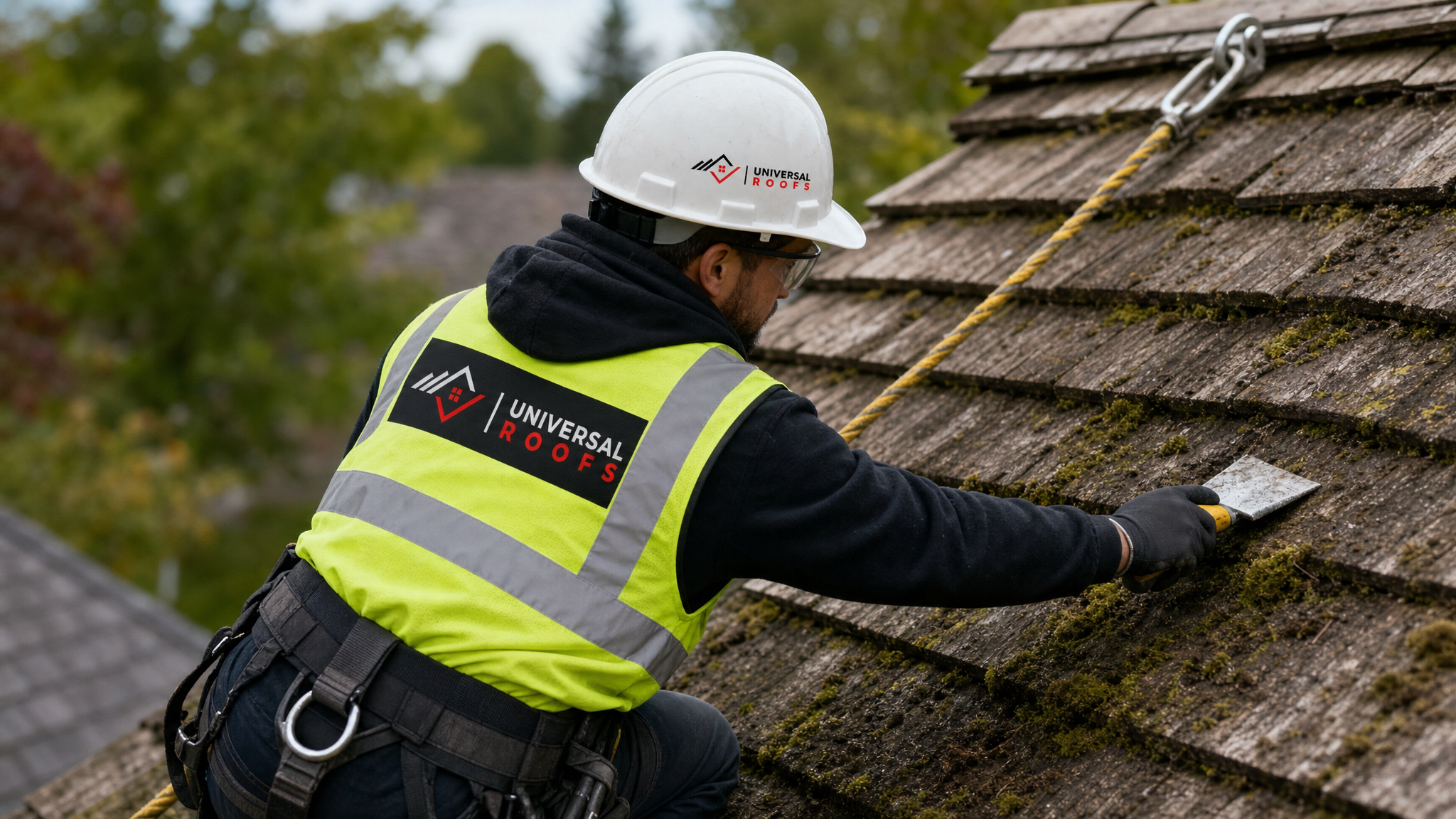
Walking a wood shake roof is also inherently more dangerous than walking asphalt shingles. Shakes are more slippery when wet or covered in moss, and the wood itself can be soft or degraded in spots that are not obvious from the ground. For these reasons, we strongly recommend leaving moss and algae removal on wood shakes to a professional crew with proper fall protection, rather than attempting it as a homeowner DIY project on a steep or high roof.
A pre-cleaning assessment should check for:
- Soft spots or visible rot in the shake butts
- Cracked, split, or curling shakes that may need replacement before cleaning
- Condition of flashing around chimneys, vents, and skylights, since aggressive cleaning near these penetrations can dislodge sealant
- Gutter condition and any standing water sources feeding the growth
If the inspection turns up significant wood damage, it may be more cost-effective to address roof repair for the affected sections before investing time and money into a full moss and algae removal treatment, since new growth will simply return to compromised wood faster than to sound shakes.
Safe Removal Methods That Will Not Damage Your Shakes
The single biggest mistake homeowners make when they search for how to clean a wood shake roof is reaching for a pressure washer. High-pressure water blasts strip away the fibrous surface of the wood, force water underneath shakes and into the roof deck, and can actually accelerate future moss and algae growth by roughing up the wood surface, giving spores even more texture to grip onto.
The correct approach uses low-pressure methods paired with the right chemical treatment:
| Method | Best For | Pros | Cons |
|---|---|---|---|
| Manual scraping with a soft-bristle brush or plastic scraper | Loose moss cushions, light debris | Zero risk of water intrusion, gentle on wood | Labour-intensive, does not kill root spores |
| Low-pressure rinse (garden hose or soft wash under 500 PSI) | Rinsing away loosened debris after treatment | Will not strip wood fibres or force water under shakes | Not effective alone against embedded growth |
| Chemical treatment (zinc or copper sulfate based) | Killing algae, moss, and lichen at the root | Long-lasting, penetrates into wood grain | Requires careful application away from plants, gutters, downspouts |
| High-pressure power washing | Not recommended for wood shakes | None that outweigh the risk | Strips wood fibres, drives water under shakes, voids many shake warranties |
The safest and most durable results come from a two-step process: a chemical treatment that kills the moss, algae, or lichen at the root, followed by a gentle, low-pressure rinse once the growth has died back and loosened naturally. This typically takes anywhere from a few days to two weeks depending on the product and the severity of growth, so patience matters more than force here.
Choosing the Right Cleaning Solution
Not every product marketed as a “roof cleaner” is safe for wood shakes. Chlorine bleach, for instance, is aggressive enough to lighten and dry out cedar prematurely, breaking down the natural oils that give shakes their weather resistance. The safest and most widely recommended options are:
- Zinc sulfate solutions — effective against algae and moss, gentler on wood fibre than chlorine-based products, and commonly used by roofing professionals for shake and shingle roofs alike.
- Copper sulfate solutions — strong moss and lichen killer, though it requires careful handling since copper can stain lighter-coloured shakes if overapplied.
- Oxygen bleach (sodium percarbonate) based cleaners — a gentler alternative that breaks down into water, oxygen, and soda ash rather than harsh chlorine byproducts, making it a favour to nearby landscaping and downspouts that drain into gardens or lawns.
Whichever product is used, it should always be applied according to label directions, on a dry, overcast day (never immediately before rain, which will wash away the treatment before it can work), and with plants, shrubs, and lawn areas below the roofline protected or pre-rinsed with plain water to dilute any overspray.
Step-by-Step: A Professional Wood Shake Cleaning Process
While every roof is slightly different, a thorough moss and algae removal on wood shakes generally follows this sequence:
| Step | Task | Typical Duration | Notes |
|---|---|---|---|
| 1 | Roof inspection and debris removal | 30-60 minutes | Clear leaves, branches, and loose debris from valleys and gutters |
| 2 | Manual scraping of heavy moss cushions | 1-3 hours | Removes bulk growth before chemical treatment for better contact |
| 3 | Application of zinc or copper sulfate solution | 1-2 hours | Applied evenly across affected areas, allowed to sit per label instructions |
| 4 | Dwell time for treatment to kill growth | 3-14 days | Growth dies back and loosens naturally; no rinsing needed during this period |
| 5 | Low-pressure rinse | 1-2 hours | Removes dead moss and algae residue without stripping wood |
| 6 | Preventative zinc strip installation (optional) | 2-4 hours | Long-term deterrent for future growth, especially near ridge lines |
This process is deliberately gentle and gradual because wood shakes simply cannot tolerate the same aggressive scrubbing or pressure that asphalt or even some flat roofing membranes can handle. If your home also has a lower-slope section with a different roofing material, note that a flat roofing surface requires an entirely different maintenance approach than wood shakes, so do not assume the same cleaning products or methods apply across your whole roofline.
Preventing Moss and Algae From Coming Back
Cleaning a wood shake roof without addressing the underlying conditions that caused the growth is a short-term fix. Within a season or two, especially in a shaded, humid GTA neighbourhood, moss and algae will often return unless preventative steps are taken.
Effective long-term prevention includes:
- Installing zinc or copper strips near the ridge line — rainwater washing over these metals carries trace amounts down the roof slope, which naturally inhibits new moss and algae growth for years at a time.
- Trimming back overhanging tree branches to increase sun exposure and airflow across shaded slopes.
- Keeping gutters clear so water does not pool against the lower courses of shakes; this is one of the simplest and most overlooked prevention steps.
- Improving attic ventilation so warm, moist interior air is not condensing on the underside of the roof deck and keeping shakes damp from below — see our attic ventilation services for an assessment.
- Scheduling annual inspections, ideally in late spring or early summer, to catch new growth before it establishes deep roots.
Homeowners in shadier, older neighbourhoods across the Toronto core tend to see faster regrowth than those in newer, more open subdivisions, simply due to mature tree canopy. The same is true in parts of Peel Region and York Region with established residential streets. If your property falls into this category, a preventative maintenance schedule is worth the investment compared to repeating a full cleaning every year.
When Cleaning Is Not Enough: Signs You Need Repair or Replacement
Sometimes moss and algae are a symptom of a shake roof that is nearing the end of its service life rather than the root problem itself. If, during cleaning or inspection, any of the following are found, cleaning alone will not solve the underlying issue:
- Shakes that are soft, spongy, or crumble when pressed
- Widespread splitting, curling, or missing shakes across multiple courses
- Visible daylight or water staining on the underside of the roof deck from inside the attic
- Growth that returns aggressively within just a few months of a thorough cleaning
- A roof that is already 25-30 years old, which is near or past the typical lifespan for cedar shakes in the GTA climate
In these situations, a full or partial roof replacement is usually the more cost-effective long-term solution rather than continuing to clean and treat a roof that is structurally failing. A qualified inspection can tell you which category your roof falls into before you commit budget to a cleaning-only approach.
| Roof Condition | Recommended Action | Estimated Cost Range (CAD) | Expected Result |
|---|---|---|---|
| Light surface algae, sound wood | Chemical treatment + low-pressure rinse | $400-$900 | Restored appearance, 2-4 years before recleaning needed |
| Moderate moss with some root penetration | Manual scraping + chemical treatment + zinc strips | $800-$1,800 | Restored appearance plus multi-year prevention |
| Heavy lichen or growth on aging shakes | Treatment plus spot repair of damaged shakes | $1,500-$4,000+ | Extends roof life but may only be a short-term deferral |
| Widespread rot or shakes past 25-30 years old | Partial or full roof replacement | Varies by roof size and material — request a quote | Long-term solution, eliminates recurring cleaning costs |
Because every roof’s exposure, shading, and wood condition are different, these figures should be treated as general ranges rather than a firm quote. The only reliable way to know which category your roof falls into is an on-site assessment.
Seasonal Timing for Moss and Algae Removal in the GTA
Timing matters when it comes to treating a wood shake roof. Late spring through mid-summer, when temperatures are stable and rainfall is more predictable, is generally the best window for a full cleaning and treatment cycle, since chemical treatments need several dry days to properly dwell on the wood surface before any rinsing.
Attempting this work in late autumn, when the GTA sees more frequent rain and an early frost risk, often means treatments get washed away before they take effect, or worse, water gets trapped in the wood right before a freeze, which can crack shakes as that moisture expands. Summer, like right now, is genuinely one of the better times of year to schedule this kind of maintenance, both for weather reliability and to have everything settled well before the wetter autumn season arrives.
If moss and algae removal is paired with any deck-level work, checking nearby skylights or considering a skylight replacement for units with degraded seals is worth doing at the same time, since a crew is already safely up on the roof with fall protection in place.
What is the best way for removing moss and algae from wood shake roofs without damaging the wood?
Can I pressure wash moss off my wood shake roof myself?
How often does moss and algae removal need to be done on a wood shake roof?
Does moss on a wood shake roof actually cause damage, or is it just cosmetic?
What is the difference between moss, algae, and lichen on a wood shake roof?
Is summer a good time in Toronto for removing moss and algae from wood shake roofs?
Need Help With Removing Moss and Algae?
A wood shake roof is a long-term investment, and keeping it free of moss, algae, and lichen is one of the simplest ways to protect that investment. If your roof shows signs of growth, soft shakes, or you are simply unsure which treatment approach is right for your home, Universal Roofs can assess the roof and recommend the safest path forward.
Call us today at (416) 732-2421 or request a free inspection to get started.
Universal Roofs proudly serves Toronto, Mississauga, Brampton, Vaughan, Markham, Oakville and the GTA since 2005.