
If your roof is leaking, sagging, or you have noticed soft spots when you walk across the attic floor, chances are good you have heard some version of “it’s probably just the decking.” Roof decking repair sounds like a simple, almost boring line item on a quote — a few sheets of plywood swapped out and you are done. In reality, it is one of the most misunderstood parts of any roofing job in the Toronto area, and misunderstanding it costs homeowners real money.
At Universal Roofs, we have been repairing, replacing, and inspecting roof decking across the GTA since 2005, and the same four myths come up on almost every job site. Homeowners assume decking damage is always visible from the attic, that any plywood will do, that decking repair is a quick add-on to a re-roof, or that a small water stain means a small problem. None of that is reliably true, and believing it can lead to a roof that fails years before it should.
This guide walks through what roof decking actually is, why these four misunderstandings persist, and what a proper decking repair or replacement should look like on a home in Toronto, Mississauga, Vaughan, or anywhere else in the GTA. We will cover materials, cost ranges, timelines, and the warning signs that tell you decking trouble is brewing, whether it is the middle of a humid July or the depths of a February freeze-thaw cycle.
What Roof Decking Actually Is (and Why It Matters More Than People Think)
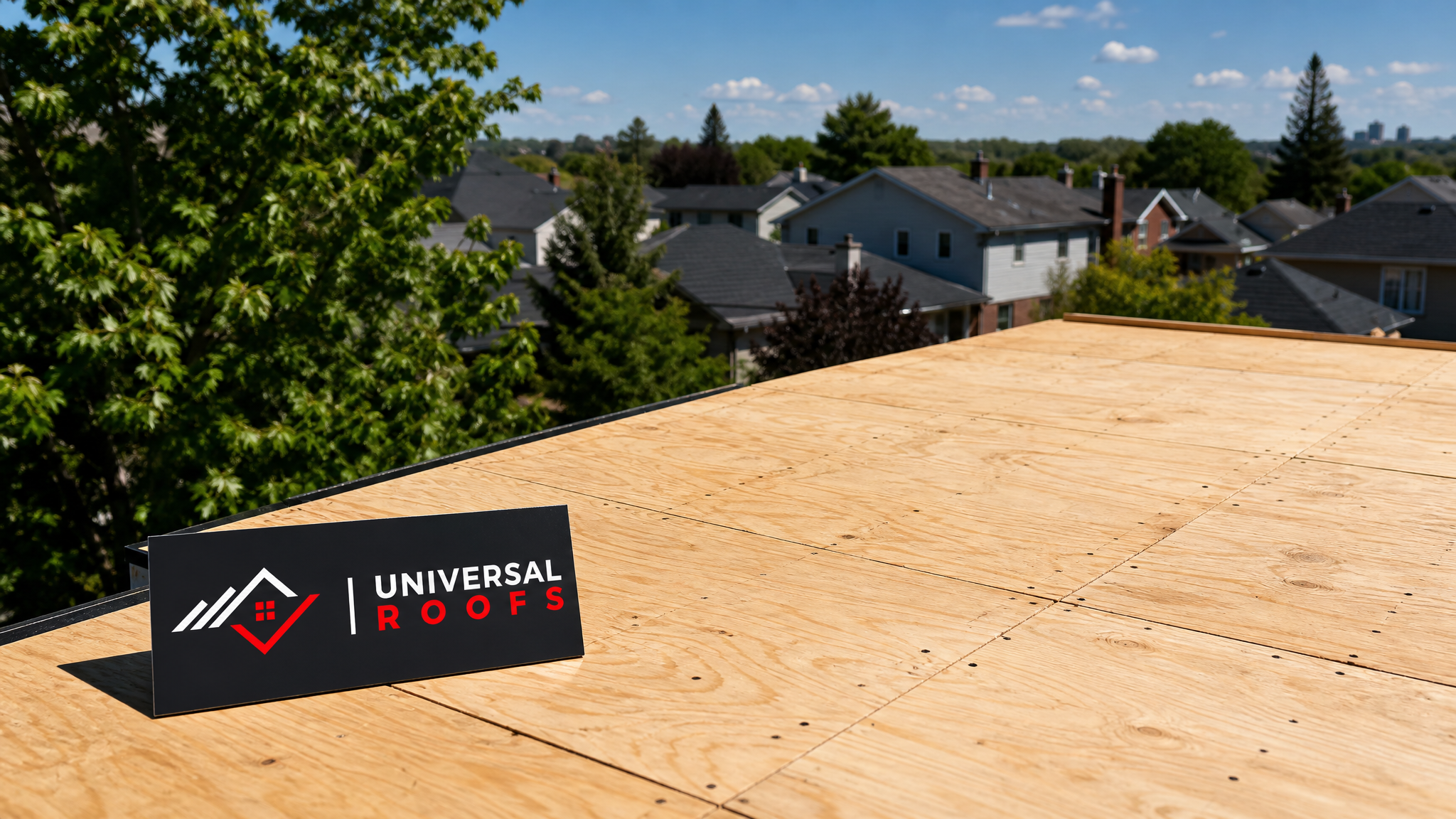
Roof decking, also called sheathing, is the structural layer that sits directly on top of your rafters or trusses. In most GTA homes built from the 1960s onward, decking is either oriented strand board (OSB) or plywood, typically 7/16 inch to 5/8 inch thick depending on the era and the rafter spacing. Everything else on your roof — the underlayment, the shingles, the flashing, even the ice and water shield along the eaves — is fastened to or supported by this layer.
When homeowners talk about “unveiling the truth” behind roof decking repair, what they are really asking is: how do I know if my decking is actually the problem, and how do I know if a contractor is fixing it properly rather than papering over it? Decking failure rarely announces itself the way a missing shingle does. It shows up as spongy spots underfoot, sagging rooflines visible from the street, nail pops working their way through shingles, or dark staining on the underside of the roof deck in the attic.
Because decking sits underneath the visible roofing material, most of the misunderstandings about repairing it come from the fact that homeowners simply cannot see it without someone pulling shingles or climbing into the attic. That knowledge gap is exactly where bad assumptions take root, and it is why we always recommend starting with a proper inspection rather than guessing. Our roof repair team walks every deck section by hand during an assessment, because a visual scan from the ground or even from the attic hatch will miss localized soft spots.
Misunderstanding #1: “If the Attic Ceiling Looks Fine, the Decking Is Fine”
This is the single most common misunderstanding we run into, and it is also the most dangerous because it gives homeowners false confidence. Water does not always travel straight down. It can wick sideways along a rafter, follow a nail shank, or pool at a low point in the decking for months before it ever shows as a stain on the drywall ceiling below. By the time a homeowner sees a brown ring on the ceiling, the decking above it has often been wet, drying, and re-wetting for one or more full seasons.
In the GTA specifically, our freeze-thaw winters make this worse. Water that seeps into decking in November can freeze in December, expand the wood fibres slightly, thaw in a January melt, freeze again, and repeat that cycle a dozen times before spring. Each cycle weakens the wood a little more, long before any visible sign reaches the living space below. A deck that looks structurally sound in October can be delaminating by April.
The only reliable way to catch this early is a physical inspection: walking the roof deck and checking for flex, probing suspect areas with a moisture meter, and looking at the underside of the sheathing in the attic for discolouration, mould, or a chalky white residue (a sign of moisture wicking through OSB). If you notice sagging on your roofline when viewed from the driveway, that is often the first visible sign of a problem that has existed, unseen, for a long time. A quick attic glance without a proper inspection gives a false sense of security.
Misunderstanding #2: “Any Plywood or OSB Sheet Will Do for a Repair”
The second myth is that decking material is interchangeable — grab whatever sheet is stacked at the lumber yard and nail it down. In practice, matching the replacement material to the original decking, the local building code, and the roof’s specific conditions matters a great deal for long-term performance.
OSB is less expensive and is what most GTA production-built homes from the 1990s onward use, but it swells more than plywood when repeatedly exposed to moisture, and it does not dry out as quickly. Plywood costs more but tends to hold fasteners better after minor water exposure and is often preferred for roofs with lower slopes or in areas prone to ice damming, such as north-facing sections that stay shaded through a Toronto winter. Thickness matters too: swapping in a thinner sheet than what was originally installed can leave a soft, springy feel underfoot and may not meet current Ontario Building Code span requirements for your rafter spacing.
| Decking Material | Typical Thickness | Moisture Resistance | Best Use Case |
|---|---|---|---|
| OSB (Oriented Strand Board) | 7/16″ – 5/8″ | Moderate; swells at edges if repeatedly wet | Standard re-roofs on well-ventilated attics |
| CDX Plywood | 1/2″ – 5/8″ | Good; dries faster, holds fasteners well | Low-slope sections, ice-dam-prone areas |
| Tongue-and-Groove Plywood | 5/8″ – 3/4″ | Good | Wider rafter spacing, reduces deflection |
| Pressure-Treated Plywood | 1/2″ – 5/8″ | Excellent | Flat roof transitions, skylight curbs, high-moisture zones |
We also see mismatched thickness cause a visible ridge or dip where a repair patch meets the original decking, which can telegraph through even a heavier architectural shingle. On any legitimate roof replacement or repair, the new sheathing should match the existing deck’s thickness and be fastened according to current code spacing, not just “close enough.”
Misunderstanding #3: “Decking Repair Is Just a Quick Add-On During a Re-Roof”
This misunderstanding costs homeowners the most money, because it usually surfaces as a surprise mid-project. Many contractors quote a re-roof assuming zero decking replacement, then charge significant change-order fees once shingles come off and rot is discovered. Homeowners who were told “it’s just a quick add-on” are often blindsided by both the cost and the schedule delay.
The truth is that decking condition cannot be fully assessed until the old shingles and underlayment are removed. A responsible contractor builds a contingency into the estimate and explains this up front, rather than treating a decking discovery as a shock. On average GTA re-roofs, somewhere between 10% and 25% of homes need at least some decking replacement, most commonly around chimneys, plumbing vents, valleys, and the lower few feet of the roof near the eaves where ice damming does the most damage over the years.
| Roof Area | Common Decking Issue | Typical Cause | Repair Priority |
|---|---|---|---|
| Eaves / lower 3 feet | Delamination, soft spots | Ice damming, poor ventilation | High |
| Valleys | Rot along seams | Water concentration, aged flashing | High |
| Around chimneys | Localized soft spots | Failed flashing, condensation | Medium-High |
| Skylight curbs | Water staining, swelling | Aging seals, improper flashing | Medium-High |
| Field of roof (open areas) | Minor nail pops, isolated soft spots | General age, minor leaks | Low-Medium |
Because decking cannot be fully priced sight-unseen, the honest answer is that a re-roof estimate should always include a per-sheet decking replacement rate disclosed before work begins, not discovered after the fact. This is also why we walk every roof surface during a roof repair assessment before quoting, so there are as few surprises as possible once the tear-off starts.
Misunderstanding #4: “A Small Water Stain Means a Small, Isolated Problem”
The fourth and final misunderstanding is the assumption that the size of a visible stain corresponds to the size of the underlying decking issue. In our experience, this is backwards more often than it is right. A small, faint stain can indicate a slow, long-running leak that has spread moisture across several feet of decking, while a large, dramatic-looking stain from a single storm event might represent a one-time occurrence with minimal structural impact, especially if it was addressed quickly.
What actually determines the extent of the problem is duration and moisture cycling, not the stain’s visible diameter. A leak active for two winters will do more damage than a leak that dumped a lot of water once and was fixed within a week. This is why any competent decking assessment goes beyond looking at the stain and includes probing the surrounding wood, checking adjacent rafters for softness, and, where accessible, examining insulation in the attic for compaction or mould, which often signals a longer-term moisture problem than the stain alone suggests.
Homeowners in older Toronto neighbourhoods with older insulation should be especially cautious here, since insulation can mask both the moisture and the smell of rot for a long time. If you are noticing a musty odour in an upstairs room, especially in summer humidity, that is often a stronger signal than the stain itself. We often coordinate decking assessments with our attic inspection service specifically because the two problems — deck rot and attic moisture — tend to travel together.
How a Proper Roof Decking Repair Should Actually Proceed
Once the myths are set aside, the real process is straightforward, methodical, and should never feel rushed. Here is what a legitimate decking repair looks like from start to finish on a typical GTA home.
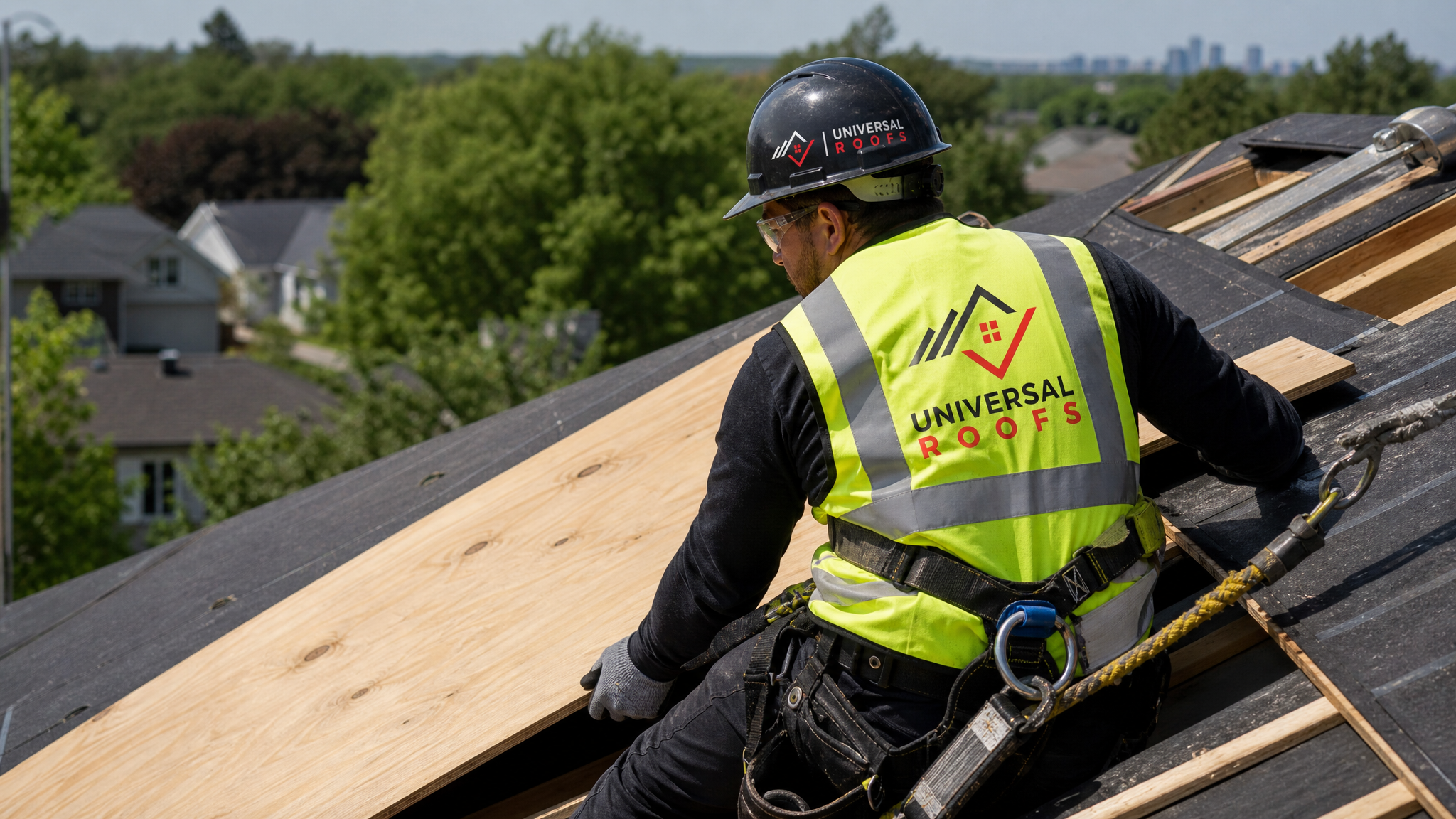
First, the roofing crew removes shingles and underlayment only in the affected area, or across the full roof if it is a complete re-roof. Second, every deck panel is walked and probed, not just visually scanned, with particular attention to valleys, eaves, and penetrations. Third, any panel showing softness, delamination, or discolouration consistent with rot is cut out along the nearest rafter centre lines, never patched mid-span, because a patch that does not land on solid framing will flex and eventually fail. Fourth, replacement sheathing matching the original thickness is installed, fastened per code spacing, and, where the roof design calls for it, an ice and water shield membrane is applied over vulnerable areas like eaves and valleys before the new underlayment and shingles go down.
| Repair Step | What Happens | Typical Duration |
|---|---|---|
| Tear-off and inspection | Remove shingles/underlayment, probe entire deck | Half a day to 1 day |
| Deck panel removal | Cut out damaged sections at rafter centres | 1–3 hours depending on extent |
| Sheathing replacement | Install matched-thickness panels, fasten to code | 2–4 hours |
| Ice and water shield / underlayment | Apply membrane over eaves, valleys, penetrations | 2–3 hours |
| Shingle and flashing installation | Complete roofing system over repaired deck | 1–2 days (full roof) or hours (localized) |
For homes with flat or low-slope sections, the process shifts slightly — decking under a membrane roof is assessed for both rot and proper drainage slope, which our flat roofing team handles as a distinct scope from sloped asphalt shingle decking. Similarly, decking around a skylight curb requires its own attention, since a poorly flashed or rotted curb is one of the most common sources of “mystery” leaks; our skylights and skylight replacement teams coordinate directly with the roofing crew whenever decking work touches a skylight opening.
Cost Ranges for Roof Decking Repair in the GTA
Cost is one of the areas where misunderstanding causes the most friction between homeowners and contractors, largely because decking repair is priced per sheet replaced, not as a flat fee, and the final number depends on how much rot is found once tear-off begins.
| Scope of Work | Approximate Cost Range (CAD) | Notes |
|---|---|---|
| Single sheet replacement (localized) | $150 – $350 per sheet | Includes removal, disposal, and installation |
| Multiple sheets (valley or eave section) | $500 – $1,500 | Common after a prolonged undetected leak |
| Full deck replacement during re-roof | $2,000 – $6,000+ | Varies with roof size and percentage of deck affected |
| Emergency repair (active leak) | $300 – $900 | Temporary or permanent fix depending on access and weather |
These ranges reflect typical pricing across Toronto and the surrounding regions we serve, though material costs have fluctuated in recent years and should always be confirmed with a current, on-site quote rather than an old estimate or a number from a different region.
Seasonal Timing: Why Summer Is the Best Window for Decking Repairs
Right now, in the middle of summer, is genuinely one of the best times to address suspected decking issues in the GTA. Dry, warm conditions mean any residual moisture in the wood has a chance to evaporate before new sheathing and shingles seal it in, and roofing adhesives and sealants cure properly in warm weather rather than struggling in near-freezing temperatures. Contractors also have more flexibility with scheduling in summer compared to the compressed pre-winter rush that floods roofing companies every September and October.
Waiting until autumn or winter to address a soft spot you already suspect is a common mistake. Cold-weather decking repairs are possible but come with real limitations: shingle sealant strips do not bond properly below roughly 4°C, and any lingering moisture in newly exposed decking can freeze rather than dry. If you noticed sagging or soft spots over the winter, this summer is the ideal window to have it properly diagnosed and repaired before the next freeze-thaw cycle begins in the fall.
Regional Considerations Across the GTA
Decking conditions vary noticeably across the areas we serve. Older housing stock in central Toronto neighbourhoods often has thinner original plank or plywood decking that was never designed for modern heavier architectural shingles, which can mean earlier-than-expected sheathing upgrades during a re-roof. Newer subdivisions across Peel Region and York Region tend to have OSB decking that is holding up well structurally but can be vulnerable to attic ventilation issues if soffit vents were undersized during construction, a common builder shortcut in the 2000s.
Homes in Halton Region closer to the escarpment sometimes see more wind-driven rain infiltration around ridge lines, which shows up as deck staining near the peak rather than the eaves. And in Durham Region, we frequently find ice-damming-related decking damage along the lower roof edges of homes backing onto ravines or treed lots, where extra shade slows spring melt and prolongs freeze-thaw cycling. Wherever you are in the GTA, the underlying lesson is the same: decking condition is local and specific to your roof’s history, not something that can be assumed from a neighbour’s experience or a generic online estimate.

Questions to Ask Before Hiring Anyone for Decking Repair
Given how many misunderstandings surround this part of a roof, it is worth arming yourself with a short list of questions before signing any contract. Ask whether the estimate includes a specific per-sheet rate for decking replacement discovered during tear-off, so there are no surprise change orders. Ask what thickness and grade of sheathing they plan to use and whether it matches your existing deck. Ask how they handle valleys and eaves specifically, since these are the highest-risk areas. And ask whether photos will be taken during tear-off, before the deck is covered back up, so you have documentation of exactly what was found and replaced.
A contractor who welcomes these questions and answers them specifically, rather than vaguely, is generally one who understands the real complexity behind roof decking repair rather than treating it as an afterthought. You can read what past customers have said about our process on our reviews page, and browse common questions on our FAQ page if you want more detail before booking an assessment.
Preventing Future Decking Damage
Beyond repairing existing damage, a few maintenance habits meaningfully extend decking lifespan. Keeping gutters clear year-round prevents water from backing up under shingles at the eaves, which is the single biggest contributor to decking rot we see across the GTA. Ensuring attic insulation does not block soffit vents preserves the airflow that keeps decking dry from underneath, not just from above. And having your roof visually inspected after any major wind or hail event, rather than waiting for a stain to appear indoors, catches small issues while they are still cheap to fix.
Homeowners who treat decking as a maintenance item rather than a mystery tend to get significantly more life out of their roofing system overall. If you are ever unsure whether what you are seeing warrants a call, it is almost always cheaper to have someone look than to wait and find out the hard way.
What is the biggest misunderstanding about roof decking repair?
How do I know if my roof decking needs to be repaired or replaced?
Can any plywood or OSB be used for a roof decking repair?
Why does decking replacement often become a surprise cost during a re-roof?
Does the size of a water stain indicate how serious the decking damage is?
Is summer a good time to schedule roof decking repair in the GTA?
Need Help With Unveiling the Truth 4?
If you suspect your roof decking has been affected by a slow leak, ice damming, or simple age, the team at Universal Roofs can give you a clear, honest assessment before any work begins, so none of these four misunderstandings end up costing you more than they should.
Call us today at (416) 732-2421 or request a free inspection to get started.
Universal Roofs proudly serves Toronto, Mississauga, Brampton, Vaughan, Markham, Oakville and the GTA since 2005.