
A sound roof only performs as well as the deck underneath it. Homeowners across the Greater Toronto Area often focus on shingles, flashing, and gutters while ignoring the plywood or oriented strand board (OSB) sheathing that everything else is fastened to. When that structural layer is compromised, no amount of new shingles will stop leaks, sagging, or premature failure.
This guide covers the most common solutions for roof deck issues, how to recognize the warning signs early, and what a proper repair or replacement actually involves. Whether you are dealing with soft spots after a wet spring, delamination from years of attic moisture, or storm damage that exposed the sheathing, understanding your options helps you make an informed decision before hiring a contractor.
Toronto’s climate is particularly hard on roof decks. Freeze-thaw cycles, humid summers, and heavy snow loads all place stress on sheathing, fasteners, and the ventilation systems that are supposed to protect them. Catching problems in July, while the roof is dry and accessible, is far easier and cheaper than waiting until autumn storms make the damage worse.
What Causes Roof Deck Problems in the First Place
Roof deck issues rarely appear overnight. They are almost always the result of ongoing moisture exposure combined with age. Understanding the root cause is the first step toward choosing the correct solutions for roof deck issues rather than a temporary patch that fails again within a year or two.
- Prolonged shingle failure — Cracked, curling, or missing shingles allow water to seep through the underlayment and saturate the sheathing underneath.
- Poor attic ventilation — Trapped warm, moist air condenses on the underside of the deck, leading to rot and mould over time. Learn more on our attic ventilation page.
- Ice damming — Snowmelt refreezing at the eaves forces water backward under shingles, a problem that shows up every spring in the GTA.
- Improper flashing — Gaps around chimneys, vents, and skylights let water track directly onto the deck.
- Structural age — Original sheathing installed decades ago, especially in homes built before 1990, is often thinner and more prone to sagging.
- Pest and rodent damage — Squirrels and raccoons in the GTA frequently chew through soffits and decking to access attics.
Because the deck sits beneath the visible roofing layer, damage often goes unnoticed until a leak appears indoors or a contractor pulls back shingles during a roof replacement.
Recognizing the Warning Signs of a Failing Roof Deck
Most homeowners never climb onto their own roof, so the earliest signs of deck trouble usually show up indoors or from the ground. Knowing what to look for can save thousands of dollars by catching a small problem before it becomes a full structural repair.
- Sagging rooflines — A visible dip or wave along the roof plane, especially between rafters, often signals softened sheathing.
- Bouncy or spongy feel underfoot — If a roofer walking the deck notices flex or give, the plywood has likely absorbed moisture.
- Ceiling stains and bubbling paint — Brown rings or peeling paint on interior ceilings almost always trace back to a deck or underlayment failure above.
- Musty attic odour — A persistent damp or mouldy smell in the attic points to trapped moisture reaching the sheathing.
- Visible daylight through the attic — Small gaps where sheathing has separated from rafters let light through and are an obvious red flag.
- Nail pops or telegraphing seams — Raised bumps in the shingle pattern often trace back to shifting or swelling deck panels beneath.
If you notice any of these signs, it is worth scheduling an inspection through our roof repair team before the next rainy stretch. Early detection is the difference between a localized sheathing patch and a full deck replacement.
Solutions for Roof Deck Issues: Repair Versus Replacement
Not every roof deck problem requires tearing the whole roof off. The right solution depends on how much of the deck is affected, how old the existing roof covering is, and whether the damage is isolated or widespread. Below is a comparison of the most common approaches contractors use across the GTA.
| Solution | Best For | Typical Cost (CAD) | Lifespan Added |
|---|---|---|---|
| Spot sheathing repair | Small, isolated soft spots under 1 m² | $400 – $900 per section | 10–15 years |
| Partial deck replacement | Damage concentrated in one roof plane or valley | $1,200 – $3,500 | 15–20 years |
| Full deck replacement | Widespread rot, sagging, or a roof over 25 years old | $4,000 – $12,000+ | 25–30 years |
| Overlay with new sheathing layer | Sound existing deck needing added rigidity | $2,500 – $6,000 | 15–20 years |
| Ventilation and moisture correction only | Early-stage moisture with no structural softening yet | $600 – $1,800 | Prevents future damage |
These figures are general GTA market ranges and will vary based on roof size, pitch, access, and the type of roofing installed above the deck. A licenced roofer should always confirm the extent of damage with a physical inspection before quoting a fixed price. In many cases, a roof repair assessment reveals that only a portion of the deck needs attention, which keeps costs well below a full tear-off.
Step-by-Step: How Professional Roof Deck Repair Works
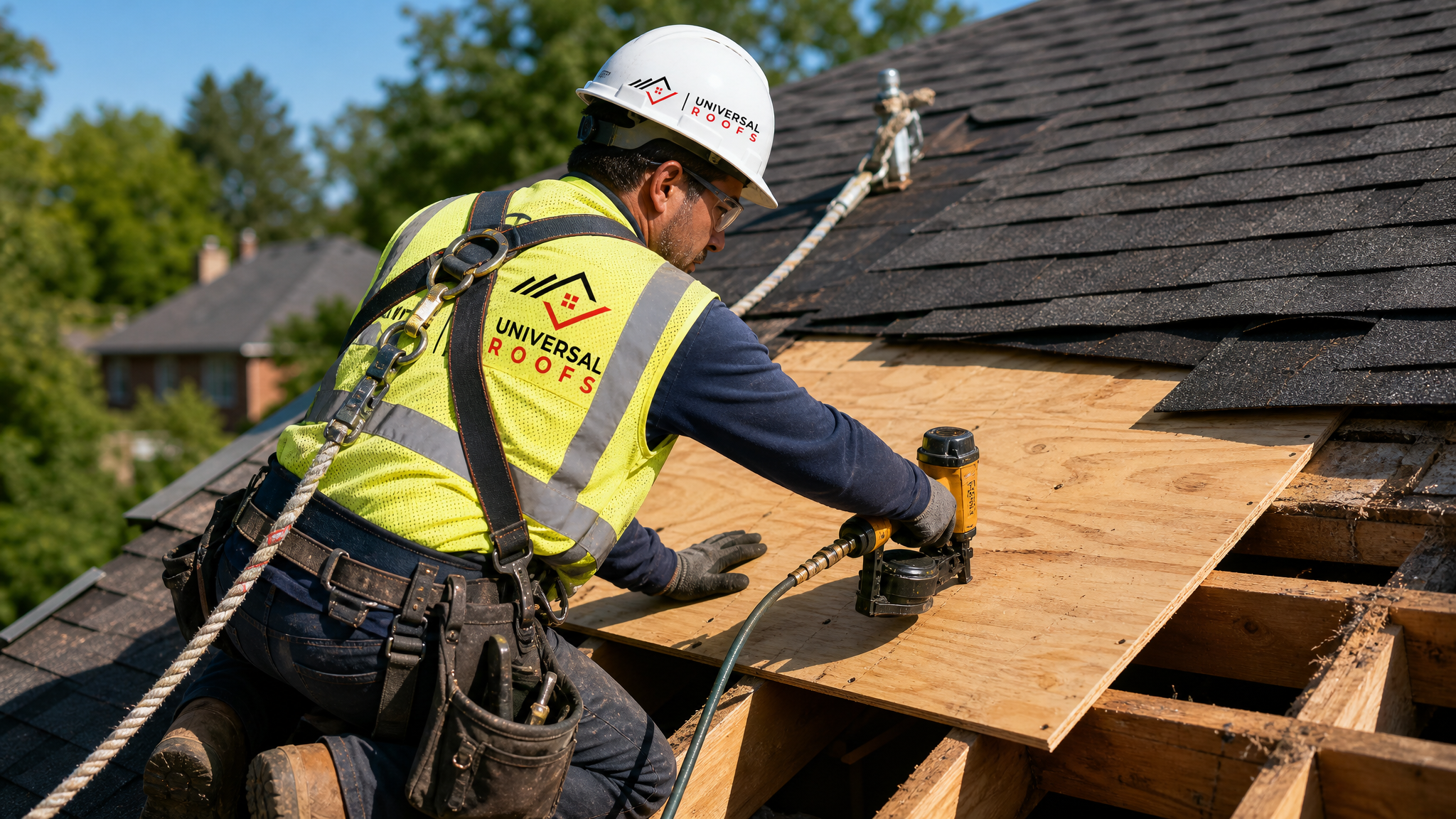
When our crews identify compromised sheathing during an inspection or mid-project, the repair follows a consistent process designed to restore structural integrity without disturbing more of the roof than necessary.
- Remove the affected roofing materials — Shingles, underlayment, and flashing are carefully pulled back from the damaged section.
- Assess the extent of the damage — The crew probes surrounding panels to confirm exactly where sound wood ends and compromised wood begins.
- Cut out and remove damaged sheathing — Rotted or soft panels are cut back to the nearest rafter or truss for a clean, supported edge.
- Inspect and repair the framing — Rafters or trusses underneath are checked for rot; any compromised framing members are sistered or replaced before new sheathing goes down.
- Install new plywood or OSB panels — Panels matching the original thickness (typically 12.7 mm or 15.9 mm) are fastened with corrosion-resistant nails on proper spacing.
- Add or correct ventilation — Baffles, vents, or additional airflow paths are installed if poor ventilation contributed to the original failure.
- Reinstall underlayment, flashing, and shingles — New synthetic underlayment and ice-and-water membrane are applied before the roofing material is reinstalled to match the surrounding roof.
This sequence applies whether the roof above is asphalt shingle, or a flat roofing membrane system, though flat roof decking repairs also require attention to slope and drainage to prevent the same moisture problem from recurring.
Roof Deck Issues Around Skylights and Penetrations
Some of the most persistent deck problems we encounter start at roof penetrations rather than open roof planes. Skylights, chimneys, vent stacks, and plumbing boots all require cuts through the sheathing, and any flashing failure at these points sends water directly into the surrounding deck.
Older skylight curbs are a particularly common culprit. As sealants age and flashing corrodes, water tracks along the curb and saturates the plywood framing the opening. If you notice staining or softness specifically around a skylight, it is worth having both the unit and the surrounding deck evaluated together through our skylights team. In many cases, a skylight replacement with properly integrated step flashing solves the leak permanently, rather than repeatedly patching sealant around a failing curb.
The same principle applies to chimney flashing and plumbing vents — addressing the penetration and the deck damage together, in a single visit, avoids paying for repeat repairs on the same section of roof.
Comparing Roof Deck Materials for Replacement
When sheathing needs to be replaced, homeowners sometimes ask whether to upgrade the material rather than simply matching what was there before. The table below outlines the common options used across GTA roofing projects.
| Material | Moisture Resistance | Relative Cost | Notes |
|---|---|---|---|
| Standard OSB (7/16″) | Moderate | Lowest | Common builder-grade choice; swells if exposed to prolonged moisture |
| Plywood (1/2″ – 5/8″) | Good | Moderate | More dimensionally stable than OSB; preferred for older homes |
| Radiant-barrier sheathing | Good | Higher | Reflective coating helps reduce attic heat gain in summer |
| Zip System sheathing | Excellent | Highest | Integrated weather-resistant barrier reduces future moisture intrusion |
| Tongue-and-groove plywood | Good | Moderate–High | Reduces seam gaps; often used on flat and low-slope sections |
For most GTA homes, standard plywood remains the practical choice for cost and availability, but for roofs with a history of moisture problems, upgrading to a weather-resistant sheathing system during a roof replacement can prevent the same issue from recurring in ten or fifteen years.
Preventing Future Roof Deck Damage
Once a deck has been repaired or replaced, protecting that investment comes down to a handful of maintenance habits that most homeowners can manage with occasional professional support.
- Maintain balanced attic ventilation — Intake at the soffits and exhaust at the ridge should be balanced to prevent condensation from forming on the deck’s underside.
- Clean gutters twice a year — Blocked gutters contribute directly to ice damming and water backing up under shingles.
- Address shingle damage promptly — A missing shingle left through even one winter can be enough to soften the plywood beneath it.
- Schedule annual inspections — A trained eye can spot early softening, staining, or flashing wear well before it becomes visible from inside the house.
- Manage attic humidity — Bathroom fans and dryer vents should exhaust outside the attic space entirely, never into it.
- Trim overhanging branches — Falling limbs and constant shade both contribute to premature shingle and deck wear.
Homeowners in different parts of the GTA face slightly different conditions — properties in Toronto and Peel Region tend to see more urban heat-island stress on shingles, while homes in York Region, Halton Region, and Durham Region often deal with heavier tree cover and more variable snow loads. A regional inspection schedule tailored to your property’s specific exposure goes a long way toward preventing deck issues before they start.
Typical Repair Timelines and What to Expect
One of the most common questions homeowners ask is how long a roof deck repair will actually take. The answer depends heavily on the scope of the damage and weather conditions during the project.
| Repair Scope | Estimated Timeline | Disruption Level | Weather Sensitivity |
|---|---|---|---|
| Spot repair (1–2 panels) | Half day to 1 day | Low | Low — can pause easily if rain arrives |
| Partial deck section (one slope) | 1–2 days | Moderate | Moderate — open deck needs dry conditions |
| Full deck replacement | 3–7 days | High | High — best scheduled in stable summer weather |
| Ventilation correction only | Half day | Low | Low |
| Combined skylight and deck repair | 1–3 days | Moderate | Moderate |
Summer is genuinely the best season for larger deck projects in the GTA. Long dry stretches, stable temperatures, and extended daylight hours let crews open sections of the roof with lower risk of a surprise storm causing interior water damage mid-repair. If you have noticed sagging, staining, or soft spots this year, July is an ideal window to book the work before the fall rain season begins.
What Happens If Roof Deck Issues Are Left Untreated
Deferring a deck repair rarely saves money in the long run. Left untreated, soft or rotted sheathing continues to absorb moisture every time it rains, gradually spreading damage to adjacent panels and framing members. What starts as a $500 spot repair can become a $5,000 structural replacement within a few seasons if ignored.
Beyond cost, an unaddressed deck problem creates real safety concerns. Severely rotted sheathing can no longer support foot traffic safely, which complicates future maintenance, snow removal, or even routine gutter cleaning. In more serious cases, sustained moisture intrusion leads to mould growth in the attic, which can affect indoor air quality throughout the home.
If you are unsure whether your roof has reached this stage, an inspection is the only reliable way to know. Our team can walk you through frequently asked questions about the process, and you can read about other homeowners’ experiences on our reviews page before booking a visit.
Choosing the Right Contractor for Roof Deck Repairs
Roof deck work is structural, not cosmetic, so the contractor you choose matters more here than almost anywhere else on the roof. A few questions are worth asking before hiring anyone for this type of repair:
- Will you show me photos of the damaged sheathing before covering it back up?
- What thickness and grade of plywood or OSB will you use to match or improve on the original?
- How will you correct the ventilation issue that likely contributed to the damage?
- Is the framing underneath being inspected, not just the sheathing layer?
- Does the quote include disposal of the old, damaged material?
Learn more about our team’s approach and history on our about page. We have been solving exactly this kind of structural roofing problem across the GTA since 2005, and transparent documentation of every repair is standard practice on every job we complete.
What are the most common solutions for roof deck issues?
How do I know if my roof deck needs repair?
Can a roof deck be repaired without replacing the whole roof?
What causes roof deck rot in Toronto homes?
How much does it cost to fix a roof deck?
Is summer a good time to schedule roof deck repairs?
Need Help With What Are the Solutions?
Roof deck problems only get more expensive the longer they sit untreated. If you are seeing sagging, staining, or soft spots on your roof, the team at Universal Roofs can identify the cause and recommend the right fix the first time, without unnecessary upsells.
Call us today at (416) 732-2421 or request a free inspection to get started.
Universal Roofs proudly serves Toronto, Mississauga, Brampton, Vaughan, Markham, Oakville and the GTA since 2005.