
When a leak shows up in the middle of a July thunderstorm, or a soft spot appears on the flat roof over your garage, the material you use to patch it matters just as much as the repair technique itself. Not all patches are created equal. Some products bond for a season and fail at the first freeze-thaw cycle; others hold tight through fifteen Toronto winters. If you are searching for the most durable roof patching materials, the honest answer depends on your roof type, the size and location of the damage, and how long you actually need the repair to last.
At Universal Roofs, we have been patching, repairing, and replacing roofs across the Greater Toronto Area since 2005. In that time we have seen almost every patching product on the market applied correctly, applied incorrectly, and applied as a temporary fix that homeowners hoped would become permanent. This guide breaks down the materials that actually hold up under GTA weather, how they compare on cost and longevity, and when a patch is the right call versus when you are better off looking at a full roof repair or replacement.
We will cover asphalt-based patches, modified bitumen, liquid rubber and acrylic membranes, EPDM rubber patches, metal flashing repairs, and specialty sealants, plus the specific failure points that matter most in a climate that swings from -20°C in January to 30°C plus humidity in July.
Why Roof Patching Material Choice Determines How Long a Repair Lasts
Every patching material is engineered for a specific set of conditions: temperature range, UV exposure, ponding water tolerance, and flexibility during expansion and contraction. Using the wrong product is the single biggest reason patches fail early. A patch that works beautifully on a flat commercial roof in Arizona may crack within a year on a sloped Toronto roof that experiences dozens of freeze-thaw cycles between November and March.
Freeze-thaw cycling is the real enemy here. Water that seeps into a poorly sealed patch expands by roughly 9% when it freezes, which pries apart seams, lifts shingle edges, and widens hairline cracks that were barely visible in the fall. A durable patching material needs to remain flexible at sub-zero temperatures while also resisting UV breakdown and heat softening during the summer months, when roof surface temperatures can exceed 60°C on a sunny July afternoon.
The other major factor is substrate compatibility. A patching material that bonds beautifully to asphalt shingles will not necessarily adhere to a modified bitumen flat roof, and a product designed for EPDM rubber may not stick to a metal flashing detail at all. Matching the patch chemistry to the existing roofing material is just as important as the durability rating printed on the product label.
Comparing the Most Durable Roof Patching Materials
Below is a side-by-side comparison of the patching materials we use most often across residential and light commercial jobs in the GTA, ranked by realistic service life when installed correctly by a professional.
| Patching Material | Best Used On | Typical Lifespan | Freeze-Thaw Performance | Relative Cost |
|---|---|---|---|---|
| Modified bitumen (torch or cold-applied) | Flat and low-slope roofs | 15-20 years | Excellent | Moderate-High |
| EPDM rubber patch/splice | Rubber membrane roofs | 15-25 years | Excellent | Moderate |
| Liquid rubber/polyurethane membrane | Flat roofs, seams, penetrations | 10-15 years | Good-Very Good | Moderate |
| Metal flashing (aluminum/galvanized steel) | Chimneys, valleys, vents | 20-30+ years | Excellent | Moderate-High |
| Acrylic elastomeric coating patch | Flat roofs, minor cracks | 8-12 years | Good | Low-Moderate |
| Asphalt plastic roof cement | Shingle repairs, small gaps | 3-7 years | Fair | Low |
| Butyl/rubberized asphalt tape | Emergency and quick patches | 2-5 years | Fair-Good | Low |
Modified Bitumen: The Workhorse of Flat Roof Patching
Modified bitumen (often called “mod bit” or SBS membrane) is one of the most durable roof patching materials available for flat and low-slope roofs, which describe a large share of the garage, addition, and porch roofs we see across Toronto and the surrounding regions. It is asphalt reinforced with rubber polymers, which gives it excellent flexibility across a wide temperature range without becoming brittle in winter or soft in summer heat.
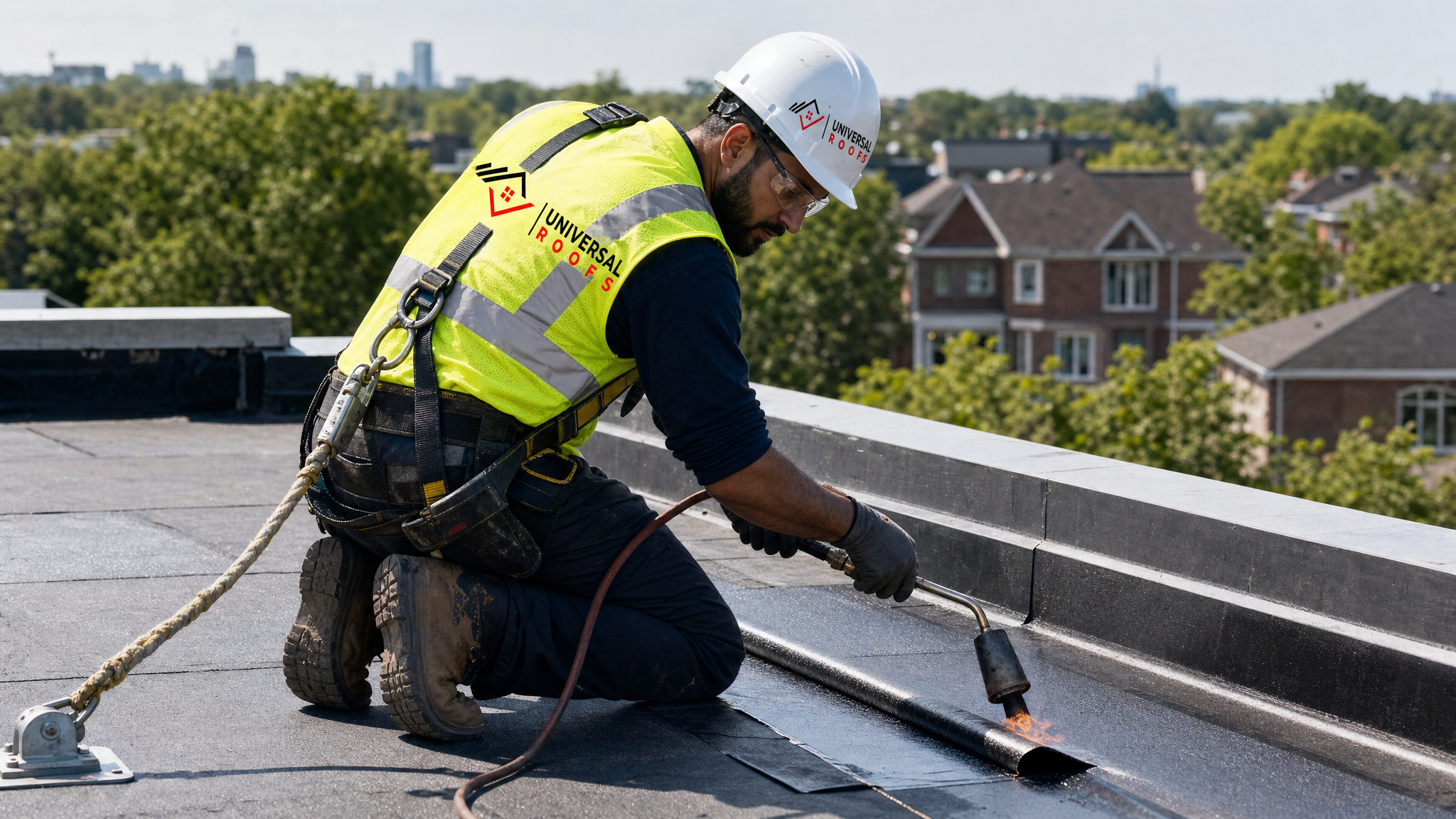
For a patch, a section of modified bitumen is either torch-welded or cold-applied with adhesive over the damaged area, then sealed with compatible flashing cement at the edges. When installed by an experienced crew, a modified bitumen patch can last as long as the surrounding roof membrane, often 15 to 20 years. This is why it is our default recommendation for anyone maintaining a flat roofing system.
EPDM Rubber: Built for Membrane Roofs
EPDM (ethylene propylene diene monomer) is a synthetic rubber membrane that has become one of the most trusted flat roofing materials in North America, and its patching kits are just as reliable. EPDM patches use a specialty primer and either liquid adhesive or a self-adhering splice tape to bond a new rubber section directly to the existing membrane, creating a seamless, watertight repair.
EPDM’s biggest advantage is elasticity. It can stretch and recover without cracking through repeated freeze-thaw cycles, and it resists UV degradation far better than plain asphalt products. If your flat roof is already EPDM, patching with matching EPDM is almost always the correct call rather than mixing membrane chemistries.
Liquid Roofing Membranes: Versatile and Seamless
Liquid-applied membranes, whether polyurethane, silicone, or acrylic-based, have become increasingly popular for patching seams, pipe boots, and awkward penetrations where a solid sheet patch is difficult to install cleanly. These products are rolled or brushed on as a liquid and cure into a seamless, fully adhered rubber-like coating.
The advantage is coverage: liquid membranes fill small cracks and irregular surfaces that a rigid patch cannot conform to. The trade-off is that surface preparation is critical. Any dirt, moisture, or loose granules left under a liquid membrane will shorten its life considerably, which is why professional application matters more with this category than almost any other patching material.
Sloped Roof Patching Materials That Actually Hold Up
Most GTA homes have a sloped asphalt shingle roof, and patching a shingle roof involves a slightly different set of materials than a flat roof repair. The goal on a sloped roof is almost always to integrate new material invisibly with the existing shingles while restoring a proper water-shedding path.
Replacement Shingles and Underlayment
The single most durable way to patch a shingle roof is, somewhat counterintuitively, not a “patching compound” at all. It is replacing the damaged shingles themselves along with the underlayment beneath them, then re-integrating the new shingles into the surrounding courses with proper nailing and sealant strips. This method restores the original manufacturer-rated lifespan to that section of roof, typically 20 to 30 years depending on the shingle grade.
Flashing: Often the Real Fix
A large share of the leaks we get called out for are not shingle failures at all, they are flashing failures around chimneys, skylights, vent stacks, and roof valleys. Aluminum and galvanized steel flashing, properly bent, sealed, and integrated under the shingle courses (never just caulked on top), is one of the most durable roof patching materials there is, often outlasting the shingles around it. If you have a skylight that keeps leaking at the same spot, the flashing detail is almost always the culprit, not the glass unit itself. We handle this regularly through our skylights and skylight replacement services.
Roof Cement and Sealants: Useful, But Limited
Asphalt plastic roof cement and butyl-based sealant tapes are inexpensive, widely available, and genuinely useful for small emergency patches, a lifted shingle edge, a nail pop, a pinhole in flashing. However, they are not a long-term durable solution on their own. Roof cement dries out, shrinks, and cracks within a few years, especially with direct summer sun exposure, and should generally be considered a stop-gap rather than a permanent fix for anything larger than a small gap.
Patching Materials Ranked by Real-World Toronto Weather Performance
Toronto’s climate is genuinely tough on roofing materials. We get heavy snow load, ice damming along eaves, dozens of freeze-thaw cycles each winter, intense UV in the summer, and occasional severe wind and hailstorms. The table below reflects how each patching material actually performs against those specific stresses, based on what we see in service calls across the region.
| Material | Ice Dam Resistance | UV/Heat Resistance | Wind Uplift Resistance | Ease of Future Repair |
|---|---|---|---|---|
| Modified bitumen | Very Good | Very Good | Good | Excellent |
| EPDM rubber | Excellent | Excellent | Good | Very Good |
| Liquid membrane | Good | Good-Very Good | Excellent (seamless) | Good |
| Metal flashing | Excellent | Excellent | Very Good | Excellent |
| Asphalt shingles (replacement) | Good | Good | Good-Very Good | Excellent |
| Roof cement/tape | Fair | Fair | Fair | Excellent |
Notice that the top performers, modified bitumen, EPDM, and metal flashing, all share one trait: they remain flexible in the cold rather than becoming brittle. This is the single most important property for any material that has to survive a Toronto winter without cracking.
How Much Do Durable Roof Patches Typically Cost?
Cost is often the deciding factor for homeowners weighing a patch against a larger repair. Here is a realistic range for professionally installed patches across the GTA, materials and labour included, as of 2026.
| Patch Type | Typical Size | Estimated Cost (CAD) | Expected Lifespan |
|---|---|---|---|
| Small flashing repair | Chimney, vent, or valley | $250 – $600 | 15-25 years |
| Modified bitumen flat roof patch | 1-3 square metres | $400 – $900 | 15-20 years |
| EPDM membrane splice | 1-3 square metres | $350 – $800 | 15-25 years |
| Shingle section replacement | Up to 5 square metres | $500 – $1,200 | 20-30 years |
| Liquid membrane seam repair | Seams and penetrations | $300 – $700 | 10-15 years |
| Emergency tape/cement patch | Small gap or crack | $150 – $350 | 2-5 years |
These figures are general estimates. The actual price depends on roof pitch, accessibility, the extent of any underlying decking damage, and how many trades are needed to complete the job safely. Every roof is different, which is why we always recommend an in-person assessment before committing to a specific repair approach.
When a Patch Is the Right Call, and When It Isn’t
Durable materials only get you so far if the underlying roof is past the point where patching makes sense. As a general rule, patching is the right move when the damage is isolated, the surrounding roofing material still has significant useful life left, and the roof deck underneath is dry and structurally sound.
Patching stops making financial sense when you are dealing with multiple failure points across the roof, widespread granule loss on shingles, a membrane that has become brittle across its whole surface, or a roof that is already past 80% of its expected service life. In those situations, spending money on repeated patches often costs more over five years than simply moving to a full roof replacement. A good rule of thumb: if you have needed three or more patches on the same roof section within two years, it is time for a broader conversation about replacement rather than another patch.
It is also worth having your attic inspected when patching a leak, since prolonged moisture intrusion can affect insulation and ventilation long before it becomes visible as a ceiling stain. Our attic inspection service is a useful add-on any time you are dealing with a leak that has been active for more than a few days.
DIY Patching vs. Professional Application
Homeowners can safely apply small amounts of roof cement or tape to a shingle that has lifted after a windstorm, provided they can do so safely from a ladder without walking on a wet or steep roof. Beyond that, we strongly recommend professional application for a few reasons that go beyond just the physical safety of working at height.
First, surface preparation is everything with modern patching materials. Modified bitumen, EPDM splices, and liquid membranes all require the substrate to be clean, dry, and properly primed, and any shortcuts here dramatically shorten the life of the repair regardless of how good the material itself is. Second, correctly diagnosing the actual source of a leak is harder than it looks. Water often travels along rafters or decking before dripping through the ceiling, so the visible damage indoors can be metres away from the actual point of entry on the roof.
Third, warranty matters. A professionally installed patch using manufacturer-approved materials typically carries a workmanship warranty, while a DIY patch generally does not, and can sometimes void the warranty on the surrounding roofing material if not done to spec.
Seasonal Timing for Roof Patching in the GTA
Summer, including right now in July, is genuinely the best window for roof patching in Toronto. Warm, dry conditions allow adhesives, sealants, and self-adhering membranes to cure properly, and torch-applied modified bitumen bonds far more reliably above 10°C than it does in cold weather. If you have a known soft spot, a lifted shingle, or a slow leak that has been “on the list” since spring, this is the ideal time to have it addressed before autumn rain and winter freeze-thaw cycles turn a small patchable issue into a bigger repair.
That said, emergency patching happens year-round, and our crews carry cold-weather-rated materials for situations that cannot wait for better conditions. A temporary winter patch installed with the right product can reliably hold until a permanent repair is scheduled in warmer weather.
Maintaining a Patch Once It’s Installed
Even the most durable roof patching materials benefit from basic ongoing maintenance. We recommend a visual roof check twice a year, in spring after the snow has cleared and in fall before leaves clog gutters and valleys, to confirm the patch edges remain sealed and no new debris is trapping moisture against the repair. Keeping gutters and downspouts clear reduces the chance of water backing up under shingles near a previous patch, and trimming overhanging branches limits abrasion damage during wind events.
If you notice any granule buildup in gutters near a patched area, soft spots when walked on, or a return of interior staining, it is worth having the repair reassessed sooner rather than later. Catching a failing patch early is almost always cheaper than dealing with the water damage that follows a full failure.
Choosing the Right Contractor for a Lasting Repair
Material quality is only half the equation. Even the most durable roof patching materials will fail prematurely if installed poorly, without proper surface prep, without compatible primers, or without correct integration into the surrounding roofing system. When evaluating a roofing contractor for a patch job, ask specifically which material they plan to use and why it matches your existing roof type, request to see their fall-protection and safety protocols for working at height, and check recent local reviews rather than relying on marketing claims alone.
We encourage homeowners across Toronto, Peel Region, York Region, Halton Region, and Durham Region to read through our reviews and check our FAQ page before booking any roofing work, patch or otherwise. Transparency about materials and process is one of the clearest signals of a contractor who builds repairs to last.
What are the most durable roof patching materials for a Toronto roof?
Is roof cement a durable long-term patching material?
How long does a modified bitumen roof patch last?
Can I use the same patching material on any roof type?
Why do roof patches fail faster in Toronto winters?
When should I replace my roof instead of patching it again?
Need Help With What Are the Most?
Choosing between a temporary fix and one of the most durable roof patching materials available shouldn’t be a guessing game. The team at Universal Roofs has been diagnosing leaks and matching the right repair material to the right roof across the GTA for two decades, and we can tell you honestly whether your roof needs a patch or something more.
Call us today at (416) 732-2421 or request a free inspection to get started.
Universal Roofs proudly serves Toronto, Mississauga, Brampton, Vaughan, Markham, Oakville and the GTA since 2005.