
A dirty roof is more than a cosmetic problem. Black streaking, moss colonies, and algae mats hold moisture against your shingles long after a summer rain has passed, and that trapped moisture accelerates granule loss, wood rot, and premature ageing of the entire roof system. Many Toronto homeowners look at those dark streaks and reach for a pressure washer or a ladder, thinking a weekend of DIY effort will solve the problem cheaply.
It rarely works out that way. Roof cleaning looks simple from the ground, but the combination of steep slopes, fragile shingle mat, high-pressure equipment, and chemical runoff makes it one of the more misunderstood maintenance tasks a homeowner can attempt. This is exactly why hire professionals for roof cleaning is the search so many GTA homeowners run before they touch a hose or a scrub brush — they want to know whether the risk and cost of doing it themselves is actually worth it.
In this guide we break down what professional roof cleaning actually involves, why the wrong technique can shorten the life of a roof instead of extending it, what it costs, and how to tell when a full roof repair is a smarter investment than another cleaning cycle. We will also cover the safety realities of working at height, the chemistry behind algae and moss growth in our climate, and the questions we hear most often from Toronto, Mississauga, and Vaughan homeowners.
What Roof Cleaning Actually Involves
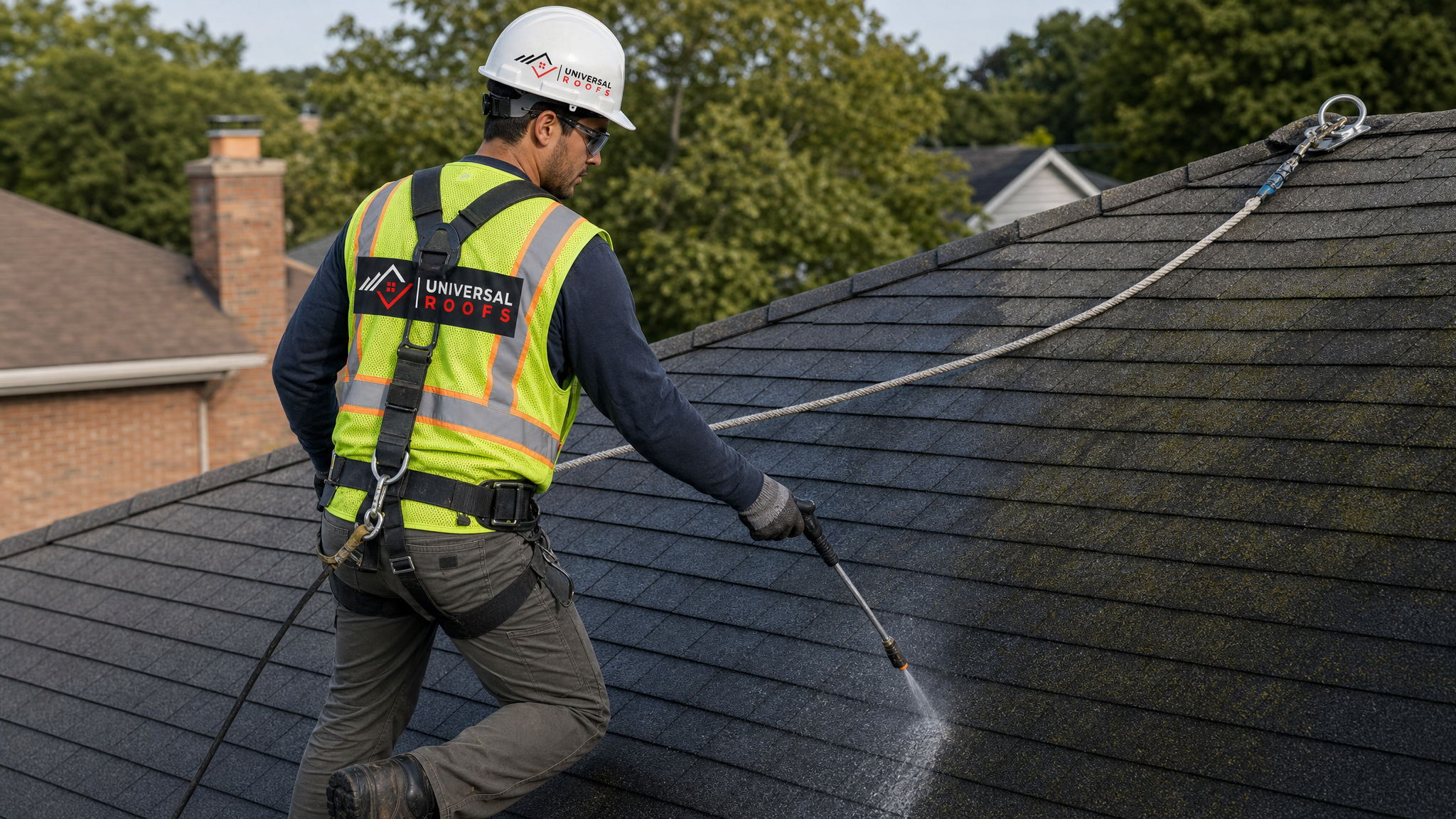
Professional roof cleaning is not the same job as cleaning a driveway or a deck. A trained crew starts with a visual inspection of the entire roof plane, identifying the type and extent of growth (algae, moss, lichen, or general grime), checking for existing damage such as lifted shingles or exposed nail heads, and confirming the roof’s overall condition before any water or chemical touches the surface. Only after that inspection does the actual cleaning begin, using a soft-wash method: a low-pressure application of a cleaning solution — typically a diluted sodium hypochlorite or specialty roof-safe blend — that kills algae, moss, and lichen at the root without blasting away the protective granules on your shingles.
This is the core distinction between professional roof cleaning and the DIY approach most homeowners default to. A consumer pressure washer set to “roof mode” still applies far more force than asphalt shingles can safely tolerate. Professionals rely on chemistry and dwell time, not pressure, to do the work. The solution is applied, allowed to sit for the manufacturer-recommended period, then rinsed at low pressure from the top down, with the runoff directed away from gardens, lawns, and storm drains wherever possible.
Homeowners considering a full renovation sometimes ask whether cleaning is worth doing before or after other roof work. In most cases, cleaning is a maintenance step that happens on its own schedule, separate from a roof replacement project, but a clean roof does make it much easier for a contractor to spot legitimate damage during an inspection, since black algae staining can visually mask cracked shingles, exposed flashing, or granule loss underneath.
Why DIY Roof Cleaning Goes Wrong So Often
The appeal of doing it yourself is obvious: a pressure washer rental costs a fraction of a professional visit, and the job looks straightforward from the driveway. In practice, we see the same handful of mistakes repeated across almost every DIY roof cleaning call we get asked to fix afterward.
The first and most damaging mistake is using high pressure directly on asphalt shingles. Pressure washers designed for concrete and siding apply force well beyond what a shingle’s granule coating can withstand. A single pass can strip away the mineral granules that protect the asphalt layer underneath from UV degradation, effectively ageing the roof by years in a single afternoon. Once granules are gone, they do not grow back, and that section of roof becomes a permanent weak point.
The second mistake is working at height without proper fall protection. Roofs in the GTA are frequently steeper than they appear from the ground, and wet shingles — which is the exact condition roof cleaning creates — become dangerously slick. Emergency rooms across Ontario see a predictable seasonal spike in fall-related injuries every summer, and roof cleaning is a recurring cause. Homeowners without harnesses, roof anchors, or ladder stabilizers are taking on real physical risk for a maintenance task.
The third mistake is chemical misuse. Straight bleach, for example, is far more concentrated than what professional-grade roof cleaning solutions use, and improper dilution can damage landscaping, discolour siding, corrode metal flashing and eavestroughs, and even bleach out shingle colour unevenly, leaving a blotchy appearance that is worse than the algae it was meant to remove.
| Cleaning Method | Typical Result on Asphalt Shingles | Risk Level | Recommended For |
|---|---|---|---|
| High-pressure power washing | Strips granules, accelerates wear | High — voids most shingle warranties | Never recommended for shingles |
| Undiluted household bleach | Uneven bleaching, corrodes metal, kills landscaping | High | Not recommended |
| Professional soft-wash (low-pressure chemical) | Removes algae/moss at the root, preserves granules | Low when applied correctly | All asphalt and most other shingle types |
| Manual scraping/brushing | Removes surface growth but can loosen shingle edges | Medium | Light moss spot-treatment only |
| Zinc or copper control strips | Prevents new algae growth over time | Low | Preventive maintenance after cleaning |
The Climate Factor: Why Toronto Roofs Grow Algae and Moss
The GTA’s climate is close to ideal for algae and moss growth on roofing. Humid summers, shaded northern exposures common in mature neighbourhoods, and repeated freeze-thaw cycles through the shoulder seasons all favour the growth of gloeocapsa magma, the blue-green algae responsible for the dark streaking most homeowners notice first, along with moss on shaded, north-facing slopes that dry out slowly after rain.
Moss is the more damaging of the two. Unlike algae, which grows on the shingle surface, moss develops a root structure that works its way under shingle edges, physically lifting them away from the roof deck. Once shingles are lifted, wind-driven rain can get underneath, leading to deck rot and interior leaks that have nothing to do with the shingle’s remaining service life — the problem becomes structural rather than cosmetic. This is one of the main reasons professional cleaning includes an inspection step: catching lifted shingles early can mean a simple spot repair through our roof repair service rather than a deck-level fix later.
Summer, when humidity is highest and algae growth is most active, is actually one of the best times to schedule a cleaning, since warmer temperatures help the cleaning solution work more effectively and give the roof time to fully dry before autumn’s wetter weather sets in.
What Professional Roof Cleaning Costs in the GTA
Pricing depends primarily on roof size, pitch, and the severity of growth, but most GTA homeowners can expect the ranges below for a typical asphalt shingle roof on a detached or semi-detached home.
| Roof Size / Condition | Typical Cost Range (CAD) | Time on Site | Notes |
|---|---|---|---|
| Small roof (under 1,500 sq ft), light algae | $350 – $550 | 2 – 3 hours | Bungalows, small semis |
| Mid-size roof (1,500 – 2,500 sq ft), moderate growth | $550 – $850 | 3 – 5 hours | Most detached GTA homes |
| Large or steep roof, heavy moss | $850 – $1,400 | 5 – 8 hours | May require extra anchor points and dwell time |
| Flat or low-slope roof cleaning/membrane rinse | $400 – $700 | 2 – 4 hours | Different technique than sloped shingles — see flat roofing |
| Preventive maintenance visit (annual) | $250 – $400 | 1 – 2 hours | Recommended once algae/moss is under control |
These figures are meaningfully lower than the cost of the damage a bad DIY attempt or a poorly executed cleaning can cause. Stripped granules, cracked shingles, or a fall injury all cost far more to remediate than a properly quoted cleaning ever would. If growth has already caused lifting or cracking, it is worth getting a roof repair quote alongside the cleaning quote so both issues are addressed in the same visit.
Why Hire Professionals for Roof Cleaning: The Real Reasons It Matters
When homeowners ask why hire professionals for roof cleaning instead of doing it themselves, the answer comes down to five factors that are difficult to replicate without training and the right equipment.
Correct technique protects your shingle warranty. Most asphalt shingle manufacturers explicitly warn against high-pressure washing in their warranty documentation. Using the wrong method can void coverage on a roof that may otherwise have another 10 to 15 years of life left in it.
Safety equipment prevents falls. A professional crew works with roof anchors, full-body harnesses, and rope-based fall protection systems appropriate for the pitch and height of your specific roof — equipment most homeowners do not own and are not trained to rig correctly.
Chemical dilution is calibrated, not guessed. Professional-grade cleaning solutions are mixed to a ratio that kills algae and moss spores effectively while remaining safe for landscaping, gutters, and metal flashing when applied and rinsed correctly.
An inspection happens alongside the cleaning. A trained technician will flag lifted shingles, cracked flashing, or early signs of leaks while they are already on the roof — problems a homeowner walking the roof for the first time in years is unlikely to catch.
The results last longer. Soft-wash cleaning combined with an optional zinc or copper strip installation slows future algae regrowth for several years, versus a DIY scrub that often sees streaking return within a single season.
Signs Your Roof Needs Cleaning Now
Not every roof needs cleaning on the same schedule. Shaded, north-facing roofs in older Toronto neighbourhoods with mature tree cover tend to need attention more often than roofs with full southern sun exposure. Watch for these signs:
- Dark streaking running vertically down the shingle field, usually starting near the ridge
- Green or grey-green patches, particularly in shaded valleys or near chimneys
- Visible moss cushions, especially on north-facing slopes
- Granules collecting in gutters or at the base of downspouts
- A noticeable colour difference between your roof and neighbouring homes of a similar age
If any of these signs are paired with visible shingle curling, cracking, or soft spots underfoot, cleaning alone will not solve the underlying problem — that combination usually points toward a conversation about roof replacement rather than maintenance.
Cleaning Schedule and Maintenance Timeline
A realistic maintenance timeline helps homeowners budget for roof care the same way they budget for eavestrough cleaning or furnace servicing.
| Roof Age / Condition | Recommended Cleaning Frequency | Additional Service to Consider |
|---|---|---|
| New roof (0 – 3 years) | As needed, typically none required | Annual visual inspection |
| Established roof (4 – 10 years) | Every 2 – 3 years, or at first sign of streaking | Zinc/copper strip installation |
| Mature roof (10 – 15 years) | Every 1 – 2 years | Combined inspection for granule loss |
| Roof near end of service life (15+ years) | Case-by-case — cleaning may not be cost-effective | Roof replacement consultation |
| Roof with existing moss lifting | Immediate cleaning plus inspection | Roof repair for lifted shingles |
How Roof Cleaning Fits Into Overall Roof Health
Roof cleaning does not exist in isolation from the rest of your roofing system. Poor attic ventilation, for instance, can trap heat and moisture that make algae and moss growth worse, since a roof deck that never fully dries out on the underside creates ideal conditions for growth on the topside as well. If your home has persistent moss regrowth even after cleaning, it is worth having your attic ventilation assessed, since balanced intake and exhaust airflow can meaningfully slow how quickly growth returns.
Skylights are another area worth checking during a roof cleaning visit. The flashing around a skylight is a common spot for algae and grime buildup, and a cleaning crew already on the roof is well positioned to note whether your skylights or their seals show any early signs of wear. If a skylight is older or showing deterioration, that is a separate conversation worth having about skylight replacement rather than trying to patch failing seals repeatedly.
We work across the whole GTA, and roof cleaning needs vary somewhat by area — mature tree canopy in parts of Toronto and York Region tends to produce more shaded, moss-prone roofs, while newer subdivisions in Peel Region and Halton Region often see more algae streaking on full-sun exposures. Homeowners in Durham Region along the lakeshore also tend to see higher humidity-driven growth given the proximity to Lake Ontario.
Choosing a Roof Cleaning Contractor
Not every company offering roof cleaning uses the soft-wash method described above, so it is worth asking a few direct questions before booking: what cleaning method and pressure level will be used, what specific product will be applied and at what dilution, whether the crew carries fall-protection equipment and liability insurance, and whether a written estimate includes an inspection of shingle condition, flashing, and gutters as part of the visit.
A contractor who cannot answer these questions clearly, or who defaults immediately to “power washing,” is not the right fit for shingle roofs. You can read what past customers have said about our approach on our reviews page, and browse common questions on our FAQ page. More about our background and service history since 2005 is available on our about page.
Why hire professionals for roof cleaning instead of doing it yourself?
Can pressure washing damage my roof?
How much does professional roof cleaning cost in the GTA?
What causes black streaks and moss on Toronto-area roofs?
How often should a roof be professionally cleaned?
Is roof cleaning worth it if I plan to replace the roof soon?
Need Help With Why Hire Professionals for?
A properly cleaned roof protects your shingle warranty, extends the life of your roofing system, and gives you an honest look at its true condition — something Universal Roofs has been doing safely and correctly for GTA homeowners since 2005.
Call us today at (416) 732-2421 or request a free inspection to get started.
Universal Roofs proudly serves Toronto, Mississauga, Brampton, Vaughan, Markham, Oakville and the GTA since 2005.