
If you have never given a second thought to the narrow boards running under your roofline or wrapping the edge of your roof deck, you are not alone. Soffit and fascia are the most overlooked components of a home’s exterior, yet they quietly do the heavy lifting of keeping water, pests, and cold air out of your attic and walls. When either one fails, the damage rarely stops at a peeling strip of aluminum or a chipped piece of wood trim.
At Universal Roofs, our crews get called out across the GTA every summer to repair rot, water staining, and pest intrusion that started with a small soffit or fascia problem nobody noticed until it reached the attic insulation or the exterior wall sheathing. This guide explains exactly why soffit and fascia repair is crucial for water damage prevention, how these components work together with your roof and eavestroughs, what warning signs to watch for, and how Toronto-area homeowners can budget for repairs before a minor issue becomes a major one.
Whether you are dealing with a single soft spot in your fascia board or a full stretch of damaged soffit venting after a rough winter, understanding how these systems protect your home will help you make smarter decisions about repair timing, materials, and contractors.
What Soffit and Fascia Actually Do
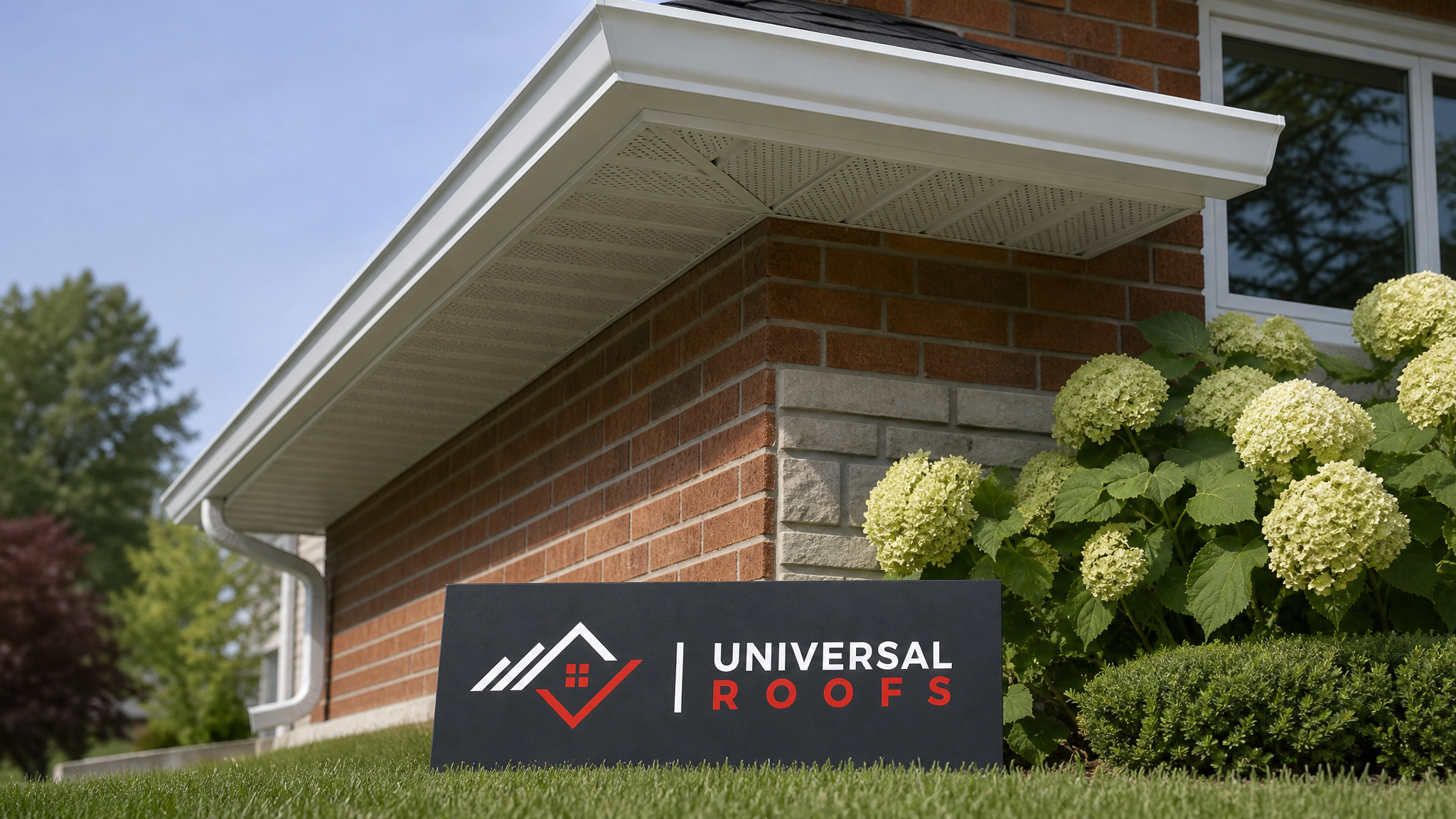
Soffit and fascia are two separate but interdependent parts of your roofline. The fascia is the vertical board that runs along the edge of the roof, directly behind the eavestrough. It is the piece you see when you look up at the edge of your roof from the street, and it is what your gutters are physically fastened to. The soffit is the horizontal panel underneath the roof overhang, connecting the fascia back to the exterior wall of the house and closing off the underside of the eaves.
Together, these components serve three critical functions: they seal the gap between the roof structure and the walls, they support and anchor the eavestrough system, and they ventilate the attic through perforations or vents built into the soffit panel. When any one of these functions is compromised, water damage prevention becomes significantly harder, because the roofline is no longer a sealed, ventilated system — it is an open invitation for moisture.
Most GTA homes built from the 1960s through the 1990s were finished with wood fascia and either wood or vinyl soffit. Homes renovated more recently, or homes that have gone through a roof replacement, typically have aluminum-wrapped fascia and vented aluminum or vinyl soffit, which resist moisture far better than bare wood.
Why Soffit and Fascia Repair Is Crucial for Water Damage Prevention
The core reason soffit and fascia repair is crucial for water damage prevention comes down to water’s path of least resistance. Rainwater and melting snow are funnelled by your roof shingles toward the eavestrough, which is bolted directly into the fascia board. If the fascia is rotted, warped, or pulling away from the roof deck, the eavestrough loses its anchor point and begins to sag, pull free of its brackets, or pitch in the wrong direction. Water then overflows the trough instead of draining through the downspout, running straight down the face of the fascia and behind the soffit into the wall cavity.
Damaged soffit creates an equally serious problem from a different angle. Soffit panels are perforated or vented specifically to let attic air escape, which balances the intake air pulled in near the roof edge and the exhaust air escaping through a ridge or roof vent. When soffit rots, cracks, or is chewed through by squirrels and raccoons, that controlled airflow becomes uncontrolled. Wind-driven rain, snowmelt, and even condensation can wick directly into the attic through the gaps, soaking insulation and, over time, staining or rotting the roof deck from underneath.
This is precisely why roof repair contractors always inspect the soffit and fascia as part of any water damage assessment. A leak that appears to be coming from the shingles is, in a surprising number of cases, actually originating at a failed fascia-to-eavestrough connection or a gap in the soffit venting.
Common Signs of Soffit and Fascia Damage
Toronto’s freeze-thaw winters are particularly hard on soffit and fascia because moisture that gets trapped behind these components expands as ice and contracts as it melts, repeatedly stressing joints, fasteners, and seams. By early summer, homeowners often notice the cumulative damage from the winter just past. Watch for these signs during a walk around your property:
- Peeling or bubbling paint on fascia boards, which usually indicates moisture trapped behind the surface
- Soft or spongy fascia wood when pressed with a gloved hand or the back of a screwdriver
- Sagging or pulling eavestroughs, since they are only as strong as the fascia they are bolted to
- Visible daylight or gaps between the soffit panel and the wall or fascia
- Water stains on the underside of the soffit or on the exterior wall just below the roofline
- Signs of pests — wasp nests, squirrel entry holes, or bird nesting — in soffit vents
- Musty odours or visible mould in the attic near the eaves
- Ice damming along the roof edge in winter, often a symptom of poor attic ventilation caused by blocked soffit vents
If you notice several of these signs at once, it is worth having a professional assess not just the soffit and fascia but also your attic insulation and ventilation, since the three systems are deeply connected.
How Soffit and Fascia Failure Leads to Bigger Water Damage
Water damage rarely announces itself immediately. What starts as a small gap in the soffit or a hairline crack in the fascia typically progresses through a fairly predictable sequence over one to three seasons if left unaddressed.
| Stage | What Happens | Typical Timeframe | Visible Warning Sign |
|---|---|---|---|
| 1. Initial gap or crack | Small opening forms in soffit or fascia from age, impact, or pest activity | Immediate | Hairline crack, small hole, loose seam |
| 2. Moisture intrusion | Rain and snowmelt begin entering the gap during storms | 1 season | Damp staining near the eaves |
| 3. Insulation saturation | Attic insulation nearest the eaves absorbs moisture and loses R-value | 1-2 seasons | Musty attic odour, visible wet insulation |
| 4. Wood rot and structural softening | Roof deck, rafter tails, or fascia framing begin to soften and decay | 2-3 seasons | Spongy fascia, sagging roofline |
| 5. Interior and structural damage | Water tracks into wall cavities or ceiling drywall; mould growth begins | 3+ seasons | Ceiling stains, peeling interior paint, mould smell |
Catching the problem at stage one or two, through routine inspection and prompt soffit and fascia repair, is dramatically less expensive than addressing stage four or five, which often requires opening up drywall, replacing insulation, and in severe cases repairing structural framing.
Soffit and Fascia Materials Compared
Not all soffit and fascia materials perform equally well against Toronto’s climate. When repairing or replacing damaged sections, the material you choose has a direct effect on how long the repair lasts and how well it protects against future water intrusion.
| Material | Water Resistance | Typical Lifespan | Best Use Case |
|---|---|---|---|
| Bare wood | Poor — absorbs moisture, prone to rot without diligent repainting | 10-15 years | Heritage homes requiring an authentic wood profile |
| Painted wood with primer sealant | Fair — needs recoating every 3-5 years to stay watertight | 15-20 years | Character homes where owners commit to regular maintenance |
| Aluminum-wrapped fascia | Very good — sheds water, will not rot underneath if properly sealed | 25-30+ years | Most Toronto-area homes, especially after a roof replacement |
| Vented vinyl soffit | Very good — will not rot, resists insect damage | 20-30 years | Standard residential soffit replacement |
| Perforated aluminum soffit | Excellent — corrosion resistant, holds paint finish longest | 30+ years | Homes prioritizing long-term low maintenance |
For most homeowners we work with across Toronto and the surrounding Peel Region, aluminum-wrapped fascia paired with vented aluminum or vinyl soffit offers the best long-term balance of water resistance, low maintenance, and cost.
The Soffit and Fascia Repair Process, Step by Step
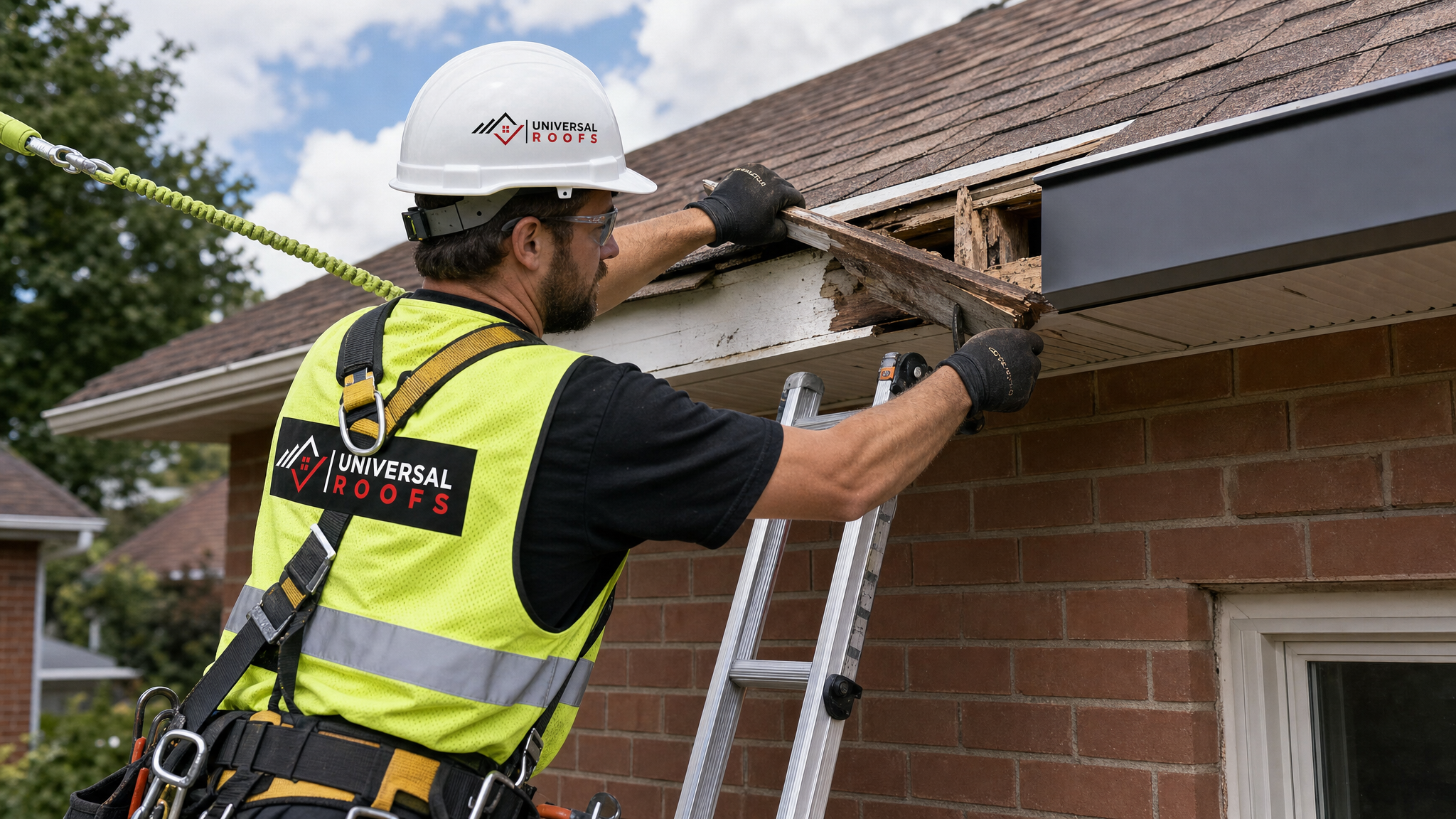
A proper soffit and fascia repair is more than just screwing a new piece of aluminum over a rotted board. Our crews follow a consistent sequence to make sure the repair actually stops water intrusion rather than just hiding it:
- Inspect the eavestrough and roof deck. Because fascia failure is so closely tied to eavestrough support and roof edge condition, we check both before starting any repair.
- Remove damaged sections. Rotted wood or cracked panel is cut back to solid, dry material — patching over compromised wood only delays the problem.
- Assess the roof deck and rafter tails underneath. If moisture has reached the framing, that structural wood needs to be dried, treated, or replaced before new soffit and fascia go back on.
- Install new fascia board. Pressure-treated wood or a composite board is fastened to the rafter tails, then wrapped in prefinished aluminum coil for a fully weatherproof, low-maintenance finish.
- Reinstall or upgrade the soffit. Vented panels are cut to fit and fastened into the F-channel against the wall and the fascia’s underside J-channel, maintaining proper intake airflow.
- Re-secure the eavestrough. New hangers are set into the solid fascia at the correct pitch so water flows toward the downspouts rather than pooling or overflowing.
- Seal all seams and joints. Every seam, corner, and end cap is sealed with an exterior-grade sealant rated for Toronto’s temperature swings.
- Verify attic ventilation balance. Intake at the soffit should roughly match exhaust at the ridge or roof vents, so we confirm the vented soffit area is not blocked by insulation.
This full-system approach is the same principle we apply during a roof replacement — soffit, fascia, eavestrough, and roof deck are treated as one connected water management system rather than isolated parts.
DIY Repair vs. Professional Soffit and Fascia Repair
Some homeowners are tempted to patch a small section of soffit or caulk a fascia crack themselves. For very minor cosmetic issues at ground-accessible areas, that can be reasonable. But because soffit and fascia repair sits at height, next to live electrical service masts in many cases, and directly affects structural water management, professional repair is strongly recommended for anything beyond the smallest touch-up.
| Factor | DIY Repair | Professional Repair |
|---|---|---|
| Ladder and height safety | Higher risk without fall protection or proper ladder stabilizers | Crews use harnesses, ropes, and roof anchors on every job |
| Rot detection behind panels | Easy to miss hidden rot in rafter tails or roof deck | Trained to probe and identify hidden structural moisture |
| Eavestrough realignment | Difficult to achieve correct pitch without experience | Re-pitched and re-hung to manufacturer spec |
| Ventilation balance | Often overlooked entirely | Verified against attic intake/exhaust ratios |
| Material matching | Limited access to matching aluminum coil colours | Trade access to full range of prefinished coil colours |
| Warranty | None | Workmanship warranty included |
If you are unsure whether your situation calls for a simple patch or a full section replacement, our FAQ page covers many of the questions homeowners ask before booking an inspection.
Soffit, Fascia, and Attic Ventilation: The Overlooked Connection
It is worth spending a moment on ventilation specifically, because it is the piece of this puzzle homeowners most often miss. Vented soffit is not just decorative perforated aluminum — it is the intake half of your attic’s ventilation system. Cool outside air is drawn in through the soffit vents, travels up along the underside of the roof deck, and exits through a ridge vent or roof-mounted exhaust vents near the peak.
When this airflow works properly, it keeps the underside of your roof deck cool and dry in summer and prevents warm, moist household air from condensing against cold roof sheathing in winter. When soffit is damaged, painted over, or blocked by insulation stuffed too far into the eaves, that intake airflow stops. The result is often condensation dripping inside the attic, which looks and behaves exactly like a roof leak even though the shingles themselves may be perfectly sound.
This is one of the most common misdiagnoses we see: a homeowner books a roof repair appointment convinced they have a shingle leak, and our technicians find the actual cause is blocked or damaged soffit venting starving the attic of airflow. Restoring proper soffit function often resolves the “leak” entirely without touching a single shingle.
If your roofline also includes a skylight, ventilation problems can compound existing condensation risk around the skylight curb. Our skylights and skylight replacement teams frequently coordinate with the soffit and fascia crew on homes where both issues are present at once.
Seasonal Timing: Why Summer Is the Right Time for This Repair
Soffit and fascia repair can technically happen in most seasons, but summer offers real practical advantages for GTA homeowners. Sealants and caulking cure properly in warm, dry conditions, aluminum coil stock is easier to form and fit without becoming brittle in the cold, and crews can work longer, safer hours on extension ladders and roof anchors without contending with ice or snow load on the roof edge.
Getting repairs done before autumn also means your eavestroughs and soffit vents are fully functional heading into the fall leaf-drop season and the winter freeze-thaw cycle that follows — the exact conditions most likely to expose any remaining weak points. Homeowners across York Region, Halton Region, and Durham Region who schedule soffit and fascia repair in summer typically avoid the winter emergency calls that come with ice damming and frozen, overflowing eavestroughs.
What Soffit and Fascia Repair Typically Costs in the GTA
Costs vary depending on the extent of damage, material chosen, and how much of the roofline needs attention, but the table below reflects typical ranges we see across the Greater Toronto Area for common scopes of work.
| Scope of Repair | Typical Cost Range (CAD) | Notes |
|---|---|---|
| Spot repair of a single fascia section (up to 3 metres) | $300 – $700 | Includes removal, new board, aluminum wrap, and resealing |
| Soffit panel replacement (per section) | $250 – $600 | Vented vinyl or aluminum, matched to existing colour where possible |
| Full roofline fascia replacement (average home) | $1,800 – $4,500 | Includes eavestrough removal and reinstallation |
| Full soffit and fascia replacement with ventilation upgrade | $3,500 – $8,000+ | Recommended when rot is extensive or ventilation is undersized |
| Rafter tail or roof deck repair (per affected area) | $400 – $1,500 additional | Only required when moisture has reached structural framing |
Every property is different, and the only reliable way to know your actual cost is a physical inspection. You can review real customer experiences on our reviews page, or learn more about how long we have been serving the region on our about page.
Preventing Future Soffit and Fascia Damage
Once a repair is complete, a few simple habits go a long way toward preventing a repeat problem:
- Clean eavestroughs at least twice a year so overflow does not run down the fascia
- Trim overhanging tree branches that scrape against soffit and fascia in wind
- Check soffit vents for pest entry points each spring and fall
- Keep attic insulation pulled back from soffit vents to preserve airflow
- Schedule a roofline inspection every two to three years, or after any major storm
- Repaint or reseal wood fascia promptly if you have not yet upgraded to aluminum-wrapped boards
These habits are inexpensive compared to the cost of reactive repairs after water has already reached your attic insulation or wall cavities.
Why is soffit and fascia repair crucial for water damage prevention?
How do I know if my soffit or fascia needs repair?
Can damaged soffit cause an attic leak even if the roof is fine?
What is the best material for soffit and fascia repair in Toronto’s climate?
How much does soffit and fascia repair cost in the GTA?
Is summer a good time to schedule soffit and fascia repair?
Need Help With Why Is Soffit and?
Ignoring a small soffit gap or a soft fascia board rarely stays a small problem for long, especially through a Toronto winter. Getting ahead of it now protects your attic insulation, your eavestroughs, and the structural wood along your entire roofline. Universal Roofs has been repairing and replacing soffit, fascia, and full roofing systems across the GTA since 2005, and our crews know exactly what to look for at every stage of damage.
Call us today at (416) 732-2421 or request a free inspection to get started.
Universal Roofs proudly serves Toronto, Mississauga, Brampton, Vaughan, Markham, Oakville and the GTA since 2005.