
A summer squall rolling off Lake Ontario can push gusts over 80 km/h across the GTA in minutes, and it doesn’t take a tornado to strip shingles, lift flashing, or crack a ridge cap. What it does take is a homeowner who knows what a proper roof wind damage repair warranty actually covers before the next storm rolls through. Too many Toronto homeowners find out the hard way — after a windstorm, staring at a repair invoice — that their “warranty” only covered materials, or worse, nothing related to wind at all.
This guide breaks down the six best roof wind damage repair warranty options available to homeowners across the Greater Toronto Area, what each one actually protects, how long coverage lasts, and the fine print that trips people up. Whether you’re patching storm damage right now or planning ahead of next season’s wind events, understanding these options will save you money and frustration down the road.
We’ll also walk through how wind damage actually happens to a Toronto roof, what a fair repair warranty should look like on paper, and the questions to ask any contractor before they touch your roof. If you’re dealing with active storm damage today, our roof repair team can assess the damage and walk you through warranty-backed options directly.
How Wind Actually Damages a Toronto Roof
Before comparing warranty options, it helps to understand what wind damage looks like in practice, because insurers and contractors use very specific language to describe it, and that language often determines whether a warranty claim gets approved. Wind doesn’t just “blow shingles off.” It works through a few distinct mechanical failure modes.
Uplift failure happens when wind gets underneath the leading edge of a shingle, usually one whose seal strip never bonded properly or has weakened with age and UV exposure. Once air gets under one tab, it peels back like a page in a book, and the shingles behind it become vulnerable too. This is the most common wind damage claim on GTA roofs, especially on homes with south or west-facing slopes that catch the prevailing wind.
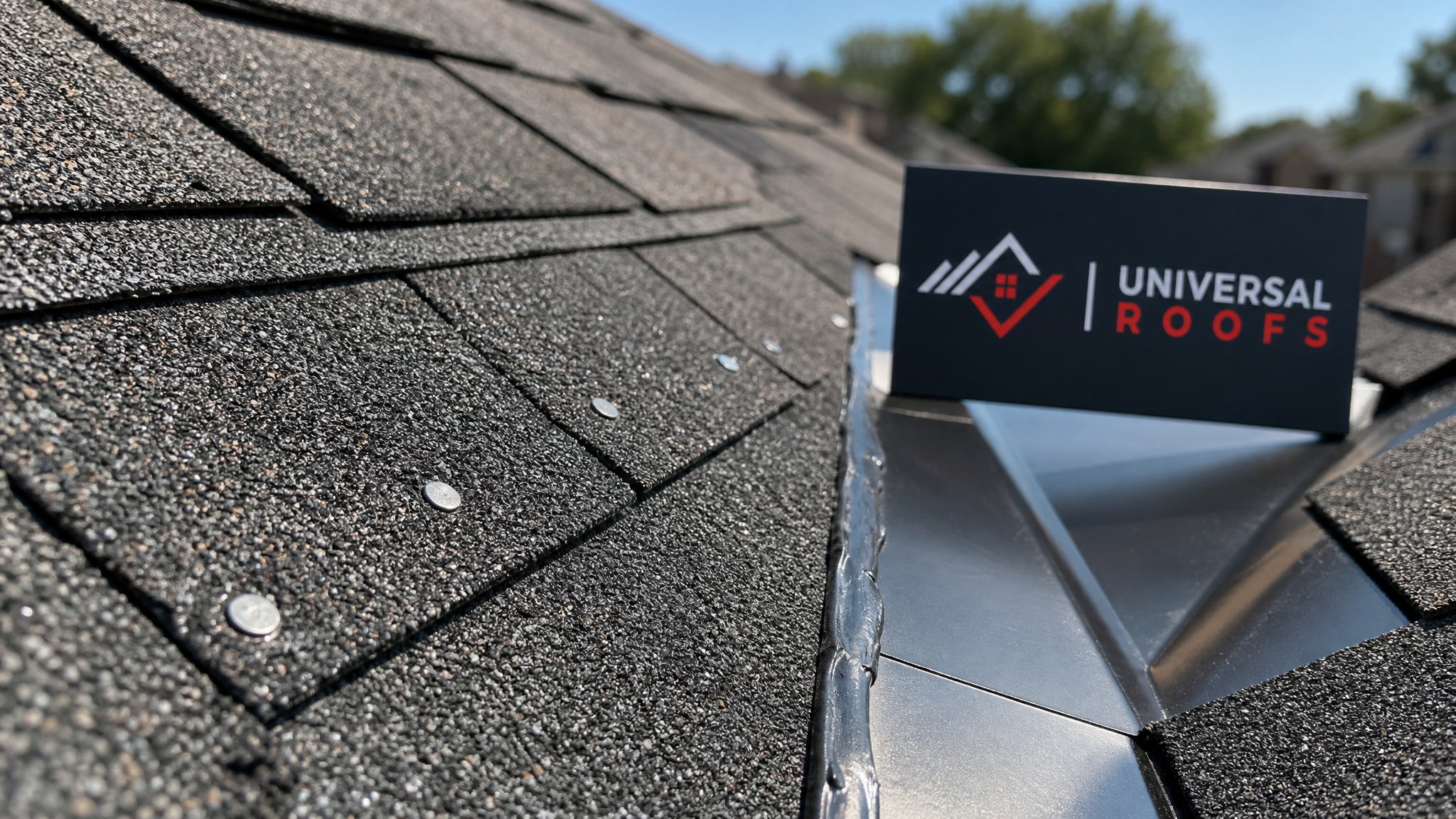
Fastener failure occurs when nails were installed too high on the shingle, at the wrong angle, or into weakened decking. Over time, thermal cycling — our freeze-thaw winters followed by hot, humid summers — works nails loose. A wind event just finishes what temperature swings started. This is why a repair that only replaces the visibly missing shingles, without checking the fastening pattern on adjacent courses, often fails again in the very next storm.
Flashing and edge metal displacement is the third major category. Wind pressure differentials are strongest at roof edges, ridges, and any place metal meets shingle — chimney flashing, valley metal, drip edge. A gust doesn’t need to remove a whole section of roofing to cause a leak; it only needs to lift a flashing edge a few millimetres to let wind-driven rain behind it.
Each of these failure modes has different repair requirements, and that matters enormously for warranty selection, because a warranty written around “shingle replacement” may say nothing about flashing, decking, or fastening — the parts of the job most likely to fail again if done poorly the first time.
Option 1: Manufacturer Wind-Resistance Warranty (Passed Through by the Installer)
Every major asphalt shingle line — architectural laminates in particular — carries a wind-speed rating from the manufacturer, typically 130 km/h to 210 km/h depending on the product tier and installation method. This is the warranty most homeowners already have without realizing it, because it comes bundled with the shingle purchase at the time of original installation or full replacement.
The catch: this warranty only stays valid if the repair crew follows the manufacturer’s exact nailing pattern, starter strip requirements, and fastener count per shingle. A repair that “looks fine” but uses six nails instead of the required labelled nail line can void the wind warranty entirely, even though the shingle brand and colour match. This is one of the most overlooked details in wind damage repair — the manufacturer warranty travels with proper installation, not with the product itself.
If your roof is old enough that a repair is really a partial re-roof, it’s worth discussing full roof replacement options, since a full tear-off lets a contractor apply the manufacturer’s highest wind-rated installation method across the entire slope rather than patching around existing, possibly non-compliant, fastening.
Option 2: Contractor Workmanship Warranty on the Repair Itself
Separate from the shingle manufacturer’s product warranty, a reputable contractor issues their own workmanship warranty covering the labour and technique used in the repair — proper flashing integration, correct fastener placement, sealed transitions, and matched shingle coursing. This is arguably the single most important warranty type for wind damage specifically, because most wind failures trace back to installation error, not product defect.
A strong workmanship warranty for wind repair should explicitly name wind uplift as a covered failure mode, not just “leaks” generically. Ask any contractor quoting your repair to show you this in writing before work starts, and confirm the warranty term (typically 2 to 10 years depending on the company) and whether it’s transferable if you sell the home.
| Warranty Type | Typical Term | Covers Wind Uplift? | Requires Registration? |
|---|---|---|---|
| Manufacturer wind-rating warranty | 10-25 years (product only) | Yes, if installed to spec | Sometimes |
| Contractor workmanship warranty | 2-10 years | Yes, if named explicitly | No |
| Extended labour warranty (upgrade) | 10-50 years | Usually, check exclusions | Yes, within 30-60 days |
| Homeowner’s insurance wind endorsement | Annual, renews with policy | Yes, subject to deductible | N/A (policy-based) |
| Flashing/detail-specific warranty | 5-15 years | Only for flashing failures | No |
| Full system warranty (post-replacement) | 25-50 years | Yes, comprehensive | Yes, at install |
Option 3: Extended Manufacturer Labour Warranty (Upgrade Tier)
Most premium shingle manufacturers offer an upgraded warranty tier that extends coverage beyond materials to include labour costs for a defect-related repair, sometimes for the full life of the warranty rather than a prorated declining scale. This upgrade usually requires the installing contractor to be a certified/accredited installer with that manufacturer, and the homeowner typically must register the warranty within 30 to 60 days of installation or repair.
For wind damage specifically, this matters because it can mean the difference between paying out of pocket for a second repair if the first one fails prematurely due to a material defect versus having both materials and labour covered. The trade-off is cost — extended labour warranties are usually only offered on higher-tier shingle products, so this option tends to apply more to full slope replacements than small patch repairs.
If a significant portion of your roof needs replacing after a storm — often the case when wind damage is combined with hail or falls near the end of the shingles’ service life — it’s worth asking your contractor whether extending to a full roof replacement unlocks this warranty tier versus a smaller patch repair that wouldn’t qualify.
Option 4: Homeowner’s Insurance Wind/Storm Endorsement
This isn’t a warranty from a roofing company at all, but it’s the coverage most GTA homeowners actually rely on financially after a wind event, so it deserves a place on this list. Most standard Ontario homeowner policies include wind and hail as named perils, but the details vary enormously between insurers: some apply a flat deductible, others apply a percentage-based wind/hail deductible that can run 1-5% of your home’s insured value.
The practical overlap with contractor warranties: insurers increasingly require documentation that the repair was performed to code and manufacturer specification in order to approve a claim, and some require photos of the damage before repair. A contractor familiar with insurance claims can provide the inspection report and photo documentation your insurer needs, and can time the repair so it doesn’t compromise your claim. This is worth discussing during your initial assessment, particularly if the damage affects a large area or multiple slopes.
Option 5: Flashing and Detail-Specific Warranties
Because so much wind damage actually originates at flashing, valleys, and roof-to-wall transitions rather than open shingle field, some contractors issue a separate, narrower warranty specifically for these details when doing a wind repair. This is common when the repair scope is a single valley, chimney cricket, or skylight curb rather than a full slope.
If your wind damage repair included work around a skylight curb or flashing, make sure that warranty explicitly names the flashing detail and the fastening method used, not just “the skylight.” Skylight flashing failures under wind load are a frequent callback issue, and a dedicated skylight replacement or reflash, done correctly the first time with a documented warranty, is far cheaper than repeated patch attempts. If you’re unsure whether your current skylight curb can even be properly reflashed versus needing full replacement, our skylights team can assess it alongside the roof repair.
Option 6: Full System Warranty With Post-Replacement Wind Coverage
When wind damage is severe enough, or frequent enough, that patch repairs stop making financial sense, a full roof system replacement carries the strongest available warranty: a combined manufacturer materials warranty, extended labour coverage, and a contractor workmanship warranty, all applying to one continuous installation rather than a patchwork of past repairs with different warranty terms and start dates.
This is also the point where flat roof sections, common on additions, garages, and porch roofs across older Toronto homes, deserve separate attention, since flat membrane systems have entirely different wind uplift requirements (perimeter fastening density, adhesive coverage, termination bar detail) than sloped shingle roofs. If your property has a mixed roof — sloped shingles plus a flat section — ask about flat roofing wind-rated warranty terms specifically, since a single “roof warranty” quote sometimes only covers the shingle portion.
Comparing Cost and Turnaround Across Warranty Tiers
Warranty strength and repair cost are related but not identical — a stronger warranty sometimes costs the same as a weaker one if the difference is really about paperwork and registration rather than materials. The table below reflects typical GTA pricing and timelines as of this writing; always confirm current numbers with a written quote, since material and labour costs shift throughout the year.
| Repair Scope | Typical Cost Range (CAD) | Typical Turnaround | Warranty Tier Available |
|---|---|---|---|
| Spot shingle replacement (under 10 shingles) | $350 – $750 | Same day to 2 days | Contractor workmanship only |
| Single slope re-shingle | $1,800 – $4,500 | 1-2 days | Manufacturer + workmanship |
| Flashing/valley reflash | $600 – $2,200 | 1 day | Detail-specific warranty |
| Skylight curb reflash or replacement | $900 – $3,500 | 1-2 days | Detail-specific + product warranty |
| Multi-slope repair (storm-wide damage) | $3,000 – $9,000 | 2-4 days | Manufacturer + extended labour |
| Full roof replacement | $9,000 – $22,000+ | 2-5 days | Full system warranty |
Questions to Ask Before You Sign a Wind Damage Repair Contract
A written warranty is only as good as what it actually names. Before approving any wind damage repair, whether it’s a $400 spot fix or a $15,000 slope replacement, walk through these points with your contractor:
- Does the warranty name “wind uplift” or “wind damage” specifically, or does it only reference generic leaks?
- Is the fastening pattern being used compliant with the shingle manufacturer’s wind-rating requirements for this specific product line?
- Does the warranty cover labour, materials, or both — and is that coverage full-term or prorated?
- Is there a registration deadline, and who is responsible for filing it?
- Does the warranty transfer to a new owner if you sell the home within the coverage period?
- Are flashing, valley, and skylight details covered under the same warranty, or do they need a separate one?
A contractor who can answer all six of these without hesitation, and put the answers in writing, is one worth trusting with storm-related work. If you’d like to see how past customers rated our response time and workmanship after wind events, our reviews page has verified feedback from homeowners across the GTA, and our FAQ page covers additional warranty and insurance questions we hear often.
Regional Considerations Across the GTA
Wind exposure isn’t uniform across the Greater Toronto Area, and it affects which warranty tier makes the most sense for your specific property. Homes near open water or on elevated terrain typically see higher sustained gusts and should lean toward the strongest available manufacturer wind rating and full system warranties rather than spot repairs.
In Toronto proper, older housing stock with mixed flat and sloped sections often benefits from a combined warranty review covering both roof types together. Homes across Peel Region and York Region, where newer subdivisions dominate, more often qualify for extended manufacturer labour warranties since the original roofs are younger and better documented. In Halton Region, lakeside wind exposure in communities like Oakville and Burlington makes wind-rating verification especially important during any repair. And across Durham Region, where storm cells frequently track in off the lake, a documented workmanship warranty with clear wind-uplift language gives homeowners the strongest protection for repeat weather events.
Attic Ventilation’s Overlooked Role in Wind Damage Warranties
One detail that rarely comes up until a warranty claim is disputed: poor attic ventilation can accelerate shingle deterioration from underneath, weakening the seal strips that resist wind uplift in the first place. A manufacturer may reduce or deny a wind warranty claim if they determine inadequate attic ventilation contributed to premature shingle failure, since excess heat and moisture buildup is considered a maintenance issue rather than a product or installation defect.
This is worth checking any time you’re evaluating a wind damage repair warranty, particularly on homes built before modern ventilation codes were standard. A quick attic inspection alongside your roof assessment can confirm whether soffit and ridge ventilation are balanced, and can head off a denied claim long before it becomes an issue.
Frequently Asked Questions About Roof Wind Damage Repair Warranties
| Wind Damage Type | Common Cause | Repair Priority | Warranty Type Needed |
|---|---|---|---|
| Shingle uplift/tab peeling | Failed seal strip, aged shingles | High | Manufacturer wind-rating warranty |
| Fastener back-out | Improper nailing, thermal cycling | High | Contractor workmanship warranty |
| Flashing/edge metal displacement | Wind pressure at roof edges/valleys | Urgent | Flashing-specific warranty |
| Ridge cap failure | Direct wind exposure at roof peak | High | Contractor workmanship warranty |
| Granule loss/surface stripping | Wind-blown debris abrasion | Moderate | Manufacturer wind-rating warranty |
What does a typical roof wind damage repair warranty actually cover?
How long should a roof wind damage repair warranty last?
Will my roof wind damage repair warranty be voided by improper installation?
Does homeowner’s insurance replace the need for a roof wind damage repair warranty?
Can attic ventilation problems affect a roof wind damage repair warranty claim?
Is a roof wind damage repair warranty transferable if I sell my home?
Need Help With 6 Best Roof Wind?
Choosing the right roof wind damage repair warranty starts with an honest assessment of the actual damage and the installation work behind it, not just a quote number. Universal Roofs has been documenting and repairing wind damage across the GTA since 2005, and we put every warranty term in writing before work begins.
Call us today at (416) 732-2421 or request a free inspection to get started.
Universal Roofs proudly serves Toronto, Mississauga, Brampton, Vaughan, Markham, Oakville and the GTA since 2005.