
Wood shake roofs give Toronto-area homes a warm, textured, custom-built look that vinyl siding and asphalt shingles simply cannot replicate, but that beauty comes with a maintenance responsibility most homeowners underestimate until something goes wrong. Cedar shakes are a natural material, and like any natural material, they age, weather, and eventually fail in predictable, identifiable ways. Catching those signs your wood shake roof needs repair early is the single biggest factor separating a homeowner who spends a few hundred dollars on spot repairs from one who ends up paying for a full deck replacement after water has been quietly working its way into the attic for a season or two.
The trouble with wood shake roofs is that the damage often starts from the underside, hidden from view, long before it becomes visible from the ground or even from a ladder. A shake that looks intact from the driveway can already be splitting along its grain, cupping from repeated wetting and drying cycles, or hosting a colony of moss that is holding moisture against the wood twenty-four hours a day. By the time curling, discolouration, or daylight through the attic boards becomes obvious, the underlying issue has usually been developing for months.
This guide walks through the five most reliable warning signs that a cedar or wood shake roof needs professional attention, explains why each one matters, and gives you a realistic sense of what repair versus replacement looks like in the Greater Toronto Area’s climate. We will also cover inspection frequency, typical repair costs, and the freeze-thaw dynamics that make our winters particularly hard on wood roofing. If you manage a wood shake roof anywhere from Toronto to Oakville to Markham, this is the reference to bookmark.
Why Wood Shake Roofs Need a Different Inspection Approach
Asphalt shingles fail in fairly uniform ways: granule loss, blistering, and eventual brittleness that shows up more or less evenly across the whole roof plane. Wood shake behaves differently because it is an organic material reacting to moisture, sunlight, and temperature at the level of individual boards. Two shakes installed side by side, cut from the same bundle, can age at completely different rates depending on how much direct sun they get, how well air circulates beneath them, and whether water tends to pool or drain quickly off that particular section of roof.
That variability means a proper inspection has to be granular. Instead of scanning the roof as a single surface, an experienced technician walks (or more often, avoids walking directly on) each slope and looks at individual shakes and clusters of shakes, checking the butt ends, the exposed faces, the nail heads, and the gaps between courses. This is also why professional roof repair services for wood shake differ meaningfully from a general handyman patch job — the diagnostic process itself requires specialized knowledge of how cedar ages.
In the GTA specifically, our climate accelerates several of these failure modes. We get roughly 100+ freeze-thaw cycles per winter, meaning water that gets into a split shake freezes, expands, and widens that split, then thaws and lets more water in the next time it rains or the snow melts. Combine that with humid summers that encourage moss and algae growth, and you have a climate that is genuinely tough on wood roofing compared to drier regions where cedar shake originally became popular.
Sign 1: Curling, Cupping, or Warping Shakes
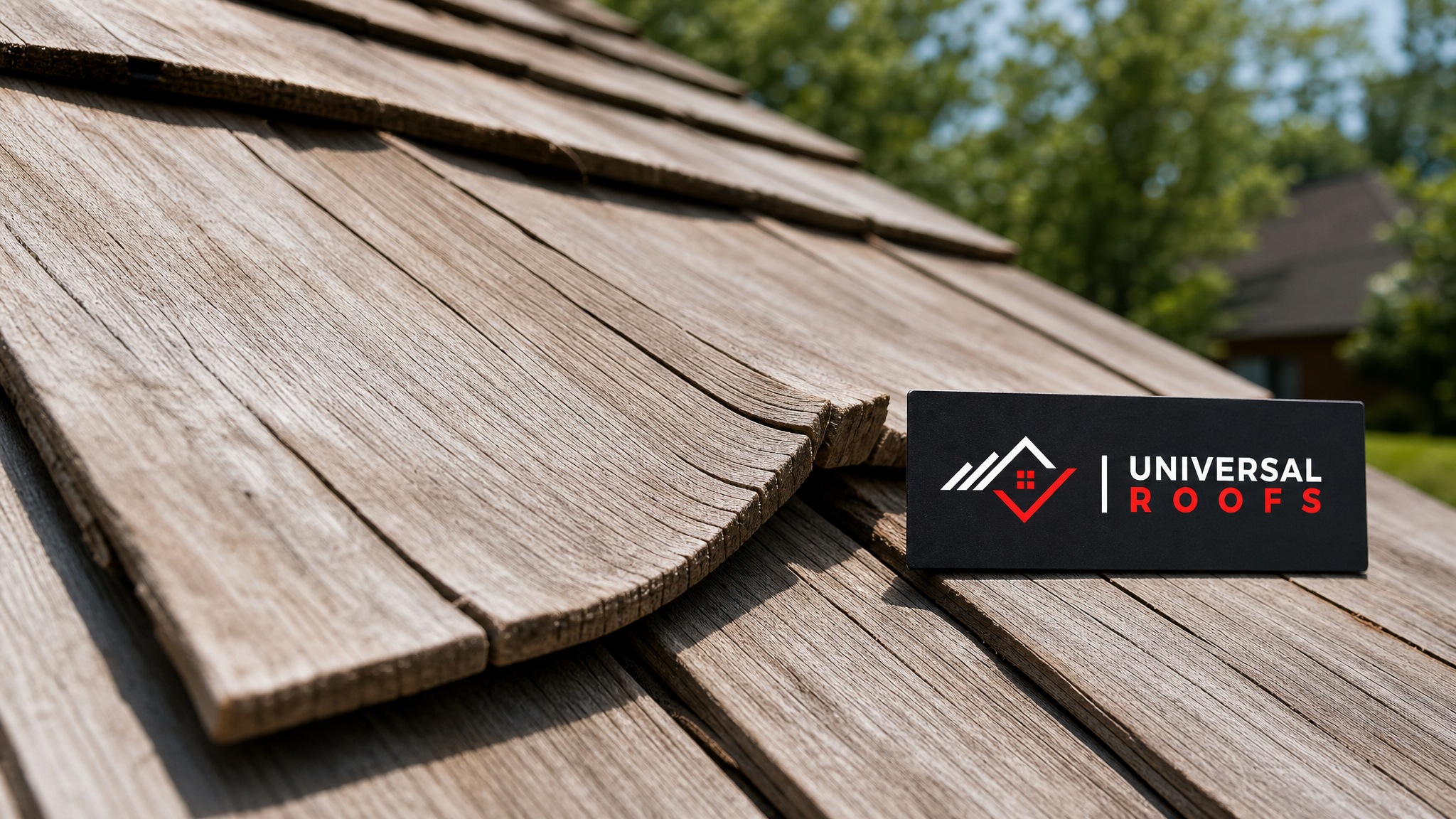
The most visually obvious of the signs your wood shake roof needs repair is distortion in the shape of the shakes themselves. Healthy cedar shakes lie relatively flat against the roof deck, with a slight, uniform overlap between courses. When shakes begin to curl upward at the edges, cup in the middle, or twist out of plane, it means the wood is drying unevenly — typically because the top surface is exposed to sun and wind while the underside stays damp from limited airflow or from moisture trapped against the roof deck.
Curling matters for more than appearance. Once a shake curls, its edges lift away from the shakes around it, creating gaps where wind-driven rain and snowmelt can get underneath. Curled shakes are also far more likely to crack when walked on or when subjected to strong wind, since the distorted shape puts the wood fibres under constant stress even when no one is on the roof. A roof with widespread curling has usually lost the ventilation balance it needs, which often ties back to problems in the attic below — insufficient intake or exhaust venting lets heat and moisture build up and bake the underside of the shakes from below.
Isolated curling on a handful of shakes is a straightforward, inexpensive repair: replace the affected shakes and confirm the ventilation in that section is adequate. Widespread curling across an entire slope, however, usually signals that the whole section is past its serviceable life and heading toward a broader roof replacement conversation within the next few years, even if it is not urgent today.
Sign 2: Splitting, Cracking, or Missing Shakes
Splits running with the wood grain are the second major sign your wood shake roof needs repair, and they are arguably the most direct path to an active leak. A tight, hairline split that runs only partway down the shake may not leak immediately, but every freeze-thaw cycle through a Toronto winter pries it open a little further. Eventually the split runs the full length of the shake, and water has a direct channel straight to the underlayment and deck below.
Missing shakes are the more advanced version of the same problem — a shake that split badly enough, or that lost too many fasteners to wind uplift, eventually breaks free entirely and leaves a gap in the weather barrier. On a well-installed cedar roof, the layered, overlapping pattern means one missing shake doesn’t necessarily create an instant leak, since the course below and the felt or synthetic underlayment beneath it are providing some backup protection. But that backup layer is not designed to be a primary weather surface indefinitely, and UV exposure will degrade exposed underlayment far faster than shakes that are properly covered.
| Damage Type | What Causes It | Urgency Level | Typical Repair Approach |
|---|---|---|---|
| Hairline split (partial length) | Freeze-thaw cycling, sun exposure drying one face faster than the other | Moderate — monitor and schedule repair | Slide in a replacement shake or seal with a compatible wood-safe sealant |
| Full-length split | Prolonged freeze-thaw cycling on an existing hairline split | High — active leak risk | Full shake replacement, inspect underlayment beneath |
| Missing shake(s) | Wind uplift, nail failure, advanced splitting | High — immediate weather exposure | Replace shake and fasteners, inspect surrounding courses |
| Curling / cupping | Uneven drying, poor attic ventilation | Moderate to high depending on extent | Spot-replace or reassess ventilation and plan section replacement |
| Moss / algae colonization | Shade, poor drainage, humidity retention | Moderate — accelerates rot if untreated | Careful cleaning, zinc or copper strips, improve airflow |
A single missing shake near a ridge or hip, where water concentrates as it drains, should be treated as an urgent repair rather than something to leave until the next scheduled inspection. If you notice daylight through the attic sheathing in the area beneath a missing or badly split shake, that is a strong indicator water has already found its way in, and a prompt call for roof repair can prevent the problem from reaching the insulation and framing.
Sign 3: Moss, Algae, or Dark Streaking on the Shakes
Cedar shake roofs in the GTA are particularly prone to moss and algae growth, especially on north-facing slopes, under overhanging tree branches, and in valleys where water and debris tend to collect. A light green or black discolouration might look like a purely cosmetic issue, but moss functions like a sponge sitting directly on top of your roofing material — it holds moisture against the wood far longer than the shake would otherwise stay wet after a rainfall, which is exactly the condition that promotes rot.
Left unaddressed through a few Toronto summers and winters, moss-colonized shakes soften, lose structural integrity, and eventually crumble under foot traffic or heavy snow load. The dark streaking often associated with algae (as opposed to moss) is generally less structurally damaging on its own, but it is a reliable indicator of a roof surface that stays damp longer than it should, which usually points back to shade, poor drainage, or debris buildup that traps water against the shakes.
Removing moss from cedar shake requires a gentler touch than removing it from asphalt shingles. Pressure washing, in particular, can blast away the protective surface fibres of the wood and shorten the shake’s remaining life dramatically. A proper moss remediation approach uses low-pressure cleaning, targeted zinc or copper strips near the ridge to discourage regrowth, and — where the root cause is inadequate airflow — improvements to ventilation that keep the roof surface drying out faster after each rain.
Sign 4: Soft Spots, Rot, or Sagging in the Roof Deck
The fourth of the major signs your wood shake roof needs repair moves past the shakes themselves and into the structure underneath. If you notice a soft or spongy feel when walking near the roof edge, visible sagging between rafters when viewed from inside the attic, or a section of roofline that dips compared to the rest of the house, the roof deck itself — the plywood or board sheathing the shakes are fastened to — may be rotting.
Deck rot is almost always the end result of one of the previous three issues left unaddressed for an extended period: water finding its way through split or curled shakes, sitting under moss, and slowly saturating the sheathing below. Wood shake roofs are more vulnerable to this failure mode than most other roofing types precisely because the covering material itself is porous and organic, offering less of a hard barrier against slow, chronic moisture intrusion than something like metal or a modern synthetic shingle.
From inside the attic, a flashlight inspection on a bright day is one of the most effective diagnostic tools available to a homeowner. Pinpoints of daylight visible through the sheathing, staining or discolouration on the underside of the boards, or a musty smell are all signals worth acting on immediately. This is also the point where a broader inspection of the attic space — insulation condition, ventilation baffles, and any signs of mould — becomes just as important as the roof surface itself, since chronic roof leaks and inadequate attic ventilation tend to compound each other.
| Warning Sign From Inside the Attic | Likely Meaning | Recommended Action |
|---|---|---|
| Visible daylight through sheathing | Active gap in shake coverage or full-length split | Schedule repair inspection within days, not weeks |
| Dark staining on rafters or sheathing | Ongoing or historical water intrusion | Locate source from the exterior, assess extent of rot |
| Musty or damp odour | Trapped moisture, possible mould growth | Improve ventilation, address moisture source, consider air quality check |
| Sagging between rafters | Sheathing or rafter degradation from sustained moisture | Structural assessment, likely deck or section replacement |
| Insulation compressed or damp | Water has bypassed the roof deck into the insulation layer | Replace affected insulation after the roof leak is resolved |
Sign 5: Granule-Like Wear, Excessive Fading, or Brittle, Dry Wood
The final of the five key signs your wood shake roof needs repair is more subtle than a split or a missing shake, but it is just as important for long-term planning. As cedar shakes age past their expected service life — typically 25 to 30 years for properly installed and maintained shakes, sometimes less in harsher exposures — the wood’s natural oils dry out, the surface becomes rough and fibrous rather than smooth, and the shakes take on a uniformly silvery-grey appearance across the entire roof rather than the varied, warm tones of a newer install.
Some fading and greying is completely normal and expected as cedar weathers; it does not by itself indicate a repair is needed. The concerning version of this sign is when the wood becomes brittle enough to crack under light pressure, when you notice small wood fibres coming loose and collecting in gutters after wind events, or when the shakes feel dry and hollow rather than solid when gently pressed. This kind of wear tends to affect the entire roof at roughly the same rate, since it’s driven by cumulative UV exposure and age rather than a localized moisture problem, which is exactly why it usually points toward planning a full replacement rather than ongoing spot repairs.
Homeowners in this situation often ask whether it makes more financial sense to keep patching individual shakes as they fail or to plan for a complete roof replacement. The honest answer depends on how much of the roof is already showing this uniform wear versus how much is still performing well. A rule of thumb many roofing professionals use: once more than 20-25% of a roof’s shakes show this end-of-life brittleness, ongoing repair costs start to outpace the value of deferring replacement.
Repair Versus Replacement: Making the Right Call
Deciding between another round of spot repairs and a full wood shake replacement comes down to three factors: the age of the existing roof, the percentage of shakes affected, and the condition of the underlying deck. A 12-year-old roof with a handful of wind-damaged shakes near one hip is an easy repair decision. A 27-year-old roof with curling across multiple slopes, moss on the north face, and soft spots discovered during an attic inspection is heading toward replacement territory regardless of budget preferences, because continuing to chase individual repairs on a roof that is fundamentally at the end of its service life rarely pencils out.
| Roof Condition | Estimated Age Range | Recommended Path | Rough Cost Consideration |
|---|---|---|---|
| Isolated damage, less than 5% of shakes affected | Any age | Targeted repair | Lowest cost, addresses issue directly |
| Scattered damage across 5-20% of shakes | 10-20 years | Multi-area repair, reassess in 1-2 years | Moderate cost, extends usable life |
| Widespread wear, 20-40% of shakes affected | 20-25 years | Section replacement or plan full replacement within 2-3 years | Higher cost, but still less than full replacement |
| Uniform greying, brittleness, deck concerns | 25-30+ years | Full roof replacement | Highest upfront cost, resets the service-life clock |
The most reliable way to make this call with confidence is a professional assessment rather than guesswork from the ground. A detailed inspection can distinguish between a roof that looks worn but still has structurally sound shakes and a roof that looks fine from the street but has significant hidden deck damage. If you are weighing this decision for a home anywhere in the Toronto, Peel Region, York Region, Halton Region, or Durham Region area, a walk-through inspection is the right first step before committing to either path.
Seasonal Timing and Inspection Frequency in the GTA
Summer is genuinely the best window for wood shake roof work in this region. Dry conditions, longer daylight hours, and stable temperatures allow proper drying time for any sealants or treatments used during repair, and there’s no risk of surprise precipitation interrupting a project the way there often is in spring or fall. If you’ve noticed any of the five signs above, scheduling an assessment now — while the weather cooperates — avoids the scramble that happens every October when everyone realizes winter is close and roofing contractors get booked solid.
Beyond acting on visible warning signs, a proactive inspection schedule pays for itself. Most wood shake manufacturers and roofing associations recommend a professional inspection every 1-2 years, with additional checks after major wind events, hailstorms, or unusually heavy snow accumulation. Between professional visits, a homeowner can do a lot from the ground with binoculars: checking for obvious curling, missing shakes, or dark streaking, and checking the attic periodically for daylight, staining, or odours.
It’s also worth having other roof-adjacent features checked at the same time. If your home has a skylight integrated into a wood shake roof, the flashing around that penetration is one of the most common leak points on the entire structure and deserves the same scrutiny as the shakes themselves — and if that flashing or the unit itself is aging, a skylight replacement is often bundled efficiently into the same service visit as shake repairs. Homes with a secondary flat roof section, such as over a garage or addition, should have that inspected on the same schedule as well, since flat sections and sloped wood shake sections often meet at transitions that are particularly prone to leaks.
What a Professional Wood Shake Repair Actually Involves
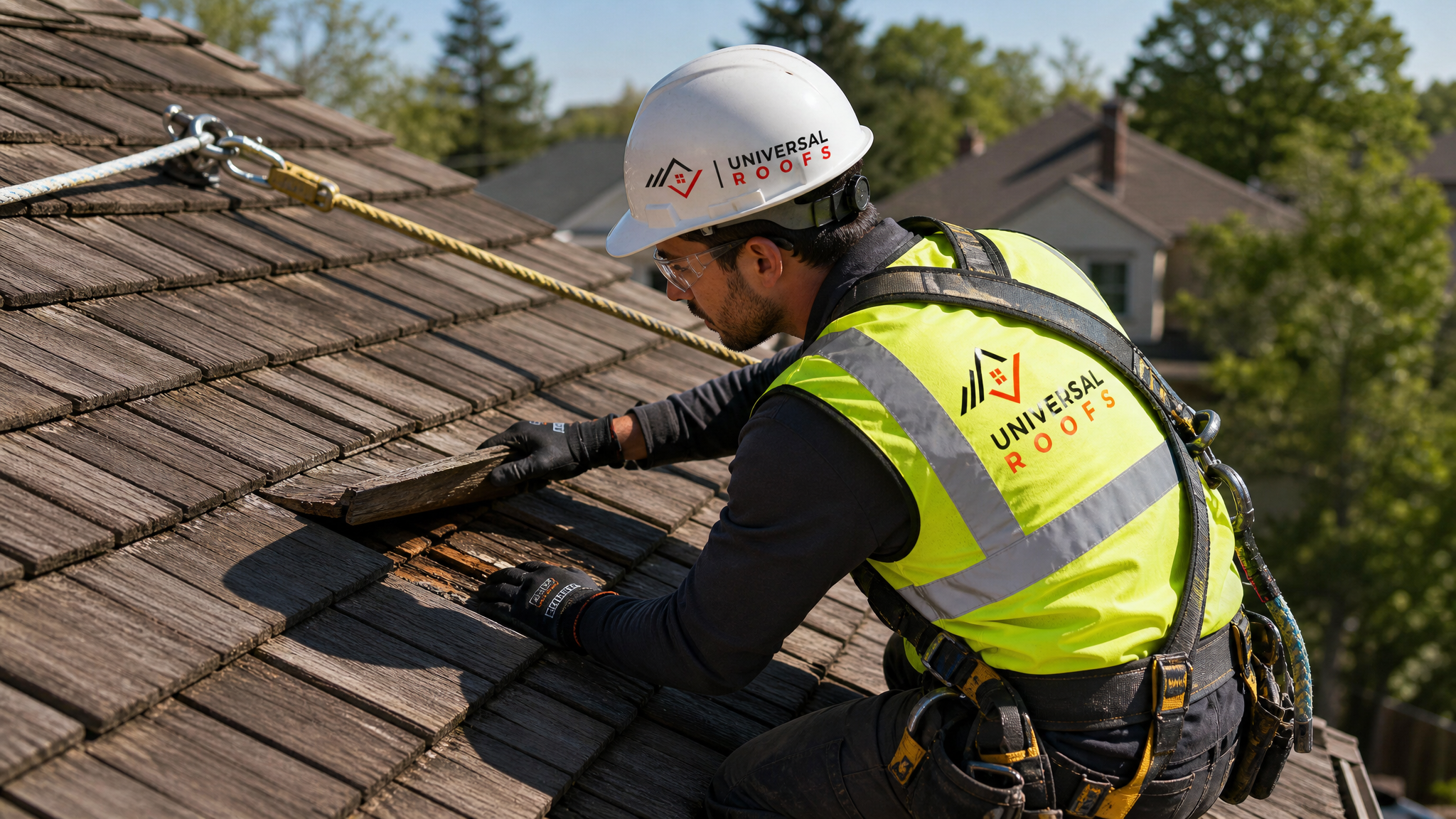
When you bring in a roofing contractor to address these signs, the process typically starts with a full walk of the roof (using proper fall protection, since walking on aged cedar without the right technique can crack sound shakes) combined with an attic-side inspection. From there, damaged shakes are individually removed using a shake ripper or flat bar to avoid disturbing adjacent, healthy shakes, and new matching cedar shakes are slid into place and fastened with corrosion-resistant nails positioned to maintain proper water-shedding overlap.
Where underlayment has been exposed to UV or water for an extended period, it’s replaced in that section rather than reused, since degraded felt or synthetic underlayment beneath sound-looking shakes is a common cause of “surprise” leaks that show up well after a repair that only addressed the visible shakes. Flashing around chimneys, vents, and valleys gets special attention during this process too, since flashing failures are frequently mistaken for shake failures — the shakes might look fine while the metal flashing beneath them has corroded or pulled away.
Frequently Asked Questions
What are the most common signs your wood shake roof needs repair?
How urgent is it to fix a missing or split wood shake?
Can I remove moss from my wood shake roof myself?
How long do wood shake roofs typically last before repair or replacement is needed?
How do I know if I need a repair or a full roof replacement?
Is summer a good time to repair a wood shake roof in Toronto?
Need Help With 5 Signs Your Wood?
If you’ve spotted any of these warning signs on your own roof, the team at Universal Roofs has the specialized experience in cedar and wood shake systems to tell you exactly what you’re dealing with and what it will take to fix it properly.
Call us today at (416) 732-2421 or request a free inspection to get started.
Universal Roofs proudly serves Toronto, Mississauga, Brampton, Vaughan, Markham, Oakville and the GTA since 2005.