
Metal roofing has become one of the most popular choices for Toronto-area homeowners because it is durable, energy-efficient and built to withstand our harsh climate. But even the toughest standing-seam or corrugated metal panel is not indestructible. Hailstorms, wind-driven debris, ladder mishaps, fallen branches and simple age-related wear can all leave a metal roof with dented, scratched, punctured or corroding panels. The good news is that most metal panel damage is repairable if it is caught early and addressed with the right technique.
This guide covers the best solutions for damaged metal roof panels, from minor cosmetic dents that only need monitoring to full panel replacement when corrosion or structural damage has gone too far. We will walk through how to diagnose the type and severity of damage, the repair methods contractors actually use, realistic costs, and how to prevent the most common causes of metal roof damage in the Greater Toronto Area’s freeze-thaw climate.
At Universal Roofs, we have been repairing and replacing metal roof panels across the GTA since 2005. Whether you are dealing with a single dented panel after a summer storm or a roof that is showing widespread corrosion after fifteen years of service, this article gives you the practical knowledge to understand your options before you call a contractor.
Identifying the Type and Severity of Metal Roof Panel Damage
Before choosing among the solutions for damaged metal roof panels, you need to understand exactly what you are dealing with. Not all damage looks the same, and the correct fix depends entirely on the type, depth and cause of the problem. A light cosmetic dent from hail is a very different repair than a puncture from a fallen tree limb or a panel that has started rusting through from the underside.
Start with a visual inspection from the ground using binoculars, then move to a closer look if it is safe to do so. Never walk on a metal roof without proper fall protection and an understanding of where the panel seams and structural framing are located — metal panels can be surprisingly slippery, especially when wet, dew-covered or coated in morning frost, which is common well into late spring in the GTA.
Common categories of metal roof panel damage include:
- Cosmetic dents — Shallow depressions from hail or minor debris impact that do not break the paint or protective coating.
- Punctures and tears — Full penetration through the panel, usually from falling branches, ladders, or foot traffic in the wrong spot.
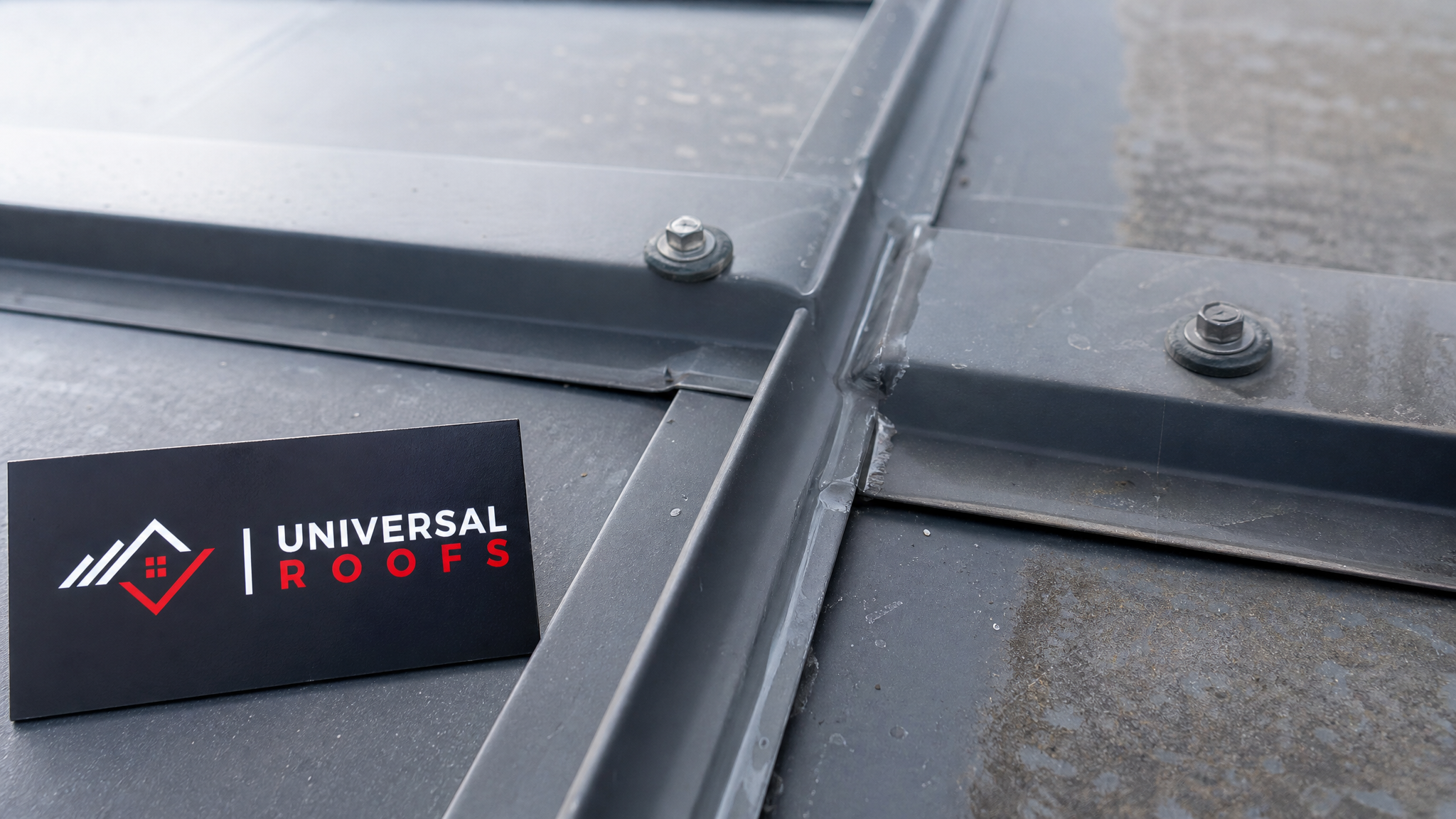
- Seam separation — Standing-seam panels that have pulled apart at the interlocking rib, often due to thermal movement or poor original installation.
- Corrosion and rust-through — Deterioration of the metal itself, often starting at cut edges, fastener penetrations, or areas where the protective coating has failed.
- Fastener backout and loose panels — Screws or clips that have worked loose from repeated expansion and contraction, allowing panels to shift or lift.
- Coating failure and chalking — Fading, chalking, or peeling paint that exposes bare metal to moisture and accelerates corrosion.
Each of these has a different best-fit repair, which we break down in the sections below. If you are unsure which category your damage falls into, a professional roof repair assessment is the safest way to get an accurate diagnosis before spending money on the wrong fix.
| Damage Type | Typical Cause | Severity Indicator | Recommended Solution |
|---|---|---|---|
| Cosmetic dent | Hail, minor impact | No cracked paint, panel still flat overall | Monitor or cosmetic dent repair |
| Puncture or tear | Fallen branch, tool drop, foot traffic | Visible hole, daylight through panel from attic | Patch repair or panel section replacement |
| Seam separation | Thermal cycling, poor original install | Gap or lifting at panel rib joint | Reseal and re-fasten seam, or seam repair clip |
| Surface corrosion | Coating wear, coastal-style pollutants, age | Orange staining, surface pitting | Clean, treat, and recoat |
| Rust-through | Long-term untreated corrosion | Holes, flaking metal, soft spots | Full panel replacement |
| Loose fasteners | Expansion/contraction, wind uplift | Visible screw backout, panel movement in wind | Re-fasten with correct gasketed screws |
Cosmetic Dent Repair: When Minor Damage Does Not Need Replacement
Shallow dents from hail or light impact are the most common form of metal roof panel damage, and thankfully also the easiest and least expensive to address. If the paint and protective coating are still intact and the panel has not cracked or split at the dent, the roof’s weatherproofing performance is usually unaffected. In many cases, cosmetic dents are a visual issue only, and homeowners choose to leave them alone rather than pay for a repair that provides no functional benefit.
That said, there are situations where cosmetic dent repair is worth doing. If the dents are concentrated on a highly visible slope facing the street, or if you are planning to sell the home, a contractor can often use specialized paintless dent removal techniques adapted for roofing, gently working the metal back toward its original profile from the underside where accessible, or using suction-based tools on standing-seam panels. This works best on aluminum and lighter-gauge steel panels; heavier-gauge steel and copper are more resistant to this kind of correction.
Before writing off dents as purely cosmetic, however, have them checked. A dent that has stretched and thinned the metal, or that sits at a seam or fastener point, can become a stress point where cracking and eventual corrosion start. This is exactly the kind of judgment call that benefits from an experienced eye during a roof repair inspection rather than guessing from the ground.
Patching and Sealing Punctures Without Full Panel Replacement
Punctures and small tears are more serious than dents because they create a direct path for water to reach the roof deck below. The good news is that a properly executed patch repair can restore full weatherproofing for years without the cost of replacing the entire panel, provided the surrounding metal is otherwise sound.
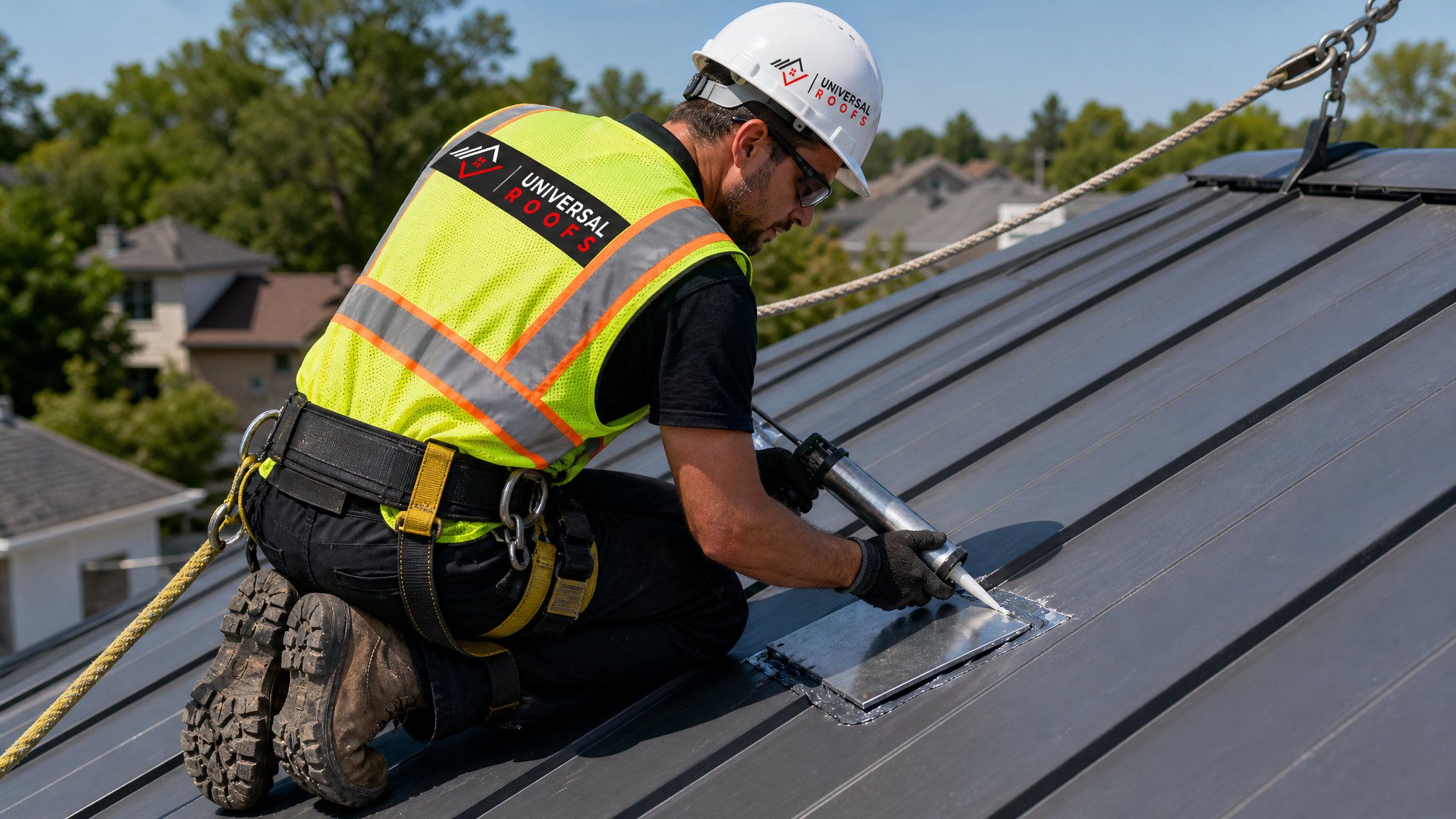
The standard professional process for patching a metal panel puncture involves several steps that should not be skipped, because rushing any one of them is the single most common reason patch repairs fail prematurely:
- Clean the area thoroughly — All dirt, rust, chalking paint and loose debris must be removed with a wire brush and solvent wipe so the patch material can bond properly.
- Trim and prepare the puncture edges — Sharp or curled edges are flattened and any loose metal is trimmed away to create a clean, stable surface.
- Cut a matching metal patch — A patch of the same metal type and gauge is cut with generous overlap, typically extending 100 to 150 millimetres beyond the damaged area in every direction.
- Apply roofing-grade sealant or butyl tape — A high-quality, UV-stable sealant compatible with metal roofing is applied beneath and around the patch, never a generic caulk that will fail within a season or two.
- Fasten and seal the patch — The patch is mechanically fastened with gasketed screws and then top-sealed to shed water in the correct direction, matching the natural water flow of the existing panel profile.
- Colour-match the coating — A touch-up coating matched to the existing panel finish protects the patch from UV degradation and blends it visually with the surrounding roof.
Done correctly, a patch repair on a metal roof panel can last 10 to 15 years or more. The key limiting factor is always the condition of the surrounding metal — patching a puncture next to an area of active corrosion is a temporary fix at best, since the underlying material is already compromised.
Seam Separation and Fastener Repairs on Standing-Seam Roofs
Standing-seam metal roofs rely on interlocking ribs that allow panels to expand and contract with temperature changes without cracking the metal. In the GTA, where temperatures swing from minus 20 degrees Celsius in January to over 30 degrees Celsius in July, this thermal movement is constant and significant. When the seam was not installed with the correct clip spacing, or when the wrong fastener type was used, seams can gradually separate over years of cycling.
A separated seam is a serious concern because it is often located at the highest point of water flow concentration on the panel. Solutions for damaged metal roof panels with seam problems generally fall into three categories, in order of increasing severity:
- Reseal and re-crimp — For minor separation, the seam can be cleaned, resealed with a compatible sealant, and mechanically re-crimped using a seaming tool to restore the interlock.
- Seam repair clips — For seams that have separated more significantly or that see repeated movement, specialized repair clips are installed to reinforce the joint and prevent further opening.
- Section replacement — When the seam has been compromised over a long run, or the panel edge itself has deformed, replacing that section of panel from ridge to eave is usually more reliable than trying to repair a long seam piecemeal.
Loose or backed-out fasteners are a related and very common issue, especially on exposed-fastener corrugated panels rather than concealed-fastener standing-seam systems. Every fastener cycle of loosening and re-tightening slightly enlarges the screw hole in the metal, which is why simply re-driving the same screw is rarely a lasting fix. The correct solution is to replace the fastener with the next size up, fitted with an intact rubber washer, or to relocate the fastener slightly and seal the old hole. On roofs where more than a handful of fasteners have backed out, this is usually a sign the original installation used the wrong screw pattern or spacing, and a broader roof repair assessment is worthwhile to check the rest of the roof before problems spread.
Treating Corrosion and Rust on Metal Roof Panels
Corrosion is the most serious form of metal roof panel damage because, unlike a dent or a puncture, it represents ongoing deterioration of the material itself. Left untreated, surface rust becomes pitting, pitting becomes perforation, and perforation means the panel needs to be replaced rather than repaired. Catching corrosion early is one of the highest-value things a homeowner can do to extend the life of a metal roof.
Corrosion typically starts at one of a few predictable weak points: cut panel edges where the protective coating was not properly sealed during installation, around fastener penetrations where the washer has degraded, at points of dissimilar-metal contact (for example, where steel flashing touches copper, triggering galvanic corrosion), and anywhere standing water or debris has been allowed to sit against the panel surface for extended periods.
The appropriate treatment depends on how far the corrosion has progressed:
| Corrosion Stage | Appearance | Recommended Treatment | Typical Longevity of Fix |
|---|---|---|---|
| Early surface staining | Light orange discolouration, coating still intact | Clean, apply rust-inhibiting primer, recoat | 8-12 years |
| Active surface rust | Visible rust texture, coating breached | Wire brush, treat with rust converter, prime and recoat | 5-10 years |
| Pitting | Small pockmarks in the metal surface | Grind, treat, patch if pits are deep, recoat entire panel | 5-8 years |
| Perforation/rust-through | Holes, flaking or crumbling metal | Full panel or section replacement | 25-40+ years (new panel) |
| Galvanic corrosion at dissimilar metals | Accelerated rust at flashing or fastener contact points | Replace with compatible metal/isolate with proper flashing | 15-25 years |
Rust-inhibiting primers and specialty metal roof coatings have improved considerably in recent years, and for early to moderate corrosion, a properly applied recoat system can genuinely add a decade or more of service life to an otherwise sound panel. However, once perforation occurs, no coating can restore structural integrity, and replacement of that panel or section is the only real solution. This is also why annual inspections matter — most corrosion problems we see at Universal Roofs were treatable at an earlier stage but were left unaddressed for several seasons.
When Full Panel Replacement Is the Better Solution
Not every instance of damage justifies a full panel replacement, but there are clear situations where trying to patch or repair is throwing money at a problem that will simply recur. Understanding when to stop repairing and start replacing is one of the most valuable things a homeowner can learn about metal roofing.
Full panel replacement is generally the right call when:
- Rust has perforated the panel in one or more locations, indicating the metal itself has failed structurally.
- Damage covers a large percentage of a single panel’s surface area, making patch repair impractical or unsightly.
- The panel profile has been bent or deformed significantly, affecting how water sheds and how adjacent panels interlock.
- Multiple panels in the same area show the same failure pattern, suggesting a systemic issue like incorrect original installation, inadequate ventilation causing underside condensation, or a batch of defective material.
- The roof is already 20 to 30 years old and repair costs are approaching a significant fraction of what a full or partial roof replacement would cost.
One advantage of standing-seam and most panelized metal roofing systems is that individual panels or panel runs can often be replaced without disturbing the entire roof, provided a matching profile and colour can be sourced. This is not always possible with older or discontinued panel profiles, which is worth checking before assuming a like-for-like replacement is straightforward. In cases where an exact match cannot be found, some homeowners opt to replace an entire roof slope so the finished appearance remains uniform.
| Solution | Best For | Approx. Cost Range (CAD) | Typical Timeline |
|---|---|---|---|
| Cosmetic dent correction | Shallow hail dents, no coating damage | $150 – $500 per area | Half day |
| Puncture patch repair | Isolated holes/tears, sound surrounding metal | $300 – $900 per puncture | Half day to 1 day |
| Seam reseal/re-crimp | Minor seam separation | $400 – $1,200 per seam run | 1 day |
| Fastener replacement (per section) | Loose/backed-out screws on a slope | $500 – $1,500 | 1 day |
| Corrosion treatment and recoat | Early to moderate rust, intact structure | $3 – $7 per square foot | 1-3 days |
| Single/multiple panel replacement | Rust-through, severe deformation, localized failure | $800 – $2,500 per panel | 1-2 days |
| Full roof replacement | Widespread failure, roof near end of service life | $9 – $16 per square foot | 3-7 days |
Costs vary based on panel material (steel, aluminum, copper or zinc), roof pitch, accessibility, and the specific panel profile involved. Always get an in-person assessment rather than relying on rough averages, since a straightforward-looking dent can sometimes hide a more significant issue underneath, and vice versa.
Preventing Future Damage to Metal Roof Panels in the GTA Climate
Once damaged panels are repaired or replaced, the next priority is reducing the odds of a repeat problem. Toronto and the surrounding regions present a specific combination of stressors for metal roofing: heavy freeze-thaw cycling through winter and spring, intense summer UV exposure, occasional severe hailstorms, and high winds during seasonal storm systems. A few preventive steps go a long way:
- Trim overhanging branches — Falling limbs are one of the leading causes of punctures and dents. Keep tree canopies well clear of all roof edges and slopes.
- Inspect after major storms — Hail, high wind and heavy snow-load events are the times damage is most likely to occur. A quick visual check after any severe weather catches problems while they are still small and inexpensive to fix.
- Keep gutters and valleys clear — Debris buildup traps moisture against panel surfaces and accelerates corrosion, particularly at seams and low points.
- Maintain proper attic ventilation — Condensation forming on the underside of metal panels due to poor attic ventilation is a surprisingly common and underdiagnosed cause of corrosion starting from the inside out.
- Avoid unnecessary foot traffic — Walking on metal panels in the wrong spots, or without proper technique, causes dents and can stress seams. Any required rooftop work, including servicing skylights or vents, should be done by someone who knows where it is safe to step.
- Schedule annual professional inspections — Most serious metal roof problems started as something small that went unnoticed for a season or two. An annual check by a qualified roofer catches issues while they are still a $300 fix rather than a $3,000 one.
Homeowners in different parts of the region face slightly different exposure profiles. Properties in the Toronto core and older neighbourhoods often deal with mature tree canopies and older panel installations, while newer developments across Peel Region, York Region, Halton Region and Durham Region tend to see more open exposure to wind and hail. In every case, the fundamentals of prevention and prompt repair remain the same.
DIY Repair vs. Hiring a Professional: What Homeowners Should Know
It is worth being honest about which metal roof repairs are realistically within reach for a handy homeowner and which ones genuinely require a professional. Small, ground-accessible cosmetic touch-ups, such as re-applying touch-up paint to a scratch on a low garage roof, are reasonable DIY territory for someone comfortable with basic maintenance.
Almost everything else on a sloped metal roof is safer and more cost-effective to leave to a licensed contractor, for a few concrete reasons:
- Fall risk — Metal panels are among the most slippery roofing surfaces, particularly when wet, frosted, or coated in pollen or algae film. Professional roofers use harnesses, anchor points and rope systems specifically rated for metal roof pitches.
- Matching materials correctly — Using the wrong fastener, sealant, or patch metal against the existing panel can trigger galvanic corrosion or cause a repair to fail within a single season.
- Voiding manufacturer warranties — Many metal panel and coating warranties require repairs to be performed by a certified installer using approved materials and methods.
- Correct diagnosis — What looks like a simple dent from the ground can be masking a deeper seam or fastener issue that only becomes visible up close.
- Insurance documentation — If the damage is storm-related, a professional assessment with photo documentation is often required to support an insurance claim.
A short conversation with an experienced contractor before you climb a ladder can save both money and risk. Reading through independent reviews from other homeowners, or checking a company’s FAQ page and about page for their history and credentials, is a reasonable way to vet who you are trusting with the job.
Insurance Claims and Warranty Considerations for Metal Roof Damage
Storm-related metal roof panel damage, including hail dents and wind-driven debris impact, is frequently covered under standard homeowner insurance policies, but the claims process has specific requirements that are worth understanding before you start any repair work.
Most insurers require dated photographic evidence of the damage as close to the storm event as possible, ideally supported by a professional inspection report that documents the extent and likely cause of the damage. Making repairs before an adjuster has assessed the roof can sometimes complicate or reduce a claim, so if you suspect storm damage, it is worth getting an inspection scheduled promptly rather than patching things yourself first.
On the manufacturer side, most quality metal roofing systems come with material warranties covering paint finish and substrate performance for 25 to 50 years, but these warranties typically have conditions: they may be voided by unauthorized repairs, incompatible fasteners or sealants, or a failure to maintain proper ventilation. Keep your original installation paperwork and any warranty documents, and when in doubt about whether a repair might affect coverage, ask your contractor to confirm before work begins.
What are the best solutions for damaged metal roof panels that are just dented, not punctured?
Can a puncture or hole in a metal roof panel be patched instead of replaced?
How do you know when corrosion on a metal roof panel requires full replacement?
Why do standing-seam metal roof panels develop seam separation in Toronto?
What is the typical cost of repairing damaged metal roof panels?
How can homeowners prevent future damage to metal roof panels?
Need Help With What Are the Best?
If your metal roof has dents, punctures, seam separation, or corrosion, Universal Roofs can assess the damage and recommend the most cost-effective, lasting solution — whether that means a targeted repair or a full panel replacement.
Call us today at (416) 732-2421 or request a free inspection to get started.
Universal Roofs proudly serves Toronto, Mississauga, Brampton, Vaughan, Markham, Oakville and the GTA since 2005.