
A damp patch on the ceiling rarely tells the whole story. By the time a stain appears on drywall, water has usually been travelling along rafters, insulation, and sheathing for weeks or even months, often surfacing metres away from where it actually entered the roof. This is exactly why roof leak detection tools essential to any serious roofing inspection have become standard equipment for professional contractors across the Greater Toronto Area. Guesswork and a garden hose simply cannot compete with infrared cameras, electronic moisture meters, and pressure-testing equipment when the goal is finding the true source of a leak rather than just chasing symptoms.
Toronto homeowners face a particular challenge: our climate cycles through humid summers, torrential rainstorms, and brutal winter freeze-thaw cycles, all of which stress roofing systems differently. A leak that starts in July from a clogged gutter backing up under shingles can behave completely differently from one that opens up in February when an ice dam forces meltwater backward under the roofline. Understanding why are roof leak detection tools essential for accurately diagnosing these different failure modes can save homeowners thousands of dollars in unnecessary repairs, prevent mould growth, and protect the structural integrity of the home for years to come.
In this guide, we will walk through the specific tools professional roofers use to detect leaks, explain how each one works, compare their strengths and limitations, and give you a clear framework for knowing when it is time to call in a professional rather than attempting a DIY fix.
Why Roof Leak Detection Tools Essential for Homeowners to Understand
Most homeowners discover a roof leak the same way: a brown ring appears on the ceiling, or water drips visibly during a storm. The instinct is to look straight up from that spot and assume the roof is damaged directly above it. Unfortunately, water rarely falls straight down. It follows the path of least resistance along roof decking, truss members, and insulation batts, sometimes travelling several metres horizontally before it finally soaks through drywall and becomes visible.
This is the core reason roof leak detection tools essential to a proper diagnosis exist in the first place. Without them, a contractor (or a determined DIYer) is left poking around blindly, sometimes replacing shingles or resealing flashing that had nothing to do with the actual problem. Not only does this waste money, it allows the real leak to continue causing hidden damage while everyone believes the issue has been solved.
Professional-grade detection tools remove the guesswork. They let a trained technician trace moisture back to its true entry point, whether that is a cracked pipe boot, a nail pop, deteriorated flashing around a chimney, or a failed seam on a flat roof membrane. Getting the diagnosis right the first time is the single biggest factor in keeping repair costs low and preventing repeat leaks.
The Hidden Cost of Misdiagnosed Leaks
When a leak is misdiagnosed, the consequences compound quickly. Drywall and insulation stay wet longer than necessary, creating ideal conditions for mould colonization within 24 to 48 hours in warm, humid conditions. Wood framing can begin to rot, and in severe cases, structural sheathing needs to be replaced entirely rather than simply patched. Homeowners often end up paying for two or three repair visits instead of one, because each attempt addresses a symptom rather than the source.
There is also an insurance dimension to consider. Many home insurance policies in Ontario require documented evidence that a leak was addressed promptly and correctly. A properly diagnosed leak, backed by moisture readings or thermal images showing the exact entry point, gives homeowners a much stronger paper trail if they ever need to file a claim for interior water damage.
| Consequence of Misdiagnosis | Typical Timeline | Additional Cost Risk | Prevented By |
|---|---|---|---|
| Mould growth begins in wet insulation | 24-48 hours | $800-$4,000+ remediation | Moisture meter readings pinpointing wet zones |
| Wood sheathing begins to rot | 2-6 weeks of ongoing moisture | $1,200-$5,000 decking replacement | Infrared thermography identifying saturation before it spreads |
| Repeat service calls for “same” leak | Each rainfall event | $150-$400 per visit | Dye testing confirming exact entry point on first visit |
| Insulation loses R-value permanently | Immediate upon saturation | $500-$2,000 to replace batts | Early detection limiting water spread |
| Insurance claim denied for “lack of maintenance” | At time of claim filing | Full repair cost out of pocket | Documented inspection reports with tool-based evidence |
Electronic Moisture Meters: The First Line of Detection
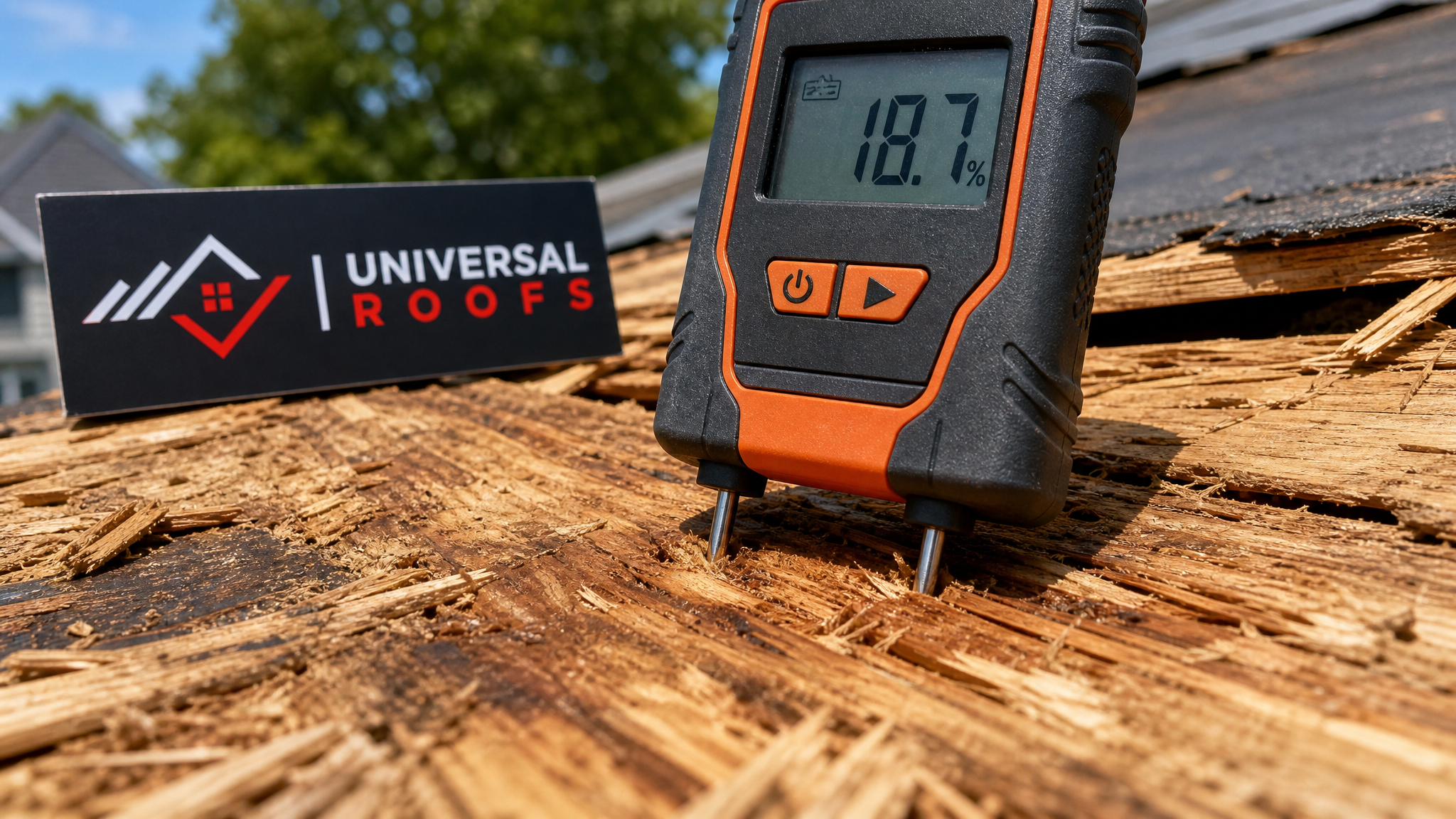
Electronic moisture meters are often the first tool a technician reaches for once inside an attic or crawlspace. These handheld devices use either pin-type probes, which measure electrical resistance between two small metal pins pressed into wood or drywall, or pinless sensors, which use electromagnetic signals to detect moisture beneath a surface without puncturing it.
Pin-type meters are extremely precise for spot-checking specific boards or rafters, and they give an exact percentage reading of moisture content in the wood. A healthy piece of roof sheathing typically reads between 9 and 14 percent moisture content. Anything consistently above 20 percent indicates active or recent water intrusion that needs attention. Pinless meters are faster for scanning large areas like an entire attic floor or a section of ceiling drywall, because the technician can simply glide the sensor across the surface without leaving marks.
The real value of a moisture meter is that it turns a subjective judgment call (“this feels damp”) into an objective, repeatable measurement. When our technicians document readings before and after a repair on a project tied to roof repair work, homeowners get concrete proof that the moisture problem has actually been resolved, not just covered up.
Infrared Thermography: Seeing Through the Roof Deck
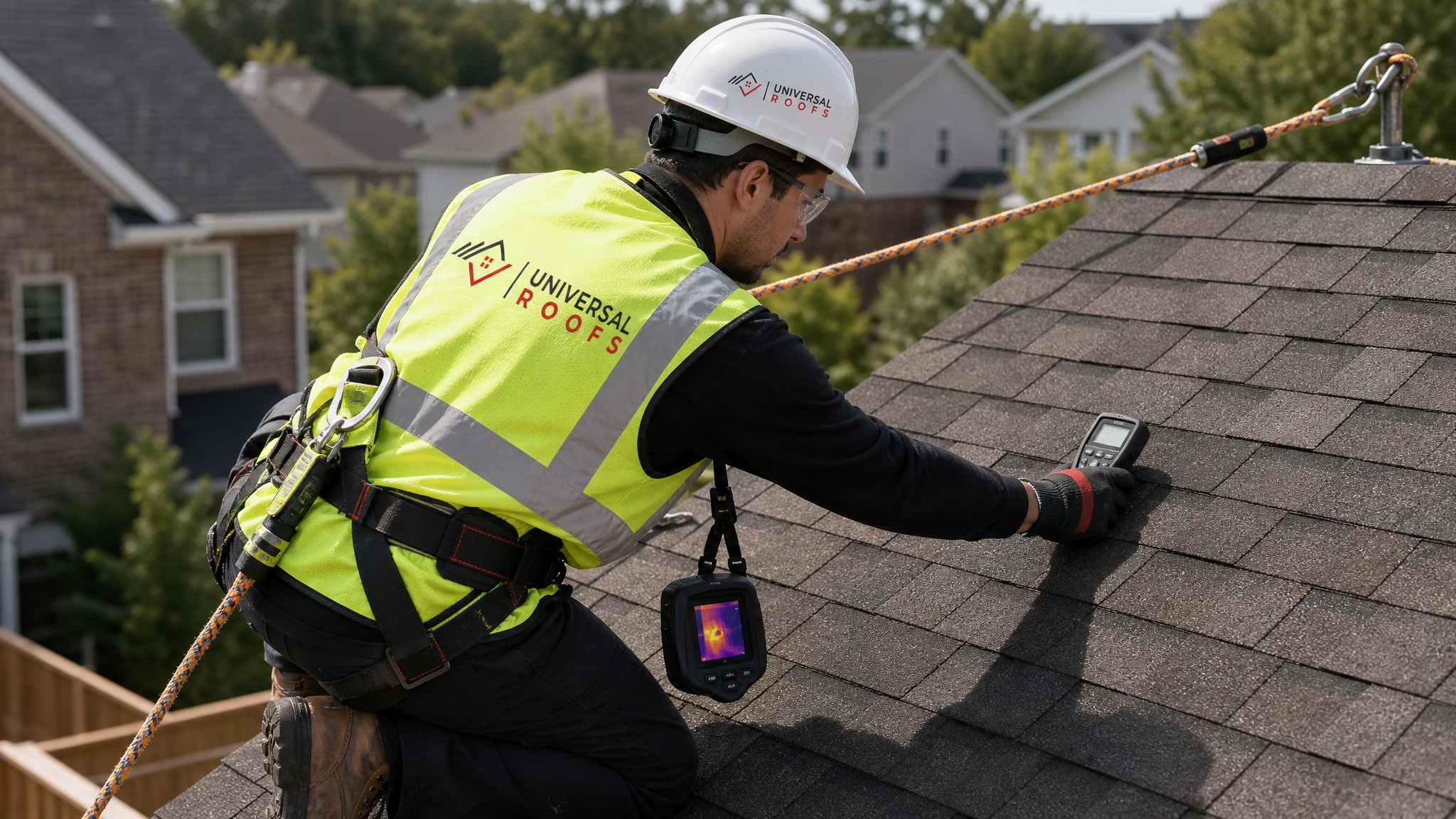
Infrared (thermal imaging) cameras have become one of the most valuable roof leak detection tools essential to modern roofing diagnostics, particularly for larger residential and commercial flat roofs. These cameras detect subtle differences in surface temperature. Wet insulation retains heat differently than dry insulation, so during the right conditions (typically at dusk, after the roof surface has absorbed daytime heat and begun to cool), a thermal camera can reveal a clear thermal signature showing exactly where moisture is trapped beneath the roofing membrane.
This technique is especially powerful on flat and low-slope roofs, where water can spread laterally across a huge area of insulation before ever finding a way to drip into the building below. A homeowner or property manager might notice a stain in one corner of a commercial unit, while a thermal scan reveals the actual saturated area is on the opposite side of the roof entirely. Without imaging, a contractor might tear up and replace the wrong section of membrane, wasting time and material.
Thermal imaging works best when there is a meaningful temperature differential, which is why many technicians schedule scans in the early evening during summer months, or immediately following a period of sustained sun exposure. It is one of the few tools that can assess a large roof area in minutes rather than hours, making it indispensable for anyone managing a commercial flat roof or a large residential property.
Dye and Water Testing: Confirming the Exact Entry Point
While moisture meters and thermal cameras are excellent at telling you where water has ended up, they do not always confirm exactly where it got in. That is where dye testing and controlled water testing come in. In a dye test, a technician introduces a small amount of brightly coloured, non-toxic dye into suspected problem areas (such as around a chimney, vent pipe, or valley) and then floods the area with water using a hose, working from the lowest point of the roof upward in stages.
By watching where the coloured water eventually appears inside the attic or ceiling, the technician can trace the exact path water is taking and confirm the true entry point with certainty. This method is particularly useful for tricky leaks around penetrations like skylights, where the boundary between roofing material and window flashing creates multiple potential failure points that can look identical from the outside.
Controlled water testing follows a similar principle but without dye, and is often used on flat roofs to isolate a leak to a specific seam or drain. The technician floods one section at a time, waiting 15 to 20 minutes between sections, while a second person monitors the interior for signs of water intrusion. This methodical, sectioned approach eliminates guesswork by process of elimination, which is especially valuable on older skylight replacement projects where multiple potential leak sources may exist simultaneously.
Comparing the Main Roof Leak Detection Tools
Every tool in a technician’s kit has a specific use case, and the best diagnostic process usually combines two or three methods rather than relying on a single reading. The table below breaks down how the primary detection tools stack up against each other in terms of cost, accuracy, and ideal application.
| Tool | Best For | Typical Accuracy | Approximate Professional Cost Per Use |
|---|---|---|---|
| Pin-type moisture meter | Spot-checking specific rafters or boards | Very high (exact percentage) | Included in standard inspection ($150-$300) |
| Pinless moisture meter | Scanning large attic or ceiling areas quickly | High | Included in standard inspection ($150-$300) |
| Infrared thermal camera | Flat roofs, large commercial areas, hidden saturation | High (requires right temperature conditions) | $250-$600 for a dedicated scan |
| Dye testing | Confirming exact entry point at penetrations | Very high (visual confirmation) | $200-$450 depending on roof complexity |
| Controlled/sectioned water testing | Isolating leaks on flat or low-slope roofs | Very high but time-intensive | $300-$700 for a full sectioned test |
Signs Your Roof Needs a Professional Leak Detection Inspection
Homeowners do not need to wait for an obvious ceiling stain before calling in a professional. There are earlier warning signs that a moisture problem is developing, and catching these early is exactly where detection tools deliver the most value, because they can find a problem before it becomes visible from inside the home.
- A musty odour in the attic or upper floor closets, particularly noticeable in humid summer weather
- Discoloured or sagging drywall, even faint yellowing, on ceilings below the attic
- Visible granule loss or curling shingles after a storm, which often correlates with hidden leaks nearby
- Higher than usual humidity or condensation on windows in upper-floor rooms
- Ice damming along the eaves in winter, which frequently forces meltwater backward under shingles
- A recent hailstorm or high-wind event, even if no exterior damage is obviously visible
If any of these signs are present, scheduling an inspection that includes proper detection equipment is far more cost-effective than waiting until water is visibly dripping. A thorough inspection of the attic space, combined with exterior roof assessment, often catches problems 6 to 12 months before they would otherwise become obvious from inside the living space.
DIY Detection Methods vs. Professional Equipment
It is worth being honest about what a homeowner can and cannot reliably do on their own. Simple visual inspection from a ladder, checking the attic with a flashlight for staining on the underside of the roof deck, and feeling insulation by hand for dampness are all reasonable first steps. However, these methods have real limitations compared to professional-grade tools.
| Method | Who Can Do It | Reliability for Finding True Source | Risk Level |
|---|---|---|---|
| Visual attic inspection with flashlight | Homeowner | Low to moderate (only catches obvious staining) | Low |
| Hand-feeling insulation for dampness | Homeowner | Low (misses water that has already dried or spread) | Low |
| Garden hose “test” from the exterior | Homeowner or contractor | Moderate (inconsistent without systematic sectioning) | Moderate (can push water further into structure if done incorrectly) |
| Electronic moisture meter | Trained technician | High | Low |
| Infrared thermal imaging | Trained technician with proper equipment | Very high under correct conditions | Low |
| Professional sectioned dye/water test | Trained technician, often two-person team | Very high | Low |
The takeaway is not that DIY inspection is worthless. A homeowner who regularly checks their attic and roofline is far more likely to catch a problem early than one who never looks. But once a leak is suspected, professional detection tools are what actually confirm the source and prevent an expensive misdiagnosis. This is the practical answer to why roof leak detection tools essential status has been earned among contractors rather than being viewed as an unnecessary upsell.
How Detection Tools Change the Repair Process
Accurate detection does not just save money on the diagnostic visit, it fundamentally changes what the repair itself looks like. When a technician knows the exact entry point, the repair can be targeted and minimally invasive; resealing a single flashing detail or replacing a small section of membrane rather than tearing off and replacing an entire roof section out of caution.
This precision matters enormously for both roof repair projects and larger-scale roof replacement decisions. Sometimes a thorough leak detection process reveals that what seemed like an isolated leak is actually symptomatic of widespread deterioration across the whole roofing system, in which case replacement becomes the more sensible long-term investment rather than a series of patch repairs. Other times, detection confirms the damage is truly localized, and a homeowner can confidently proceed with a smaller, targeted repair instead of an unnecessarily large project.
Either way, the decision is grounded in data rather than assumption. That is the ultimate value proposition of proper detection equipment: it turns roofing decisions from guesswork into an evidence-based process, protecting both the homeowner’s budget and the long-term integrity of the building.
Seasonal Considerations for Leak Detection in the GTA
Summer, including the current season, is actually one of the best times of year to schedule a thermal imaging inspection. Roofs absorb significant solar heat during the day, and the temperature differential between wet and dry insulation becomes most pronounced as the roof begins cooling in the early evening. This makes July and August ideal months for infrared scans on both residential and commercial flat roofs.
Summer thunderstorms across the GTA also tend to be intense and short, which is exactly the kind of weather event that exposes marginal flashing details and aging seams that might hold up fine during light, steady rain but fail under heavier downpour conditions. Scheduling a detection-based inspection after a major summer storm, rather than waiting until autumn or the next freeze-thaw cycle, gives homeowners a much better chance of catching and correcting small issues before winter arrives.
Regardless of season, our teams serving Toronto, the Peel Region, York Region, Halton Region, and Durham Region bring the same detection equipment to every inspection, because the underlying physics of water intrusion does not change with the calendar even if the risk factors shift.
Choosing a Roofing Contractor With Proper Detection Capability
Not every roofing company invests in proper detection equipment, and it is a fair question to ask before hiring anyone for an inspection. A contractor who shows up with only a ladder and a caulking gun is far more likely to guess at a repair than one who arrives with a moisture meter and, for larger or flat roofs, thermal imaging capability.
When vetting a contractor, ask directly what tools they use during an inspection, whether they document moisture readings, and whether they provide before-and-after evidence of the repair area drying out. A company confident in its diagnostic process will have no hesitation walking through exactly how it confirms a leak’s source. You can review feedback from past customers on our reviews page, and browse common questions on our FAQ page to understand our process before booking an inspection. For more background on our team and history serving the GTA since 2005, visit our about page.
Why are roof leak detection tools essential rather than just visually inspecting a roof?
What is the most accurate roof leak detection tool for flat roofs?
Can homeowners use roof leak detection tools themselves?
How much moisture content in roof sheathing indicates a real problem?
What is dye testing and when is it used for leak detection?
Is it worth paying for a professional leak detection inspection instead of just patching visible damage?
Need Help With Why Are Roof Leak?
Understanding why are roof leak detection tools essential is only useful if you have a team equipped to actually put that equipment to work on your home. At Universal Roofs, every inspection is backed by proper diagnostic tools, not guesswork, so you get an accurate answer and a targeted repair the first time.
Call us today at (416) 732-2421 or request a free inspection to get started.
Universal Roofs proudly serves Toronto, Mississauga, Brampton, Vaughan, Markham, Oakville and the GTA since 2005.